

On her fifth day at Cedar Harbor Naval Medical Center in Milwaukee, a shy new nurse was handed a mop in front of forty people and told to enjoy the lesson.
The storm was rolling in off Lake Michigan like a wall of gray iron, and the emergency room hall was crowded with staff, patients, and the kind of noise that makes small people disappear.
Her name tag read Paige Sutton.
She stood five foot four in bright blue scrubs two sizes too big for her, with dirty blonde hair pulled back and gray-blue eyes fixed on the floor.
Whenever someone looked at her, her hands began to shake.
Everyone in that hall had already decided she was weak, and she had let them decide it.
The man running the show was Dr. Trevor Ashford, chief of emergency medicine, silver at the temples, handsome in the way men are when they know it.
He loved an audience.
That morning, Paige had asked him one quiet question about a patient chart that did not match the patient.
Instead of answering, he had turned it into entertainment.
“Everyone gather around,” Dr. Ashford said, clapping once. “Our newest nurse has a question about a chart. A real nurse reads the chart, Nurse Sutton. A tourist questions it.”
A few residents laughed.
The charge nurse, Lorraine Keating, hid a smile behind her coffee cup.
Paige said softly that she only wanted to be sure the patient was safe.
Dr. Ashford stepped closer and used the voice people use on stray animals.
“You tremble when anyone looks at you. You hide behind your hair. In my emergency room, that is a liability. Housekeeping has a mop for you. Go learn where you belong.”
Then he said the sentence that every person in that hall would remember for the rest of their lives.
“I do not need a nurse who looks at the floor. I need one who looks at the patient. Since you love the floor so much, you can have it.”
Laughter rolled through the hall.
Paige took the mop.
For one second, her fingers closed around the wooden handle and stopped trembling, and nobody noticed.
She lowered her head as she always did and began to scrub, but the eyes on the floor were not blind.
Already they had counted seven exits.
They had noted the loose cable beside the supply cart, the crack in the north window, and the way the elevator doors stuck halfway.
These were habits from another life, a life Paige had tried to bury along with the thin scar above her left eyebrow, the small scars on her hands, the pale line along her right forearm, and a tiny tattoo under her sleeve that nobody at Cedar Harbor would ever see.
Then she heard it.
Under the thunder, under the beeping monitors and the laughter, something was coming from the front entrance.
Claws on wet tile, a guard shouted.
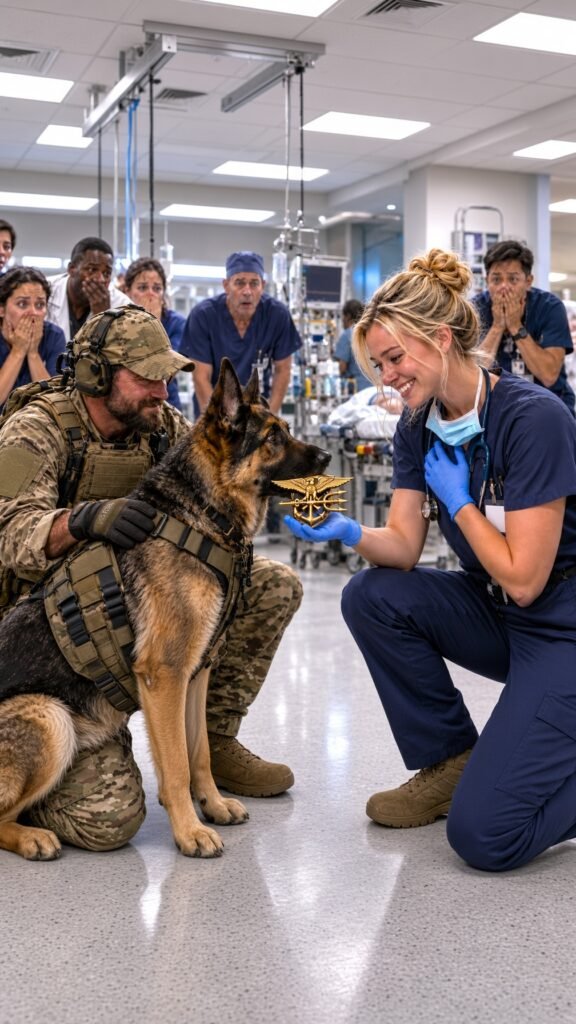
The glass doors slid apart and a German Shepherd walked in out of the storm.
He was soaked to the bone, his black and tan coat plastered flat, a torn tactical harness hanging loose across his chest.
He was alone.
Water poured off him in sheets.
In his jaws, held as gently as a mother carries a pup, was a gold insignia, an eagle gripping an anchor, a trident, and a flintlock pistol.
It was the special warfare insignia, the golden trident that every Navy SEAL on Earth would know in the dark.
“Security,” Dr. Ashford snapped. “Get that animal out of my hospital.”
Two guards started forward.
The dog never looked at them.
He did not look at the doctors, or the patients, or the nurses who stepped back with their hands over their mouths.
He walked straight down the center of the hall with his amber eyes locked on one person.
The woman holding the mop.
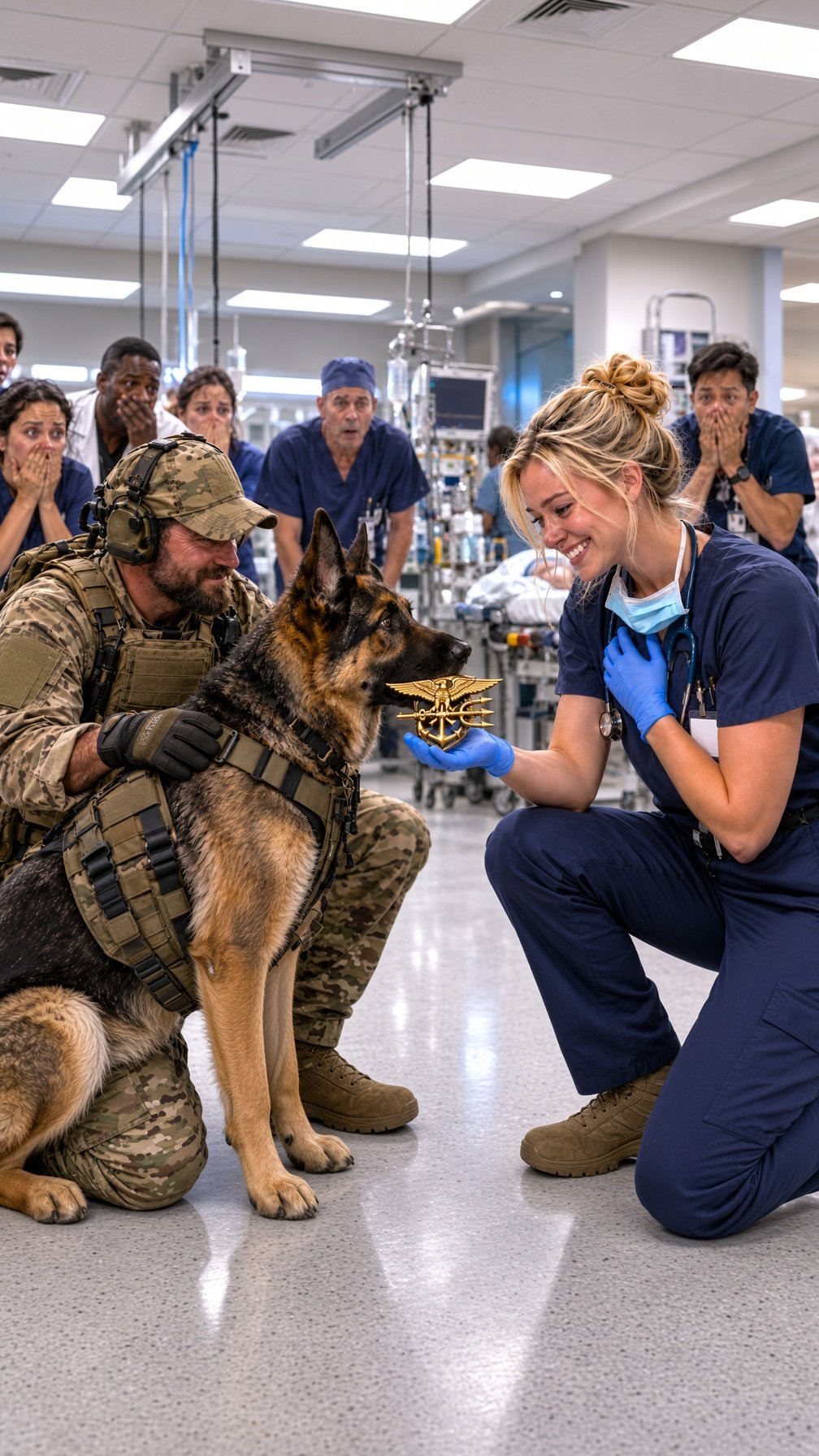
He stopped in front of her.
For a moment, the whole emergency room could hear the rain.
Then he lowered his head and laid the insignia in her open hands.
The mop clattered to the floor.
“Coda,” Paige whispered, and her voice broke.
Nobody had told her the dog’s name.
She turned the gold over.
On the back, scratched into the metal, were two initials and three words.
EM, hold the line.
Her knees nearly gave way.
Dr. Ashford laughed, but it came out thin. “It appears the janitor has a friend. Remove them both.”
Lorraine Keating stepped forward to take Paige by the arm.
Then the dog did something that stopped every voice in the room.
He caught Paige by the sleeve with his teeth and pulled hard toward the ambulance bay.
He looked back at her and made a sound somewhere between a whine and a prayer.
Paige knew that look.
She had seen it once before, a very long time ago, on a night she had promised herself never to remember.
This was not a dog asking for attention.
This was a dog reporting that someone was dying.
She ran.
The mop stayed where it fell.
Behind her, someone shouted her name, but her feet were already carrying her down the hall faster than anyone in that building had ever seen her move.
Doors banged open.
Cold wind and rain slapped her face.
In the ambulance bay, red lights were pulsing and a lone paramedic was screaming for a doctor as a stretcher rolled down the ramp.
On the stretcher lay a man in a torn wet suit top, lips the color of slate, sand in his beard, his name tape reading Hayes.
Beside him walked a huge bearded man in a soaked tactical jacket, water pouring from his sleeves, his hands shaking from cold and fury.
“Boat flipped at the old pier,” the paramedic gasped. “He was under for minutes. My partner went down on the wet ramp and I’m working alone. His heart is still going, but slow, and he is not breathing on his own.”
Dr. Ashford had followed them out under an umbrella and he began barking for a full trauma bay, an airway tray, and a full team.
It would take four minutes at least.
The man on the stretcher did not have four minutes.
Paige could see the faint, failing flutter of the pulse in his neck.
She dropped to her knees beside the stretcher and the shaking in her hands stopped as if someone had flipped a switch.
“Hayes,” she said quietly. “Stay with me.”
The paramedic stared.
Dr. Ashford said her name sharply and she did not hear him.
She tilted the man’s head back, lifted his chin, and bent to give him his first breath.
While her hands moved, here is what was happening inside Hayes and what she was doing about it.
When a person drowns, water in the airway stops the breathing first.
The heart does not quit right away.
It keeps beating for a short while, but with no oxygen coming in, it slows, weakens, and finally stops.
That is why with a drowning victim, breathing comes first.
Here are the steps.
Make sure the scene is safe and send someone to call 911.
Tap the person and shout.
If there is no answer and no normal breathing, tilt the head back and lift the chin to open the airway.
Give rescue breaths about one second each and watch for the chest to rise.
Do not waste time trying to drain water from the lungs.
If there is no sign of life, push hard and fast on the center of the chest, then return to breaths.
If an AED is nearby, turn it on and follow its voice.
If the person vomits, roll them onto their side, clear the mouth, and keep going.
Back in the ambulance bay, Paige did exactly that.
She gave two slow breaths into Hayes and watched his chest rise under the wet cloth.
A pause.
Two more.
Her fingertips never left the pulse in his neck.
Rain hammered the awning and thunder shook the concrete and she heard none of it.
She heard only the pulse and it was getting weaker.
“Nurse Sutton, step away from that patient.” Dr. Ashford had pushed through the crowd that followed from the hall. “You are not cleared for airway management. You are a probationary nurse and you are about to lose your license.”
Paige gave another breath.
“Do you hear me?”
“Sir,” the paramedic said, his voice shaking. “His pulse is going.”
Under Paige’s fingertips, the flutter stumbled, stuttered, and vanished.
In the same instant, her whole body changed.
She locked her elbows, set the heel of one hand in the center of Hayes’s chest, laced the other over it, and drove downward hard, fast, steady as a drumbeat.
Her lips moved as she counted under her breath.
“You will break his ribs,” Dr. Ashford hissed.
“Then I will fix his ribs after he’s alive,” Paige answered without looking up.
Her voice had changed, too.
It was low and flat and calm, a voice built for loud places, and it carried across the bay like an order.
“Someone bring me the AED and clear a path. Move.”
A young resident ran for the AED without being told twice.
Nobody in that hall, not even Dr. Ashford, had ever heard a nurse speak that way.
The big bearded man in the soaked jacket had gone completely still.
He was watching her hands.
The pads went on.
The machine studied his heart and said no shock was advised, so Paige went back to compressions, then back to breaths, then back again, a smooth rhythm without one wasted motion.
Seconds crawled.
Dr. Ashford stood with his mouth half open, his umbrella tilting, rain pouring off its edge onto his polished shoes.
Then Hayes convulsed.
A rush of lake water burst from his mouth.
Paige rolled him onto his side in one smooth motion, swept his mouth clear, and held him steady as he coughed, gagged, and dragged in a ragged, beautiful breath, then another.
His eyelids fluttered.
The paramedic burst into tears.
“Easy, easy,” Paige said. “You are in a hospital. You are safe.”
Her voice cracked on the last word.
Only then did her hands begin to tremble again, a fine and terrible shaking that always came after the work and never during it.
Nobody on that ramp spoke.
Then the big bearded man crouched beside her, still dripping, his eyes never leaving her hands.
He was Senior Chief Bear Lindgren, leader of the SEAL team that had been training on the lake that night.
When he finally spoke, his voice was low and rough.
“A nurse follows a protocol. What I just watched was someone who has done this while people were shooting at her.”
Paige looked up and for the first time since she had walked into Cedar Harbor, she held a stranger’s eyes and did not look away.
“He needs a monitored bed and close watching for the next day,” she said. “Water does damage that shows up later.”
Dr. Ashford found his voice at last. “Senior Chief, this woman has no authority here. She practiced outside her scope in front of forty witnesses and I will be filing a report.”
Bear rose slowly.
He stood a full head taller than the doctor.
“Doctor,” he said, “forty witnesses just watched a man come back from the dead. File whatever you like.”
That was when the lightning struck.
A white blast lit the sky.
The whole bay flashed as bright as noon and then every light in Cedar Harbor went out at once.
Monitors died.
Alarms wailed and fell silent.
A heartbeat later, the backup generator coughed, sputtered, and failed.
In the blackness, a second ambulance came screaming up the street and stopped at the bottom of the ramp where the lake surge had flooded the road knee-deep.
A medic leaned out of the window. “We have another man from the boat, a young sailor, freezing and barely awake. We cannot get the stretcher up the ramp. The water is rising.”
Panic ran through the crowd like wind through dry grass.
Patients in the hall began to shout.
Staff spun in circles.
Dr. Ashford stood frozen under his umbrella, a man who had never learned what to do when nobody was laughing.
Paige stood up.
“Listen to me,” she said, and the whole bay turned.
The voice was not loud, but it cut through the noise like a blade.
“Lights from every phone and every pocket. Senior Chief, I need four of your men on that stretcher, and the rest of you in a line on the ramp, hand to hand, so nobody slips. Do not go through the front. The water is too deep there. We will use the linen corridor on the east side. It runs under the main hall. It is dry, and it has no stairs.”
Bear did not argue.
He did not even blink.
“You heard her,” he told his men. “Move.”
Four operators splashed into the black water and lifted the stretcher between them, the young sailor shivering under foil blankets.
Paige walked backward down the ramp with her phone light on the patient, calling every step.
“Left foot down, slow, easy. It is deeper near the drain. Go wide.”
Something in the way she gave orders was tugging at a memory Bear could not quite place.
“Nurse Sutton,” Dr. Ashford called from the awning. “I am the chief of this department, and I order you to stop.”
Not one person stopped.
Bear turned his head. “Sir, with respect, step aside. She is running this.”
The linen corridor was black as a cave and smelled of detergent and wet concrete.
Paige led them through it in steady, measured steps, calling each turn before it came.
Behind them, the staff followed in a long chain, wheelchairs and gurneys, and nurses carrying infants, every hand on the shoulder of the person ahead.
She had asked them to do it, and they had done it.
Nobody wondered why they trusted the woman with the mop.
In trauma bay two, she had the young sailor wrapped in warm blankets in under two minutes.
She found the emergency lantern in the supply closet before anyone told her where it was.
Then she sorted the crowded room by how sick each person was, the critical ones near the light, the stable ones against the wall, and gave every frightened resident one simple job to do.
Hayes was rolled in last with Coda trotting beside the bed and refusing to be left behind.
When the generator finally roared back to life and the lights flickered on, everyone saw the same thing.
A small nurse in oversized blue scrubs, soaked to the knees, standing in the middle of the room and giving calm orders to a dozen people, every one of them obeying.
Coda lay down beside the bed with his chin across Paige’s boot and no one could move him.
She sank to the floor next to him, wet and shaking, and ran a hand over his sodden fur.
“You brought it back to me, buddy,” she whispered. “After all this time.”
Bear heard.
His eyes dropped to the gold insignia she held against her chest and something tightened in his face.
“Ma’am,” he said quietly. “Where did you get that?”
Paige looked at the gold in her hand.
“From a hillside in the dark,” she said. “A long time ago.”
“I put it on his harness myself.”
That was all she would say.
And Bear did not push, but he stood a little straighter.
By the time the sun came up, the storm had blown itself out over the lake and Captain Neil Ferrante, commanding officer of Cedar Harbor, called everyone involved into the main conference room.
Dr. Ashford and Lorraine Keating were already seated and Dr. Ashford had a thick folder in front of him.
“Her personnel file is a joke, Captain,” he said. “Six years of nothing. A reference letter nobody signed, certificates that cannot be verified. She broke protocol. She ignored my orders and she took command of my emergency room. I want her suspended and escorted out and I want to know who hired her.”
Captain Ferrante, a gray and tired man who had not slept, turned to Paige.
She stood by the door in damp scrubs, her eyes on the carpet.
“Nurse Sutton, do you have anything to say?”
Paige was silent a long moment, then slowly she raised her head.
“Everything in my file is true, Captain. There is just a part of it I am not allowed to read to you.”
Dr. Ashford scoffed.
At that moment the door opened.
Bear Lindgren stepped in with Coda at his heel, wearing dry clothes, four SEALs behind him.
They did not enter loudly.
They entered the way men enter a church.
“Captain, permission to speak.”
“Granted, Senior Chief.”
He looked at Paige, then in front of everyone, a man who saluted nothing but flags and fallen friends came to attention and saluted her.
“Chief Sutton,” he said. “It has been six years. I did not know you at first. You cut your hair and you looked at the floor the whole time, but I know that voice and I know those hands.”
He turned to the room.
“This is Chief Hospital Corpsman Sutton, call sign Sparrow. She served eleven years with Naval Special Warfare. Her records are sealed because of where she worked and who she worked beside. She is the reason twenty-three of my brothers came home.”
Paige closed her eyes.
She was back on a cold hillside six years earlier, kneeling over Senior Chief Eli Marsh with her hands red to the wrists, his dog Coda beside them, struck through the shoulder and shaking.
Marsh died holding her hand.
Before the helicopter came, she took the gold trident from his chest, clipped it to Coda’s harness, and whispered, “Take him home.”
Then she handed the dog to the medevac crew, and she never saw either of them again.
“Eli Marsh was my best friend,” Bear said, his voice breaking. “Coda carried his trident for six years. Last night that dog tore it from his harness and ran a mile through a lightning storm. He passed three other buildings to reach this one. I do not know how he knew you were here, but I know he did not choose the loudest room. He chose the quiet one.”
Nobody in the room moved.
Captain Ferrante stood and buttoned his jacket.
“Dr. Ashford, you humiliated a member of this staff in public. You tried to remove the woman who saved a SEAL’s life, and you ordered her to stop while a young sailor was freezing on our ramp. I am relieving you as chief of emergency medicine pending a full review, effective at once.”
Lorraine Keating’s coffee cup slipped from her fingers and shattered on the floor.
Dr. Ashford opened his mouth and closed it again.
When he finally spoke, his voice was small. “I did not know who she was.”
“That,” Captain Ferrante said, “is exactly the problem. You never looked.”
The lesson Dr. Ashford had thrown at her in front of forty people had come back to him in front of five.
Later that morning, in the middle of the emergency room hall, in front of the same forty people, Dr. Ashford stood with his hands at his sides and said the hardest sentence he had ever spoken.
“Nurse Sutton, I was wrong and I am sorry.”
Nobody laughed.
Paige gave him one small nod, and that was all.
The young resident who had run for the AED found her by the supply closet afterward, his hands still shaking.
“Please,” he said. “I froze out there until you spoke. Will you teach me how to do what you did?”
Paige looked at him for a long moment and then nodded.
“Everyone starts out afraid,” she said. “The trick is to move anyway.”
Hayes woke at noon.
The first thing he saw was Coda sitting beside the bed with his head resting on the mattress, refusing to leave.
The second was a small nurse with gray-blue eyes checking his monitor.
“Sparrow,” he rasped. “Senior Chief told us stories. I thought you were a legend.”
Paige smiled, really smiled, for the first time since she had arrived.
“Just a nurse,” she said. “Drink some water.”
Hayes laughed, coughed, and reached down to scratch Coda behind the ears, and the dog sighed like a creature who had finally put down a very heavy load.
When she walked out into the hall that afternoon, the staff of Cedar Harbor stood along both walls.
Nobody clapped.
She would have hated that.
They simply stepped back one by one to let her pass.
Lorraine Keating was last, and her eyes were wet.
Two days later, at dawn, the lake was a sheet of pale gold glass.
At the end of the old pier stood a small gray stone for Eli Marsh.
Paige came with Bear, with Hayes in a wheelchair, and with Coda walking between them.
She knelt at the stone and took the trident from her pocket.
Coda put one paw on her hand.
“I kept my promise, Eli,” she whispered. “I got him home.”
Then she did not keep the gold.
She fastened the trident back onto Coda’s new harness over his heart, where it had belonged for six years.
“He earned it,” she said.
Bear’s jaw worked, and he turned away to look at the water.
“There is a place for you on my team,” he said at last. “There always was.”
Paige shook her head slowly.
“I am done with the war, Bear. But if anyone comes through the doors of Cedar Harbor drowning or bleeding or afraid, I will be there. That is the only mission I need.”
She went back to work the next morning, the same blue scrubs still a size too big, the same quiet walk.
But she did not look at the floor anymore.
When a frightened patient reached for her hand, she looked straight into their eyes and her hands were steady as stone.
She never lost her rank.
She only learned to wear it quietly.
And outside the sliding doors on the first sunny afternoon after the storm, a German Shepherd sat waiting with a golden trident gleaming on his chest, certain that the one he trusted would come out to say hello.
The trident had traveled through a storm to find her hands.
It had rested on a fallen man’s chest, then on a dog’s harness, then in the palms of a nurse who had been told she was nothing.
And now it gleamed in the sun outside a hospital in Milwaukee, where a woman who had once counted exits and scanned windows had finally stopped looking for a way out.
Because she had found her way back in.
The end.
Quick recap of the rescue.
If someone has been pulled from the water and is not breathing normally, make sure the scene is safe, call 911, and open the airway by tilting the head back and lifting the chin.
Give rescue breaths and watch the chest rise.
Do not try to drain water.
If there are no signs of life, add firm, fast chest compressions in the center of the chest and use an AED if one is close.
If the person vomits, roll them to their side and keep going until trained help takes over.
The moral of this story is that strength rarely announces itself and the quiet person in the corner may be the one who saves your life.
Kindness costs nothing and truly looking at people costs even less.
Remember that anyone can learn these skills.
A short certified course can turn an ordinary person into the one who steps forward when everyone else freezes.
If this story touched your heart, hit like, subscribe to 911 Emergency Life, and leave a comment telling us who taught you to stay calm when everything goes wrong.
Your words keep these stories alive and your share could teach someone how to save a life.
Stay with us for the next story.