
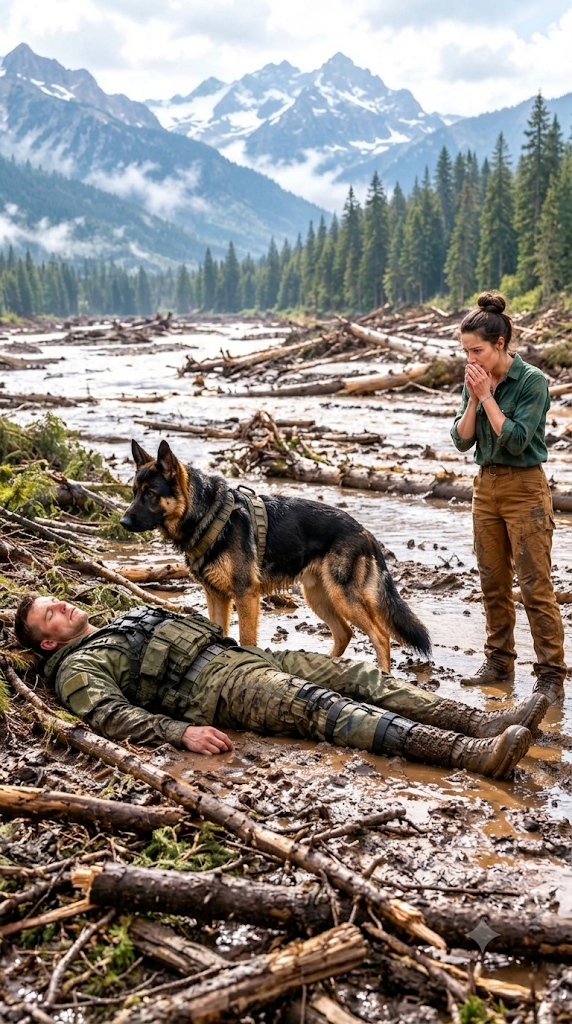
The dog would not let her near him, so Hazel stopped at the edge of the debris field.
The German Shepherd stood rigid over the unconscious man, head low, hackles raised in a perfect sharp line from neck to tail, and it did not bark.
That was the frightening part, because a barking dog wants to scare you off, but this one had already decided what it would do if she came any closer.
Hazel pressed her hands flat to her sides and kept perfectly still.
Flood waters from the Vermilion River had crested and dropped overnight, leaving behind a landscape that looked like a battlefield.
Shattered spruce trees lay scattered across the gravel bar like broken matches, and the mud was thick and gray, knee-deep in the low spots.
It smelled of torn roots and cold rot.
She had come out that morning to check on her survey equipment downstream—the motion cameras she had anchored to the cottonwood trees three weeks ago to track the Tokum Creek wolf pack.
She had not expected to find this.
The man was face down in the gravel, wearing dark tactical trousers and a black fleece pullover, both soaked through and plastered with grit.
His left arm was bent underneath him at an angle that told her his shoulder had taken a serious hit, and his right leg was the worst of it.
A spruce log, big around as a barrel, had rolled down in the flood surge and caught him across the shin.
The log had moved on downstream. The leg had not moved with it correctly.
She could see the deformation from fifteen meters away.
She was a wildlife biologist who had spent seven years in remote postings across British Columbia.
She had pulled injured animals out of wire snares, stabilized a fellow researcher with a broken pelvis two days from a trailhead, and once talked a panicking hiker down from a cliffside in the dark.
She was not easily rattled, but the dog was watching her with the specific unhurried attention of an animal that had been trained to do exactly one thing if she stepped wrong.
She crouched slowly, letting her body language say everything it needed to say: I am not a threat. I am asking.
The shepherd’s ears came forward, and its posture changed by a small but readable degree. It was listening.
“Hey,” Hazel said very quiet. “I know you did your job. He’s lucky you stayed.”
She did not reach out, and she did not look at the dog directly.
She looked just past it at the man’s back and could see the shallow rise and fall of his breathing. He was alive.
His lips were blue.
The shepherd lowered its head a fraction and took one step sideways, not inviting her in, but making room for her to prove herself.
Hazel moved forward slowly until she was close enough to reach out and press two fingers to the side of the man’s neck.
His pulse was there, slow and cold—too cold.
She looked at the dog. “I have to get him warm. That’s all. Just warm.”
The shepherd held her eyes for a long second, then sat down in the wet gravel beside the man’s shoulder, keeping its watch but sitting.
She worked fast after that.
Hazel had spent the previous thirty hours inside her Parks Canada field station, a solidly built prefab cabin tucked up against the limestone bluffs above the river’s normal flood line.
The Kootenay region had taken forty millimeters of rain in twenty-four hours on top of a late spring snowpack, a combination that was a catastrophe in slow motion.
She had known it was coming from the weather forecasts, moving her research files and hard drives to the highest shelves and filling every container she could find with clean water before the well lines could flood.
She had nailed the storm shutters over the windows and braced the door with the wooden stump she used as a chopping block.
She had ridden the flood sound out alone—the deep structural groaning of the river doing things rivers were not supposed to do, the percussion of large rocks rolling along the channel bottom.
The lights had gone out at 11:00 at night, and she had sat in the dark with a headlamp and her field journal and waited.
By dawn, the sound had eased, and she had stepped outside into a world rearranged.
Now, she was crouching in it, trying to figure out how to move a man who weighed considerably more than she did across thirty meters of unstable mud and debris to her front door.
She went back to the cabin at a run, grabbed the rescue sled she kept mounted on the wall—a rigid orange fiberglass stretcher the park used for winter operations—and a coil of static rope, then ran back.
The dog watched her approach without tension this time, standing and stepping back when she set the sled down next to the man.
Moving him was brutal, careful work.
She checked his airway first, then positioned him on his back as gently as she could manage, bracing his right leg with her knees while she worked.
He groaned once when she shifted his hip, his eyes moving beneath their lids but not opening.
She strapped him to the orange sled with the rope and harness buckles, cushioned his broken leg between two rolled sleeping pads she had run back for, and then she pulled.
The cabin was uphill, not steeply, but enough.
Her boots slipped in the mud as she leaned forward and drove her legs, moving him meter by meter across the wrecked ground.
Sweat soaked through her base layer despite the cold, and the shepherd walked alongside the sled the entire time, never crowding her, never impeding her, just present.
She got him through the door and in front of the propane heater.
She cut away his wet clothes with her trauma shears and covered him in every blanket in the cabin, then strapped a thermometer to his underarm.
Thirty-two degrees Celsius. Hypothermic, but not critically. Not yet.
She built up the heater as high as it would go and put water on to boil.
She cleaned the gash above his ear with antiseptic and closed it with butterfly strips, then looked at his leg and did not touch it beyond immobilizing it between the sleeping pads with several wraps of tensor bandage.
She had no x-ray and no way to know the full extent of the fracture, so she did the only thing she could: hold it, pad it, wait for help.
She tried the satellite communicator, but the display showed the antenna symbol with a slash through it. The flood had taken out her antenna mount on the roof.
She checked the handheld radio. Static. The repeater on the ridge was down.
She sat beside him on the floor and watched him breathe, feeling the particular heavy weight of being very far from anyone.
The dog had claimed the floor space on the man’s other side, lying with its chin on the floor and its eyes tracking back and forth between the man’s face and Hazel’s.
After a while, it let out a long, slow exhale and closed its eyes.
She noticed the collar then: military issue nylon with a small stamped tag, a serial number, and below it a name. Ranger.
“Okay, Ranger,” she said quietly. “I think we’ve got him.”
Ranger’s tail moved once against the floor.
She made tea and forced herself to eat half a protein bar, keeping one hand on the man’s forehead to feel the temperature slowly, very slowly, begin to climb back toward something survivable.
He woke at dusk.
There was no grogginess to it; his eyes opened and he was immediately completely alert.
He did not look at the ceiling or at Hazel, turning his head to look for Ranger.
Ranger was on his feet in an instant, pressing his nose against the man’s hand, and the man’s whole body seemed to decompress.
His shoulders dropped, and the hard set of his jaw eased by a degree.
He looked at the dog for several seconds, then he looked at Hazel.
“Where are we?” His voice was wrecked from the cold, low and rough.
“My field station, about three kilometers from where I found you.” She handed him a mug of warm water. “Drink this slowly, all of it.”
He took the mug with both hands and drank the way she said, measured and careful, taking inventory of himself at the same time.
She could see it in the quiet, systematic way his eyes moved around the room, noticing the storm shutters, the radio on the shelf, her equipment wall.
“Thomas Adair,” he said. “I’m active duty, on leave. Your name?”
“Hazel. Hazel Greer, Parks Canada wildlife researcher. This is my survey station.”
He nodded, looking at his leg, and she watched him register the damage and then set it aside. Just like that. File it. Move on.
“Your leg is broken,” she said. “Tibia, I think. It’s splinted and wrapped. I couldn’t reach emergency services. The antenna is down from the flood.”
“I have a personal locator beacon in my pack,” Thomas said, “if my pack came through with me.”
“It didn’t. I checked the area.”
He was quiet for a moment. “The beacon would have auto-triggered if the pack went under for more than thirty seconds.”
“Search and rescue will have a position from the river coordinates. They’ll be looking.”
“In this aftermath, it could take two days.”
“Yes.”
He looked at her steadily. “Then we wait two days.”
She respected that—the clarity of it, no useful energy wasted on what couldn’t be changed.
She gave him more water and heated a tin of soup from her stores, and he ate all of it without being asked and handed the empty tin back.
“Ranger saved your life,” she said. “He wouldn’t let me near you at first. He was standing guard.”
Thomas looked at the dog, who had put his chin on Thomas’s good knee and was watching his face with those steady brown eyes.
“He does that,” Thomas said, his voice quieter now. “He was trained for it. But he’d do it anyway.”
Outside, the wind picked up, but the cabin walls held.
She told him about her work, and he listened the way soldiers listen—economically, not missing anything.
She talked about the Takakkaw wolf pack, about the months of camera data, about the way this particular stretch of the Vermilion Corridor was one of the last places in the Rockies where wolf and grizzly and elk existed in genuine balance.
He asked one question: “How many wolves in the pack?”
“Seven adults, two pups last den season,” she said.
He nodded, and she had the feeling he filed that fact somewhere, too, though she couldn’t have said why he would need it.
There are people who make silence feel like a burden. Thomas was not one of them.
The quiet in the cabin that night was simply quiet—two people thinking alongside each other, the dog breathing between them, the heater ticking.
Then Ranger moved.
He had been sleeping. In an instant, he was not.
He raised his head, his ears went rigid, and his nostrils flared in a long, pulling inhale.
He stood, walked to the cabin door, and pressed his nose to the gap at the bottom, drawing another slow breath before looking back at Thomas.
“He has something,” Thomas said.
“An animal?” Hazel asked.
Thomas shook his head slowly, watching the dog with absolute attention. “No, the way he’s carrying himself, that’s not prey drive. That’s his search posture.”
Hazel looked at Ranger and saw it, too—the focused, contained quality, the urgency held inside perfect stillness.
“Search as in?”
“He’s a trained SAR dog,” Thomas said. “Military working dog, multi-certified find and tracker.” He was already trying to push himself upright. “He’s found a person.”
She put her hand on his shoulder. “Your leg is broken.”
“I know.” He looked at her directly. “Is there anyone else who might have been caught in this flood? A camp, a trail?”
She thought of what she’d seen that morning walking downstream: a yellow bear hang rope, a bright orange tent pole half buried in the gravel.
She had noted them and moved on.
“There was a family campsite on the gravel bar downstream,” she said slowly. “I saw debris from it this morning. I didn’t see anyone.”
Thomas’s expression did not change. “How far?”
“Six hundred meters.”
“Ranger.” He said the name with quiet authority. “Hold.” He looked at Hazel. “I can’t walk it. You’ll have to go. Follow him closely. He’ll take you right to the source. Don’t let him dig without checking for structural stability first. If someone is buried, the wrong movement can collapse what’s protecting them.”
Hazel pulled her jacket off the hook and laced her boots tight. “What am I looking for?”
“Whatever he shows you.” Thomas reached over and gripped her wrist for a moment, not hard, just enough to make sure she was looking at him. “Trust him,” he said. “Completely.”
The light was going fast.
Hazel pulled her headlamp on and opened the door, cold air hitting her full in the face.
The mud outside had begun to firm as the temperature dropped toward freezing.
Ranger went immediately. He did not look back.
He moved with purpose through the debris field, picking a path between the fallen trees and boulder deposits with the confidence of an animal that knew exactly where it was going.
Hazel followed him at a near jog, her breath coming in short white clouds.
They crossed the gravel bar, and the wrecked campsite appeared in the sweep of her headlamp: a destroyed tent, a toppled camp stove, a child’s red rain jacket hanging from a spruce branch twenty feet above the ground, deposited there by the surge.
Her chest tightened.
Ranger went right past the campsite.
He pushed through a stand of young alders that had survived the flood and stopped at a natural cut bank—a high wall of compressed gravel and clay left by an older river meander, carved into now by the flood.
A section of the face had partially collapsed.
In front of the collapse, Ranger sat down and looked at Hazel, then at the bank, then at Hazel again.
“Show me,” she said.
He stood, walked to a spot on the bank face, and pressed his nose to it.
She dropped to her knees in the cold mud and pushed her hands into the loose material.
It came away in chunks, revealing a hollow—a natural gap where the bank had failed inward, creating a small dark space before the face sealed itself shut.
From inside the hollow, she heard a sound.
A child’s voice, very small, saying one word over and over.
“Hello. Hello. Hello.”
Hazel pressed her face to the gap.
Her headlamp beam cut into the dark, and she saw a small face looking back at her.
A little girl, perhaps seven years old, dark hair matted against her forehead, wrapped in the metallic film of an emergency blanket from a first aid kit.
Someone had been thinking clearly, even in panic.
She sat in a pocket of air about a meter deep. Her lips were pale, but her eyes were focused and alive.
“Hi,” Hazel said, keeping her voice completely level. “My name’s Hazel. I’m with Parks Canada. What’s your name?”
“Mia.” The word came out in a shivering exhale.
“Mia. You did exactly the right thing staying in there. You’re going to be okay. I’m going to get you out.”
She turned and assessed the bank.
The collapse above was unstable, and she could hear the material shifting when she moved weight near it.
She needed to widen the gap from the bottom, not from above, and do it fast before the temperature dropped another degree and Mia stopped shivering.
She ran back to the cabin.
Thomas had pulled himself to the door, sitting on the threshold with his splinted leg extended onto the porch step and a headlamp on his forehead.
He had the cable winch kit she kept for vehicle recovery work in his hands and had been going through it while he waited.
“Child,” Hazel said, already moving past him to the equipment wall. “Seven years old approximately. Alone. Hypothermic. Trapped in a cutbank hollow.”
“About sixty centimeters of opening. Unstable overhang.”
“Size of the hollow? She can sit up. No more.”
“How wide is the gap at the base?”
“Forty centimeters. I could widen it. Not without risking the overhang.”
He looked at the winch cable. “If you anchor the cable to a root mass above the gap and run it under and back, you can apply lateral tension to the bank face. Controlled pull to widen the lower opening without disturbing the top. Like spreading a seam slowly.”
She looked at him. “Walk me through it. Step for step.”
She grabbed the cable kit, the hand drill, the static rope, and two heavy-duty carabiners, then ran back to the bank with Thomas’s voice in her head.
She had listened hard and filed every word.
She set the anchor in a root mass above and to the left of the gap and rigged the cable the way he had described.
She applied tension slowly, watching the bank face for any sign of failure above.
The seam widened—not much, but enough.
Hazel lay flat in the cold mud and reached into the hollow, getting both hands around Mia’s shoulders.
The girl did not fight her, reaching back and gripping Hazel’s forearms with small, cold hands.
Hazel pulled, and they came out together, sliding backward through the mud.
Then Mia was out in the open air, and Hazel was wrapping her own jacket around her and holding her tight against her chest.
Mia made a sound that wasn’t a word, pressing her face into Hazel’s neck and shaking.
Ranger pressed close on the other side, a warm, solid mass against the girl’s back.
Hazel knelt in the cold mud holding both of them, allowing herself exactly five seconds of that before she stood up, lifted Mia against her chest, and walked back to the cabin.
That night, Mia slept in the bunk closest to the heater, with Ranger curled at the foot of the mattress, his body warmth working as well as any blanket.
Thomas stayed awake by the propane heater, his leg elevated, his face quiet and watchful.
Hazel sat across from him at the small table, both of them keeping watch without saying that was what they were doing.
Just after 2:00 in the morning, Thomas said, “Her family’s campsite registration at the park warden station will list how many were in the party.”
“I know,” Hazel said. “We can’t do anything about it until daylight.”
He nodded, and neither of them said the rest out loud.
Just after first light, Hazel heard the sound before she could name it—a mechanical beat, rhythmic and distant, then closer.
She stepped onto the porch.
A yellow search and rescue helicopter was following the river corridor south.
It had caught not Thomas’s beacon—his pack was gone—but the auto alert from the Parks Canada emergency system that triggered when her main communicator went offline during the flood.
The warden district had sent a team.
The helicopter set down on the wrecked campsite on the gravel bar, and two paramedics came out at a jog with a warden Hazel recognized behind them.
“Hazel,” Dave the warden came up with his face full of questions. “Status?”
“One adult male, tibia fracture, hypothermic overnight, stable now. One child, approximately seven years old, family surname unknown, hypothermic but conscious. Her camp is the site on the bar. There may be other family members. I haven’t been able to search.”
Dave put a hand briefly on her shoulder. “We’ve got it. Go inside.”
The paramedics moved past her into the cabin, and she stood on the porch and watched Mia being carried out wrapped in a foil blanket with Ranger walking close beside her.
She watched Thomas being brought out on the stretcher, and he caught Hazel’s eye as they passed.
“Can you give us a minute?” he said to the paramedic.
The stretcher stopped.
Thomas reached into the breast pocket of the dry jacket the paramedics had given him and pulled out a small, worn card, holding it out to Hazel.
She took it. A personal contact number, his name, and a unit designation.
“Dave,” Thomas called out, and the warden looked over. “She pulled me out of the flood alone and rode out the night with a hypothermic kid. Make sure she’s fully resupplied before you leave. Full emergency kit, new satellite communicator, one month’s food stores. Log it to my unit.”
Dave looked at Hazel. “You should have said something.”
“She wouldn’t,” Thomas said, and he looked at Hazel when he said it, not unkindly, just like a man who paid attention.
The paramedics lifted the stretcher, and Thomas kept his eyes on her as they carried him toward the helicopter.
“I’ve got a deployment after this,” he said, his voice calm and steady. “Eighty-six days.”
She looked at the card in her hand. “I’ll be here,” she said.
Ranger passed her last. He paused beside her boot, pressed his nose briefly against her palm, then turned and trotted after Thomas across the wrecked gravel bar without looking back, because he knew exactly where he was going.
The helicopter lifted, banked east above the Vermilion ridgeline, and disappeared behind the spruce.
The valley went quiet.
The river ran brown and fast over its new course, and somewhere in the debris field, a Clark’s nutcracker called once, sharp and clear, announcing that the world was still here and still worth announcing.
Hazel stood on the porch with a small worn card in her fist and the morning light coming cold and bright off the limestone peaks above.
Eighty-six days.
She had tracked a wolf pack through seven months of winter. She could wait eighty-six days.
She went inside, put the card on the shelf above the radio, and put a kettle on.
She sat down at her field journal and opened it to the first blank page.
She started writing.
Some things find you in the wreckage, not because the flood was kind or because the story needed a reason, just because a dog held his ground at the right moment and a woman knelt in the mud and chose to be trusted.
Some gifts arrive already muddy. You clean them off and you keep them.
The weeks that followed were a blur of activity and quiet waiting.
The search and rescue team found Mia’s parents downstream, clinging to a snag and suffering from exposure but alive.
They had been swept away when the flood hit their campsite and had spent the night in a desperate struggle to survive.
The reunion at the hospital was a blur of tears and relief, and Hazel watched it all from the sidelines, feeling a strange mixture of joy and emptiness.
She returned to her field station, which felt smaller and quieter than before, and threw herself into her work.
She tracked the wolf pack, analyzed the camera data, and wrote her reports.
But every night, she found herself looking at the small worn card on the shelf above the radio.
Eighty-six days.
She counted them down like a prisoner, crossing off each day on a calendar she kept hidden in her journal.
She wondered if Thomas was thinking of her, if he was safe, if he was counting the days too.
She wondered if she was crazy for waiting for a man she barely knew, a man who was a soldier, a man who lived in a world of danger and uncertainty.
But she knew, deep down, that she wasn’t crazy.
She was just trusting her instincts, the same instincts that had told her to trust Ranger, the same instincts that had told her to trust Thomas.
And she knew that some things were worth waiting for.
On the eighty-sixth day, Hazel stood on the porch of her field station, watching the sun set over the limestone peaks.
She had just finished her evening rounds, checking the equipment and securing the cabin for the night.
The air was cold and crisp, and the sky was a brilliant canvas of orange, purple, and pink.
She heard the sound of an engine before she saw the vehicle.
A dark pickup truck was coming up the dirt road toward the station.
Her heart hammered against her ribs.
She stood perfectly still, watching as the truck pulled up and stopped in front of the cabin.
The door opened, and a man stepped out.
He was tall, lean, and dressed in civilian clothes—jeans and a flannel shirt.
His right leg was still in a brace, but he was walking without crutches.
He looked up at her, and his face broke into a wide, genuine smile.
“Eighty-six days,” he said.
Hazel felt tears prick her eyes.
“Eighty-six days,” she repeated.
And then Ranger was there, bounding out of the truck and running toward her, his tail wagging furiously.
He reached her and pressed his head against her legs, whining with joy.
She knelt down and wrapped her arms around his neck, burying her face in his fur.
“Good boy, Ranger,” she whispered. “Good boy.”
She stood up and looked at Thomas, who was walking slowly toward her, his gait still a little stiff but determined.
He stopped a few feet away, looking at her with those steady, serious eyes.
“I’ve got a few weeks of leave,” he said. “I was hoping I could spend them here.”
Hazel smiled, a real smile that reached her eyes.
“I was hoping you’d say that,” she said.
And then she stepped forward and kissed him.
It was a gentle kiss, tentative and sweet, but it held all the promise of a new beginning.
When they pulled apart, Ranger was sitting beside them, looking up with his head tilted, as if to say, “What took you so long?”
Thomas laughed, a deep, warm sound that Hazel had never heard before.
“He’s been asking about you,” Thomas said.
“Has he?” Hazel asked, scratching Ranger behind the ears.
“Every day,” Thomas said. “And so have I.”
That winter, Thomas and Hazel built a life together in the Kootenay region.
He took a job as a search and rescue coordinator for the park, and she continued her work as a wildlife biologist.
They bought a small house near the river, with a big yard for Ranger to run in.
They got married in the spring, in a small ceremony on the gravel bar where they had first met.
Ranger was the ring bearer, carrying the rings in a small pouch around his neck.
It was a perfect day, filled with laughter and love and the promise of a future together.
And as the sun set over the limestone peaks, painting the sky in shades of orange and purple and pink, Hazel looked at Thomas and knew that she had found her home.
She had found it in the wreckage, in the mud, in the cold, in the eyes of a dog who had held his ground and a man who had trusted her.
She had found it in the eighty-six days of waiting, in the long nights of doubt, in the quiet moments of hope.
She had found it in the love of a good man and the loyalty of a good dog.
And she knew, deep in her heart, that some things were worth waiting for.
Some things were worth fighting for.
And some things, like the love of a family, were worth everything.