

Every doctor in the Coral Bluff emergency room had a joke about the rookie nurse who never looked up.
Then a battle-scarred German Shepherd burst through the doors, ignored every white coat in the building, and ran straight to her.
Elite Navy SEALs followed in silence.
One of them saluted, and the whole hospital began to understand that the quiet nurse they had mocked was hiding something far bigger than a name — a wounded operator, a chemical emergency, and a secret she swore never to speak aloud again.
Along the way, you will learn a real first aid skill that can save eyesight and skin, explained step by step inside the story.
If this story already has your attention, hit like, subscribe to 911 Emergency Life, and tell us in the comments what you think the dog saw in her that nobody else could see — because the answer is coming, and it changes everything.
Ela Marrow had learned how to make herself small.
At Coral Bluff Regional Medical Center in Corpus Christi, Texas, she walked the emergency room hallway with her shoulders curved and her eyes on the floor, wearing bright blue scrubs one size too big.
She stood five foot four with dirty blonde hair twisted into a tired knot, gray-blue eyes, and a thin pale scar above her left eyebrow that she hid under her bangs.
In her third week on the job, Dr. Philip Hargreave decided she would be the entertainment.
Hargreave was the chief of the emergency department — tall, silver at the temples, and he loved the sound of his own voice.
Last week he had made Ela restock gauze for six hours straight.
The week before, he had told a patient’s family that she was a volunteer.
Now it was shift change, and the whole team stood in a loose circle near the nurses’ station while he plucked the clipboard out of her grip and held it over his head like a trophy.
“Everyone, meet our rookie,” he said. “Three weeks in and she still gets lost on the way to the supply closet.”
Laughter rolled around the circle.
Charge nurse Bonnie Tilden covered her mouth, but her shoulders shook.
A young resident wiped his eyes.
“I only wanted to finish my charting,” Ela said, so softly that the words barely left her lips.
“Charting?” Hargreave repeated, savoring it. “Her hands trembled so badly she could not hold a pen steady in a hurricane. Look at them, people.”
Everyone looked.
Her hands were trembling, as they always did when people stared.
Ela pressed them flat against her thighs and gave the small apologetic smile she had practiced in the mirror — the smile that told everyone she was harmless.
The room laughed again.
What none of them noticed was smaller than a joke.
When a metal tray crashed to the floor behind her, Ela did not flinch.
She turned toward the sound with her feet already set, her eyes already moving from door to door to door, counting exits the way other people count change.
Then the moment passed, and she became the shy rookie again.
“Now go stand in the corner, rookie,” Hargreave said. “And try not to touch anything that matters.”
Ela went to the corner.
With the clipboard gone and the laughter fading, she slid her left thumb beneath her watchband and touched a tiny black star inked on the inside of her wrist.
Nobody at Coral Bluff knew what it meant.
She intended to keep it that way.
She had come to Texas to be nobody.
Eight years of war had taught her that the loudest people in a room are rarely the ones who save it, and that nobody asks a quiet woman for anything more than coffee.
Quiet was safe. Quiet was a place to rest.
The overhead speaker clicked.
“Coral Bluff, this is Medic 9 inbound with six patients from the port. Tanker truck collision. Chemical spill. Dock workers with eye and skin exposure. We are four minutes out.”
Hargreave straightened his white coat.
“Trauma bays one and two, people. Rookie — stay out of the way.”
Four minutes later, the ambulance doors banged open and the emergency room filled with screaming.
The first patient through was a dock worker named Luis Ortega — thick through the shoulders, his shirt soaked dark, his face blotched red.
Both of his hands were clamped over his eyes, and he was sobbing like a child.
“It burns. It burns. I can’t see,” he cried.
Nurses crowded around him, but nobody touched him.
Hargreave swept in and pointed a finger at the ceiling.
“Nobody does anything until we know the exact chemical,” he announced. “Get the paperwork from the port. Get him scanned. Keep that man calm.”
“Doctor, he is in agony,” one nurse said.
“And he will stay in agony until I have a name,” Hargreave snapped. “That is protocol.”
Seconds stretched into minutes. Luis screamed.
In the corner, Ela heard every scream like a hand pressing on the back of her neck.
For one heartbeat, she was somewhere else — inside a tent in the desert with sand on her boots and a young Marine thrashing under her hands and her own voice calm as iron saying the only thing that mattered.
“Water. Keep it moving. Do not stop.”
The trembling in her hands stopped.
Not slowly, not shakily. It simply stopped.
Ela crossed the floor.
“Move, please,” she said, and the nurses stepped aside without knowing why.
She took Luis by the shoulders, and he went still at the sound of her voice.
“Rookie, step away from my patient,” Hargreave said.
“No, sir,” Ela said.
It was the first time anyone at Coral Bluff had heard her speak without a shake in her voice.
“Every second we wait, that chemical keeps burning him. Water cannot make this worse. Waiting can.”
She steered Luis to the eyewash station on the wall, settled him into a chair, and turned the water on.
Here is what was happening to Luis, and here is exactly what Ela did.
When a chemical splashes into the eyes or onto the skin, it does not stop working just because the person has reached a hospital.
It keeps burning tissue for as long as it stays there, and an eye can be badly damaged in a matter of minutes.
That is why the first step is not a test and not a name.
The first step is water.
Ela tilted his head to the side so the water would run from the inner corner of the eye toward the outer corner, away from the healthy eye.
With gentle fingers, she held his eyelids open, because a burning eye squeezes shut on its own.
She let clean, lukewarm water pour over the eye in a steady, gentle stream — never a hard blast.
While a nurse kept it flowing, she cut away his soaked shirt and rinsed the skin beneath, and she never rubbed.
She did not try to cancel the chemical with some other liquid, because that can make the injury worse.
The flow kept going for at least fifteen minutes before anyone looked closer.
And away from a hospital, the same rule works at any sink, hose, or shower while someone calls 911.
Within two minutes, Luis stopped screaming.
The sound melted into a groan and then into a breathless, shaky laugh.
“I can see light,” he whispered. “I can see the light.”
The nurses around him went silent.
Even Bonnie Tilden stared.
Hargreave turned the color of a sunburn.
“You are contaminating my treatment area,” he said through his teeth. “I will have your badge before this shift ends.”
“Write it down later,” Ela said, and she moved to the next stretcher.
Bonnie hesitated. Then she walked to the third patient and did exactly what she had just watched — tilting his head, holding his lids open, letting the water run.
A second nurse followed her, then a third.
The whole room slowly rearranged itself around the rookie nobody had wanted to look at, and Ela did not even notice, because she was already counting minutes under her breath.
Hargreave stood in the middle of it all with his arms crossed, watching his own emergency room obey someone else.
His jaw worked.
He did not know yet that the worst moment of his morning had not arrived.
That was when the main doors exploded open.
Not the ambulance doors. The main entrance — the glass doors that slid wide for a heartbeat before something hit them hard enough to rattle the frame.
A clatter of steel. A scrape of claws on slick tile.
Every head in the room turned.
A German Shepherd came down the corridor like a thrown spear.
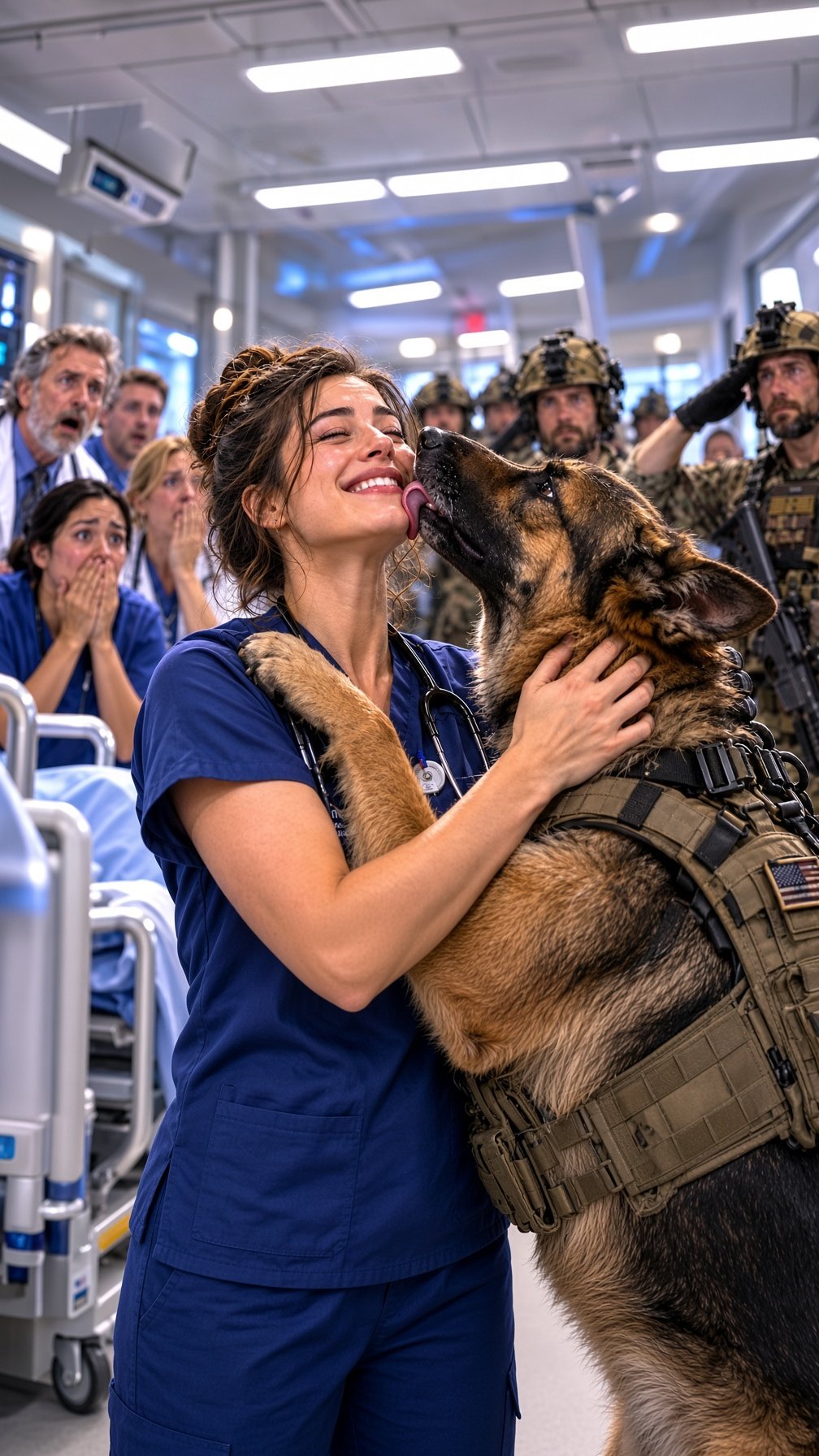
He was black and tan, thick through the chest, with a notch in his left ear and a tactical harness hugging his ribs, a small American flag patch sewn near the shoulder.
A broken steel chain whipped and rattled behind him.
He raced past the front desk.
He raced past a security guard who threw up both hands.
He tore straight through a knot of white coats, and Hargreave stumbled backward against the counter.
“Who let a dog in here?” Hargreave shouted. “Get that animal out of my emergency room.”
The dog did not care.
He did not glance at a single doctor.
His nose was high, his eyes locked on one small woman in oversized blue scrubs, and he did not slow down.
Ela turned just in time.
The dog rose on his back legs, planted both front paws on her shoulders, and licked her face.
He licked her cheek, her chin, her closed eyes, whining in a voice so high and broken that every person in the room felt it in the chest.
“Sarge,” Ela whispered, and then her face crumpled and she was laughing and crying at the same time, holding his thick neck with both hands.
“Hey, big man. Hey. You remember me? You remember me?”
Nobody breathed.
Doctors, nurses, patients, even the guards stood frozen.
The rookie they had laughed at ten minutes earlier was kneeling in the middle of the floor with a combat dog in her arms, and the dog was crying in the only way a dog can.
Then came boots.
Four men in desert camouflage and combat helmets pushed through the doors at a run, carrying a stretcher between them, rifles slung across their chests.
The man in front was broad and bearded and carried himself like a wall.
Senior Chief Nathan Pryor, call sign Breaker.
He stopped three steps inside the room, and the stretcher stopped with him.
He saw the dog. Then he saw the woman.
His eyes went to the thin scar above her left eyebrow.
The sleeve of her scrubs had slid back as she held the dog, and the watchband sat loose on her wrist, and under it was a small black star.
Breaker raised his right hand and saluted.
It was slow and perfect.
One by one, the men behind him followed, even with the stretcher held between them, until the whole team stood at attention in the middle of a Texas emergency room, saluting a nurse in blue scrubs on her knees.
“Lieutenant,” Breaker said, and his voice cracked on the single word.
Hargreave found his voice again.
“What is going on here? Who is in charge of this?”
Breaker did not even look at him.
“Not you, sir,” he said.
On the stretcher lay Petty Officer Reed Sullivan, call sign Cobalt — one of the strongest men on the team, and he was fighting like a trapped animal.
His eyes were clamped shut, swollen and weeping.
His neck and forearms were blistered red, and his gear was soaked with a harsh chemical smell that made the nurses cough.
He had been out on the water near the port when the tanker rolled, and he had gone straight into the spill to drag four dock workers to safety.
“He will not let anyone touch him,” Breaker said. “He keeps shouting a name. The dog broke his chain in the parking lot the second we pulled up. He has never done that in his life. He caught a scent at the door.”
Cobalt thrashed against the straps.
“Valkyrie,” he groaned. “Where is Valkyrie?”
The name hung in the air.
Ela went pale, and for one second she looked at the floor again, the old habit pulling at her.
Hargreave frowned.
“Valkyrie? What nonsense is that?”
He turned to his resident.
“Sedate him and send him to scan. We follow hazard protocol. Nothing touches this man until we confirm what he was exposed to.”
The resident nodded and reached for a syringe.
“Do not,” Ela said.
It was not loud. It did not need to be.
She stood up and held both hands out in front of her, and they did not move at all.
Not a tremor, not a flutter. Steady as stone.
One of the younger operators leaned toward the man next to him.
“Look at her hands,” he murmured. “Those are not the hands of a nurse. That is battlefield training.”
Ela knelt at the head of the stretcher and lowered her mouth beside Cobalt, close to his ear.
“Cobalt,” she said softly. “It is Valkyrie. I have you. Stop fighting and trust me one more time.”
The thrashing stopped as if someone had pulled a plug.
His whole body unclenched.
A rough sound came out of him — half sob, half laugh.
“Lieutenant,” he rasped. “You are late.”
“I am right on time, Ela.”
Hargreave stepped forward, red in the face.
“I am the attending physician in this room, nurse.”
Ela stood and looked him full in the eyes without bowing, without shaking.
“Doctor, a chemical burn does not wait for a lab report. Every minute this man spends in those clothes, his eyes and his skin keep burning. Step aside, or I will step around you.”
Breaker and his men moved without a word and formed a wall between the doctor and the stretcher.
The orders came fast, and they came in a voice nobody at Coral Bluff had ever heard from her.
“Cut the gear off him. Gloves and gowns on everyone who touches him. Bring every bag of saline in this department and clear the decontamination shower room. Breaker, hold his head steady and gentle. Bonnie, start the clock.”
“Right away,” Bonnie Tilden said, and she meant it.
They rolled Cobalt into the shower room.
Ela worked with the same slow, steady flush she had used on Luis, her hands calm, her voice lower than a whisper.
She told Cobalt each thing before it happened, so that nothing in the dark could surprise him.
Sarge lay across the doorway with his chin on his paws, never taking his eyes off her.
Fifteen minutes crawled by.
Breaker stood in the doorway with his helmet under his arm.
“Eight years,” he said quietly. “Every reunion, every memorial, we left a chair empty for you.”
“I asked you not to look for me,” Ela said without turning her head.
“You never asked us to stop missing you.”
Ela said nothing.
Her hands kept moving, her eyes on the clock.
At last, Cobalt opened one eye a crack.
“I can see shapes,” he whispered. “I can see your hair.”
Ela bowed her head, closed her eyes, and for a moment, her shoulders shook.
The doors banged again, and this time they brought a man in a gray suit and two security guards.
Gordon Fisk, the hospital administrator, had been called out of his office by Hargreave, and his tie was crooked and his temper was straight.
“Nurse Marrow,” Fisk said. “Dr. Hargreave informs me you have been treating patients outside the scope of your role, defying a physician, and interfering with hazard protocol. You are suspended, effective immediately. Surrender your badge.”
The nurses stared at the floor.
Hargreave stood behind Fisk with a thin smile, the smile of a man who believed the story was ending exactly the way he had written it.
Ela did not argue.
She unclipped her badge and held it out.
“Sir,” Breaker said, stepping forward. “I would be very careful with your next sentence.”
“Stay out of this,” Fisk said. “This is a civilian hospital, and you are guests.”
That was when someone coughed.
Then someone else.
Then a woman screamed in the waiting room.
Sarge was on his feet before anyone else.
His head swung toward the front of the building, his nose working, a low growl rumbling in his chest.
The smell reached Ela a second later.
Sweet, sharp, wrong.
She understood at once.
The contaminated stretchers and gear still sat in the ambulance bay with the doors propped open, and the air intake for the front of the building hung directly above them.
An invisible cloud was being pulled inside and pushed into the waiting room, where thirty people sat in plastic chairs — elderly patients, a mother with two small children, a teenager with a broken wrist.
“Mr. Fisk,” Ela said. “Your waiting room is filling with fumes. You can suspend me after we get those people out.”
Fisk blinked.
Hargreave opened his mouth and closed it again.
And for the first time in his career, nothing in his protocol book told him what to do.
Down the hall, the coughing grew louder.
Ela pressed the badge back into her pocket.
Something changed in her then, and everyone saw it.
Her shoulders went back. Her chin came up.
The curved, frightened rookie was gone, and in her place stood a woman the walls themselves seemed to obey.
“Listen to me, all of you,” she said. “Close the ambulance bay doors and keep them shut. Call facilities and shut down the east air intake. Nobody uses the front lobby. We move the waiting room out through the east service corridor and into the garden. And we do it now.”
“We need a plan,” Hargreave stammered.
“This is the plan,” Ela said. “Dr. Hargreave, you take the children and the elderly. Walk them out slowly. Tell them to cover their mouths and do not run. People follow a calm voice, so give them one.”
He stared at her.
Something inside him crumbled.
“Yes,” he said. Then, smaller: “Yes, Nurse Marrow.”
The next minutes moved like a drumbeat.
Breaker split his men into pairs, and they lifted the elderly like children.
Bonnie Tilden wheeled chairs two at a time.
A hospital engineer slammed the intake switch, and the hum overhead died.
Ela and two nurses dragged garden hoses across the east lawn and set up a rinse line under the open sky, where anyone who had breathed the fumes could remove outer clothing, rinse face and skin, and wrap up in a blanket.
“Every child first,” Ela called. “Every child first.”
Then the scream of a mother cut through the noise.
“My daughter. Where is my daughter?”
Ela turned to the dog.
“Sarge, find her.”
The shepherd hit the corridor with his nose low, weaving past stretchers and chairs, and the whole line of rescuers followed him down the hall to the public restroom.
The door was closed.
Behind it, a very small voice was whimpering.
Ela soaked a towel at the sink and tied it across her nose and mouth.
She went in alone.
She came out with a little girl of four on her hip, hiccuping and wide-eyed, and carried her all the way to the garden, rinsed her face with cool water, and placed her in the arms of her mother.
“The dog found her,” the mother whispered. “That dog found my baby.”
“Yes,” Ela said, her voice not quite steady. “He does that.”
In eleven minutes, the building was clear.
No one from the waiting room went down.
Breaker lifted his radio and spoke into it with the voice of a man reading an order he had waited eight years to give.
“All teams, listen up. Lieutenant Commander Marrow has the lead.”
On the grass, Gordon Fisk stood holding his own suspension papers with his mouth hanging open, watching a woman he had wanted to fire command a lawn full of people.
By sunrise, the garden smelled of salt and wet grass, and the last ambulance had rolled away.
Forty-one people had been treated, and every single one of them was alive.
Upstairs, an eye specialist finished examining Cobalt and pulled off her gloves.
“Whoever started that irrigation saved this man his eyesight,” she said. “Another ten minutes of waiting, and I would be telling you a very different story.”
Later, the staff gathered in the lobby.
Nobody seemed to know where to stand.
Breaker stepped to the front with his helmet in his hand and Sarge sitting at his boot.
“You deserve to know who has been standing in front of you for three weeks,” he said. “Her name is Lieutenant Commander Ela Marrow, United States Navy Nurse Corps. Call sign Valkyrie. Eight years ago in the mountains of Afghanistan, my team was ambushed. She was our forward surgical nurse. She ran across open ground under fire to reach my wounded men. A piece of shrapnel opened her right forearm, and she kept working with one hand until the helicopter came. That dog was bleeding out on a table made of ammunition crates, and she saved him, too. Six men are alive today because she refused to leave. Afterward, she left the service quietly and asked us never to speak her name. We kept that promise until this morning.”
Nobody moved.
Somewhere, a nurse began to cry.
Hargreave walked forward.
His white coat was wrinkled, and his voice, for once, was not loud at all.
“I stood in front of this woman and mocked the hands that saved this building,” he said. “I held her clipboard over my head and called it a joke. I am ashamed, Commander. I am sorry.”
Ela looked at him for a long moment.
“Doctor, you are not the first person to look down on me, and you will not be the last,” she said. “But the next time someone is afraid in your emergency room, I hope you ask what they know before you ask who they are.”
He nodded, his eyes wet.
Gordon Fisk tore the suspension papers in half.
“Commander, I am asking you to stay.”
“I will stay,” Ela said. “On one condition. We teach this to everyone. Every nurse, every doctor, every security guard, every person who walks through those doors and wants to learn.”
“Done,” Fisk said. “What do we call it?”
Ela looked at Luis Ortega, who had come back to say thank you with his eyes still red but open, and then at the dog asleep against her ankles.
“Rinse 15,” she said.
Months passed, and the hospital changed.
A bright poster hung beside every sink and shower in Coral Bluff.
And every Saturday morning, the training room filled with nurses, dock workers, teachers, and mothers learning to rinse.
Hargreave sat in the front row of every class, and he was always the first to say thank you at the end.
Under the desk at the front of the room, Sarge slept with his chin on a chewed red rubber ball, and Ela kept it beside her notes — a small reminder of the day a dog walked straight through an entire hospital to find the one person who had never forgotten him.
Ela still wore her scrubs one size too big.
But her shoulders were back now, and her eyes were up.
And when people looked at her, they no longer saw a rookie.
They saw someone who had never needed to prove anything at all.
She was never small.
She was only quiet.
And quiet is where command waits.
Quick recap of the skill in this story.
When a chemical splashes into the eyes or onto the skin, start rinsing with clean, lukewarm water right away, and do not wait to identify the chemical.
Tilt the head so the water runs away from the healthy eye.
Hold the eyelids open and keep a gentle stream going for at least fifteen minutes.
Remove soaked clothing, rinse the skin, do not rub, and do not try to cancel the chemical with another liquid.
Call 911 while the water keeps flowing.
The moral is simple.
Never judge a person by how small they make themselves, and never wait for permission to do the right thing.
Anyone can learn this skill, and one calm minute of water can save a life or a pair of eyes.