
A man once ran toward danger, but now he rolls through silence, paralyzed in the line of duty and convinced his story was over until a shadow stepped out from the trees.
It was not a ghost, not a threat, but a forgotten hero with golden eyes and scars the world stopped seeing—a canine lost in time, loyal beyond reason, standing guard once more for a man the world left behind.
What happened next would restore faith in loyalty, in healing, and in second chances, proving that some bonds are never truly broken.
The town of Cedar Run was barely a dot on the map, tucked between the mossy arms of Mount Jefferson and the endless sprawl of pine forests.
It was late May, and the spring still clung to the chill of winter, the wind smelling of damp bark and the earthy sweetness of thawing soil.
Morning mist hovered like a memory that refused to lift, curling low over the gravel road that led to the old Bennett cabin, where time moved slower and that was exactly what Troy Bennett needed.
The police-issued SUV rumbled to a stop in front of the cabin, its tires crunching over pine needles and grit, and Troy remained still in the passenger seat, staring through the windshield at the structure ahead.
Weather-worn wood, a slanted porch, the screen door that always squeaked—it hadn’t changed.
Troy Bennett, 32, was once the kind of man who moved like a loaded spring, tall, broad-shouldered, with a soldier’s frame molded from years in patrol and narcotics.
His square jaw was now half shadowed by a week’s worth of stubble, and his close-cropped dark hair had grayed slightly at the temples, not from age, but from the kind of nights that don’t end when the sun comes up.
Now that spring had uncoiled, he sat in a matte black wheelchair, leg braced and strapped, his right foot still swollen from the last surgery.
A raid gone wrong, a meth lab explosion, bone and silence and blood.
He opened the car door slowly, his body no longer rushing toward anything, and with practiced motion, he swung out, lowered himself, and wheeled up the cracked stone path to the porch.
No greeting party, no flags waving in the breeze, just wind, pine, and the creaking sigh of old wood.
Inside, the air was musty with dust and cedar as he wheeled through the entrance hall, where faded photos of fishing trips and Thanksgiving smiles lined the walls.
Uncle Ray had died six months ago from a heart condition, alone in this very cabin, and Troy never made it to the funeral.
The guilt stung more than the fracture ever had.
“You made it,” a voice called from the back room.
Emily Bennett stepped out from the kitchen wiping her hands on a faded tea towel.
She was 27, petite and wiry, with sun-kissed freckles across her nose and waves of dark blonde hair pulled into a loose ponytail.
Her hazel eyes carried a softness that came from years of listening to animals no one else understood.
Emily was a certified animal behaviorist and trauma response trainer for therapy pets, always more at ease with fur than with people, but the smile she gave her cousin was real, if tired.
She crossed the room and crouched slightly to meet him eye level. “You look like you fought the mountain and lost.”
Troy gave a half smile. “You should see the mountain.”
The moment passed quietly as she stood and guided his wheelchair into the living room.
The cabin’s interior had been cleaned, but Emily’s touch was everywhere—piles of folded throws, jars of dried herbs on the counter, and dog-eared psychology books beside the armchair.
“Still sleeping on the couch?” he asked, nodding at the heap of blankets.
Emily shrugged. “Bed feels too empty without Bailey.”
Her voice cracked at the end.
Bailey had been her Labrador retriever mix, six years old, gentle as a cloud, and diagnosed with an aggressive form of bone cancer last fall.
She had put him down a month ago, and the loss still haunted the corners of her eyes, where hope used to live.
Troy didn’t press; he just nodded and rolled forward, letting the silence fill the cracks.
He understood the language of loss.
Later that day, the sun crawled above the pines, lazy and golden, and Emily made tea, serving it in mismatched mugs.
They talked about nothing, which was easier than talking about why he now lived in a chair, or why she still cried in her sleep.
Outside, the wind moved through the forest like a whisper, and by sundown, a light fog had settled along the treeline.
Troy wheeled himself to the porch and sat there for hours, staring out into the woods.
No sounds of traffic, no dispatch crackling in his ear, just him and the ache in his leg and a growing itch in his gut he couldn’t explain.
It was then, in that heavy hush of dusk, that he felt it: being watched.
He turned his head slowly, scanning the edge of the trees.
Nothing moved, no deer, no wind chime, rustle of branches, but the feeling sat deep, like a presence just beyond the veil.
It didn’t frighten him; in fact, for the first time in months, it made him feel awake.
Back inside, Emily lit a fire, and they ate reheated stew and shared stories about Uncle Ray, his laugh, his fishing hat, his ridiculous banjo songs.
Then the conversation faded, and the cabin fell into the kind of silence only found far from cities.
That night, Troy lay awake long after Emily’s soft breathing settled into rhythm down the hall.
He stared at the ceiling and listened to the creak of trees in the wind, his hand resting on his braced leg.
He could still feel the explosion sometimes in his dreams—the heat, the flash, the void.
But tonight, something else filled that space.
Not a memory, not a nightmare.
Something watching, waiting, out there in the pines.
Morning settled gently over Cedar Run, wrapping the trees in ribbons of pale fog and turning the sky a muted silver.
The air smelled of pine needles and damp moss, fresh like something new had just begun.
From the porch of the old Bennett cabin, the forest seemed endless, as if it might stretch into another world entirely.
Birds called to one another in the distance, their songs thin and cautious in the chilly dawn.
Troy Bennett sat in his wheelchair beneath the porch awning, sketchpad open on his lap.
His hands moved carefully, etching the shapes of trees, shadowed trunks, and layered branches.
He didn’t draw the cabin, or the porch, or Emily’s herbs hanging to dry near the kitchen window.
He drew the forest, specifically the place where the mist grew thickest near the treeline, where something had stirred the previous evening just beyond his vision.
His pencil stilled.
There it was again, just inside the edge of the mist, not thirty yards from the porch.
A shape. A large figure, silent, still, and alert.
Troy squinted.
The creature’s form was blurred by fog and distance, but unmistakable: a German Shepherd, massive with dense black and tan fur.
Its posture was regal, yet cautious. Its ears stood erect, and most unsettling of all, its golden eyes were fixed directly on him.
Troy didn’t move.
The dog didn’t either.
They watched one another, two survivors trying to read something unspoken.
Then, without warning, the animal stepped backward into the fog and vanished.
Troy let out a slow breath.
Not fear, not relief, something stranger. Familiarity.
He looked down at the page.
His pencil had pressed too hard and torn the paper.
He flipped to a clean sheet and began again, this time not with trees, but with the dog. The eyes, especially.
He couldn’t quite capture their knowing sadness.
He didn’t tell Emily.
Inside the cabin, Emily Bennett moved with quiet purpose.
She wore one of her oversized flannel shirts, rolled at the sleeves, and her jeans were splattered with dried paint and bits of fur.
She was the kind of person who never sat still for long.
The death of her dog Bailey had dimmed her spark, but not her curiosity.
She was in the process of boiling chamomile when she noticed something strange.
Tossed over the back of a porch chair was Troy’s jacket, the canvas one he wore every morning.
Emily reached for it to hang it up, but paused.
She ran her fingers along the shoulder and frowned.
Clinging to the fabric were several coarse dog hairs—long, thick, black, and tan.
Bailey’s fur had been white and golden.
Her brows drew together.
She stepped out onto the porch, glancing toward the trees.
Nothing but mist.
When Troy came inside later, she didn’t mention it right away.
She studied his face instead.
He looked sharper, more focused.
Something had shifted in him.
“You were out early,” she said casually.
“Couldn’t sleep,” he replied, not meeting her gaze. “Sketching helps.”
She set the kettle down. “Did you see anything out there?”
“Trees,” he muttered. “Birds.”
“And maybe a big dog?”
Troy’s fingers tensed. “Nope. Just the usual.”
Emily didn’t push, but she didn’t believe him either.
Later that afternoon, she opened an old storage trunk in the back room, the one that used to belong to her Uncle Ray.
She rummaged through blankets, fly-fishing gear, old radios.
Tucked in the corner was a trail camera, dusty, but intact.
Emily brushed it off and smiled to herself.
Meanwhile, Troy had returned to the porch.
The forest had grown quiet again, but the memory of those golden eyes lingered in his mind.
He wasn’t imagining it. He was sure now.
The way the dog moved, the way it didn’t bark, didn’t flinch.
It wasn’t just a wild animal. It was trained.
Somewhere deep in his bones, the cop in him stirred.
Back inside, Emily was fiddling with the batteries for the camera.
She adjusted the settings, then slipped on her boots and carried it out the back door.
She found a tree at the edge of the clearing, halfway between the porch and the woods, and mounted it at chest height.
Its motion sensors still worked.
“Let’s see what you’re hiding,” she whispered.
That evening, the fog returned thicker than before, curling through the woods like breath from an invisible mouth.
Troy sat inside now, sketching by firelight.
He kept glancing out the window.
Emily brought him tea and sat across from him.
“You know,” she said slowly, “when dogs lose their handlers, sometimes they keep searching for days, even years.”
Troy looked up, cautious. “What are you getting at?”
“Nothing,” she sipped. “Just thinking out loud.”
But she was watching him.
And in that moment, she knew he’d seen something.
He just wasn’t ready to admit it yet.
And so, as the night settled in and the wind pressed against the windows like a whisper, neither of them spoke again of the dog or the presence that had watched him from the woods.
But both of them felt it.
Something was beginning.
Rain whispered against the cabin windows in steady rhythm, soft and persistent like a lullaby for the woods.
The storm wasn’t angry, just melancholy—a gray hush that soaked through the forest and pooled in the mossy roots.
Inside, the warmth of the fireplace combatted the chill that settled into the floorboards.
A kettle hissed softly on the stove, and somewhere in the cabin’s belly, a floorboard creaked under no one’s weight.
Troy Bennett sat at the dining table with a mug of black coffee cooling beside his elbow.
He was staring at a folded manila file in front of him, dog-eared, stained with age and coffee.
He hadn’t opened it in months, not since the day he got discharged, not since they told him he wouldn’t walk the same again.
He opened it now with trembling hands.
Inside were clippings, maps, and faded reports, all from the Mission Ridge narcotics raid, a year and a week ago today.
That day had started like any other.
Five officers, one suspect.
Then a secondary call came through.
A woman heard barking near the upper trail loop.
K9 was on another call, so Troy went alone.
He remembered the way the woods closed in on him.
He remembered the frantic barking, and then he found the dog—a German Shepherd, large and dust-caked with intelligent amber eyes and a bloodied paw.
No tags, no vest, but trained, clearly trained.
The dog had led him to a hiker trapped beneath a fallen branch, an old man who would have died without help.
Troy had called it in.
The man was rescued.
But moments later, the ridge shook.
A landslide roared down like thunder.
When the dust cleared, the dog was gone.
Vanished.
He never forgot those eyes.
Now, as he stared out the rain-streaked window, he wondered, was the dog outside the same one?
The same intelligent, wordless stare?
The same ash-dusted fur?
He didn’t believe in ghosts, but he believed in loyalty, and dogs.
They remembered.
Meanwhile, in the attic, Emily Bennett was kneeling on the old pine floor, surrounded by cardboard boxes labeled in Uncle Ray’s angular scrawl.
She had started with the intention of finding old blankets, but ended up unearthing a life.
Ray Bennett had lived alone for nearly twenty years after retiring from wildlife service.
He was a man of silence and wilderness, a caretaker of trails and things most people forgot.
She opened one of his leather-bound field journals, the kind he always carried during patrols.
The pages were filled with sketches, tracks, weather notes, and then, about halfway in, a line caught her eye.
“Saw him again today. Same time, same place. Black and tan, watching, not hunting, waiting. Like he knows something I don’t. Like he’s not done yet.”
Emily turned the page.
“I think he remembers. The dog. He still comes back. Just watching from the trees. Never close, but never gone. That kind of loyalty, it’s rare. I wonder if he’s waiting for someone or something.”
She felt a chill as the words soaked in.
This wasn’t recent.
The entry was dated four years ago.
Could it really be the same dog?
Later, Emily came down the stairs holding the journal like a relic.
Troy looked up from his paperwork but said nothing.
She placed the journal on the table. “Uncle Ray saw him, too. Years ago.”
Troy scanned the page, his brows tightening.
“You think it’s the same dog?” she asked gently.
“I don’t know,” he said, voice quiet. “I found a dog like this once, during Mission Ridge. He helped me save a man. Then he disappeared in a landslide.”
Emily sat down across from him. “You never mentioned that.”
“Didn’t think it mattered. Thought he died that day. But what if he didn’t?”
Troy’s fingers tapped the table in a slow rhythm.
He could feel the storm pressing against the windows.
“He wasn’t wearing a vest, but he acted like a canine. Focused, silent, no fear.”
Emily nodded slowly. “Some dogs go missing during duty. It happens, and they don’t always get found.”
A silence settled between them, thick with unspoken things.
Troy broke it with a half smile. “If it is him, why now? Why here?”
Emily’s voice softened. “Maybe he recognized you. Maybe he’s the one who found you.”
Troy shook his head, but it wasn’t disbelief.
It was the terrifying pull of possibility.
The rain outside eased into a mist, veiling the pines in translucent silver.
Troy wheeled toward the window and stared out at the forest.
There were no shadows among the trees, but he felt them watching.
That night, Emily tucked the journal into her nightstand.
Before sleep claimed her, she whispered into the dark, “If you’re out there, thank you.”
Troy, in the living room, pulled his sketch pad close and began to draw from memory again.
Not from sight this time, from feeling.
He drew the dog’s face, the fur, the intelligent tilt of the head, and finally, the eyes.
Amber. Knowing. Haunted.
He stared at the image long after it was finished.
He didn’t need proof.
He knew.
The fog hadn’t lifted since morning.
It hung like a breath held too long, curling around the pine trunks and turning every shadow into something almost human.
The creek behind the cabin murmured softly as it wound its way through moss and stone, its waters swollen by spring melt.
The sun was an idea behind clouds, casting no light but teasing warmth, just enough to make you forget it was still cold.
Troy Bennett sat in silence at the base of the ramp that led from the back porch to the forest’s edge.
He had wheeled himself there without telling Emily, slipping out while she was on a long phone call with a client, a woman in Colorado seeking help for a traumatized service dog.
Troy knew she wouldn’t notice he was gone for at least half an hour.
The ground was damp but firm, soft pine needles muffling the quiet crunch of his wheels.
He stopped where the trees began, at the very threshold of the wilderness, just near the small trail that led to the creek.
He didn’t call. He didn’t whistle.
He simply waited, and then it happened.
Like a ghost, the figure emerged from the mist—a German Shepherd, towering and regal, with a coat flecked in black and tan, damp from the fog and streaked with the pale gray of age.
His eyes were amber, ringed with gold, and they didn’t blink as they locked onto Troy.
The dog stood motionless, close enough to see the moisture on his nose, but far enough to vanish in two steps if he chose.
He didn’t growl, didn’t wag his tail, just stood as if studying Troy in return.
Troy slowly extended his hand, palm open and still, a gesture he remembered from old canine training seminars, an offering of peace.
His hand didn’t shake, even though his breath caught in his chest.
The dog took a step forward, one paw, then the other, crunching gently over the damp leaves.
He moved not like an animal in fear, but like a soldier on reconnaissance, measured, precise, and then he stopped again, just out of reach.
Troy whispered, “It’s you, isn’t it?”
The Shepherd tilted his head slightly.
His ears perked, but he didn’t move away.
A strange warmth filled Troy’s chest.
Not relief, not joy, but something older, something rooted in shared survival.
For a long moment, neither moved.
Then, without warning, the dog turned and disappeared into the trees once more.
That night, Emily sat cross-legged on the living room rug, laptop open and a blanket wrapped around her shoulders.
She was reviewing the motion sensor footage from the trail cam she’d installed the day before.
It had taken her almost two hours to get the files off the old SD card.
Her laptop’s reader kept blinking out, and she had to use a backup USB adapter from her field kit.
The screen flickered to life with grainy night vision.
Deer passed by at 2:11 a.m. A rabbit darted through around 3:08.
Then, at 3:41 a.m., something else.
She sat up straighter.
The camera had caught a shadow.
Not just any shadow, but unmistakable.
Large, canine, and it wasn’t just moving through the frame; it was standing still beside a shape that made her breath stop.
Troy’s wheelchair.
The dog was standing just inches from it, as if guarding it.
His head turned toward the forest, then toward the camera, eyes glowing faintly in the night vision light.
He didn’t move.
He simply stayed there, still and sentinel-like, before vanishing off screen at 3:49.
Emily hit rewind. Played it again.
Paused at the clearest frame.
She zoomed in.
The shepherd was massive, thick-furred and powerful, with a slightly grayed muzzle and a nick in his right ear.
But what caught her more than the physical details was the posture.
It wasn’t a stray’s stance. It was a guardian’s.
“Troy,” she called quietly, but there was no answer.
He was asleep in the den, arms folded across his lap, head tilted to one side.
The sketchpad had slipped to the floor showing a page where he had drawn the same eyes over and over again, the same tilted head, the same golden ring.
She didn’t wake him.
Instead, she saved the still from the video to her phone, added a soft note beside it: he’s watching him like he remembers.
The next morning, Emily made her way to the feed site she had set up near the trail, sprinkling bits of jerky and kibble.
It wasn’t bait, more like an offering.
If the dog came back, she wanted him to have something more than mist to greet him.
Later, when she returned to the porch, she found Troy sitting in the same spot as the day before.
He looked up at her, eyes tired but calm. “I saw him.”
“I know,” she replied, and held out her phone. “So did I.”
The air was drier today, though it still clung to the skin with that early spring heaviness, as if the forest itself hadn’t quite decided whether to let winter go.
Light filtered through the pine canopy above, dappled and golden.
The morning mist had finally lifted, revealing the raw green of the forest floor.
For once, the woods behind the Bennett cabin didn’t seem so haunted, just quiet.
Troy wheeled himself down the trail near the creek, a narrow path softened with pine needles and weathered by years of use.
His wheels bumped gently over roots and stones, but he didn’t mind.
He had returned to the place where he’d seen the shepherd last.
It had been three days since that silent meeting, and each day since he’d come back to this spot.
Not expecting, just hoping.
Today, something was different.
A patch of disturbed soil caught his attention, just off the trail near a thick root cluster.
The earth had been churned recently, soft, dark, still moist, like something had been buried and then unburied again.
Curious, Troy maneuvered closer and reached down carefully.
With fingers calloused from years of gripping cuffs and steering wheels, he dug through the dirt.
His hand struck something hard, cold.
He brushed it off slowly.
It was a metal collar, old, tarnished, but still intact.
Bolted to it was a brass tag, weather-worn, but legible.
K9 Ghost, Unit 47, Jackson County.
He froze.
The name hit him like a jolt to the spine.
Ghost.
It had a number, a unit, a county.
Everything official, everything real.
This wasn’t just a stray.
This was a working dog, or once was.
And not just any dog, the same one from the Mission Ridge landslide.
He’d never known the name then, but now, the memory clicked into place.
The intelligent eyes, the silent demeanor, the discipline.
The dog hadn’t vanished into the mountain that day.
He had survived.
And somehow, he had ended up here.
Troy turned the collar in his hands, the nameplate glinting in the soft light.
The metal was cracked slightly on one side, and the leather underneath had grown stiff with age, but it was unmistakable.
He took a deep breath, then looked toward the trees.
“Ghost,” he said aloud. “So, that’s your name?”
As if in answer, a rustle stirred in the brush, but nothing emerged.
Back at the cabin, Emily was seated at the kitchen table, her laptop open and steaming mug of herbal tea untouched beside her.
She wore her usual work-from-cabin attire: worn jeans, thick socks, and a soft brown hoodie that once belonged to her father.
Her glasses were sliding down her nose as she typed.
Across the screen was the face of Marcus Glenn, her long-time friend and a seasoned journalist for a regional paper out of Medford.
Marcus was in his late thirties, African-American, with a clean-shaven head, a soft voice, and sharp eyes that missed nothing.
He had the rare combination of cynicism and warmth, someone who’d seen too much but still chose to believe in something.
“Marcus, I need a favor,” Emily had said fifteen minutes earlier. “Something about a K9 unit, Jackson County, unit 47. Dog’s name was Ghost.”
Marcus had blinked, leaned back in his cluttered home office.
Behind him were shelves of books, stacks of papers, and a guitar that hadn’t been played in years.
“Ghost?” he repeated. “That’s a name I haven’t heard in a long time.”
Emily leaned forward. “You know it?”
Marcus nodded slowly. “I covered a rescue story years ago. Snowstorm, landslide up near Mission Ridge, six years back, maybe more. Three hikers trapped after a sudden whiteout. Two K9 handlers went in. One of them didn’t make it. The other made it out barely. But the dog Ghost? He vanished. Everyone assumed he was buried under the snow.”
Emily’s throat tightened. “He wasn’t.”
Marcus raised an eyebrow. “You’re telling me Ghost is still alive?”
“He’s here,” she said softly. “He’s been living in the woods watching Troy, protecting him.”
Marcus rubbed his jaw. “That’s unbelievable.”
“No,” she corrected. “That’s loyalty.”
Marcus promised to dig into the archives and send her everything he could find.
Before hanging up, he added, “If that really is Ghost, then your cousin’s sitting next to a legend. That dog didn’t just help save three hikers. He went back and forth through the snow alone, found each of them, guided the search teams in. He wasn’t just a tracker; he made choices, strategic ones. That kind of intelligence isn’t taught, it’s lived.”
Emily closed her laptop and sat in stunned silence.
By the time Troy returned, dirt smudged on his sleeves and the collar clutched tightly in his hand, she already knew what he was going to say.
He dropped the collar gently onto the table. “I found this buried by the creek,” he said. “It’s his.”
Emily reached for it and turned it over carefully.
Her fingers traced the engraving like it was a sacred artifact.
Her eyes welled up, not just with recognition, but with reverence.
“He’s not just a ghost,” she whispered. “He’s a survivor.”
They sat together in silence for a long time, the collar between them like a thread tying past and present, loss and reunion.
In the distance, the forest remained quiet, but both of them knew now they weren’t alone.
The storm came without warning.
By early evening, the clouds had grown thick and bruised, crawling over the Oregon sky like an old memory returning unwanted.
The pine trees swayed with mounting unease, their limbs creaking against one another as if whispering some ancient warning.
Thunder grumbled in the distance, and the scent of ozone clung to the wind, sharp and metallic.
Inside the cabin, Emily moved through the living room lighting the last of the lanterns.
The power had flickered twice already.
She glanced at her phone. No service.
Her eyes darted toward the window, but the forest outside had turned into a blur of swaying silhouettes.
“Troy?” she called.
But the only response was the sound of wind beating against the walls.
His wheelchair was gone from the front room.
Panic prickled at the back of her neck.
Outside, the storm let loose its fury.
Rain fell in sheets, heavy and slanted, driven sideways by howling gusts.
Lightning cracked the sky like a fractured bone, illuminating the forest in flashes.
The cabin groaned with every blast of wind.
Troy Bennett had never been a man who feared the weather.
In his days on the force, he’d run across icy rooftops, waded into flood waters, and once even stood between a tornado warning and an evacuation order.
But now, with steel rods in his femur and his mobility wrapped in wheels, the storm felt different, larger, heavier.
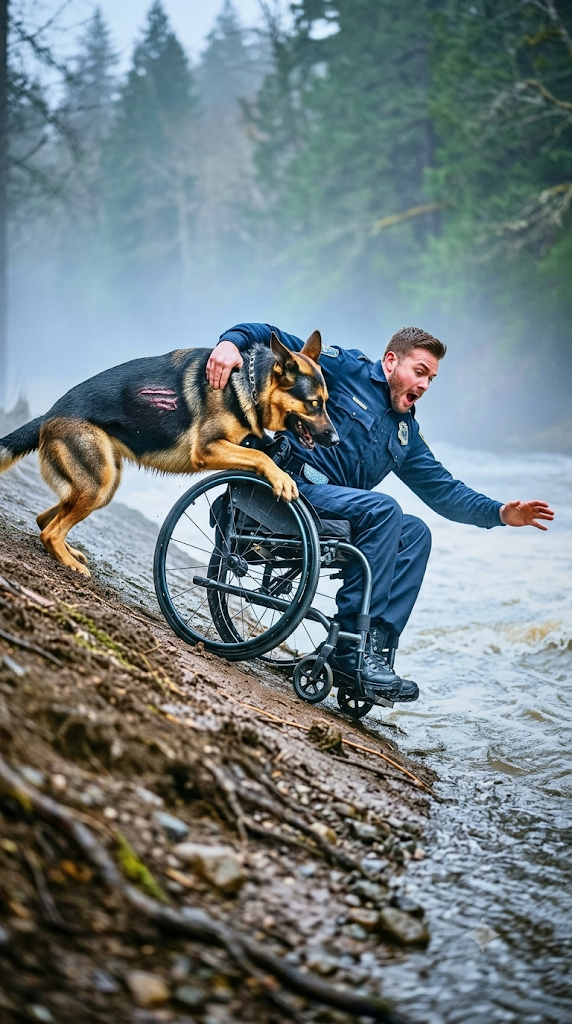
He had gone out before the rain started, wheeling himself down the path behind the cabin toward the creek.
He wanted to check the trail to see if the soil near the burial spot where he’d found Ghost’s collar was holding, but the moment he reached the ridge above the water, the first crack of thunder rolled over the valley.
He hesitated.
Then the earth moved.
The left wheel caught on a patch of slick mud that hadn’t been there two days ago.
His chair tilted suddenly, violently.
Troy’s hands scrabbled at the arms for balance, but the rain had already made the rims slick.
The chair buckled sideways.
His weight shifted with it.
His shoulder struck the edge of a mossy rock, and he gasped as the cold rushed in.
He slid inches closer to the drop, a sharp slope that gave way to the swollen creek below.
Roots jutted out like grasping fingers, but he couldn’t reach them.
His leg, braced and useless, dangled at an awkward angle, anchoring him where the slope steepened.
He was halfway over.
The wind screamed above him.
And then, without warning, there was warmth.
A weight, a body. Ghost.
The shepherd lunged from the brush with terrifying grace, planting his front paws into the soil inches from Troy’s head.
His chest pressed against Troy’s shoulder, grounding him.
The dog didn’t bark, didn’t growl.
He simply leaned in, steady, silent, a wall of muscle and breath.
Troy’s breath came ragged. “Easy. Easy, boy.”
Ghost lowered his head beside Troy’s neck, using the leverage of his body to counterbalance the slipping weight.
His paws dug into the earth.
His hind legs trembled with tension, but he didn’t move.
He was anchoring him.
Just like before, just like that day in the snow six years ago.
Through the rain, Troy’s eyes burned. “You remember.”
Back at the cabin, Emily had already thrown on her coat and boots.
She sprinted into the storm, flashlight in hand, calling Troy’s name again and again.
Her chest tightened with each unanswered cry.
The forest looked monstrous now, every tree bending like a bowstring, branches tearing across the path.
She slipped twice, once scraping her knee on a stone, but she didn’t slow down.
Her hair, soaked and tangled, whipped across her face.
And then, through the deluge, she saw them.
Two shapes at the edge of the slope.
The wheelchair lay tilted on its side, wheels spinning uselessly in the mud.
Troy was half submerged in slick earth, but not alone.
Ghost stood over him, body rigid, muscles locked in resistance, holding the weight of the man with the power of instinct and memory.
Emily stumbled forward and dropped to her knees. “Troy!”
His eyes met hers. “I’m okay. He’s holding me.”
Without hesitation, she crawled closer, wrapping her arms under Troy’s shoulders, helping him shift back from the edge.
Ghost didn’t move until she said softly, “It’s okay now. I’ve got him.”
Only then did the shepherd ease away.
Mud smeared Troy’s jacket and Emily’s palms, but he was upright now, half laughing from adrenaline and disbelief.
Emily turned to the dog.
He was soaked, shivering slightly, but his posture was proud, unmoving.
His eyes were locked on Troy, not her.
She moved forward slowly, cautiously, and knelt in front of Ghost.
Her fingers trembled as she reached out.
He didn’t flinch.
Emily laid her hand on his wet, broad chest and whispered, “Thank you for coming back.”
For the first time, Ghost blinked.
Then he sat, still facing Troy, tail curled around his feet like a sentinel who had done this before, who would do it again.
They didn’t speak on the way back.
The storm continued above, but beneath it, in the hush between thunderclaps, something deeper passed between the three of them.
Recognition, perhaps. Trust, maybe.
Or something older still.
By the time they reached the cabin, power had returned.
The fireplace crackled again.
Troy leaned back in the armchair while Emily dried Ghost with a warm bath towel, working through the dirt and leaves as if she were cleaning a sacred relic.
Ghost didn’t resist.
He lay quietly by the hearth, body pressed close to the flames, chest rising and falling in slow rhythm.
Emily sat nearby and didn’t look away.
Neither did Troy.
Because tonight, for the first time, the storm hadn’t taken anything.
It had given something back.
The morning after the storm arrived with a deceptive calm.
Sunlight pierced through thin veils of mist still clinging to the tree trunks, casting long golden lines across the mossy ground.
Birds resumed their cautious chatter, and somewhere deep in the forest, water dripped rhythmically from pine needles to stone.
Inside the Bennett cabin, quiet ruled.
The air still held the echo of chaos from the night before, but now it was layered with something else: reverence.
Ghost lay on a folded quilt near the fireplace, his massive frame still, save for the slow rise and fall of his breath.
His rear right leg was wrapped in a careful splint, supported by rolled towels and gauze, secured with a torn strip from Emily’s emergency kit and a hand-carved wooden paint stick she’d broken in half.
The fracture had occurred the night before when he used his own body to stop Troy’s wheelchair from sliding into the ravine.
Troy hadn’t known right away, not until they got back.
Ghost never whimpered, never limped.
He only lay down slowly, as if exhaustion had finally caught up with him.
Troy sat nearby now, staring into the fire.
One hand rested gently on Ghost’s back, feeling the steady thrum of life beneath the damp fur.
Emily returned from the kitchen holding a thermos of warm broth and a small dish of shredded chicken.
Her eyes were puffy from lack of sleep, but her movements were precise.
She knelt beside Ghost and placed the bowl within reach.
The dog raised his head, sniffed, and gently took a piece between his teeth.
He chewed slowly, methodically.
“He still got his appetite,” Emily said softly.
Troy nodded, his voice hoarse. “He took the whole weight of me and didn’t make a sound.”
Emily checked the bandage again.
The swelling had gone down slightly. “That leg took the brunt of your fall. Femur, maybe. We need to get him looked at properly.”
“I already called Doc Leland,” she added. “She’s cleared her morning for him.”
The Cedar Run Veterinary Clinic was nestled between the town’s only barber shop and an old mechanics garage.
It was a squat white building with green shutters and a hand-carved sign that read Cedar Run Animal Care since 1982.
Inside, the walls were lined with framed photos of local pets, thank-you notes, and one worn newspaper clipping of a grinning woman holding a litter of rescued puppies during a flood in ’99.
That woman was Dr. Helen Leland, now in her early fifties with steel-gray hair pulled into a low knot and the practical strength of someone who had delivered calves in blizzards and stitched up wolves by flashlight.
She met them at the side entrance, Emily leading Ghost on a leash, Troy close behind in his wheelchair watching every movement with a silent intensity.
Dr. Leland’s eyes went immediately to Ghost’s posture and the makeshift splint. “What happened?”
“He saved my life,” Troy said quietly.
She didn’t ask for details.
Inside the exam room, the floor was warm and clean.
Ghost stood shakily, allowing himself to be lifted gently onto a low table.
Emily kept a hand on his side the whole time.
Dr. Leland worked efficiently, scanning, palpating, murmuring to herself.
Then she turned on a handheld device, passed it over Ghost’s shoulder, and waited.
Beep.
She froze.
Troy leaned forward. “You found something?”
She nodded. “Microchip. It’s still functional.”
A second later, the chip ID flashed onto the screen.
K9, Ghost, Unit 47, Jackson County Search and Rescue, Handler Deceased, Status Retired, Presumed Lost.
Dr. Leland exhaled sharply. “Well, that answers that.”
Troy’s voice dropped. “It’s really him.”
Emily’s hand stilled on Ghost’s fur. “After all these years, he was never lost. Just waiting.”
Dr. Leland gently touched the injured leg again. “He’s got a mid-shaft femur fracture. Clean, but painful. I can splint it properly and prescribe pain meds, but he’ll need six to eight weeks of rest. No stairs, no running, no guarding cliffs.”
She gave Troy a pointed look.
“Understood,” he said, then gently placed his hand on Ghost’s head. “We’ll take care of you now.”
By the time they returned to the cabin, the town already knew.
Marcus Glenn’s article had gone live on the Cedar Run Sentinel website under the title “The Guardian in the Pines: K9 Ghost Lives.”
The piece included a brief history of Ghost’s last known rescue six years prior, a quote from Dr. Leland, and a photo of Ghost resting beside Troy’s wheelchair, leg wrapped but posture alert.
That evening, as the sun dipped behind the ridge, the first car pulled up outside the cabin.
Then another, and another.
People stepped out in pairs, in silence.
One man, Cliff Harmon, wore a thick brown jacket and a knitted cap.
He walked with a cane, his limp pronounced.
He approached slowly, holding a glass candle in both hands.
“I was one of the hikers,” he said, eyes shining. “He found me in the snow. I didn’t think I’d ever see him again.”
He knelt beside Ghost, who lifted his head just enough to meet his gaze.
“Thank you,” Cliff whispered. “You were the reason I came home.”
He placed the candle on the porch railing and lit the wick.
It flickered in the breeze.
By nightfall, eight candles lined the porch.
Some in Mason jars, some in simple glasses.
Each left by someone who had either heard the story or lived a part of it.
A quiet vigil, not for mourning, but for gratitude.
Inside, Troy sat by the window, Ghost resting beside him.
The dog’s leg was elevated on the blanket.
He didn’t move much, but his eyes were open, watching every flicker of light through the glass.
Emily stood behind them, arms folded across her chest, overcome.
Troy looked down and whispered, “You never stopped being a protector.”
And even wounded, even still, Ghost’s tail gave a soft, steady thump.
The pines whispered a different song now, less of mourning, more of movement.
A year had passed since the storm, since Ghost had used his aging body to shield Troy from a deadly fall.
The forest around the Bennett cabin had gone through its seasons: spring’s thaw, summer’s shimmer, autumn’s fire, and now, once again, wore its cloak of soft snow and quiet.
But the cabin itself had changed.
It was no longer just a place of refuge.
It was alive with new voices, fresh footprints, and the steady rhythm of purpose.
A modest wooden sign now hung above the porch, carved in bold but careful letters: Guardian Pines, a sanctuary for retired K9s.
Troy Bennett sat in a chair under that sign, sketch pad balanced on his lap, watching the late afternoon light slant across the training yard they’d carved from the clearing behind the cabin.
His hair was a bit longer now, his beard trimmed close, and though his legs still ached in cold weather, he moved with practiced ease in his upgraded wheelchair—titanium rims, smooth pivots, quiet strength.
Beside him, Ghost lay curled in his usual spot on the porch, head resting over his outstretched front paws.
His fur had grown grayer, and the once-torn ear drooped slightly more than before.
But his eyes, those amber eyes, still burned with quiet fire.
His back leg, the one broken during the storm, had never fully regained its former strength, but Ghost had learned to walk with a slow, deliberate rhythm.
When he moved, it was like watching a story unfold in slow motion, each step a chapter, each glance a page.
Troy glanced down at his sketch pad.
He had drawn Ghost again, as he often did.
Not as he had been in his prime, but as he was now—older, worn, and magnificent.
There was pride in those lines, not just in the dog, but in what they had built together.
Behind them, the sound of laughter echoed from the training yard.
A group of young volunteers, mostly veterinary students and recent graduates, were working with three retired service dogs.
A golden retriever named Roscoe, who had a cataract in one eye but still sniffed out lost gloves with remarkable accuracy.
A stoic black lab named Nina, formerly a bomb-sniffing dog.
And a nervous Belgian Malinois named Dex, who had flinched at every loud sound during his first week but now wagged his tail when someone called his name.
Emily Bennett stood near the fence line, clipboard in hand, hair braided down her back, and a red flannel shirt tied around her waist.
She moved with purpose, but her smile came easy now.
She had become the heart of Guardian Pines, balancing clinical care with a soft intuition that animals trusted.
Her past grief had not vanished, but it had softened.
Her late dog Bailey’s collar now hung on a small wooden post near the porch, a quiet memorial among pine cones and carved stones.
Ghost lifted his head slightly and watched the field.
His tail thumped once.
He still had a role, less physical now, more symbolic.
The younger dogs followed his gaze, his posture.
If Ghost rose to check on a new volunteer, so did they.
If Ghost laid still and trusted someone, they did, too.
He had become the silent judge of character, the heart of the sanctuary, and the living proof that loyalty never truly fades.
Troy reached down and rested his hand on Ghost’s head, feeling the warmth of the dog who had saved him twice.
“Good boy, Ghost,” he whispered. “Good boy.”
And in the quiet of the afternoon, surrounded by the pines and the people who had come to believe in second chances, the old dog closed his eyes and rested, knowing that his watch was finally complete.