

At 10:17 p.m., the entire emergency department at St. Matthews Medical Center watched a rookie nurse get humiliated in front of a waiting room full of patients.
Dr. Richard Cole held her medical chart above his head and shook it like a trophy.
“Everyone, this is Emily Carter. Three weeks on the job, and she still looks terrified whenever a patient asks her a question.”
A few nurses laughed.
Emily stood beside the nurse’s station, her oversized blue scrubs hanging loosely from her narrow shoulders.
Her chestnut hair was tied into a careless ponytail, and a faint scar disappeared beneath the sleeve covering her left forearm.
“I’m sorry, doctor,” she whispered.
Cole lowered the chart.
“That’s your favorite word, isn’t it? Sorry. Perhaps you should apologize to the hospital for accepting a job you’re clearly not ready to handle.”
More laughter followed.
Charge nurse Melissa Grant looked away.
Two residents exchanged amused glances.
Even the receptionist pretended to be busy with her computer.
Emily said nothing.
She had learned that defending herself often made cruel people more determined to hurt her.
But when a metal tray crashed behind her, something strange happened.
She didn’t flinch.
Her feet shifted automatically.
Her eyes scanned the exits, the corridor, and the nearest emergency equipment.
For one brief second, she looked less like a frightened nurse and more like someone who had spent years anticipating danger.
Then she lowered her head again.
Cole never noticed.
“Go restock the trauma room,” he ordered. “And try not to injure anyone on your way there.”
Emily collected the chart and walked away.
Inside the supply room, she closed the door and leaned against the wall.
Her hands were shaking.
She hated that they still did.
Five years earlier, those hands had worked beneath collapsed buildings, wrapped bleeding limbs in freezing rain, and performed emergency procedures while helicopters circled overhead.
She had once been trusted with lives that depended on every decision she made.
Now she was a joke.
Emily opened her locker and removed a small photograph.
A younger version of herself stood in the mountains beside a black-and-tan German Shepherd wearing a red rescue harness.
The dog’s ears were raised, his eyes bright, and his front paws rested proudly against her boots.
On the back, in faded handwriting, were four words.
Together, we bring them home.
Emily pressed the photograph to her chest.
“Not tonight,” she whispered.
She had promised herself she would never return to her old life.
No more rescue missions, no more mountains, no more searching through wreckage while listening for voices that might never answer.
She had come to St. Matthews to become someone ordinary — someone who could sleep through the night, someone who could finally stop blaming herself for the brother she had lost.
Then the emergency department doors exploded open and the dog in her photograph came running toward her.
The automatic doors slid apart so violently that a security guard stumbled backward.
A German Shepherd charged into the hospital.
His black-and-tan coat was soaked with snow.
A red tactical harness crossed his chest, one strap hanging loose, and a thin line of blood marked the fur above his right paw.
A broken leash dragged behind him.
“Stop that animal!” Cole shouted.
The dog ignored him.
He raced past reception, dodged a wheelchair, and slipped between two paramedics carrying equipment.
His eyes searched the room.
Then he saw Emily.
The shepherd stopped so suddenly that his paws skidded across the polished floor.
Emily turned.
The photograph slipped from her hand.
“No.”
The dog sprinted toward her.
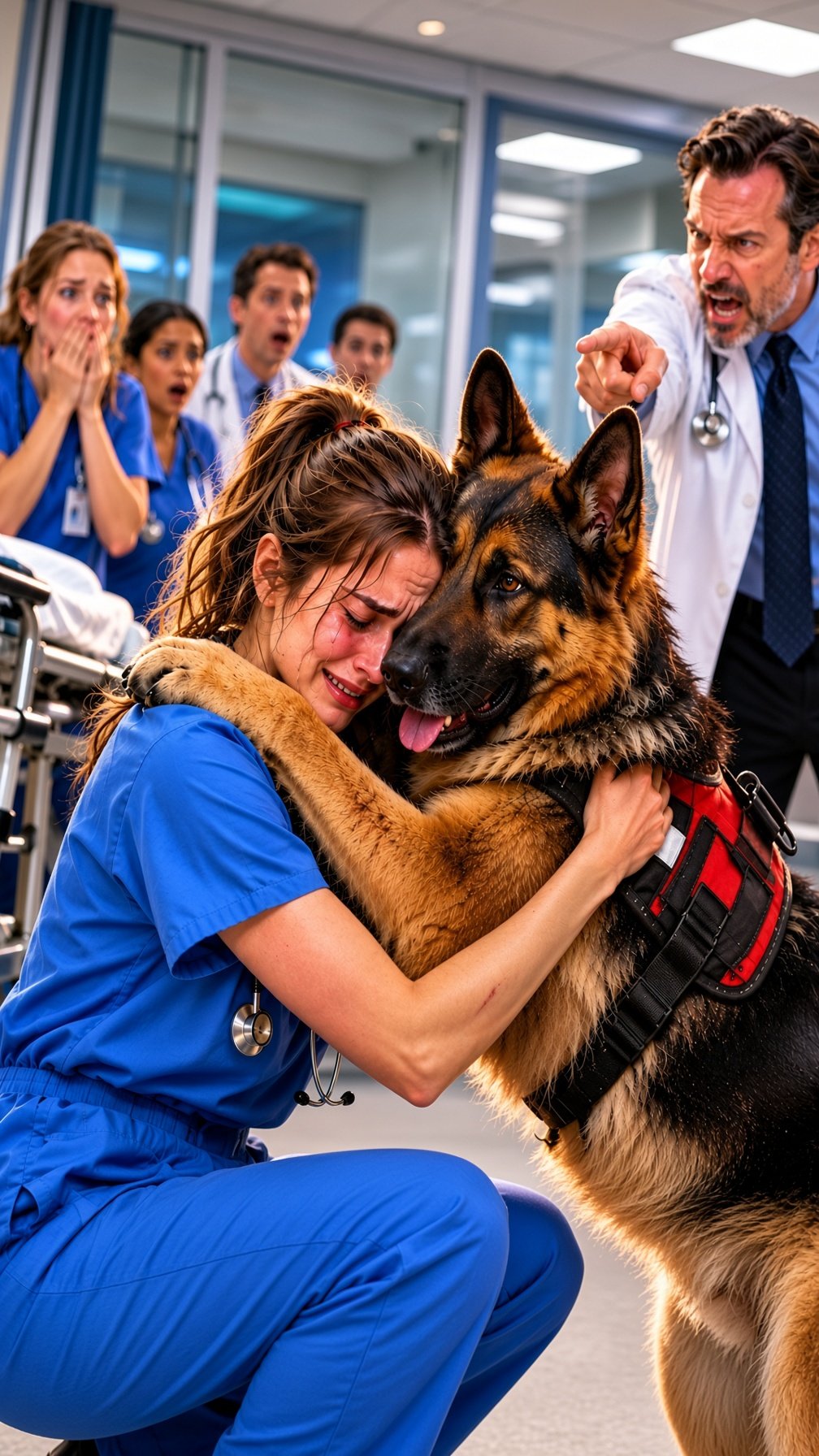
Atlas rose onto his hind legs and placed his front paws against her shoulders.
He pressed his muzzle against her cheek, whining with a desperate intensity that made several people turn away.
Emily dropped to her knees.
“Atlas.”
The dog pushed his head beneath her chin.
She wrapped both arms around his neck and buried her face in his fur.
“You’re alive. Oh my God, you’re alive.”
Atlas licked her face and whined again.
His tail swept across the floor as he pressed himself against her, refusing to create even an inch of distance between them.
Emily began to cry.
For five years, she had wondered whether the dog who once saved lives beside her had forgotten her.
Now he was trembling in her arms as though he had been searching for her just as desperately.
The room went silent.
Cole stepped forward.
“What is this ridiculous spectacle?”
Atlas immediately turned his head and growled.
“Get that dog out of my department.”
Emily placed a hand against the shepherd’s chest.
“Easy, Atlas. It’s okay.”
The growling stopped.
Cole stared at her.
“You know this animal?”
“Yes.”
“Then take responsibility for him.”
Before Emily could respond, the doors opened again.
Three rescue personnel rushed into the emergency department carrying an injured man on a stretcher.
“Medical team needed immediately,” one shouted. “Vehicle collapse on the mountain access road. One rescue worker critically injured, and a sixteen-year-old boy is missing.”
The injured man wore a torn rescue jacket.
His face was pale, and blood stained his sleeve.
Atlas suddenly stood.
He rushed to the stretcher, sniffed the man’s hand, and released a sharp bark.
Then he ran back to Emily.
He caught the loose fabric of her scrub top gently between his teeth and pulled.
Emily looked at him.
“What is it?”
Atlas pulled again.
His eyes moved toward the stretcher, then toward the hospital doors.
Emily’s expression changed.
She knew that behavior.
Atlas wasn’t asking for comfort. He was trying to tell her something.
“Who is this man?” she asked.
“Daniel Brooks,” a rescuer answered. “Our team leader. The mountain road collapsed during a search for a missing hiker. He went back to look for the boy and was injured when another section gave way.”
“Where did you last see the boy?”
“Near the eastern maintenance tunnel. We heard something beneath the wreckage, but visibility was terrible. Atlas was with our team when the collapse happened. We thought he was trapped somewhere on the slope.”
Emily looked at the dog.
“How did he get here?”
“We don’t know. He disappeared during the confusion.”
Daniel suddenly opened his eyes.
His gaze moved across the room before settling on Emily.
For several seconds, he simply stared.
Then he whispered a name.
“Valkyrie.”
Emily went completely still.
Daniel tried to raise his head.
“Commander Carter.”
Cole looked from the injured man to the nurse.
“What did you call her?”
Emily’s hands began to tremble again.
She had spent five years trying to bury that name.
Now, in a hospital full of people who had mocked her, a wounded rescue commander had just spoken it aloud.
Atlas pressed his head against her chest, and Emily understood that her old life had finally found her.
“Doctor, I need a radio and the mountain rescue map,” Emily said.
Cole blinked.
“Excuse me?”
“The missing boy may still be alive. We need the last confirmed location and the current rescue team’s position.”
“You need to return to your assigned patients.”
Emily looked directly at him.
“With respect, doctor, we don’t have time for this.”
The words were quiet, but the authority behind them was unmistakable.
Daniel watched her with recognition.
“She’s right,” he murmured. “Get her the map.”
Cole turned toward him.
“You’re a patient in my hospital. I decide who directs the response.”
Daniel tried to sit up, then winced.
“That woman has led medical evacuations in conditions you wouldn’t believe.”
“And I have spent twenty years running an emergency department.”
“Then you should know when to listen.”
A tense silence settled over the room.
Emily stepped between them.
“Please. We can argue later.”
She took the radio from a rescuer and pressed the transmit button.
“This is Emily Carter at St. Matthews. I need the rescue coordinator.”
A burst of static followed.
Then a voice answered.
“Rescue coordination. Identify yourself.”
“Emily Carter, former Alpine Disaster Response Unit. I’m assisting with the hospital-side response. Give me the last confirmed location of the missing boy and the condition of the tunnel.”
The voice on the radio changed immediately.
“Commander Carter.”
Emily closed her eyes briefly.
“Just Emily is fine.”
“Ma’am, we have an unstable section near the eastern entrance. One team heard tapping beneath the debris, but we haven’t established visual contact.”
Emily looked at the map as it arrived.
The eastern maintenance tunnel ran beneath an old mountain road.
A drainage channel connected the lower passage to a narrow outlet on the western side.
If the entrance had collapsed, the missing boy might have been forced into the lower channel.
“Do not send anyone into the tunnel until the structural team checks the entrance,” she ordered. “Move a second team toward the western outlet. Bring a thermal camera and keep communication open.”
“Understood.”
Cole stared at her.
“Who exactly do you think you are?”
Emily lowered the radio.
Before she could answer, Daniel spoke.
“Lieutenant Commander Emily Carter, former medical lead for the Alpine Disaster Response Unit. Call sign Valkyrie.”
A nurse dropped a stack of paperwork.
Daniel continued.
“She was one of the youngest medical specialists assigned to our high-risk rescue operations. She saved twelve people during the Silver Creek collapse. She was also the handler who trained Atlas.”
The emergency department fell silent.
Cole’s expression changed.
“That Emily Carter?”
Emily looked uncomfortable.
“I was part of a team.”
Daniel shook his head.
“You were the medic who went back into the building after the withdrawal order because a child was still trapped inside.”
Emily’s face drained of color.
“Daniel, stop.”
He stopped.
He understood that he had touched a wound deeper than any physical injury.
Atlas nudged Emily’s hand.
She stroked his head.
“I left that work for a reason.”
Daniel nodded slowly.
“I know.”
But his eyes moved toward the radio.
“And I think a sixteen-year-old boy is about to need the person you used to be.”
Emily looked at the mountain map.
Then she picked up the radio again.
“Tell the field team I’m staying on the line.”
For the first time that night, nobody laughed.
The next twenty minutes were filled with broken radio transmissions and unanswered calls.
The rescue team reached the western drainage outlet but found the opening partially blocked by snow, broken concrete, and fallen timber.
They could not see inside.
Emily studied the map while Atlas paced beside her chair.
“What’s his name?” she asked the coordinator.
“Noah Bennett. Sixteen years old. His father reported that he had a mobile phone with him.”
“Have they tried calling it?”
“Repeatedly. No answer.”
Emily looked at the drainage channel again.
“Ask his father to call once more. Have the field team listen for the ringtone. But nobody enters the channel until the structure is assessed.”
The coordinator relayed the instructions.
Seconds passed.
Then a faint noise crackled through the radio.
Three taps. A pause. Three more taps.
Emily leaned forward.
“Repeat that transmission.”
The field team repeated the sound.
Atlas suddenly stopped pacing.
His ears rose, and he turned toward the radio.
Then he whined.
Emily looked at him.
“What is it, boy?”
The shepherd approached the desk and touched the radio with his nose.
Emily remembered the training exercises she had conducted with him years earlier.
When visibility disappeared, they had developed a simple method of communication.
Atlas would search for a sound or scent, then return to her and repeat a specific behavior to indicate that he had located something important.
Three taps. A pause. Three taps.
Emily grabbed the radio.
“Team at the western outlet, confirm the direction of the tapping. Is it coming from above you or below the drainage channel?”
“Stand by.”
Static.
Then the answer came.
“Below. We have a narrow opening leading toward the lower passage.”
Emily exhaled.
“That’s where he may be trapped. Don’t widen the opening until the structural team approves it. Check for signs of movement and prepare a controlled extraction.”
The coordinator acknowledged.
Daniel, lying on a stretcher nearby, watched her.
“You still remember every detail.”
Emily shook her head.
“I remember what matters.”
A sudden crackle interrupted the radio.
“Possible secondary collapse. We have lost the tapping.”
Emily’s heart seemed to stop.
“What changed?”
“Movement in the debris. Dust coming from the lower passage. We have withdrawn to a safe distance.”
Emily stared at the map.
She could imagine the narrow channel, the unstable supports, and a frightened boy trapped in darkness.
For one terrible moment, she was back at Silver Creek.
She could hear Nathan calling her name.
She could see the concrete slab that had separated them.
Her hands began to shake.
Atlas immediately pressed his head against her chest.
Emily closed her eyes.
“Not again,” she whispered.
Daniel heard her.
“Emily, look at me.”
She didn’t move.
“You’re here. You’re in the hospital. Atlas is beside you. You’re not back at Silver Creek.”
Her breathing slowed.
She opened her eyes and looked at the map again.
The boy was not her brother.
The mountain was not the same mountain, and this time she had a team waiting for her instructions.
Emily pressed the radio button.
“All units, do not rush the extraction. Stabilize the accessible section first. If the lower passage is unsafe, find another route. Noah needs us to bring him out alive, not create another victim.”
The coordinator responded immediately.
“Copy, commander.”
Emily released the button.
Atlas rested his head on her knee.
She stroked his fur.
“We’re going to get him home, boy.”
For the first time in five years, she believed her own words.
At 11:26 p.m., a second emergency threatened to overwhelm the hospital.
The storm had damaged a power line near the service wing.
Smoke began drifting from an electrical maintenance room, and the backup power system started behaving erratically.
A fire alarm sounded.
Patients stirred in their beds.
Nurses hurried through the corridors.
Cole immediately ordered the staff to prepare for a possible evacuation.
But when he saw Emily directing nurses to check essential equipment and prepare portable monitoring devices, he snapped.
“You are not in charge here.”
Emily turned.
“Doctor, we have unstable power in the affected wing. We need to prepare vulnerable patients in case the fire team orders a transfer.”
“That’s my decision.”
“And on. Then make it. But please make it now.”
Cole stared at her.
For a moment he seemed ready to send her away simply to reassert his authority.
Then a nurse rushed into the department.
“Dr. Cole. The electrical fault is affecting the monitors in two rooms.”
Cole hurried toward the corridor.
Emily followed.
She did not argue again.
She helped the nurses move patients according to the hospital’s emergency procedures, ensuring that essential equipment and appropriate staff accompanied them.
Atlas remained close to her.
Whenever she stopped, he stopped. Whenever she moved, he followed.
Then the security officer appeared.
“We can’t find a little girl from pediatric observation. Her mother says she was standing near the rear corridor when the alarm started.”
Emily looked toward Atlas.
The shepherd had already turned in that direction.
His nose moved rapidly.
He barked once and ran toward the service corridor, stopping before the smoke-filled section.
“Atlas, stay!” Emily called.
The dog stopped immediately.
Emily instructed the security officer to notify the fire team and keep everyone away from the affected corridor.
She would not enter a hazardous area without the appropriate clearance.
Minutes later, a firefighter reported that the immediate route to the pediatric storage alcove was safe to approach.
Emily and a staff member followed under the fire team’s direction.
They found the little girl crouched behind a supply cart, frightened and crying.
Atlas lowered himself to the floor.
The girl looked at him.
“Doggy.”
He gave a soft whine.
Emily knelt beside her.
“Hello, sweetheart. What’s your name?”
“Sophie.”
“Well, Sophie, Atlas is going to stay right here while we take you somewhere safe.”
The child reached for the dog’s fur.
Atlas remained perfectly still.
Emily carried Sophie back to the main department, where her mother rushed forward and held her tightly.
“Thank you,” the woman whispered. “Thank you for finding her.”
Emily nodded.
Atlas leaned against her leg, but the hospital was still dealing with the electrical emergency, and the rescue operation on the mountain remained unresolved.
Emily returned to the radio desk.
Cole followed her.
“I want you to hand that radio over.”
She looked at him.
“The rescue team is still working to reach Noah.”
“This is a hospital, not a military command post. You are treating patients beyond your authority and issuing instructions to people who aren’t even employed here.”
“Doctor. I am coordinating information. The rescue commander remains responsible for the field operation.”
“Enough.”
His voice echoed across the department.
Several patients turned to look.
Cole pointed toward the nurse’s station.
“Hand over the radio, and you can explain your behavior to the administrator in the morning.”
Emily stared at him.
For nineteen days, she had accepted his insults because she believed silence would protect her.
Now his demand could interrupt communication during a dangerous rescue.
She placed the radio on the desk.
Then she looked him in the eyes.
“If you want to take it, doctor, you can. But I want you to understand what you’re choosing. There is a child trapped beneath a collapsing structure, and the team trying to reach him is relying on information we have helped establish.”
Cole hesitated.
The radio crackled.
“Command, we have located the boy. He’s alive, but we’re having trouble reaching him.”
Emily turned toward the speaker.
Cole looked at the radio, then at the staff watching him.
Slowly, he stepped aside.
“Continue,” he said.
Emily picked up the radio.
“Tell me exactly what you can see.”
The field team had located Noah in a narrow pocket beneath the collapsed drainage channel.
He was conscious but frightened, with one leg pinned beneath a heavy section of timber.
The opening was too unstable for the rescuers to pull him out immediately.
The structural team was working to secure the surrounding debris.
Emily listened carefully as the field commander described the scene.
“He’s asking for his father. He’s cold and losing confidence.”
“Keep talking to him,” Emily said. “Tell him you’re staying with him. Don’t promise a time you can’t guarantee.”
The commander acknowledged.
Emily closed her eyes briefly.
She remembered Nathan’s voice beneath the concrete.
She remembered promising him that she would get him out.
She had believed it with every part of herself.
And she had been unable to keep that promise.
Daniel watched her from his stretcher.
“You’re thinking about your brother.”
Emily nodded.
“What if I make the wrong call again?”
Daniel answered without hesitation.
“Then you listen to the people beside you, reassess, and make the next decision with the information you have. You don’t get to control everything. Neither did I.”
She looked at him.
“You went back for Noah.”
“Yes.”
“And you were injured.”
“Yes.”
“Why?”
Daniel smiled faintly.
“Because he was still there.”
Emily looked toward Atlas.
The dog stood beside her, watching the radio as if he understood every word.
She realized that she had spent five years treating survival as a debt she could never repay.
Every person she couldn’t save had become a reason to stop trying.
But Atlas had never abandoned her.
Even after the worst day of her life, he had continued doing what he had been trained to do — search, communicate, and help bring people home.
Emily lifted the radio.
“Field team, what’s the condition of the timber pinning Noah’s leg?”
The commander answered.
“Stable for now, but we need to relieve the pressure before moving him.”
“Then don’t pull him free until the structure is secured. Keep him warm if you can do so safely. Monitor his condition and have your medical team ready at the opening.”
A pause followed.
“Copy.”
Emily took a breath.
“Commander, this is Emily Carter. I know you can hear me through the radio. We know you’re frightened. The team is working carefully to reach you. You don’t have to do anything except keep talking to them if you can.”
For several seconds, there was no response.
Then a faint voice came through.
“Are you a doctor?”
Emily smiled sadly.
“I’m a nurse.”
“Are they going to get me out?”
Emily looked at the rescue map.
“Everyone there is working to bring you out safely. They’re not giving up on you.”
A weak breath followed.
“Okay.”
Emily closed her eyes.
“That’s right, Noah. One moment at a time.”
The rescue team worked slowly.
They stabilized the damaged section, relieved the pressure on Noah’s leg, and created enough room for a controlled extraction.
At 12:07 a.m., the field commander spoke again.
“We have him free.”
Emily’s knees nearly gave way.
“What’s his condition?”
“Conscious. Injured, but responding. We’re moving him to the medical team now.”
The emergency department erupted in relieved applause.
Melissa covered her mouth.
Daniel began crying.
Atlas barked and pressed his body against Emily’s side.
Emily dropped to her knees and held him.
“We did it,” she whispered. “We brought him home.”
For a moment, the entire room disappeared.
She was no longer thinking about Silver Creek.
She was thinking about the boy who would see his father again.
And for the first time in five years, the memory of her brother did not feel like a punishment.
It felt like love.
At 12:32 a.m., Noah arrived at St. Matthews by ambulance.
The medical team immediately took over his care.
His father followed behind the stretcher, pale with fear and exhausted from waiting.
When he saw his son alive, he broke down.
Emily stood at the edge of the treatment area, giving the medical team room to work.
Atlas sat beside her.
Noah’s father approached after the initial assessment.
“Are you the nurse who spoke to him over the radio?”
Emily nodded.
The man took her hand.
“He told me someone kept talking to him when he thought nobody could hear him. He said he was scared, but your voice made him feel like somebody was still there.”
Emily swallowed.
“I’m glad he could hear us.”
The father looked down at Atlas.
“And this dog helped too.”
Emily smiled.
“He’s very good at finding people.”
Before the man could respond, the hospital administrator, Margaret Ellis, arrived with two senior physicians.
Dr. Cole immediately stepped forward.
“Margaret, we need to discuss a serious issue. Miss Carter has been using rescue communications without authorization and has been directing staff outside her role.”
Margaret looked at him.
“Is that so?”
“Yes. I intend to file a formal report.”
Daniel, now stable enough to sit upright, spoke from the nearby bed.
“Then I suggest you include my statement.”
Cole turned.
Daniel held out his identification.
“Senior Rescue Commander Daniel Brooks. I was leading the operation when the mountain road collapsed. Emily Carter helped us locate Noah and avoid an unsafe approach to the tunnel.”
Margaret examined the document.
Daniel continued.
“She didn’t replace the field commander. She provided critical information and kept communication moving while our team worked.”
A senior physician glanced at Emily.
“Commander Carter.”
The title traveled through the department like a sudden current.
One of the older nurses looked at Emily more closely.
Then she whispered, “Valkyrie.”
Several people turned.
Margaret looked at Daniel.
“Is this the same Emily Carter who worked the Silver Creek disaster?”
Daniel nodded.
“The same one.”
He looked toward the gathered staff.
“Five years ago, she led medical support during one of the most dangerous structural collapse operations our unit had faced. She went into unstable areas to treat injured survivors, coordinated evacuations, and worked alongside Atlas until the rescue team pulled them out.”
He paused.
“She also lost her younger brother during that operation.”
The room grew quiet.
Emily lowered her eyes.
Daniel continued gently.
“Afterward, she left rescue work. She didn’t ask for recognition. She didn’t tell people what she’d done. She simply wanted to become a nurse and build a life outside the memories that haunted her.”
He looked at Cole.
“Tonight, you humiliated her because she was quiet. You mistook her grief for incompetence, and you nearly interrupted a rescue because you were more concerned with authority than with the information she was providing.”
Cole’s face turned red.
For once, he had no response.
Margaret turned to Emily.
“Why didn’t you tell us about your experience?”
Emily looked at the people surrounding her.
“Because I didn’t want to spend the rest of my life being introduced as the woman who survived Silver Creek. I wanted to help patients. I wanted to be allowed to start again.”
Her voice trembled.
“I know I’m not perfect. I still have things to learn. But being new doesn’t mean I have nothing to offer.”
Melissa stepped forward.
“Emily, I’m sorry. I watched people ridicule you, and I didn’t stop it.”
One of the residents lowered his head.
“So am I.”
Cole finally approached.
He removed his identification badge from his coat and held it in his hand.
“I was wrong,” he said quietly. “I used my position to embarrass you. I treated your silence as a weakness because it made me feel more powerful.”
Emily looked at him.
“I don’t need you to feel ashamed forever, doctor. I need you to treat the next new nurse differently.”
Cole nodded.
“I will.”
Margaret turned toward the staff.
“Then let this be the beginning of a better department. We will review our emergency procedures, strengthen our rescue coordination, and ensure that every employee is treated with the respect their role deserves.”
She looked at Emily.
“And if you are willing, I’d like you to help us develop the new training program.”
Emily glanced at Atlas.
The shepherd sat calmly beside her, his eyes fixed on her face.
For the first time, she didn’t feel that accepting her past meant surrendering to it.
She could choose what to carry forward.
“Yes,” she said. “I’ll help.”
Three months later, St. Matthews Medical Center was a different place.
The emergency department had introduced new training sessions for mass casualty events, communication during disasters, and safe evacuation procedures.
Emily helped develop the program.
She taught nurses how to remain calm under pressure, how to communicate clearly with rescue teams, and how to recognize when a frightened patient needed reassurance as much as medical attention.
Dr. Cole attended the sessions.
He no longer made jokes about inexperienced staff.
And when a new nurse asked a question, he listened.
Atlas became a familiar face during approved hospital visits and training demonstrations.
His health was carefully monitored, and he worked only when cleared by his handlers.
Eventually, arrangements were made for him to spend his retirement with Emily.
She had a small house near the edge of the city with a garden, a comfortable bed for Atlas, and a photograph of Nathan on the living room shelf.
On a quiet spring morning, Emily sat beside the window while Atlas slept at her feet.
She opened the old photograph.
The younger woman in the picture looked confident, unafraid, and certain that every rescue had a happy ending.
Emily smiled sadly.
“I used to think I had to become that person again.”
Atlas lifted his head.
She stroked his ears.
“But I don’t, do I?”
The dog moved closer.
Emily looked toward the garden, where sunlight touched the new leaves on the trees.
She still remembered Silver Creek.
She still missed Nathan.
And sometimes, when the world became too loud, she still felt the old fear rising in her chest.
But she no longer believed that surviving meant she had failed someone.
She had learned that grief could live beside hope, that courage could exist alongside fear, and that asking for help did not make a person weak.
Atlas placed his chin on her knee.
Emily leaned forward and rested her forehead against his.
“Thank you for finding me, old friend.”
His tail thumped against the floor.
A moment later, her phone rang.
It was Melissa.
A frightened young nurse had just started her first shift at St. Matthews.
She had made a mistake with a chart.
And Dr. Cole had asked Emily to help her settle down.
Emily laughed softly.
“Tell her I’ll be there in twenty minutes.”
She put on her jacket and reached for Atlas’s leash.
The dog rose immediately, ready to follow.
“No, sweetheart,” she said, kneeling beside him. “Today, you can stay here and rest.”
Atlas tilted his head.
Emily smiled.
“I know you’d rather come with me.”
She kissed his forehead.
“But you’ve already done enough rescuing for one lifetime.”
At the hospital, the young nurse stood near the nurse’s station, her eyes red from crying.
Emily approached without making a scene.
“Hi. I’m Emily.”
The nurse wiped her cheeks.
“I’m sorry. I made a mistake.”
Emily gave her a gentle smile.
“Then we’ll figure out what happened, correct it, and learn from it. You don’t have to be perfect to become good at this job.”
The nurse looked up.
“Really?”
“Really.”
Emily placed a reassuring hand on her shoulder.
“Being new doesn’t mean you have nothing to offer.”
And somewhere in those words, the woman she had once been finally found peace.
She had not returned to the mountains.
She had not erased her grief.
She had simply stopped allowing the worst day of her life to decide every day that followed, because Atlas had reminded her of something she had forgotten.
The purpose of a rescue was never to prove that a hero was fearless.
It was to make sure that someone who was afraid did not have to face the darkness alone.
And sometimes the person who needed rescuing most was the one everyone else believed was already safe.
Never judge a person by how quietly they move through the world.
You may not know what they’ve survived, what they’ve lost, or how many lives they’ve helped save without asking for recognition.
Emily’s story reminds us that real courage isn’t the absence of fear.
It’s choosing to help someone even when your own heart is still healing.
And Atlas reminds us that the bond between a rescue dog and its handler is built on trust, loyalty, and the promise that neither will willingly leave the other behind.
The photograph on the shelf said it best, in four faded words that had never stopped being true.
Together, we bring them home.