

Rain hammered the windshield of Ethan Walker’s truck hard enough to blur the highway lights into long silver streaks.
He had driven forty miles out of his way to find a diner with an empty parking lot, and the Rusty Anchor on the outskirts of Seattle had looked like exactly the kind of place where a man could drink bad coffee in silence.
At thirty-five, Ethan carried himself with the relaxed but hyper-aware posture of a Navy SEAL on leave.
His shoulders were broad, his jaw was cut with a faint scar, and his gray eyes moved across the diner the way a searchlight sweeps a perimeter.
Beside him, a black-and-tan German Shepherd named Shadow lay curled under the booth, his amber eyes half-closed but his ears twitching at every clatter of silverware.
Shadow had served three combat rotations as a military working dog before an injury ended his career.
Ethan had adopted him the same week he left active duty, and the two of them had been inseparable ever since.
Ethan ordered coffee and a slice of pie he did not intend to eat, mostly because the waitress, Sarah, had a tired, kind face and he did not want to be the stranger who took up a booth for nothing.
The diner was nearly empty at nine at night, just a trucker in the corner and an elderly woman in a wool coat near the window.
Ethan noticed her immediately, the way he noticed everything.
She sat alone with a cup of tea she had not touched, her small hands folded on the table, her pale blue eyes darting toward the front door every few seconds.
Shadow noticed her too.
The dog lifted his head, let out a soft huff, and rested his chin back on his paws, but his ears stayed up.
Ethan watched the woman for a full minute before he understood what he was seeing.
She was not waiting for someone.
She was hiding from someone.
Then the door opened, and two men walked in, and the temperature in the room seemed to drop.
The first was thick-necked and heavy, with a broken nose and a jacket that pulled tight across his shoulders.
The second was younger, thinner, and unsettlingly still, and his eyes landed on the old woman for exactly one second too long before he looked away.
Shadow’s ears flattened, and a low growl rumbled in his chest.
“Easy,” Ethan murmured, dropping a hand to the dog’s neck.
The woman stood up slowly, her cane clicking against the linoleum, and walked toward Ethan’s booth with the careful dignity of someone who had spent a lifetime pretending not to be afraid.
She stopped at his table, and her voice was steady, though her hands were not.
“Excuse me,” she said. “Would you mind walking me to my car? I’m afraid I may not make it there safely on my own.”
Ethan looked at her for a moment, then at the two men by the window, then back at her.
“We’d be honored,” he said.
Shadow was already standing, calm and ready, his big body pressed against Ethan’s leg.
That single request, spoken in a diner at nine at night, would turn out to be the hinge on which three lives swung.
The woman’s name was Evelyn Harper, and she was eighty-two years old, and she was carrying twenty years of dangerous truth in a leather handbag.
Ethan did not know any of that yet.
What he knew was that a frail old woman had asked him for help, and that a small part of him that had been asleep since he left the service had just woken up.
He paid his check, told Sarah to keep the change, and walked Evelyn out into the rain with Shadow leading the way.
The parking lot was dark and slick, and the rain came down in sheets, and Ethan scanned the lot in a slow sweep before he let her take three steps.
Her silver sedan sat under a broken streetlight, and the black SUV in the far corner had its engine running.
Two men were already walking toward them.
Ethan stepped between Evelyn and the men and did not raise his voice.
“Evening,” he said. “Is there a problem?”
The heavier man smiled with his mouth only. “No problem. We’re just here to talk to Mrs. Harper.”
Evelyn’s hand tightened on Ethan’s arm, and her voice was quiet and sharp. “I have nothing to say to you.”
The taller man, the one with the expensive overcoat, stepped forward and kept his voice pleasant. “Mrs. Harper, Mr. Coleman prefers that these matters be handled quietly. You’ve been difficult to reach.”
Ethan heard the name and watched Evelyn’s face change, and understood that this was not a family disagreement.
Shadow’s growl deepened, and his weight shifted forward onto his front paws.
“Easy,” Ethan said again, though he had already slid half a step in front of the old woman.
“Ma’am, get in the car,” he said, and she handed him her keys without a word.
The heavier man reached inside his jacket, and Ethan’s training moved faster than his thoughts, a hand signal to the dog, a sidestep, a low, calm command.
Shadow barked once, hard and sharp, and the sound cracked through the rain like a warning shot.
The men stopped.
Not because they were afraid of a dog, but because a man in a soaked jacket had positioned himself between them and their target with the kind of stillness that meant he had done this before.
“This isn’t over,” the tall man said quietly, and then he turned, and the two of them walked back to the SUV, and the black vehicle pulled away into the rain.
Ethan did not relax until the taillights vanished.
He helped Evelyn into the passenger seat, and Shadow jumped into the back, and Ethan slid behind the wheel and did not start the engine.
“Now,” he said. “You should tell me what that was about.”
Evelyn looked at him with her clear pale eyes and made a decision she had been postponing for twenty years.
“My husband was Thomas Harper,” she said. “He was an accountant. Twenty years ago, he found irregularities in the accounts of a company called Coleman Financial Group.”
Ethan listened without interrupting.
“Richard Coleman built his company by laundering money for organized crime,” she went on. “Thomas gathered evidence and gave it to the federal authorities. Four months later, he died of a heart attack at forty-nine years old.”
She paused, and her hands were not trembling anymore.
“Before he died, he gave me copies of everything,” she said. “I have kept them hidden ever since. Last month, the case was reopened, and I agreed to testify.”
“And the men in the parking lot worked for Coleman,” Ethan said.
“They worked for the men Coleman pays,” she corrected. “They want the documents. They want me to be quiet. I’ve been moving from motel to motel for two weeks.”
Ethan looked through the rain-streaked windshield at the dark road.
“Mrs. Harper,” he said, “I have a family ranch up in the Olympic Mountains. It’s remote, it’s quiet, and nobody finds it unless I want them to. You’ll be safe there.”
Evelyn turned her head and looked at him for a long moment.
“You would do that for a stranger you met in a diner?”
“I would do that for anyone who asked for help,” Ethan said. “That’s not a favor. That’s just what you do.”
He started the engine, and Shadow rested his chin on the back of the seat between them, and the three of them drove out of Seattle into the dark and the rain.
The ranch had been in Ethan’s family for three generations, a low timber house at the end of a gravel road with a barn, a well, and forty acres of pine.
Ethan’s sister Lily had taken over the maintenance when their parents died, and she kept the place alive out of love and stubbornness.
By the time they pulled into the yard, the rain had softened to a drizzle, and the sky was beginning to pale.
Lily was already on the porch with a mug of coffee and a worried frown.
Ethan intro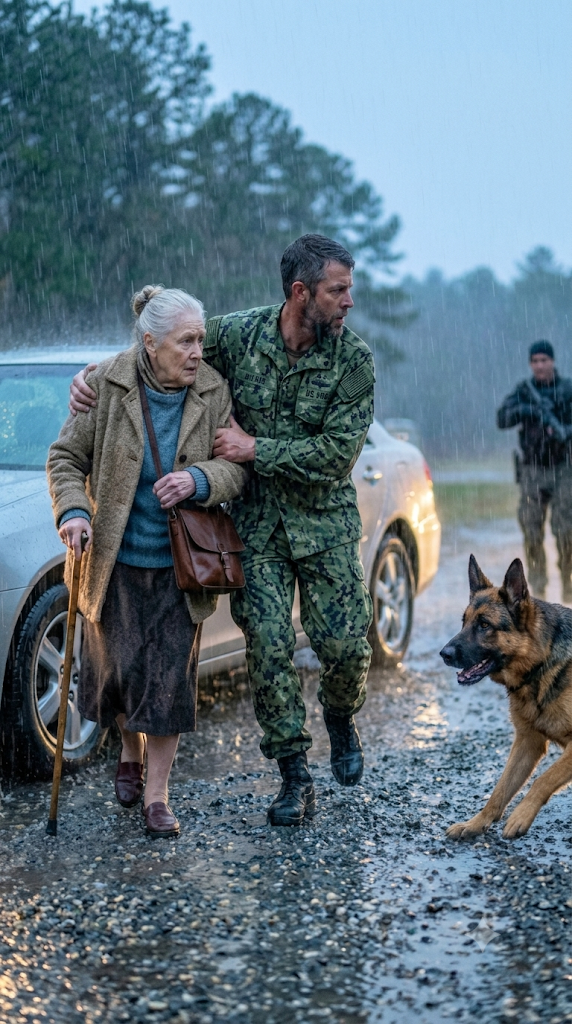 duced Evelyn, and Lily, who was thirty-two and had her brother’s gray eyes and none of his guardedness, took one look at the old woman’s face and did not ask a single question.
“You’re safe here,” she said, and she meant it.
Shadow circled the yard once, nose down, then came back and settled on the porch steps with a satisfied sigh.
But later that morning, Shadow came back to the tree line and stopped and growled, low and steady, at a set of tire tracks that had not been there the night before.
Ethan followed the tracks to the overlook on the eastern ridge, where the mud was deep and a cigarette butt was still fresh.
Someone had been watching the house.
Ethan called the one person he trusted with a problem like this, a local detective named Mark Sullivan.
Mark was thirty-eight years old, with a calm voice, a neatly trimmed beard, and a reputation for being honest in a county where honesty was expensive.
His younger brother had been killed by organized crime when Mark was twenty-four, and he had spent every year since trying to make the word “justice” mean something.
“I have a federal witness at my ranch,” Ethan said. “I think we’re being watched.”
Mark did not hesitate.
“Send me the address,” he said. “I’ll be there within the hour.”
Lily, meanwhile, had gone to work at the rescue center she ran on the edge of town, a low cinderblock building full of wounded animals and soft voices.
She had taken in a sandy-haired stray the night before, a medium-sized dog with gentle brown eyes and a battered leather collar.
When she cleaned the collar, she found a small metal tag inside the lining.
It read: Property of T. Harper.
Lily’s hands went still.
She remembered the name from the news, from an article about a reopened federal case and a dead accountant.
She opened the seam of the collar with a pair of surgical scissors and found a thin USB drive tucked inside the padding.
She plugged it into her laptop and found a folder of spreadsheets, bank records, and scans of handwritten ledgers, all of it pointing to Coleman Financial Group and a network of shell companies.
She called her brother.
Ethan answered on the second ring.
“You’re going to want to see this,” Lily said.
Mark arrived at the ranch before noon, and Ethan met him on the porch with a handshake that turned into a brief embrace.
Inside the kitchen, Evelyn sat at the table with her teacup and her handbag and a quiet resolve in her eyes.
“I understand you’ve been through a great deal,” Mark said. “I’m here to make sure you don’t have to go through any more of it alone.”
Evelyn studied him for a moment. “You’re a good man,” she said. “I can tell. My Thomas was a good man too.”
Mark pulled out a chair and sat down and listened as she told the whole story again, and this time, Ethan heard the parts she had left out in the car.
A man named Daniel Reeves, an accountant who had helped Thomas gather the evidence and who had disappeared three weeks later, leaving behind a wife and a young daughter.
A deputy named Harold Briggs, who had signed off on the original police report and whose name appeared in the ledgers more than once.
A warehouse on the waterfront that had burned down in the same month Thomas died, destroying records that had never been recovered.
Mark wrote everything down and did not interrupt.
When she finished, he closed his notebook and looked at Ethan.
“With this evidence,” he said, “we can go over the heads of the local department. There’s a federal prosecutor in Seattle, a woman named Karen Reyes, who has been quietly building a case against Coleman for two years. She’ll want this.”
“Then we go to her directly,” Ethan said. “No local channels.”
“No local channels,” Mark agreed.
But by then, it was already too late to keep things quiet.
That evening, Evelyn walked out onto the porch to watch the sunset, and Shadow followed her and lay down at her feet.
She looked down at the old dog and smiled for the first time since she had arrived.
“You remind me of a shepherd my father had,” she said. “He was the loyalest creature I ever knew.”
Shadow thumped his tail against the boards, and Evelyn reached down and scratched behind his ears.
Inside, Ethan was showing Mark the tire tracks, and Mark was frowning at a photograph on his phone.
“Harold Briggs isn’t just on the payroll,” Mark said. “He’s Coleman’s man on the inside. If he finds out we have the ledgers, he’ll move fast.”
“How fast?”
“Fast enough that we shouldn’t sleep tonight.”
At two in the morning, Shadow woke Ethan with a low growl and a nudge against his hand.
Ethan was out of bed before his eyes were fully open, and he found the dog standing at the front window with his ears flat and his tail rigid.
Down the gravel road, headlights were cutting through the trees.
Two vehicles, moving slow, no sirens, no lights on the roofs.
Ethan woke Mark and told him to get Evelyn into the back bedroom and to stay with her.
Then he took his pistol from the lockbox and walked out onto the porch with Shadow at his side.
The first SUV stopped fifty yards from the house, and four men got out, wearing dark jackets and no uniforms.
They spread out in a loose line and moved toward the house, and Ethan recognized the pattern.
They were not coming to talk.
Shadow’s growl vibrated through the porch boards.
Ethan raised his voice just enough to carry. “That’s far enough. This is private property, and there is a federal witness inside this house.”
One of the men laughed and kept walking.
Then the second SUV’s headlights swung around and illuminated the whole yard, and three more men stepped out, and Ethan saw the sheriff’s department decals on the doors.
Deputy Harold Briggs walked up the driveway in his uniform with his hand on his belt, and he did not look like a man who had come to help.
“Evening, Ethan,” Briggs said. “I hear you’ve got a guest who’s been causing some trouble.”
“She’s not causing trouble,” Ethan said. “She’s telling the truth.”
Briggs smiled the way a man smiles when he thinks he has already won.
“Here’s how this is going to go,” he said. “You’re going to bring Mrs. Harper out here, and she’s going to give me the documents, and then we’re all going to go back to bed and forget this ever happened.”
“No,” Ethan said.
Briggs’s smile faded. “I wasn’t asking.”
He took another step forward, and Shadow launched himself off the porch.
The dog did not bite him.
Shadow hit the ground in front of Briggs, teeth bared, and barked once, and Briggs stumbled backward and fell into the mud.
In the same instant, Ethan raised his pistol and put one round into the dirt three feet from Briggs’s hand, and the sound of the shot rolled across the valley like thunder.
Every man in the yard froze.
“Next one goes in the air,” Ethan said. “The one after that goes wherever it needs to go. You have thirty seconds to get off my property.”
Briggs scrambled to his feet, his face white, and for one long moment, he looked like he was going to order his men forward anyway.
Then the sound of sirens came up the valley road, distant but growing, and Briggs turned and looked at the lights coming through the trees.
Mark had called the federal prosecutor’s office on the satellite phone the moment he heard the first engine, and the marshals were closer than anyone had realized.
Briggs’s men looked at each other, and then they started backing toward their vehicles.
“You’ll regret this,” Briggs said.
“I’ve regretted a lot of things,” Ethan said. “I don’t think this is going to be one of them.”
The marshals arrived four minutes later, and Briggs and his men were disarmed and detained in the mud of the front yard under the headlights of their own vehicles.
The tall man in the expensive overcoat was in the back of the second SUV, and when he was pulled out, Evelyn Harper walked onto the porch with Mark at her side and looked at him without flinching.
Her voice was quiet and clear. “You took my husband,” she said. “You won’t take anything else.”
Richard Coleman looked at her for a long moment and said nothing at all.
The evidence was enough.
The ledgers, the USB drive, the testimony of an eighty-two-year-old woman who had kept a promise for twenty years, all of it came together in a federal courtroom in Seattle over the next eight months.
Coleman was convicted on twenty-three counts of money laundering, conspiracy, and obstruction of justice, and sentenced to thirty years in federal prison.
Harold Briggs was convicted of tampering with evidence and aiding and abetting, and lost his badge and his pension and his freedom.
The warehouse fire was reopened as a homicide investigation, and Daniel Reeves’s disappearance was finally investigated the way it should have been twenty years earlier.
Evelyn did not want to live alone anymore.
She moved into a small cottage on the edge of the ranch, and she took her tea on the porch every morning with Shadow at her feet.
She donated the remainder of her husband’s estate to Lily’s rescue center, which used it to build a wing for retired military and service animals.
Ethan walked away from his last contract and never went back, and he spent his days fixing fences and training Shadow to ignore the deer and helping Lily with the rescue center.
Lily and Mark took things slowly, the way two careful people do, and by the following spring, they were talking about a future that neither of them had thought they would get.
Shadow lived another five years, and when he died, he died on the porch in the sun with his head in Evelyn’s lap.
Ethan buried him at the edge of the pine trees, and Evelyn planted wildflowers over the grave, and every spring after that, the flowers came up and nobody ever picked them.
The dog who had been a weapon became a guardian and then a friend and finally a kind of symbol, a reminder that loyalty is not something you can buy or train or demand.
It is something you give, freely, to the people who have earned it.
And sometimes, it starts with a single question, asked in the rain, by a stranger who is not really a stranger at all.
“Can you walk me to my car?”
Ethan Walker said yes, and it changed everything.
It always does.