

The January wind off Lake Lou was a knife that cut through the thin canvas of Benjamin Tanner’s field jacket.
He was forty-two years old, a former Army infantryman who had spent the last two winters sleeping in the bed of his pickup truck behind St. Mark’s Church in town.
His hands were red and cracked from the cold, and his face was weathered with the kind of exhaustion that came from years of being invisible.
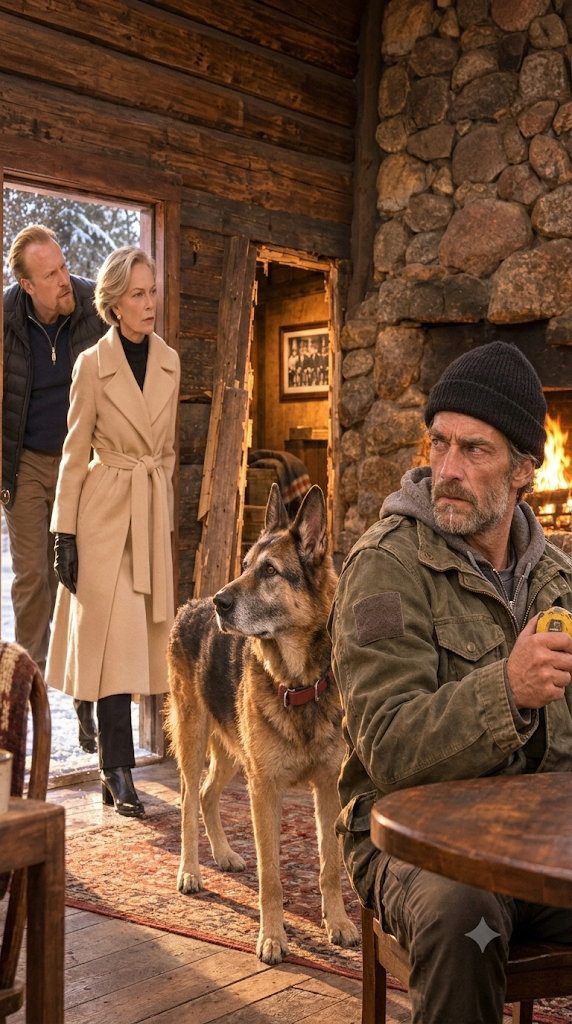
Beside him on the worn wooden bench of the cabin porch sat Scout, a German Shepherd mix with graying fur and patient brown eyes.
Scout had been with Ben for two years, a gift from an anonymous donor who had paid for the dog’s food at the local shelter.
Ben had never met the donor, but he had always suspected it was someone who knew him, someone who understood that he needed a reason to get up in the morning.
Now, Ben was staring at the cabin his father had left him, a structure that was half-collapsed and sinking into the mud of Loon Point.
The lawyer had called it worthless, but Ben had seen the way the sunlight hit the porch in the afternoon, and he had felt something he had not felt in a long time.
He had felt a sense of belonging.
The confrontation at the reading of the will had been brutal, a reminder that his stepmother Celeste and his stepbrother Preston had never considered him family.
They had offered him five thousand dollars to sign away the property before he had even set foot on it, and Ben had refused.
He had refused because he was stubborn, and because he was tired of being pushed around, and because Scout had looked at him with those patient brown eyes and he had known he had to try.
Now, as the wind howled off the lake, Ben stood up and walked to the edge of the porch, looking out at the gray water.
He heard a sound behind him, a soft whine, and he turned to see Scout pawing at the wooden floorboards near the chimney.
“What is it, buddy?” Ben asked, walking over.
Scout pawed again, a sharp, insistent scratch, and then he let out a low bark.
Ben knelt down and ran his hands over the boards, feeling for a seam, for a difference in texture, for anything.
Then he found it: a small, almost invisible groove in the wood, hidden behind a loose stone in the hearth.
He pried at the stone, and it gave way, revealing a dark, narrow opening that led beneath the cabin.
The space was cold and damp, and it smelled of old earth and secrets.
Ben grabbed his flashlight and crawled inside, with Scout following close behind, his nails clicking on the stone.
The crawlspace was cramped, barely tall enough for a man to kneel, and it was filled with the debris of decades.
There were old newspapers, rusted tools, and broken fishing rods, but Ben’s light landed on a wooden crate in the corner, and his heart started to pound.
The crate was marked with his father’s name, Eugene Tanner, and it was sealed with a heavy iron padlock.
Ben tried to break it open, but the lock was too strong, and he had no tools.
He felt a surge of frustration, a hot, angry wave, and then he felt Scout’s nose press against his hand.
The dog was looking at him, not at the box, and Ben understood.
He had to be patient, and he had to be smart, and he had to find another way.
He crawled out of the crawlspace and sat on the porch, staring at the gray water, and he made a decision.
He was going to stay, and he was going to fight, and he was going to find out what his father had left for him.
The first step was to fix the roof, and the second step was to find a way into that box.
He spent the next three days making the cabin livable, patching the roof with tar paper, replacing the broken window with a sheet of plastic, and cleaning the fireplace so he could finally have a fire.
Scout kept him company, lying by the fire, watching him with those patient brown eyes, and Ben felt something he had not felt in years.
He felt at home.
On the fourth day, a neighbor knocked on the door, an older man named Hal Jensen, who had known Ben’s father for forty years.
Hal was a tall, rawboned man with a weathered face and a quiet voice, and he carried a thermos of coffee and a bag of sandwiches.
“You’re Jean’s boy,” Hal said, not a question.
“Yes, sir,” Ben said.
“Your dad called me this fall,” Hal said, sitting down on the porch steps. “Every time Celeste went down to the cities, my phone rang. I drove him three times. First trip, his lawyer in the morning, the lake in the afternoon. Then twice more, just the lake. Every trip, he had a box on his lap and he never let me pass the porch.”
“What was in the box?” Ben asked.
“Didn’t ask,” Hal said. “The way he talked about that cabin, you’d think it was a church. He had things he meant to tell you himself, son.”
Ben was quiet for a long moment.
“He had six years to tell me,” Ben said.
“Celeste answered his phone for six years,” Hal said, and his voice was hard.
Hal left after an hour, and Ben went back to work, his mind churning with the things Hal had said.
He found the key to the padlock later that afternoon, in the boathouse, exactly where his father had always kept his good tools.
He walked back to the cabin, his hands trembling, and he opened the crate.
Inside, he found a journal, a stack of blueprints, and a letter with his name on it.
He opened the letter first, and he read it while Scout lay at his feet.
The letter was short and raw.
“Ben, if you’re reading this, Scout did his job and I’m gone. I’m sorry about the years. Read the diary first. The blueprints will show you the rest. The key is where I always kept the good tools.”
Ben read it twice, and then he picked up the journal and started to read.
The entries were small and careful, written in his father’s cramped handwriting.
They spoke of a dream: a veterans’ shelter, a place where men and women who had served could come and find a warm bed and a hot meal.
Eugene Tanner had been building it in secret for years, using the cabin as a front.
The blueprints showed the cabin expanded into a full dormitory, with eight beds, a kitchen, and a porch light that would never go out.
Ben sat back, his eyes burning, and he looked at Scout.
“He sent you,” Ben whispered. “He sent you to find me.”
Scout thumped his tail on the floor.
But the dream was already in danger.
The next morning, Ben saw a black SUV pull up the gravel driveway.
Two men got out: one was Warren Fisk, a representative of Northshore Resorts, and the other was Preston Tanner, Ben’s stepbrother.
“Mr. Tanner,” Fisk said, offering a slick smile. “We’re here to make you an offer.”
Ben stood on the porch, his arms crossed.
“I’m not selling.”
“The resort owns the Northshore,” Fisk said. “We’ve got plans for a marina, a hotel, a casino. Your father already agreed to sell.”
“My father signed the deal?” Ben asked.
“He signed the offer,” Fisk said. “And we have the paperwork.”
Preston stepped forward, his face red with anger.
“The land is worthless,” he said. “The cabin is falling down. Take the offer, Ben, and you can go back to sleeping in your truck.”
Ben felt a cold rage settle in his chest, but he kept his voice steady.
“My father couldn’t hold a pen,” Ben said. “He had a stroke on March 14th. The signature on that offer is dated March 20th. He was paralyzed.”
Fisk’s smile faltered, and Preston’s face went pale.
“You’re lying,” Preston said.
“I have the medical records,” Ben said. “And I have the diary.”
Fisk stepped forward, his voice cold.
“If you fight this, we’ll bury you,” he said. “We’ll tie you up in court for years. You’ll lose everything.”
Ben didn’t flinch.
“Then I’ll see you in court,” he said.
They left, their tires spitting gravel, and Ben stood on the porch, his heart pounding, and he knew the fight was just beginning.
The next few weeks were a blur of phone calls and paperwork.
Ben found a lawyer named Monica, who worked for Veterans Legal Aid, and she took his case for free.
She was a small, sharp woman with gray hair and a fierce gaze, and she was not afraid of a fight.
“The will is valid,” Monica said. “Your father signed it in October, and he was of sound mind. The March 20th offer is a forgery. We can prove it.”
“What about the fund?” Ben asked.
“The Porch Light Fund,” Monica said, reading from the journal. “Your father set it up to help veterans. He left it to the shelter, with Celeste and Preston as co-trustees. But they’ve been stealing from it.”
“How much?”
“Three hundred and eighty thousand dollars,” Monica said. “And they wired it to a casino in Nevada.”
Ben felt a wave of nausea, and then a cold, hard resolve.
“We’re going to get it back,” he said.
The trial was held in the county courthouse on a gray, rainy morning in March.
The gallery was filled with people from the town, veterans who had heard about the case, and neighbors who had known Eugene Tanner.
Celeste and Preston sat at the petitioner’s table, their faces cold and composed.
Ben sat at the respondent’s table, with Monica beside him, and Scout lay at his feet.
The attorney for the petitioner, a smooth-talking man in a tailored suit, called Dr. Hail to the stand.
Hail was a neurologist who had examined Eugene Tanner in April, and he testified that Tanner was cognitively impaired.
“He was confused,” Hail said. “He could not manage his own affairs.”
Monica cross-examined him.
“Dr. Hail,” she said, “did you examine Mr. Tanner in October?”
“No,” Hail said. “But the impairment was progressive.”
“Did you know that Mr. Tanner signed a will on October 9th?” Monica asked.
“I was not aware,” Hail said.
“Did you know that he made a recording that same day?” Monica asked.
The courtroom went silent.
Monica played the recording, and Eugene Tanner’s voice filled the room, clear and strong.
“It’s October 9th,” he said. “My name is Jean Tanner. This morning, I signed a new will at my lawyer’s office, and I know exactly what I’m doing. Celeste, if you’re hearing this in a courtroom, then Celeste is telling people I’m confused. I’m leaving Loon Point to Ben because he knows how cold a winter night can get.”
The judge, an older man with a stern face, listened without expression.
When the recording ended, he looked at Celeste and Preston, and his eyes were hard.
“The court finds the will of October 9th valid,” he said. “Benjamin Tanner is confirmed as owner of Loon Point and as trustee of the Porch Light Fund.”
He paused, and the silence in the room was absolute.
“On the petitioner’s counter-petition,” he said, “Celeste and Preston Tanner are removed as co-trustees and ordered to account for and repay every dollar taken from the fund. The March 20th agreement is void.”
He turned to the county attorney, who was sitting in the front row.
“This file goes to your office for review of forgery, theft, and the break-in at Loon Point.”
Preston stood up, his face white.
“Ben,” he said, “we’re family.”
Ben looked at him, and his voice was quiet.
“My father was my family,” he said. “So are they.”
He nodded toward the veterans who had filled the gallery, the men and women who had come to support him.
That evening, Ben walked back to the cabin with Scout at his side, and he stood on the porch, looking out at the lake.
The sun was setting, and the water was a sheet of gold.
He heard a sound behind him, and he turned to see a young man standing at the edge of the driveway.
He was thin and pale, with the hollow look of someone who had been sleeping rough.
“I heard there’s a place out here,” the man said. “Someone said there’s a light.”
Ben looked at Scout, and Scout wagged his tail.
“Come on in,” Ben said. “The light’s always on.”
The man walked up the porch steps, and Ben opened the door, and the warmth of the fire spilled out into the cold.
The cabin was not just a cabin anymore.
It was a shelter, a promise, a place where the door would always be open and the light would always be on.
Ben stood in the doorway, watching the man step inside, and he felt a sense of peace he had not felt in years.
He looked at Scout, who was lying by the fire, his head on his paws, his eyes closed.
“You did good, buddy,” Ben said.
Scout thumped his tail once, twice, three times, and then he was asleep.
The winter wind howled outside, but inside the cabin, the fire was warm, and the light was on.
Ben knew that the road ahead would not be easy.
There would be legal battles, and financial struggles, and the long, hard work of rebuilding a dream.
But he also knew that he was not alone.
He had Scout, and he had the memory of his father, and he had a community of people who believed in him.
He had a home.
And that was enough.
The next morning, Ben woke to the smell of coffee and the sound of Scout barking.
He walked to the window and saw a group of people standing at the edge of the property, their breath pluming in the cold air.
They were veterans, men and women of all ages, and they were carrying tools and supplies.
Hal Jensen was at the front, a hammer in his hand.
“We’re here to help,” Hal said.
Ben opened the door, and the sunlight poured in, and he felt a surge of gratitude so strong it almost brought him to his knees.
“Thank you,” he said.
They worked all day, repairing the roof, replacing the windows, and clearing the debris from the yard.
Scout supervised from the porch, his tail wagging, his eyes bright.
By evening, the cabin was transformed.
It was not just a cabin anymore.
It was a symbol of hope, a testament to the power of community, and a promise that no one would be left out in the cold.
Ben stood on the porch, watching the sunset, and he thought about his father.
He thought about the years of silence, the years of hurt, and the years of longing.
He thought about the letter, and the journal, and the blueprints.
And he thought about the dog who had led him home.
“Thank you, Dad,” Ben whispered.
He looked at Scout, who was lying at his feet, and he smiled.
“Let’s get to work,” he said.