

On the night of August 25, 2026, while every channel in America was playing the same footage of a woman in rhinestones waving from a stage, a seventy-four-year-old man in Sherman Oaks, California, unlocked a desk drawer that had stayed closed for thirty-two years.
Inside was one cassette box. On the spine, in blue ink and a hand he would have known anywhere, were two words. Not yet.
He had watched Michael Jackson die and kept the drawer shut. He had watched the world move on and kept it shut. Now the last person who could tell him what those two words meant was gone, and for the first time since March 1994, the drawer was open.
His name was Wendell Price, and for most of his career, he had been the man nobody in the room looked at. Thirty-one years behind consoles at Westlake, a thousand sessions, and a reputation that came down to one sentence colleagues repeated about him. Wendell never told anyone anything.
Look at that sentence again, because the whole of this story lives inside the reason it was true.
To understand the cassette, you have to go back to a phone call. And to understand the phone call, you have to be standing in an empty studio at four o’clock in the morning on January 29, 1985.
A&M Studios on La Brea. The night the biggest names in music had spent nine hours in one room singing a song Michael had written for children who were dying on the other side of the world. Forty-five artists, one sign taped to the door telling them to leave their egos outside.
By four o’clock, the last of them had gone. The coffee cups were still on the piano, and Michael, alone, sat on the edge of the riser with a phone cord stretched across the floor. He was calling Nashville. He was calling a woman who had been invited that night and had not come.
Dolly Parton picked up on the fourth ring. Awake because she had been awake, because she always was.
He did not ask why she had stayed away. He asked her something else. He asked how she wrote. Not what. Not when. How.
And there was a pause on the line long enough that Wendell, a thirty-three-year-old Westlake engineer loaned to A&M for that one night and sent back in to lock up, standing in the doorway with a borrowed set of keys, thought the call had dropped.
“Honey,” she said finally, and he could hear her smile through the wire. “You write melodies. I write lives. One of these days, each of us is going to have to try the other one’s job. It’s going to scare us both to death.”
Michael laughed. A small laugh. The kind he saved for people who told him the truth. Then he said something Wendell did not catch. Then he hung up and sat there for another minute in the dark.
And Wendell, who had been about to announce himself, decided he had heard something he was not meant to hear, and backed out of the door without a sound.
He would keep that habit for the rest of his life.
Hold that phone call in your mind and start counting the years from it, because everything in this story happens on a clock nobody in the room could see.
Nine years later, it walked into his control room.
March 1994. Westlake Recording Studios on Santa Monica Boulevard. Michael had come off the Dangerous Tour into a season of headlines he could not outrun, and inside Sony there were men in offices being careful about how they phrased their doubts.
Wendell was the second engineer on the room that week. He was told to expect material for the next album. He was not told that Michael had spent the previous month asking quietly whether a man could sing a song written by a woman about losing a man, and whether anyone would let him.
The label sent a man named Carl DeVane to make sure the answer was no.
DeVane was not cruel. He was practical, which in that building was sometimes worse. He arrived in the parking lot at the same time as a cream-colored town car, and the woman who stepped out of it made small talk with him all the way up in the elevator while he rehearsed the speech he had driven across town to give.
Michael had been in the building since seven that morning. Wendell had found him alone in the live room, no lights on, the air still smelling of floor wax and last night’s cold coffee, sitting on a road case with his jacket still zipped, humming something under his breath that was not from any of his own records.
When Wendell asked if he wanted the booth set up, Michael said yes, and then said something Wendell wrote down that night and kept.
“I’ve been carrying this one since a phone call in 1985. I want to put it down today. Nine years.”
A man who could have any song in the world had spent nine years holding one that was not his.
Inside, Michael looked up when they came in, and nothing on his face changed.
DeVane made his case. Wrong song. Wrong year. Wrong genre. Wrong moment. A country record from 1973, while the whole world was holding its breath to see whether Michael Jackson could still be Michael Jackson. He said it plainly, and he meant it.
Michael let him finish. Then he looked at Dolly and asked if she wanted to stay. She said if that was all right. He nodded once, walked into the booth, and closed the door.
Now notice where everyone was standing, because it matters later.
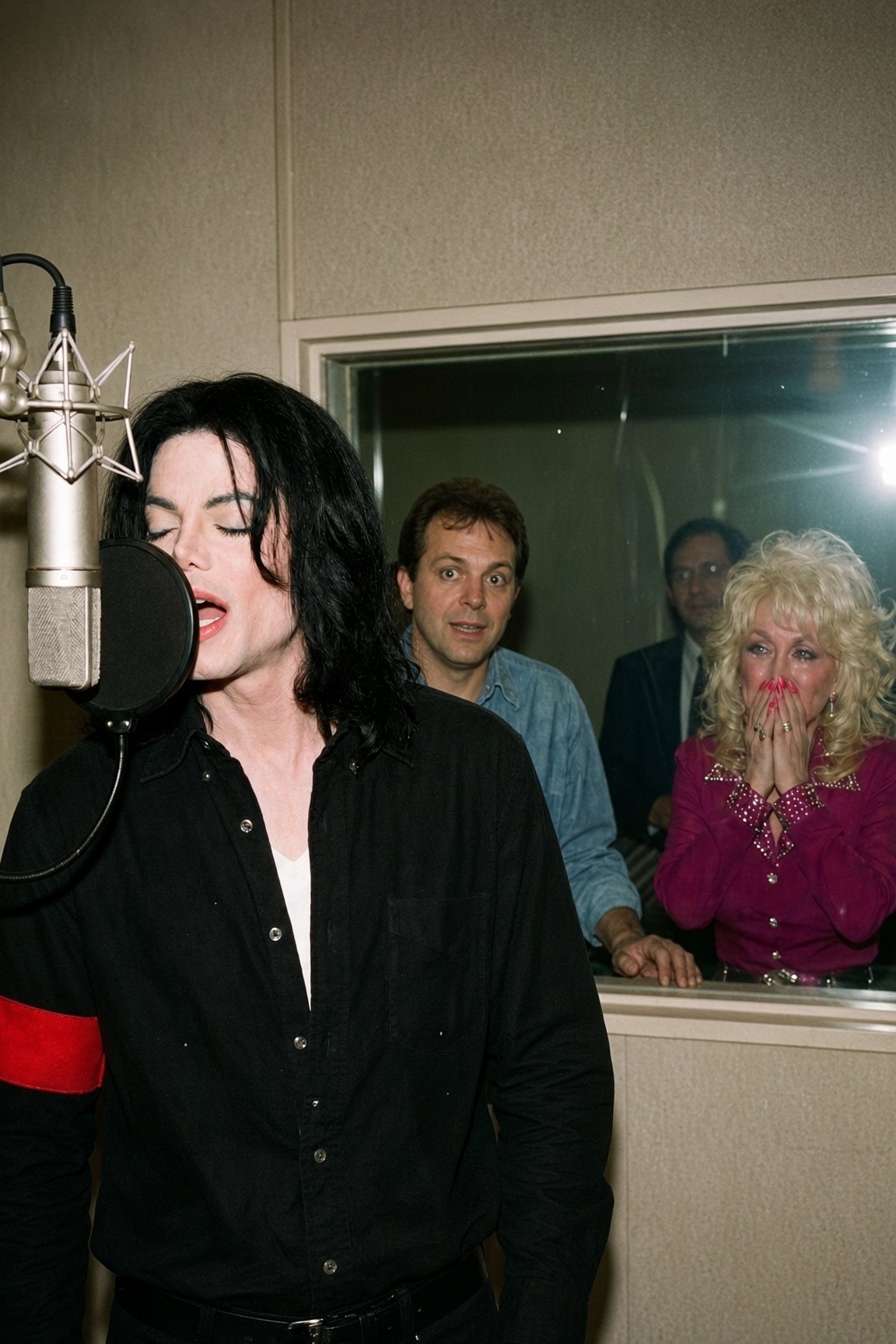
DeVane by the door, arms folded. Dolly in the chair nearest the glass, a paper cup of coffee she would forget about. Wendell at the console, one hand near a fader he would never move. And Michael in a dimmed room with no lyric sheet, eyes closed, saying a woman’s name into a microphone like she was standing beside him.
The first three notes did nothing to the room. On the fourth, Wendell looked up from his meters.
By the second verse, Dolly had set her coffee down on the console without looking to see where she put it.
When the bridge came and the voice went up into that thin, exposed register, the one that opens a singer instead of protecting him, DeVane’s arms came uncrossed. Quietly. The way a man stops holding a position he has stopped believing in.
Three minutes and forty-one seconds. Then silence.
Then a voice through the talkback, calm and a little tired, asking how that was.
Nobody answered. One second. Three. Five.
A runner who had come in with sandwiches was standing frozen in the hallway door with the bag still in his hand, and years later, asked about it by a trade magazine, he said only that he had walked into a room where four people had forgotten how to move.
DeVane’s mouth opened. Nothing came out of it.
Wendell reached for the talkback button and found that his hand had stopped halfway.
Dolly did not answer through the talkback. She stood up, walked to the booth, opened the door, and closed it behind her.
What she said to him in there took less than a minute. Wendell saw her hand rest flat on Michael’s chest. Saw Michael look at the floor and nod. Saw her wipe her face once with the back of her wrist.
He could not hear a word of it, and he never asked.
When she came out, she stopped at the console, took a pen from the cup beside the tape machine, and wrote two words on the cassette box Wendell had labeled for the rough mix.
Then she looked at him. The man nobody looked at. And said, “You keep this one. You’ll know when.”
Listen to what she did not say.
She did not say the recording was beautiful, though she was clearly still shaking. She did not say release it. She said not yet, and she said it to an engineer. Not to the label. Not to the artist. She was handing the most vulnerable three minutes of Michael Jackson’s career to the one person in the building she trusted to sit on it.
The recording was never released. It was not on the next album or any album.
DeVane asked for a copy and was told, politely, that there wasn’t one. Michael never mentioned it in an interview, and when a journalist asked him in 1997 whether he had ever recorded a country song, he smiled and said he’d recorded a lot of things, and changed the subject.
Before we go on, you need to understand one thing about Wendell Price. He was not a man who believed in secrets for their own sake. He kept the cassette because a woman he admired had told him to, and because a man he admired had looked at the floor and nodded.
That was the whole of his reasoning. It would take him another fifteen years to understand it was not the whole of hers.
You have been counting the years. Fifteen more passed with the drawer shut.
Wendell retired from Westlake in 2006 and took the cassette home in a shoebox with his union card and a photograph of his late wife. He did not play it. He told himself it was not his to play, and that was true, and it was also a way of not finding out what it would do to him.
Then, on a Thursday in June of 2009, a news alert lit up the phone in his kitchen, and the thing he had been holding for someone else became, in a single afternoon, a thing he was holding for a dead man.
July 7, 2009. Staples Center. Wendell watched the memorial on a television in a bar on Ventura Boulevard because he could not make himself go, and because nobody had invited the second engineer.
He watched the front rows fill with people he had recorded. And in the second row, on the aisle, he saw a seat with a card on it that stayed empty through the whole service. The camera passed over it twice, and both times he thought he could read the name.
That night, his phone rang at eleven. Nashville area code.
“I couldn’t sit in that building,” she said before he could speak. “I sat in a church out here with the lights off, and I played it in my head. You still have it?”
He said he did.
“Good. It’s not time. He’d want it to be his to give, not mine. And he can’t give it right now.” A pause. “You know what he said to me on that phone in ’85? The part you didn’t hear? He said, ‘Then I’ll go first.’”
She let it sit on the line.
“He always did keep his word. You understand what I’m saying to you, Wendell?”
He said he thought so. He was wrong. And she knew he was wrong, and she let him be wrong, because some things you cannot explain to a person. You can only leave them holding the box.
Here is what she meant, and it took a rock album to say it.
In 2023, at seventy-seven, Dolly Parton released a record of hard rock songs. Screaming guitars. A voice that had spent fifty years in rhinestones suddenly standing in a different room with the lights too bright.
Critics called it a stunt. It was not a stunt. It was a woman keeping a promise she had made on a phone at four o’clock in the morning in 1985, that one day each of them would have to try the other one’s job.
Michael had done his half in a booth in 1994. He had written a life instead of a melody, and it had frightened him so badly he locked the tape in someone else’s drawer.
Now, at last, she had done hers.
Stop for a second and hear the two records side by side, because that is the only way this makes sense. A soft falsetto over a single piano in a dark booth in 1994. A seventy-seven-year-old woman shouting over distorted guitars in 2023. Two people from opposite ends of American music, standing decades apart in the one room where they had no armor.
That was the deal. That had always been the deal.
She called Wendell once that year. She did not talk about the album. She said, “I did my half.” And he heard her breathing on the line, and she said, “Now it’s just about when.” And hung up.
So picture the drawer again. August 25, 2026. The news running on every channel. A man who has spent thirty-two years not telling anyone anything, sitting at a desk with a cassette in his hands and the last living reason for his silence gone.
He understood it now. All of it. The way you understand a song only when the last chord lands.
Not yet had never meant never. It meant not while either of us is alive to be asked what it cost. She had wanted the world to hear the man, not the story. And the only way to guarantee that was to hold it back until there was no one left to interview.
He did not call a label. He did not call a journalist. He put the cassette in a deck he had kept working for exactly this purpose, sat back, and let three minutes and forty-one seconds fill an empty room in the valley for the first time since 1994.
The voice came in low, almost speaking, saying a woman’s name to someone standing right beside him.
Wendell Price, who never cried at sessions, put his hand flat on his own chest without knowing why, and understood he was doing exactly what she had done, and that she had known he would.
What he did with the tape after that is his business, and he has said as much to the two people who have asked. But he did tell one of them what she said to Michael in the booth, and he told it because he had finally earned the right.
She had said, “That’s not my song anymore, baby. You just wrote your own life on top of it. Keep it until it’s yours to give away.”
And Michael had looked at the floor and nodded, because he knew, even then, that the day it was his to give was a day he would not be there to see.
The cassette box still carries two words in blue ink on the spine, and the man who kept it still keeps it, in the same drawer, in the same desk, in the same valley. Some songs are not finished when the tape stops. They are finished decades later in a quiet room by the one person left who understands what they cost.