
The dog should have been dead three years ago, and the man who finally found him was trying hard to stay that way himself.
Travis swung the splitting axe at 06:30 on a Tuesday morning in the Colorado Rockies, the blade biting into the oak as the log fell open with a sharp crack.
He tossed the halves onto the pile and set up another, his breath hanging in a white cloud in front of his face while the thermometer on the porch post read a brutal six degrees.
Travis was a 38-year-old Navy SEAL, six-foot-one, lean, with a dark beard going gray at the chin.
He did not talk much, and he had not talked much for months.
Three weeks earlier, his commander had put the keys to this cabin in his hand and said the word: mandatory medical leave.
His last deployment had ended badly, and something in him had not come home with the rest.
The doctors had a phrase for it. Travis had a simpler one.
His left hand shook when he held it out flat, and he did not like people to see, so he built a wall out of routine.
Up at 0400. Five miles through the snow. Plain oatmeal eaten standing. Three hours of firewood he did not need. Lights out at 2100.
Every hour had a job, and a man with a job has no room left over for ghosts.
Silence does not heal a soldier; for some men, silence is just an empty room, and the room fills up fast.
Travis set another log on the stump.
He had woken at 0200 that night on the floor, hands knotted in the rug, searching the dark for a weapon he did not have.
He had heard rotor blades in a room with no helicopter.
He swung.
The crack rolled down the valley like a rifle shot.
When he carried an armload to the porch, he stopped at the bottom step.
Tracks. Big ones, pressed into last night’s snow.
They ran from the treeline to the cabin, paced the length of the porch, and ran back.
Travis set the wood down and crouched.
He pulled off a glove and laid two fingers inside one print.
The pads were wide. The claws had dug through to frozen dirt.
Not a coyote. Maybe a wolf.
Then he read the stride.
The right front print barely marked the snow. The left bit deep.
Something was hurt and making up for it.
But the pattern bothered him more than the limp.
A hungry animal comes straight at food. These tracks had circled the cabin wide.
They had checked the back door, the woodshed, the two windows.
Then they had pulled out the same way they came in.
That was not appetite. That was reconnaissance.
Travis stood.
He looked at the pines, heavy and black with snow.
He let his hearing open up and pushed his own breathing out of it.
The wind dropped. The mountain went quiet.
He took one step toward the trees.
He left the knife on his belt. He wanted to learn something, not start something.
Then he heard it: a low growl thick as gravel from the brush on his left.
The animal had flanked him.
Travis did not move. His pulse dropped the way it had been trained to.
Slowly, he turned his head.
Two eyes sat in the bushes, amber and steady.
They were not the eyes of a rabid thing. They were sharp, intelligent, full of pain.
The animal stepped out.
A German Shepherd, or what was left of one.
The coat was black and tan under a crust of pine sap and old blood.
The ribs showed like the slats of a fence.
A jagged scar split the snout, and a bald patch on the left flank showed older scar tissue underneath.
The right front paw hung a little off the ground.
Ears flat, teeth bare, a growl rolling in the chest like an engine.
Travis knew that stance. It was not panic.
The dog held a precise distance from him. Kept the trees at its back. Kept him in full view.
Starving animals get sloppy. This one had not.
Somebody had put discipline in this dog, and it had outlasted the hunger.
“Easy,” Travis said.
The growl climbed.
The dog did not charge.
He lowered his eyes to the paws; eye contact would be a challenge.
He opened his hands, palms out, and let his shoulders sag.
Then he stepped back toward the porch, dragging his boots so the sound would warn rather than startle.
He never turned around.
Inside the cabin felt like a different planet.
He went straight to the refrigerator, pulled out the steak he had bought in town three days earlier, and tore the plastic open.
He half expected the porch to be empty when he opened the door.
A wild thing would have run.
The dog was nearer now, standing where Travis had been splitting wood.
The click of the latch snapped its head up. Teeth. Growl.
Travis did not come down the steps.
He took a knee on the porch, forearm across his thigh, the meat hanging in his hand.
“I know you’re hungry.”
The nose twitched. One half step forward, two back.
Trust in a war zone is never taken. It gets earned slowly, and usually by someone who is willing to look weak first.
He set the steak on the top step and pulled his hand away.
Then he did something that went against every instinct he owned.
He turned his back on a desperate animal and reached for the door.
Claws scrabbled on icy wood.
The dog hit the step like a thrown rock, snatched the steak, and did not run.
It stood there with the meat in its jaws and its eyes locked on Travis.
It was taking the gift and promising violence if he got greedy.
Travis nodded to it once and went inside.
In the morning, the step was empty except for a few frozen drops of blood.
Travis cut more meat.
He walked halfway across the yard and left it on a flat rock twenty feet from the pines.
Then he went back to his axe.
Next morning, three feet closer.
The morning after that, three feet closer still.
Patience for a soldier is not waiting. It is work.
Every second has a purpose, and you spend them all watching.
On the fourth day, the dog stopped vanishing into the woods.
It stood at the treeline, black against black.
“Bishop,” Travis said.
He had no reason for the name. It just came the way a call sign does.
The ears twitched.
“Bishop, you stay out of sight and move on the board when it counts.”
He kept the same voice he had used on night patrols. Low, flat, no baby talk.
The growling thinned a little each day.
Bishop still favored the right paw. The ribs still showed.
But something behind the eyes had shifted from desperation to a weary kind of curiosity.
On the fifth afternoon, the sky went the color of old iron.
Wind carried ice crystals that stung bare skin.
A big storm was coming down off the peaks.
Travis sat on the second step with a thawed piece of venison in his right hand.
“Bishop, come.”
The brush moved. The dog limped out.
Fifteen feet. Ten. Eight. Five.
Bishop stopped at the bottom step and looked at the meat, then at the man’s face.
No growl.
“Take it.”
One good paw on the bottom step. The wood creaked.
Bishop froze, ready to bolt.
Travis stayed carved out of stone.
The dog climbed one more step.
Now they were two feet apart, close enough for Travis to smell wet fur and old iron, close enough to count every ridge in that scar.
Bishop did not grab the venison. He leaned in and smelled it.
Then he smelled the man’s hand.
The cold black nose bumped Travis’s knuckles.
Animals do not lie, and they do not fall for lies.
Bishop read the sweat, the pulse, the intent.
What he found was quiet.
He took the meat gently. The teeth grazed his skin and applied no pressure at all.
Travis turned his palm up slowly and stopped an inch from the dog’s neck.
He let Bishop decide.
Bishop pressed his scarred head into Travis’s hand.
Snow began to fall around them. Big and slow.
The coarse fur was freezing, but under it, a strong pulse beat hard against Travis’s palm.
By midnight, the blizzard had the whole valley by the throat.
Wind screamed through the pines. Frost crept across the inside of the windows.
Travis built the fire high and sat with his coffee, but his mind stayed out on the porch.
He got up and opened the door.
The wind shoved snow into the room.
Bishop lay curled in the corner, shaking, snow in his coat.
The amber eyes lifted.
Travis said nothing.
He left the door open, went back to his chair, and sat with his hands on his knees.
Ten minutes passed. The cabin got cold.
Then a dark shape appeared in the doorway.
Bishop took one step inside. The bad paw touched the rug.
He sniffed the corners and checked the room for threats.
Wild instinct said, stay out in the dark.
His body said, fire.
He took another step. Another.
Travis closed the door behind him.
Bishop dropped by the hearth, and the heat poured into his frozen muscles.
Travis brought the medical kit, a bowl of warm water, a towel.
He sat cross-legged three feet away.
“Come here.”
Bishop dragged himself over and collapsed against his knee.
In the firelight, the damage looked worse.
The paw was swollen and packed with grit.
The bald patch on the flank was raw.
Travis cleaned the paw with slow strokes. Bishop flinched.
Travis stopped, waited, started again.
The dog let him.
Antiseptic stung, and Bishop whined low, but he did not growl.
Travis worked the way he had once worked on teammates, fast and quiet and without ceremony.
He did not pet the dog. He just did the job.
Trust is not built from speeches; it comes from quiet moments when a wounded creature expects a blow and gets a bandage instead.
When he finished, he killed the lights, kicked off his boots, and lay down on top of the blankets.
Bishop stayed by the fire, breathing deep.
Sleep came fast; rest did not.
The desert came instead.
Rotor wash, dust in his eyes, a radio full of shouting, a white flash, and the shockwave throwing him backward.
He reached for a teammate and closed his hand on air.
“Grab the line,” Travis muttered. “Grab the line.”
His arm cracked against the nightstand, and he did not wake.
His chest heaved. He was fighting a battle that had ended months ago.
Then a weight landed on his chest.
A rough, wet tongue dragged across his cheek.
A nose pushed hard against his neck.
A low whine cut through the sound of imaginary blades.
Travis gasped, his eyes opened.
The desert was gone.
Bishop stood over him with both paws on his sternum, staring into his face with total attention.
Most animals run from a thrashing man. Bishop had walked straight into the danger to pull him out.
Travis lay still. His breathing slowed. The shaking in his hands eased.
He laid one palm along the dog’s neck. Fur, heat, a heartbeat.
“I’m here,” he whispered. “I’m right here.”
Bishop sighed, turned twice at the foot of the bed, and dropped across Travis’s feet.
They slept like that until morning.
The next night was worse.
Daylight died by 1600. The radio said it was the worst blizzard in a decade.
And then the radio stopped talking.
Wind hammered the logs. Snow packed halfway up the windows.
The temperature outside fell to twenty below.
Travis added three oak logs and sat with his coffee.
A soldier learns to see a storm as an enemy tactic. It blinds you. It deafens you. It hides whatever is walking toward you.
Travis felt his old paranoia stir.
But he was not alone in the dark.
Bishop was working, not curled by the fire like a stray should be.
He moved along the front wall, pressed his nose to the gap under the door, and held his breath two full seconds.
Nothing.
He moved to the window and put his good paw on the sill. His ears turned independently.
Then he limped to the back door and ran the same check.
“You’re clearing the room,” Travis said.
Bishop looked over, wagged once, and went back to his rounds.
Travis felt a chill that had nothing to do with the weather.
No civilian teaches a dog that. Takes hundreds of hours.
Bishop moved like a sentry on duty.
“Who trained you, buddy?”
The dog finished his circuit and lay down facing the front door with Travis and the fire behind him, a wall of fur between his man and the world.
Travis fed him a crumbled ration bar. Bishop looked up for permission before he ate.
Sometime after midnight, Travis slept.
For the first time in months, there was no taste of adrenaline in his mouth.
At 02:15, something pulled him awake.
The fire was embers. The room was nearly black.
Bishop was not on the hearth.
He stood stiff at the front door, head low, ears forward.
Travis swung his legs off the bed and slid the knife from his belt.
He crossed the floor without a sound.
Bishop barked hard and deep, not fear but alarm.
Twice more, and then he clawed at the door.
“Quiet,” Travis said.
Bishop would not.
He grabbed Travis’s pant leg in his teeth and hauled backward with astonishing strength.
He dragged him to the door, let go, barked, and jammed his nose into the gap at the bottom.
Travis knelt. He put his ear against the wood.
Ten seconds of blizzard.
Then the wind dropped in pitch for a heartbeat, and in that gap he heard it.
Faint, metallic: a car horn, over and over, muffled by snow and distance.
Bishop whined and spun in tight circles, looking from the door to Travis and back.
Somebody was out there running out of time.
Travis grabbed his parka, his goggles, a coil of climbing rope.
He clipped a flashlight to his chest harness and looked at the starving, half-lame dog that would not ignore a stranger’s cry for help.
“All right,” he said. “Lead the way.”
He threw the door open, and the storm swallowed them both.
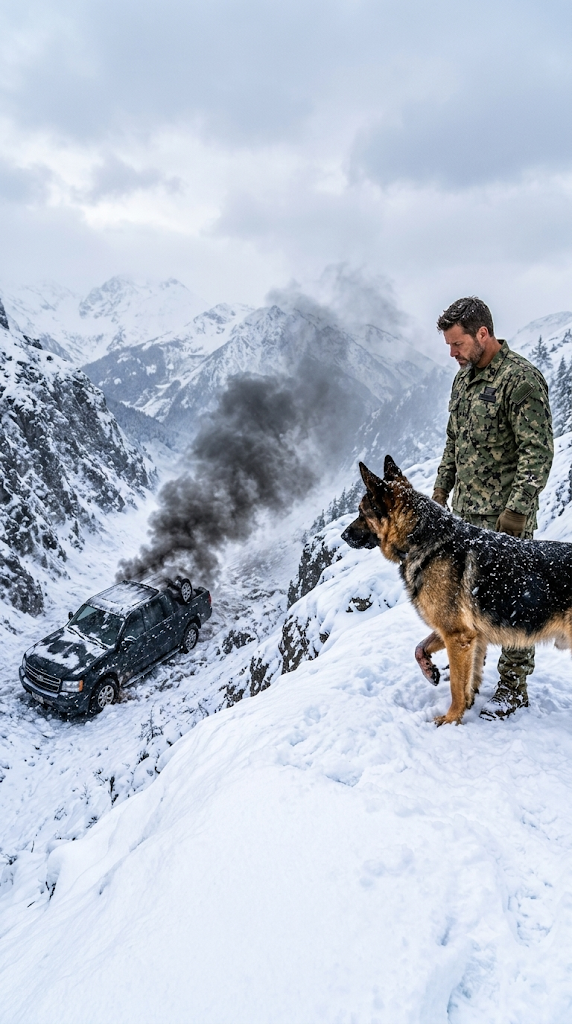
The wind hit him like a wall.
Travis pulled his goggles down and wrapped a scarf over his face.
The beam of the flashlight died a few feet out in the swirling white.
Bishop did not hesitate.
He plunged into the drifts with his nose low, following a scent no human could have found.
Travis stayed in his trail, using his boots to widen the path.
Snow came up to his waist in places. His lungs burned.
The dog did not flounder the way a normal dog would.
He chose the path of least resistance, followed the lay of the land, and steered around hidden rocks.
He moved like something born to this.
A soldier learns early that the point man decides everything. He finds the safe route. He spots the trap. If he makes a mistake, the team dies.
Travis realized, watching that black shape ahead of him, that he had handed the point to a starving dog without ever deciding to.
Trust like that happens only when words run out.
Bishop stopped at the edge of the trees.
He barked once, and the wind ate the sound.
Then he pushed on faster, the bad paw forgotten.
Travis knew where they were. His morning run passed right here.
The ground fell away into a ravine fifty feet to a rocky creek bed.
In summer it was pretty. In a blizzard, it was a grave.
Bishop stood at the lip and barked down into the dark.
Travis crawled to the edge on his belly to spread his weight and keep the snow cornice from breaking.
He aimed the flashlight down.
The beam found a vehicle at the bottom. A large SUV, upside down. Tires to the sky. Frame crushed.
Gray smoke leaked from the engine, and the wind tore it away.
The horn had stopped.
Travis felt a knot in his gut.
Silence was worse than noise. It meant the battery was dead or the person pressing the horn could not press anymore.
He backed away and tied the rope around a thick pine using a knot he had tied a thousand times.
He hauled on it. It held. He clipped in.
“Bishop, stay. Do not move.”
Bishop stayed still as a statue, eyes on him.
Travis stepped backward off the edge.
The rope burned through his gloves. His boots scraped rock under the snow. The wind fought him the whole way.
At the bottom, he waded through drifts to the wreck and wiped the driver’s window with his sleeve.
A man hung upside down in his seat belt, out cold.
A woman in the passenger seat stirred, her face smeared with blood from a scalp wound.
In the back, a girl of about six sat curled in a torn pink coat, shaking so hard her teeth clicked.
Travis smashed the rear window with the butt of his knife and kicked the glass clear.
“My name is Travis. I’m getting you out. Don’t move.”
He pulled the girl through first. She weighed almost nothing. Her lips were blue.
He laid her in the snow and looked up the cliff.
“Bishop, down here.”
The dog did not jump. He found a narrow goat path and slid down it on loose snow, bad paw and all.
Travis threw a thermal blanket around the girl.
“Bishop, cover.”
The dog understood at once.
He curled his big body around the child and laid his chin on her little boots.
She buried her face in his thick neck and held on.
Travis crawled back into the wreck.
He cut the mother’s belt, and she fell into his arms. He dragged her clear.
The father was pinned, the steering column crushing his legs against the seat.
Travis braced his back on the crumpled roof, planted his boots on the dash, and pushed with everything he had.
The metal groaned. It resisted, then it gave.
He cut the belt and hauled the man out into the wind.
They could not stay. The cornice above them looked ready to go.
He looped the rope around the mother and climbed first, hauling her up with brute force.
His shoulders screamed. He got her over the lip, rappelled back down, and strapped the father to his back in a makeshift harness.
Fifty feet with dead weight. Sweat froze on his lashes. His lungs felt like they were tearing.
He rolled the man over the edge and lay there five seconds.
He went down a third time.
Bishop was still on guard over the girl and whined when Travis arrived.
Travis tied her to his chest.
“Let’s go, Bishop. Climb.”
Bishop scrambled up the goat path, claws chipping ice.
Travis went up the rope. Halfway, a sharp crack split the ravine like artillery.
He looked up. The overhanging cornice was letting go.
“Climb!”
He hauled hand over hand, shoulders burning.
Bishop lunged over the rim just as the snow collapsed beneath his back paws.
Travis threw himself over the edge with his arms wrapped around the girl and rolled.
Tons of snow roared down into the ravine.
When it settled, the creek bed and the SUV were gone under twenty feet of ice.
One more minute below, and nobody would ever have found them.
Travis lay on his back, gasping.
Bishop stood close by, shaking snow from his coat.
He untied the girl and carried her to her parents.
Then he hoisted the father across his shoulder, caught the mother around the waist, and said, “Bishop, take us home.”
The dog put his nose down, found their own trail, and walked them back through the white for thirty agonizing minutes.
Travis kicked the cabin door open.
He laid the family on the rugs by the hearth, fed the coals, and piled every blanket he owned on top of them.
The father had a strong pulse but did not wake.
The mother clutched her daughter and cried without sound.
They were stable. They would not stay that way.
Travis opened the lockbox, took out the emergency satellite beacon, and hit the button.
A green light blinked. The signal went out.
Morning came clean and silent.
The storm had blown itself out and left a world of white.
At 0800, the thud of rotors rolled across the valley.
A medical rescue helicopter set down in the clearing and kicked up a cloud of powder.
Last night, that sound would have put Travis on the floor.
Now it sounded like rescue.
Four medics ran for the cabin.
The first through the door was a blonde woman named Amy, who dropped beside the little girl and wrapped her in a foil blanket.
The girl blinked up at the lights. Her name was Chloe. Her father was Craig, and her mother was Heather.
Travis had gotten that much out of Heather before the medics took over.
Bishop sat in the far corner and watched the strangers.
No growl, no bark. He kept his eyes on Travis.
Two sheriff’s deputies arrived on snowmobiles.
The older one was Terry Wright, late fifties, gray mustache, brown jacket, a tablet under his arm.
He took Heather’s statement first.
She said a truck had come up behind them in the dark, fast and with no regard for the ice, then clipped their rear quarter and kept going.
Their SUV went through the guardrail. That was all she remembered.
Terry wrote it down, and his jaw got tight.
Then he turned to Travis and held out his hand.
“You did something impossible out there, son.”
“I had help.” Travis nodded toward the corner.
Terry looked at the scarred, bony shepherd and smiled.
“Protocol says I scan any stray involved in an incident. Check for a chip. See if he belongs to a local farm.”
“He’s been through a lot. Go slow.”
Terry knelt. Bishop tensed. One quiet word from Travis, and he settled.
Terry waved a black scanner over the dog’s shoulders.
It beeped.
“Got a hit.”
He waited on the registry to load. The smile went away.
He frowned and tapped the screen again.
“This can’t be right.”
“What?”
Terry looked up. His face had gone pale.
“This isn’t a civilian chip. It’s Department of Defense.”
He read slowly. “Military working dog. Name of record is Titan. Assigned to Naval Special Warfare Development Group.”
Travis stopped breathing.
Three years ago, a night jump into the mountains of Eastern Europe.
High altitude, fierce winds. Two jumpers collided in the dark.
Devon, the handler, lost his grip on the harness holding their explosive detection dog.
The dog fell into the black forest below.
They searched five days. They found nothing.
The Navy wrote KIA.
The dog on the rug looked at Travis.
“Titan,” Travis whispered.
The ears shot up. The tail thumped the floorboards.
The dog got up, bad paw and all, crossed the room, and shoved his head into Travis’s chest.
Travis went to his knees. He did not care about the medics or the deputy.
He took the dog’s face in both hands.
The dog made a long, shaking sound deep in his throat. It was relief.
“That’s not all,” Terry said quietly.
He scrolled. “There’s a second flag on this chip. A transport record out of Rotterdam. Eleven months ago, a shipping container with falsified veterinary papers bound for Baltimore. The buyer’s name is on the manifest. Brett Nelson.”
Travis looked up. “Who runs a hauling outfit out of Pueblo? We’ve had complaints. Dog fighting, we think. Never could prove it.”
Terry’s eyes went to the window and the road beyond it.
“Ma’am, you said a truck hit you. What kind?”
Heather’s hands trembled. “A white one, towing a long box trailer. I heard dogs barking inside it.”
Nobody spoke.
It came together in Travis’s head like a field map.
Some broker in Europe had found a half-dead military dog in the hills, seen the training, and seen money.
Titan had been shipped like freight to a man who wanted a fighter.
He had been caged, beaten, and sent into a pit. The scars on his snout and flank were not from the wild.
And weeks ago, he had broken out of a trailer somewhere and run into the mountains until he found the one place where a man was sitting alone in the cold.
The dog had not crossed an ocean on his own. He had been taken across it.
That was the part the world never heard. But he had walked out of it on four feet, and he had walked straight to Travis.
Travis stood up slowly. His voice was flat.
“Where’s that trailer now?”
“Roadblock at the Fremont Junction. Highway patrol set it up an hour ago for another reason.”
Terry was already on the radio. “If he’s still trying to get down the mountain, he’ll hit it.”
Travis was out the door before the sentence ended.
Terry drove the snowmobile. Titan rode behind Travis, his bad leg tucked, ignoring the wind.
They reached the junction at noon.
Two patrol cars sat nose-to-nose across the plowed road.
A white pickup with a long box trailer idled in front of them.
The trailer rocked and rattled from the inside, and the barking was constant.
A man stood by the open driver’s door with two troopers on him, heavy and red-faced in his forties, wearing a camouflage jacket. Brett Nelson.
He was spitting a stream of excuses about how he had nothing to hide, nothing to say, and a right to get home.
Then the snowmobiles pulled up.
Titan slid off the back.
He did not growl. He did not bark.
He walked across the snow with his head level, stopped fifteen feet from Brett Nelson, and stared.
Brett looked at the dog. All the blood left his face.
“That’s not— That’s mine,” he said. His voice cracked. “That’s my dog. He ran off. I want him back.”
Nobody answered him.
Titan did not move a muscle. He just kept looking at the man who had put those scars on him with the calm of an animal who knew his handler was standing right behind him.
Terry stepped forward. “Mr. Nelson, we’re going to open that trailer.”
“You got no warrant.”
“I got a family in the hospital who say a white truck with a dog trailer ran them off the road last night.” Terry nodded to one of the troopers. “And I’ve got paint on your front bumper that I bet matches a crushed Suburban at the bottom of a ravine.”
Brett Nelson broke.
He lunged, not at them, but for the cab, for the keys, for anything.
He got two steps.
Titan hit him at a dead run. No snarl, no wasted motion.
Sixty-odd pounds of trained muscle took the man at the knees and put him face down in the slush.
Teeth locked on the back of the camouflage jacket and held, and the dog stood over him with his paws planted.
“Tight,” Travis said. “Out.”
The dog let go at once and stepped back, eyes never leaving the man in the snow.
The troopers cuffed Brett Nelson where he lay.
He was screaming that the dog had attacked him, that he wanted a lawyer, that somebody should put the animal down.
The troopers hauled him up, and the paint on his bumper told the rest of the story.
They cut the lock on the trailer.
Inside, eleven dogs lay shivering in steel cages, scarred, half-frozen, thin.
Two of them could not stand.
Travis took off his own parka and wrapped it around the nearest cage before he realized what he was doing.
The charges stacked up fast: felony hit and run with serious injury, leaving the scene of an accident, animal cruelty on eleven counts, interstate dog fighting, fraudulent import of a federal animal.
A judge in Pueblo gave Brett Nelson fourteen years without parole eligibility on the federal counts alone.
He never got his truck back, or his trailer, or his dogs.
Craig Peterson sat in the second row of that courtroom in a wheelchair with Heather and Chloe beside him and watched the man who ran them off the mountain be led out in chains.
He did not say a word. He did not have to.
Eight of the eleven dogs survived. Chloe named the smallest one.
Travis took his leave to the end of its last day.
He used it, not on the axe or the oatmeal.
He drove to Virginia with a dog on the back seat and sat in a sunlit office while a Navy veterinarian cataloged every scar.
He drove to a house in Norfolk and knocked.
Devon opened the door, a man who had not slept right in three years, and saw the dog on the porch.
Nobody said anything for a long time.
Then Devon sat down on his own front step and put his arms around Titan’s neck, and the sound he made was not a word.
The Navy gave Titan a full medical retirement.
He was awarded the honors his file had been waiting on for three years.
He lives with Devon now on a porch with a south-facing step where the sun hits all afternoon.
Travis visits.
His left hand has not shaken since the morning of the helicopter.
He still gets up at 0400, but he sleeps through most nights.
And when he does not, he calls Devon, and the two of them say very little to each other, and it is enough.
The narrator has told many stories about war and what it takes.
It takes youth. It takes sleep. It takes the quiet from a man’s head and leaves noise behind.
But once in a while, the universe lets one thing come back.
Travis went to the mountains to hide from his ghosts and found a starving dog standing in the snow.
He thought he was saving the animal.
The narrator knows better.
The dog had walked an ocean, a cage, and a mountain to save him.
Some loyalty does not die.
It waits. It walks. It finds you in the middle of a blizzard and pulls you out of your own bed and says, with nothing but its eyes, “You are not leaving anyone behind tonight, and neither am I.”
Some of the deepest bonds in life are the ones we share with an animal who never leaves our side.