
The dog smelled it first, and that was the part nobody believed when Garrett told the story later—that it was Rex who stopped dead on the trail, not him.
Rex planted all four paws into the frozen ground, locked his nose toward the dark timber to the east, and refused to move another inch no matter how hard the wind cut across the ridge.
Garrett had been hiking these mountains for three days straight and had not seen another human soul.
He was supposed to be resting, a word his commanding officer had actually used, as if rest was something a person just decided to do.
He was thirty-eight years old and had been a Navy SEAL for twelve of those years, his body knowing how to move through hostile terrain in the dark and stay calm while everything around him burned.
What his body did not know was how to sit still on a porch and drink coffee and not think about Kandahar.
So he came to the Bitterroot Mountains of Western Montana instead, packing seven days of supplies into a waterproof ruck, loading Rex into the truck, and driving until the highway turned to gravel and the gravel turned to nothing at all.
The Bitterroot in late October was not a gentle place, with a sky that stayed heavy and iron gray from first light to last and temperatures that dropped into the low twenties at night.
The trails through the high country turned treacherous where snowmelt froze overnight and glazed the exposed rock like a mirror.
Garrett did not mind any of it; the cold was honest, and the mountain asked nothing of him except attention—the one thing he had too much of.
Rex was a four-year-old German Shepherd with a black saddle coat, amber eyes, and a drive that most working dogs never achieved.
Garrett had trained him from eight weeks old, building the same discipline into him that the teams had built into Garrett himself.
Obedience, yes, but obedience rooted in comprehension, because Rex did not follow commands blindly—he understood purpose.
That was the difference between a trained dog and a partner, and Rex was a partner.
So when Rex stopped on the trail at the edge of the Garnet Ridge backcountry and refused to move, Garrett stopped too.
He crouched low, placing his palm flat between Rex’s shoulder blades to feel the stiff ridge of hackle hair standing straight up beneath the thick fur.
Rex’s ears were fully forward, rotating slightly like radar dishes locking onto a frequency, and the growl in his chest was barely audible—more vibration than sound.
“What is it?” Garrett said softly, not a question but an acknowledgement.
Rex swung his nose left, took three steps off the main trail into the lodgepole pines, paused, and looked back at Garrett.
Garrett checked the Glock on his right hip out of habit, the snap on the retention holster already loose, and followed the dog.
The forest floor was covered in several inches of matted pine needles that had accumulated over years, muffling sound and making movement quieter than any terrain Garrett had trained in.
They moved through two hundred yards of timber before the ground began sloping down into a shallow drainage, a dry creek bed choked with deadfall and gray mud.
Rex accelerated, hitting the bottom at a trot and breaking left along the dry channel with his nose close to the ground for another fifty yards.
Then he lifted his head and stopped entirely.
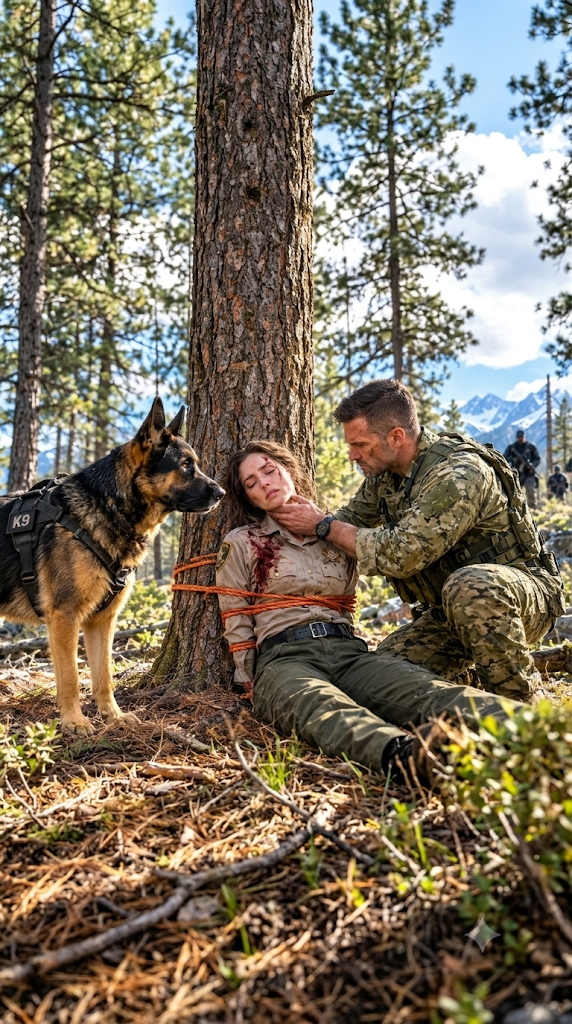
Garrett saw her, tied to a Douglas fir near the bank with orange utility cord looped around her torso and both wrists and knotted at the back of the trunk.
She wore a tan uniform shirt and dark green cargo pants, a star-shaped badge pinned above her left breast pocket, her head dropped forward with dark hair hanging loose across her face.
He moved to her fast, dropping to one knee in the cold mud and pressing two fingers against the side of her neck.
Pulse, weak and unsteady, but there.
He pulled her hair back, finding her skin pale and cold to the touch, with a deep cut above her left eye that had bled freely and dried in a dark brown crust.
Her lip was split, and the shoulder of her uniform shirt was soaked through on the right side, the tan fabric gone almost black with dried blood.
Rex stood guard, turning his back to the woman and facing outward with his nose working and his body rigid.
“Hey,” Garrett said, keeping his voice low and even. “I need you to open your eyes.”
Nothing.
He checked her wrists where the cord cut in, the skin beneath abraded raw, which meant she had been conscious after being tied.
He drew the folding knife from his chest pocket, sliced through the loops at her wrists and then the main body cord, and caught her carefully as she slumped forward.
He lowered her to the ground and rolled her onto her side to keep the airway open, then went to work.
He had done enough field trauma work in enough countries to move without thinking, pulling the compression dressing from his first aid kit and packing the shoulder wound.
He applied pressure and held it, using his free hand to unclip the emergency Mylar blanket from his pack and shake it open one-handed, tucking it around her from the waist down.
“Come on,” he said quietly, not to her specifically, more to the general situation.
Her eyelids moved, and she made a sound low in her throat.
“There you go,” Garrett said. “Stay with me. I have you.”
Her eyes opened slowly, dark green and badly unfocused with uneven pupils—a concussion, he noted, and possible significant blood loss from the shoulder.
Her lips were cracked. “Easy,” Garrett said. “Don’t move fast. What’s your name?”
Her mouth worked, and she swallowed. “Tara,” she said, her voice barely above a whisper. “Tara Reeves. I’m a deputy, Garnet County.”
“Garrett,” he said. “I’m going to keep working on that shoulder. You need to stay as still as you can. Can you do that?”
“Yes.” She blinked, her focus sharpening slightly as she looked at him, then at Rex, who had still not moved from his guard position. “Your dog.”
“His name is Rex. He’s the one who found you.”
She let out a slow, careful breath. “How long have I been out here?”
“I don’t know. You want to give me a number?”
“I got out of my vehicle around 4:00 yesterday afternoon.” She paused to breathe. “I don’t think I was unconscious the whole time. I remember it getting dark. I remember it raining.”
Garrett did the calculation: fourteen, maybe fifteen hours, in these temperatures with blood loss on top of it.
He kept his expression neutral. “Is there anyone still out here? The people who did this.”
The change in her face was immediate, the unfocused look snapping away as something hard and alert replaced it.
She tried to push herself upright, and he put a hand on her uninjured shoulder to hold her still. “Don’t.”
“You don’t understand,” Tara said, her voice coming up in volume before dropping back as if she caught herself. “There are three of them, maybe four. They have rifles. They were waiting to see if I died on my own.” She paused. “I think they were coming back to check.”
Rex turned his head, his ears swiveling.
Garrett did not look at the dog, already running the math—the drainage they were in was lower than the surrounding terrain, good cover but bad egress, with one natural exit to the north where the dry creek emptied into a wider valley.
“Where did they take your radio?” he asked.
“They kept it. They took my sidearm, too.” She met his eyes. “There is a Forest Service emergency station at the north end of the valley, about three miles. It has a landline.”
“Can you walk?”
She looked at her legs and tried to bend her right knee, her jaw tightening against the pain. “I don’t know.”
“That’s not a yes,” Garrett said.
He pulled a second compression bandage and reinforced the dressing on her shoulder, wrapping it tightly and securing it with the elastic strips.
It would hold if she stayed still; it would hold less well if he had to carry her at speed through broken timber, but that was going to have to be acceptable.
He stood up and looked at Rex, who was staring directly up the east bank.
Garrett moved two steps to the side to change his sightline, looking up through the pines.
At first there was nothing, just the gray-brown columns of the trees and the pale sky above the ridge.
Then he caught the movement: a figure coming through the timber at a deliberate pace, dark jacket, dark pants, moving with purpose rather than the occasional randomness of a lost hiker.
Garrett stepped back to Tara, keeping his voice flat and quiet. “We’re going to move now. Put your right arm around my neck. I’m going to lift you from the left side.”
She nodded, pale and shaking but not panicking, and he noted that she was working with him, not against him.
He got her upright, her weight settling against his left side as she pulled a sharp breath through her teeth from the shoulder movement and then controlled it.
He started them north along the drainage, moving fast with Rex leading.
The dog set a straight line up the center of the dry creek bed, nose low, ears back, moving without sound as his paws found the quiet patches of pine needle and avoided the loose gravel instinctively.
Watching him, Garrett felt the same trust he always felt—Rex did not waste movement, and when the dog chose a path, it was the right path.
They covered the first quarter mile in about seven minutes before the drainage curved left and narrowed, the trees closing in on both sides, providing cover but also funneling them and limiting their options.
Garrett kept one hand on Tara’s back and his eyes ranging over the high ground to the east. “Tell me about them,” he said, just above a whisper.
Tara moved alongside him, her breathing controlled but effortful as she fought against the blood loss. “I was tracking a fentanyl distribution route. Someone’s been running the product through the back country here using the old logging roads to move it before it hits the highway network. I found a cache two days ago. I was documenting it with my phone camera when they came up behind me.”
“You call it in first?”
“I called my sergeant, told him where I was and what I’d found.” She looked at Garrett, her expression careful and controlled, but something behind it was not. “You don’t trust whether the call got through,” Garrett asked.
She was quiet for three steps. “My sergeant is named Foley. He’s been my supervisor for four years. When they had me tied up before I lost consciousness, one of them made a phone call. I could hear his side of it. He told whoever he was talking to that the deputy was secured and neutralized.”
She stopped walking, looking at Garrett with those dark green eyes. “He called the person on the other end of that call ‘sergeant.’”
Garrett let that settle and started them moving again.
“Your sergeant sent them.”
“I think so.” Her voice stayed even, whatever it was costing her to say that not letting it show on her face. “Which means I can’t call for backup through the county. They’ll vector those men right back to us.”
“Forest service station has a federal line,” Garrett said.
“Yes. Then that’s where we’re going.”
Rex stopped, his body dropping low, slow, deliberate. He turned his head back to Garrett and made no sound at all.
Garrett moved them both against the bank immediately, pressing into the roots of a fallen cottonwood that had come down across the creek.
He lowered Tara behind the root ball and crouched in front of her, drawing the Glock in one quiet motion, and waited.
Thirty seconds of silence. Then he heard it: two sets of footsteps in the loose gravel above the east bank, moving north in the same direction they were headed.
The two figures were tracking them, maybe eighty yards back and above, which meant they had sight angles down into the drainage.
Garrett leaned close to Tara’s ear. “Stay flat. Don’t move unless Rex comes back to you.”
She grabbed his wrist, her grip stronger than he expected. “Don’t.”
“I’m not fighting them,” he said. “I’m slowing them down.”
He looked at Rex and made a small hand motion, palm down, fingers spread. “Stay.”
The dog settled onto his belly beside Tara, placing his chin on her leg, but his eyes stayed sharp and his body stayed coiled.
Garrett moved, going east up the bank using the timber for cover and moving uphill at an angle to get above the two figures rather than intercepting them head-on.
The pine needles deadened his footsteps as he worked from tree to tree, staying behind trunk cover and making no outline against the gray sky.
He found a position on a granite shelf above them and slightly ahead of their line of travel, seeing them clearly now: two men, one tall, one heavier, both in dark hunting jackets and ball caps.
The tall one carried a rifle at the low ready, a bolt action with a scope, while the heavier man had a short-barreled shotgun on a sling.
They were looking down into the drainage, reading the ground, and the tall one stopped and pointed at something in the creek bed—the spot where Tara had been lying—before saying something to his partner.
The heavy man pulled a phone from his jacket, looked at it, then looked up and scanned north along the creek.
Garrett did not have time for them to make a call.
He found a loose section of the granite shelf, a flat piece approximately the size of a dinner plate pried free over years of freeze and thaw, and picked it up carefully.
He adjusted his angle slightly and threw the rock hard and deliberately fifteen yards to the east of the two men into a dense thicket of young firs.
The crash in the underbrush was loud and sudden, and both men snapped toward it—the tall one raising his rifle, the heavy man moving in that direction to cover his partner.
Garrett came down off the shelf, crossing the ground between them fast and silent.
The heavy man heard him at the last possible moment and began to turn, but Garrett drove the heel of his palm into the man’s jaw with his full body weight behind it, a clean and complete impact that dropped the man without making a sound that carried far.
Garrett was already moving before he hit the ground.
The tall man spun, not having gotten the rifle to his shoulder, and Garrett got inside the barrel and drove his elbow up hard into the man’s chin, snapping his head back.
Garrett grabbed him by the front of the jacket and put him down controlled, keeping the man’s head from striking the rocks.
He relieved both of them of their weapons, broke down the bolt on the rifle, and threw the components in separate directions into the brush.
He removed the shells from the shotgun and pocketed them, then used the men’s own bootlaces to secure their wrists behind their backs.
They were breathing; they would have headaches and significant soreness for several days.
He moved back down the bank to the drainage, and Rex lifted his head as Garrett came back over the lip of the dry creek, his tail moving once.
Tara looked at Garrett, then at his empty hands, then back at his face.
“Let’s move,” Garrett said.
They covered the remaining distance to the Forest Service station in just under an hour, the last half mile with Garrett carrying Tara completely, her arm over his shoulders and her feet barely touching ground.
She did not complain; she focused on breathing.
The station was a low green building set against the treeline at the valley’s northern edge, and the door was locked.
Garrett broke the handle with one strike from a rock and pushed it open, finding a desk, some topographic maps pinned to the board wall, a mounted landline phone, and beside it a radio with a Uinta Forest Service sticker on the housing.
He set Tara in the desk chair and checked her bandage—still holding.
He picked up the phone, the line was live, and he dialed 911, identifying himself and giving his exact GPS coordinates from the unit on his watch.
He requested federal law enforcement contact by name for the DEA and the FBI field offices, not local county dispatch, and the operator hesitated.
Garrett gave his military ID and his unit designation and explained in precise terms why local county law enforcement was not to be contacted under any circumstances.
The operator understood the weight of what she was hearing and said she would connect him immediately to the federal line.
Rex lay across Tara’s feet, and she had one hand resting in the fur on his back, watching Garrett make the call.
He looked over at her while he waited for the transfer. “You knew something was wrong with the route before yesterday,” he said. It was not a question.
Tara was quiet for a moment. “Three months ago I found a discrepancy in the evidence logs. Seized product going missing between intake and storage. I started keeping my own records. I didn’t tell anyone because I wasn’t certain.” She looked at the floor. “I should have gone to the FBI sooner.”
“You were building a case,” Garrett said. “That’s not wrong.”
“I almost died in the woods because I was building a case.”
“You were doing the job the right way,” Garrett said. “The right way is usually harder.”
The federal line picked up, and Garrett turned his attention back to the phone.
The next three hours moved differently than the hours before.
Two FBI agents arrived in a truck within ninety minutes, followed by a Forest Service helicopter that landed in the meadow south of the station.
The paramedics worked on Tara immediately, starting an IV line, reassessing the shoulder wound, and calling ahead to the trauma center in Missoula.
They told Garrett it was a through and through, no arterial involvement, serious but survivable—she would need surgery to clean it, but she would keep the shoulder.
When they loaded her onto the stretcher, she asked them to stop for a moment.
She looked at Garrett. “I owe you.”
“You don’t,” he said.
“Rex, then.” She looked down at the dog.
Rex sat beside the stretcher, looking back at her with those amber eyes, calm and direct.
She reached down and put her palm on the side of his face, and he let her do it, leaning into it slightly.
“He’s good at his job,” she said.
“The best I’ve ever worked with,” Garrett said.
The FBI agents debriefed Garrett for forty minutes outside the building, telling him they would want him in Missoula to give a formal statement.
He told them he would come in voluntarily tomorrow morning, and they accepted that without pushing.
He gave them his military contact information and the exact locations where the two men were secured in the drainage.
A federal arrest warrant for Sergeant Foley was already in process, one of the agents told him, based on cell phone data they had pulled in the last hour.
When everyone had gone, the meadow was quiet again.
The sun was low in the west, breaking through the cloud cover for the first time in three days, turning the snowfields on the high peaks pink and orange and throwing long gold shadows across the valley floor.
The timber smelled clean, the temperature was dropping fast, but the wind had stopped, and without the wind, the cold was bearable.
Garrett stood outside the station door for a while, Rex sitting next to him with his shoulder against his thigh, looking out at the same light.
There were things you carried from deployment that you could not set down.
Garrett had stopped trying to set them down a long time ago; you learned instead to carry them without letting the weight change your gait.
You learned to be in places like this one, quiet and cold and honest, and let the beauty of them exist without demanding that it fix anything.
He had not been looking for a reason to be here; he had been looking for silence.
Rex had found the reason on his own. That was usually how it worked.
He picked up his pack, adjusted the straps, and looked north at the trail that wound out of the valley and up the ridge toward the backcountry he had come from.
“Four days left,” he said.
Rex stood up, looked up at Garrett, then looked at the trail.
They walked.
There are men who run toward the sound because they have no other option, and there are men who do it because something inside them was built for exactly that moment.
Garrett was the second kind.
He would not have called it courage; he would have called it obligation.
But from where the rest of us stand, watching a man carry a wounded stranger three miles through a frozen mountain and a dog charge a rifle position because his partner needed three more seconds, the word courage is the only one that fits.
Tara Reeves recovered fully, testifying before a federal grand jury eleven weeks later.
Sergeant Foley was indicted on four counts, including conspiracy to commit murder, and the network he had protected collapsed within months of his arrest.
Garrett never made it back to the beach.
The following spring, he returned to the Bitterroot, telling himself it was because the fishing was better than he remembered.
Rex knew better.