
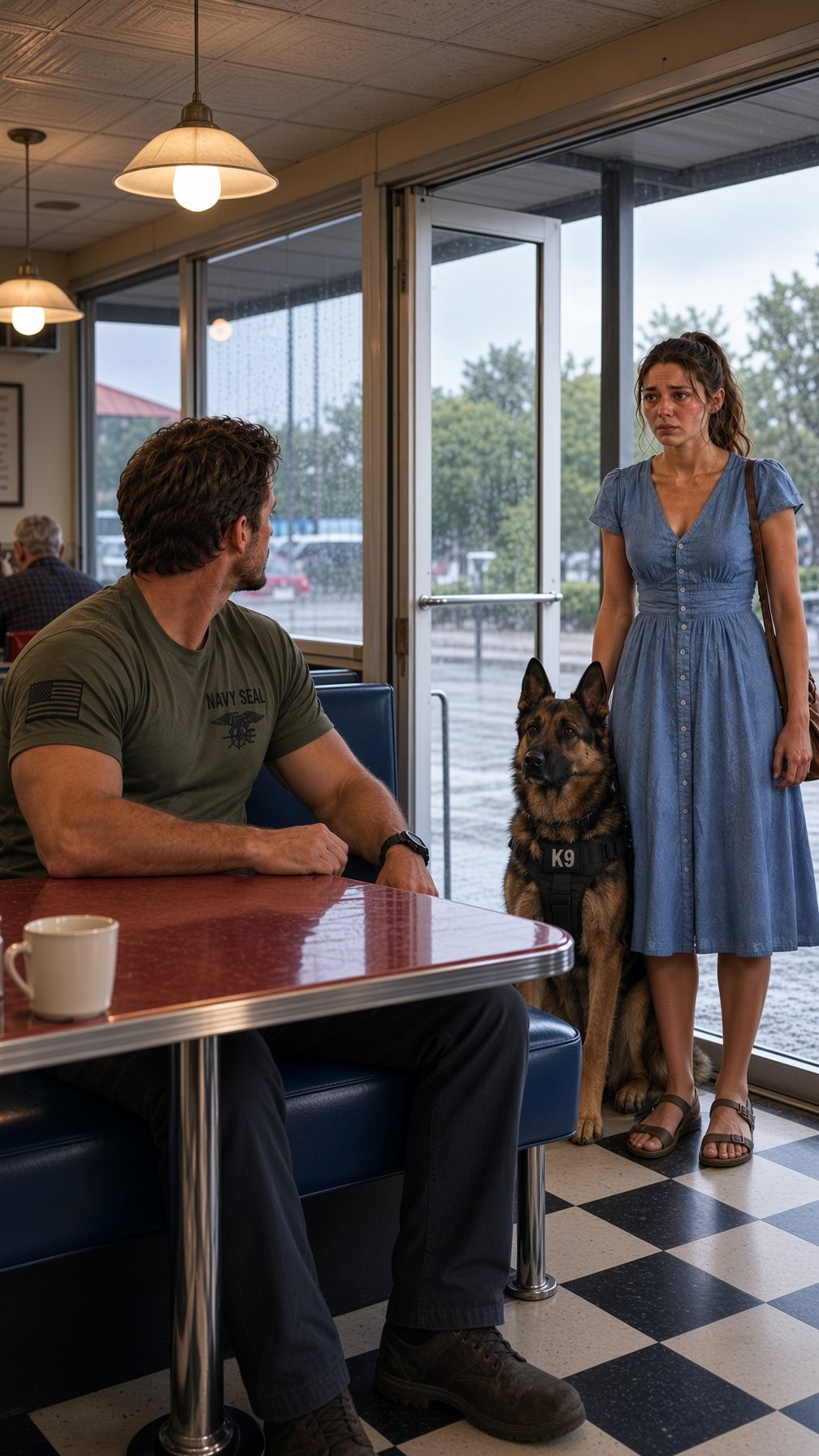
Rain hammered the windows. Midnight diner, half empty, the kind of place nobody talks in.
He liked it that way. Six years out of the teams, and silence was the closest thing he had to peace.
Then the door opened. A woman stumbled in, soaked to the bone. Mascara running, hands shaking so bad she could barely hold the leash.
Beside her, a German Shepherd, tactical vest, working harness.
The kind of gear you don’t buy at a pet store. The kind of gear he used to clip onto dogs just like it, before three of his men didn’t come home.
She looked around the room, found the one empty booth, and asked the question that stopped his coffee halfway to his mouth.
“Can we sit here?”
He wasn’t looking at her. He was looking at the patch on that dog’s vest.
A unit designation he hadn’t seen in six years. One that belonged to a team that didn’t exist anymore.
He should have said sure and gone back to his coffee.
Instead, he said four words that surprised even him.
“Where’d you get that vest?”
She looked down at the dog, then back at him, and for the first time all night, she looked like she might actually cry.
His name was Jake Mercer. Thirty-eight years old, six foot one, built like a man who used to carry eighty pounds of gear up mountains for a living, because he did.
Fourteen years a Navy SEAL. Four deployments. Two Purple Hearts he never talked about.
And one memory he couldn’t put down no matter how many years went by.
Now he drove a tow truck. Not because he had to. Because it was quiet.
Nobody in a broken-down Honda at two in the morning wants to make conversation. They just want their car fixed and they want him gone.
That suited Jake fine.
He tried the other stuff after he got out. The speaking engagements. The transition coaching.
A woman at the VA office once handed him a pamphlet titled Finding Purpose After Service.
Like purpose was something you could pick up at a pharmacy counter.
He threw it away in the parking lot.
Every night, same routine. Finish his shift around eleven. Drive to Rosie’s Diner off Route 9.
A chrome-and-red-vinyl place that hadn’t changed its menu since 1987.
Sit in the corner booth, back to the wall, facing the door. Old habit. The kind that doesn’t leave even when the war does.
He’d order black coffee and whatever the meatloaf special was, and he’d eat it slow, because there was nowhere else he needed to be and nobody waiting on him to be there.
That was the arrangement he’d made with his life. Small. Quiet. Contained.
He told himself he liked it. Most nights, he almost believed it.
See, Jake didn’t come home from his last deployment the same as he left. Nobody does. Not really.
But Jake carried something heavier than most.
His name was Danny Reyes. Everybody called him Doc, because before he was a SEAL, he’d wanted to be a paramedic, and he still patched up scraped knuckles and stitched wounds better than half the medics on base.
Doc had a dog. A German Shepherd named Titan, trained for detection, for protection, for finding things buried under rubble that human noses couldn’t.
Doc used to say Titan understood him better than most people did. Said the dog knew when he was scared before Doc even knew it himself.
Three years ago, on a joint operation gone sideways in a village whose name never made the news, Doc pushed Jake out of the path of a blast that should have killed them both.
It killed Doc instead.
Jake walked away with a concussion, two cracked ribs, and a debt he was never going to be able to repay, because the only person who could accept the payment was six feet under a flag in Arlington.
Titan went back stateside with the unit’s K9 program.
And then the program got folded. Funding got cut. Dogs got reassigned or adopted out.
And Jake never found out what happened to him.
He never let himself ask. Some doors you don’t open. You just build a wall in front of them and hope it holds.
That was Jake’s whole life boiled down. A wall, a booth, a cup of coffee, and a door he refused to look at.
His apartment told the same story if you knew how to read it.
One bedroom. Bare walls. Except for a single shelf near the window.
On it sat a folded flag in a glass case, a photograph of eight men grinning in front of a helicopter that most of them would never see again in one piece, and a dog tag that wasn’t his.
He’d kept Doc’s dog tag. Found it in his own gear bag weeks after the incident, tucked in a side pocket he never used.
He never figured out how it got there. Some quiet act of fate, maybe. Or maybe Doc had slipped it in himself. Some private joke or private promise Jake never got to ask about.
He looked at that shelf every morning. Never touched it. Never dusted it. Just looked.
The way you check a wound to make sure it’s still there, still closed, still yours to carry.
The guys from his old unit still texted sometimes. Reunions. Fundraisers. A wedding here, a funeral there, because that’s how it goes eventually for men who did what they did.
Jake always had an excuse ready. Work. Distance. A phone that conveniently died at the wrong moment.
It wasn’t that he didn’t love them. He loved them more than he knew how to say out loud.
It was that being around them meant being around the memory of a room that used to have nine men in it and now only had eight.
The math never stopped bothering him. It never would.
So he built himself a life with no math in it. No headcounts. No formations. No one to lose, because there was no one close enough to be lost.
A tow truck. A diner booth. A shelf he never touched.
Tonight was supposed to be like every other night.
Rain had been coming down since six p.m. The kind of rain that turns headlights into blurry halos and makes the whole world sound like static.
Rosie’s was quieter than usual. Just an older couple two booths down, murmuring over pie, and the night cook humming something off-key behind the counter.
Jake had his coffee. He had his booth. He had his silence.
And then the bell over the door jingled, sharp and sudden, cutting through the hum of the diner like a wire pulled tight.
He looked up. Old habit. Always know who’s coming through the door.
What he saw made him go completely still.
A woman. Maybe late twenties. Hair plastered to her face, mascara bleeding down her cheeks in dark streaks.
Her dress was soaked through, clinging to her, and she was shaking.
Not from the cold, Jake realized. Shaking the way people shake when they’re running from something and the running hasn’t caught up with their nervous system yet.
Beside her, pressed close to her leg like it was guarding her, was a German Shepherd.
Full tactical vest. MOLLE webbing. A leash clipped to a working harness, not some pet-store leather strap.
And on the side of that vest, stitched in faded thread that had clearly been through more washes and more miles than any civilian dog ever sees, a patch.
Jake’s stomach dropped straight through the floor.
He knew that patch. He’d worn that patch.
It was his unit’s K9 program insignia. The exact one Titan used to wear.
The room tilted a little, just for a second, the way it used to tilt right before something bad was about to happen.
Except there was no threat here. No gunfire. No IED.
Just a soaked stranger and a dog wearing a ghost.
The woman scanned the diner, found the empty side of Jake’s booth, and walked toward it like it was the only safe place left in the world.
She stopped at the edge of the table.
Up close, Jake could see her hands were trembling around the leash. Could see something in her eyes that looked less like fear of the storm and more like fear of something that might still be behind her.
“Can we sit here?” she asked. Her voice cracked on the last word.
Jake didn’t answer right away. He was looking at the dog. At the patch.
At six years of silence, suddenly cracking down the middle like ice on a lake that was never as solid as he thought.
“Yeah,” Jake finally said. “Sit.”
It came out rougher than he meant it to. The woman flinched slightly, and Jake immediately felt like an idiot.
Soaked. Scared. And now sitting across from a stranger who sounded like he was barking an order.
“Sorry,” he added, softer this time. “Long day. Sit down. Please.”
She slid into the booth across from him, and the dog folded down beside her feet with a trained, practiced stillness. The kind of stillness you only get from thousands of hours of repetition.
Sit. Stay. Guard.
Jake knew that stillness. He’d built it into dogs just like this one years ago, back when Titan was young and dumb and still learning that the world wasn’t just a game of fetch.
The waitress came by, dropped off water without asking, took one look at the woman’s face, and quietly disappeared again.
Small towns. People know when not to hover.
Jake wrapped both hands around his coffee mug, mostly to give himself something to do besides staring at the vest.
But he couldn’t help it. His eyes kept dragging back to that patch.
“Where’d you get that vest?” he finally asked.
The woman blinked, thrown by the question. Of all the things a stranger might ask a soaked, crying woman who just sat down uninvited at his table, that clearly wasn’t what she expected.
“What? The dog’s vest?”
Jake said, nodding toward it. “That patch. Where’d you get it?”
She looked down at Titan, though Jake didn’t know his name yet. Not for certain. Not yet.
Like she was seeing the vest for the first time in a long time.
“It was my brother’s,” she said quietly. “The dog was his. He passed away a few years ago. This was his gear.”
The word brother hit Jake like a physical thing. Like pressure changing in a room right before a storm.
“What was his name?” Jake asked. His voice had gone very quiet. Very careful.
The voice he used to use clearing a room, when one wrong move meant somebody didn’t walk out of it.
The woman studied him for a second, something wary flickering behind her exhaustion. Strangers didn’t usually ask this many questions.
Strangers usually just said sorry for your loss and went back to their meatloaf.
“Danny,” she said finally. “Danny Reyes. He was a corpsman. Everyone called him Doc.”
The mug in Jake’s hands nearly slipped out of his grip.
For six years. Three of those years carrying a guilt that had calcified into something he thought was permanent, unmovable, part of his skeleton.
For six years, Jake had never once imagined this moment.
Had never let himself picture sitting across a diner table from Doc’s sister. Had never let himself think about Titan again.
Not on purpose. Not without immediately slamming that door shut before the memory could finish forming.
And here she was. Soaked. Terrified. Sitting three feet away from him with Doc’s dog at her feet, because a storm had pushed her through the nearest door.
And the nearest door happened to be the one Jake was hiding behind.
“I knew him,” Jake said. His voice barely made it out. “I served with him.”
The woman went very still. “You knew Danny?”
“I was there,” Jake said. And then, because there was no way to say the next part gently, no way to soften six years of carrying something this heavy, “I was there when he died.”
The color drained out of the woman’s face.
For a second, Jake thought she might actually get up and leave. Walk straight back out into the storm rather than sit with whatever was about to come out of his mouth.
Instead, her hand found the edge of the table, gripping it like she needed something solid to hold onto.
“You’re—you’re one of the men from his unit,” she said slowly, putting pieces together in real time. “Oh my God. You’re Jake.”
He said, “Jake Mercer.”
Her breath caught audibly. “He talked about you,” she whispered. “In his letters. He talked about you all the time.”
Now it was Jake’s turn to go still.
“My name’s Emily,” she said, wiping at her face with the back of her wrist, though it was hard to tell anymore what was rain and what was tears. “Emily Reyes. Danny was my little brother.”
The diner around them seemed to fade out. The clinking of dishes. The hum of the radio behind the counter. The older couple’s murmured conversation two booths down.
All of it dimmed. The way sound dims when your whole world narrows down to one single point.
Jake looked at Titan again. Really looked at him.
About a mile back, she said, voice cracking. I pulled into a gas station lot, and he pulled in right behind me. I grabbed Titan and I ran. I just ran. I didn’t even think. I just—
She pressed her palms against her eyes. I saw the diner sign. The lights were on. I thought if I could just get somewhere with people, somewhere public, he wouldn’t—
She stopped herself. He wouldn’t do anything crazy in front of witnesses.
Jake finished for her, voice flat. “Emily nodded, not trusting her voice anymore.”
Under the table, Titan had lifted his head. Ears up. A low, barely audible rumble building somewhere in his chest.
Not quite a growl. More like an engine turning over.
Dogs like Titan didn’t panic. They processed. And right now, something outside that diner window had caught his attention.
Jake followed the dog’s gaze through the rain-streaked glass, out past the flickering neon sign.
A pickup truck had pulled into the far end of the parking lot. Headlights off. Engine running. Just sitting there. Watching.
Jake’s whole body went into a mode he hadn’t used in years.
Not panic. The opposite of panic.
A cold, methodical calm that used to keep him and his team alive in rooms full of people who wanted them dead.
“Emily,” he said quietly, not taking his eyes off the truck. “Don’t look right at it. But there’s a truck at the far end of the lot. Headlights off.”
Emily’s breath hitched. She didn’t need to look. She already knew.
“That’s him,” she whispered. “That’s Marcus’s truck.”
Jake felt something settle into place inside him. Not rage. Not yet. Something quieter and more dangerous than rage.
Focus.
“Okay,” he said. “Here’s what we’re going to do. You’re going to stay right here in this booth with Titan. I’m going to call this in.”
“The police already have a report on him,” Emily said. “They know about the restraining order.”
“Good. That helps.” Jake was already pulling out his phone, dialing with steady hands. “But it’s going to take them time to get here, and I’m not going to sit in a booth and hope he loses his nerve.”
“Jake.” Emily’s voice was tight with fear. Not just for herself, Jake realized, but for him. “Please don’t do anything. He’s not stable. I don’t know what he’s capable of.”
Jake looked at her for a long moment. Really looked at her.
The fear in her eyes. The exhaustion carved into her face. The way her hand hadn’t left Titan’s head since she sat down, like the dog was the only anchor she had left in the entire world.
And underneath all of that fear, Jake saw something else. Something that looked a lot like Doc.
The same stubborn set of the jaw. The same refusal to fully collapse, even when collapsing would be so much easier.
“Emily,” Jake said, voice low and steady. “I promised your brother something a long time ago. On a night I never told anyone about. I promised him if I ever got the chance to do right by his family, I would.”
Emily’s eyes filled again. This time, not from fear.
“You don’t owe me anything,” she whispered.
“I owe your brother everything,” Jake said. “This is the first chance I’ve had in six years to pay any of it back. I’m not walking away from that because some coward is sitting in a parking lot.”
The 911 dispatcher picked up.
Jake gave their location, described the truck, the restraining order, kept his voice calm and precise the entire time. The same voice he used to use calling in coordinates. Clean. Clipped. No wasted words.
When he hung up, he looked back at Emily.
“They’re sending a unit. Fifteen minutes, maybe less, given the weather.”
“Fifteen minutes,” Emily repeated, staring out at the truck that hadn’t moved.
“Fifteen minutes is nothing,” Jake said. “I’ve held rooms for longer than that with worse odds.”
He didn’t say it to sound tough. He said it because it was true, and because right now, Emily needed to hear something true and solid, something that wasn’t shaking apart at the edges the way everything else in her life currently was.
For a moment, nobody in the diner moved.
The night cook had gone pale behind the counter. The older couple, two booths down, had stopped pretending to eat their pie.
Emily’s phone buzzed in her bag. A text.
She fumbled it out with shaking hands, and when she read it, all the color drained from her face at once.
She turned the screen toward Jake without a word.
I can see you in there. Both of you come out and talk to me, or I’m coming in.
Jake read it twice. Something cold and precise settled over him. Not fear. Something that had replaced fear a long time ago, back in rooms much darker than this one.
“He’s watching the window,” Jake said quietly. “He’s not just parked out there. He’s been watching this whole time.”
Emily’s breath came fast and shallow. “Jake, he’s done things before. Not like this, but—he put his fist through a door once at my old apartment. The police report is still open on that too.”
“Then we don’t give him a door to put his fist through,” Jake said.
He kept his voice low, level. The same tone he used to use talking scared new guys through their first firefight.
Steady wasn’t just a sound. It was something you handed to someone else on purpose when they had none left of their own.
Titan’s low rumble deepened.
The truck’s door had opened.
A man stepped out into the rain. Mid-thirties, broad-shouldered, moving with the loose, unsteady gait of someone who’d been drinking.
He stood by his truck for a moment, staring at the diner. At the fogged-up windows, like he was trying to see through them.
“That’s him,” Emily breathed.
Jake stood up.
“Jake, please—”
“I’m not going out there to fight him,” Jake said, and it was mostly true. “I’m going to stand between that door and this booth. That’s all. I’m not leaving this diner. I’m just not letting him walk through that door uncontested.”
He glanced down at Titan. “Can he hold a position if I need him to? Guard command.”
Emily blinked, startled by the question, then nodded slowly. “Danny trained him on basic protection commands before—before everything. I’ve kept it up. Just in case.”
“Good,” Jake said. “Keep him with you. If that door opens and it’s not me walking back through it, you say the command. You understand?”
Emily nodded, throat too tight to speak.
Jake walked toward the front of the diner.
The night cook had noticed the tension by now, was standing frozen behind the counter. The older couple, two booths down, had gone very quiet, watching.
Jake didn’t puff himself up. He didn’t clench his fists or plant himself like some action-movie hero.
He simply walked to the door, opened it, and stepped outside into the rain.
Calm. Unhurried. The way you walk toward a problem you’ve already solved a hundred times in your head before your body catches up.
Marcus saw him immediately. Stopped in the middle of the parking lot, blinking through the downpour.
“Who the hell are you?” Marcus called out, words slurred at the edges.
“Doesn’t matter who I am,” Jake said, voice carrying easily over the rain. The same voice he’d used to calm terrified villagers, brief nervous rookies, talk down men holding more anger than sense. “What matters is you’re about five hundred feet closer to Emily than a judge said you’re legally allowed to be.”
Marcus’s face twisted. “This isn’t your business, man. This is between me and her.”
“It stopped being just between you and her the second you violated a restraining order,” Jake said, taking one slow, deliberate step forward. “Cops are already on their way. You can turn around right now and this ends with you driving home. Or you can keep standing in this parking lot, and it ends a lot worse for you.”
Marcus’s eyes flicked toward the diner windows. Toward the blurry shape of Emily visible through the fogged glass. Then back to Jake.
“She’s not yours to protect,” Marcus spat.
“No,” Jake agreed. “She’s not. But her brother was one of mine. And where I come from, that means something.”
Something in Jake’s voice. Flat. Certain. Absolutely without doubt.
Seemed to finally cut through the alcohol and rage clouding Marcus’s judgment.
He took a step back. Then another.
“This isn’t over,” Marcus muttered, backing toward his truck.
“It is tonight,” Jake said. “And there’s a police report with your name already on it. Next time you come near her, it’s not a restraining order violation anymore. It’s an arrest.”
For a long, tense moment, Marcus just stood there in the rain, fists clenched, jaw working, looking like a man trying to decide whether his pride was worth what it would cost him.
Then, somewhere in the distance, faint red and blue lights began to bleed into the wet night sky.
Marcus saw them too. Cursed under his breath. Yanked open his truck door and peeled out of the parking lot just as the first police cruiser turned in.
Jake stood in the rain for a moment longer, letting the adrenaline drain slowly out of his system. Letting his heartbeat find its way back down to something normal.
Then he turned around and walked back inside.
Emily met him halfway across the diner, Titan pressed tight against her leg. Her hands were shaking worse than before, but her eyes were dry now. Replaced by something sharper. Something like disbelief.
“You’re insane,” she said. “You walked out there completely unarmed.”
“I’ve walked into worse with less,” Jake said, sitting back down heavily, suddenly aware of just how soaked through his shirt was.
The police arrived a few minutes later. Took statements. Confirmed the restraining order violation.
Told Emily they’d be putting out an alert on Marcus’s truck and that this incident would strengthen any future legal action against him.
It wasn’t a perfect resolution. Men like Marcus rarely got neatly resolved in one night.
But it was something. It was a wall built a little higher. A door locked a little tighter.
When the officers finally left and the diner slowly settled back into its late-night hum, Emily sat back down across from Jake.
Titan curling up at her feet again, this time with his guard clearly stood down, sensing the danger had passed.
For a while, neither of them said anything.
The rain had softened outside, turning from a hammering downpour into something gentler. Almost peaceful.
“You said you were there,” Emily finally said quietly. “When Danny died. You never finished telling me what happened.”
Jake’s hands tightened around his coffee mug, now stone cold.
“You don’t have to tell me if it’s too hard,” Emily added quickly. “I don’t want to make you relive something just because I’m curious.”
“No,” Jake said slowly. “You deserve to know. You’ve deserved to know for six years, and I never had the courage to find you and tell you myself.”
He took a breath. The kind of breath that felt like lowering yourself into cold water. Necessary and impossible to do slowly.
“We were on a joint operation,” Jake began. “A village that doesn’t matter for the story except that it was raining that day too. Funny how that works.”
Emily didn’t move. Didn’t blink.
“We got ambushed. Bad intel. Worse luck. There was an explosion. A secondary device none of us saw coming. I was closest to it. Danny saw it a half second before I did.”
Jake’s voice thinned. The words coming slower now, like each one had to be dragged up from somewhere very deep.
“He didn’t think. He just moved. Threw himself between me and the blast.”
The diner went completely silent around them. Even the night cook, pretending to wipe down the counter, had gone still.
“I walked away with a concussion and two cracked ribs,” Jake said. “Danny didn’t walk away at all.”
Tears were streaming freely down Emily’s face now, but she didn’t look away. Didn’t ask him to stop.
“I’ve spent six years telling myself I don’t deserve to still be here,” Jake said, voice barely above a whisper. “Six years building a life small enough that it wouldn’t matter if I disappeared out of it. A tow truck job. An empty apartment. A booth in a diner nobody bothers me in.”
He looked up at her, and for the first time since she’d walked through that door, his composure cracked completely.
“Your brother gave me every single day I’ve had since that night,” Jake said. “And I never even had the guts to find his family and tell them that. I told myself it would just hurt you more. But really, I think I was just protecting myself from having to say it out loud.”
Emily reached across the table, and before Jake fully registered what was happening, her hand had closed over his.
“He wrote to me about you,” she said. “In almost every letter. He said you were the most stubborn, hard-headed, overly protective person he’d ever served with, and that you’d probably get yourself killed one day trying to save everyone else first.”
A wet, broken laugh escaped Jake despite himself. “Sounds about right.”
“He also said,” Emily continued, voice thick with emotion, “that if anything ever happened to him, he wanted you to know it wasn’t your fault. He said it in one of his last letters home. Like he already knew.”
Jake’s whole body went rigid. “He knew?”
“He didn’t know specifics,” Emily said. “But guys like Danny. Guys who run toward the explosion instead of away from it. I think some part of them always knows it’s a possibility. He wasn’t scared of it, Jake. He told me that. He said the only thing that scared him was the thought of one of you blaming yourself for something that was his choice, not yours.”
Jake closed his eyes.
Six years of silence. Six years of a debt he thought could never be paid.
And here it was, being paid not through some grand act of redemption, but through a handwritten letter from a dead man who’d somehow already forgiven him before Jake even knew he needed forgiving.
“I’ve carried this alone for so long,” Jake admitted. “I didn’t think there was anyone left who could tell me it was okay to put it down.”
“There’s Titan,” Emily said softly, glancing down at the dog. “And there’s me. And I think Danny would want both of us to stop carrying this thing by ourselves.”
Titan, as if he understood every word, lifted his head and rested it gently on Jake’s knee under the table.
Jake froze for a moment, staring down at the graying muzzle of a dog he hadn’t seen in six years. A dog who somehow still remembered the hands that had once trained him.
Jake reached down slowly and rested his palm against Titan’s head.
The dog leaned into it immediately, the exact same way he used to lean into Doc’s hand, all those years and all those miles ago.
And there, in a run-down diner off Route 9 at nearly three in the morning, with rain fading to a soft patter against the windows, Jake Mercer allowed himself to cry for the first time in six years.
Not the quiet, controlled kind of grief he’d rationed out to himself in private moments over the years.
Real grief. Loud. Ugly. Long overdue.
The kind that comes out only when you finally feel safe enough to let it.
Emily didn’t say anything else. She didn’t need to.
She simply moved around to his side of the booth and sat beside him. One hand on his shoulder. The other still resting on Titan’s back.
And let him have the moment he’d apparently been owed for six long years.
The sun came up a little after six that morning.
Jake and Emily were still at that same booth, having moved through three more pots of coffee and every memory of Danny either of them could summon.
The good ones. The funny ones. The ones that made them laugh through the last of their tears.
Emily told Jake about Danny at ten years old, trying to build a treehouse that collapsed the moment he stepped foot in it.
Jake told Emily about Danny at twenty-six, staging an elaborate prank war against their commanding officer that nearly got them both written up and was absolutely worth it.
For the first time in six years, Jake talked about his memories of Danny like they were something to celebrate. Not something to bury.
By the time the diner’s morning shift arrived to relieve the exhausted night cook, something had shifted between the two of them.
Not romantic. Not yet. Maybe not ever in that way.
But something just as important. A connection neither of them had realized they were both quietly starving for.
“What happens now?” Emily asked as they finally stood to leave. The storm outside completely passed. Sunlight breaking weakly through gray clouds.
“Now,” Jake said, “I think it’s time I stop hiding behind a tow truck in a booth nobody bothers me in.”
He looked down at Titan, who was watching him with those same patient, knowing eyes Jake remembered from years ago.
“Would it be all right,” Jake asked carefully, “if I came by sometimes? To see him? Maybe take him for walks. I know he’s yours, and I’m not trying to intrude on that.”
Emily smiled. The first full, unguarded smile Jake had seen from her all night.
“Jake,” she said, “I think Danny would be furious with both of us if we let this be a one-time thing.”
Over the following weeks, what started as occasional visits slowly built into something steady.
Jake started showing up twice a week to walk Titan through the park near Emily’s apartment. Sometimes Emily joined. Sometimes it was just Jake and the dog, walking in comfortable silence.
The same kind of silence Jake used to seek out alone. Except now, it didn’t feel empty. It felt earned.
Jake finally went back to the VA. Not because someone made him, but because he wanted to.
He started therapy. Actual therapy. Not the pamphlet kind.
He talked about Doc for the first time in a room designed for exactly that kind of talking.
And it didn’t fix everything overnight. But it started something moving that had been frozen solid for six years.
Marcus, for his part, got picked up two weeks later after violating the restraining order again. This time with an actual police record to back it up.
Thanks to that rainy night’s incident report, Emily filed for a permanent protective order. And for the first time in months, she started sleeping through full nights again.
Jake started a small program. Unofficial at first. Just something he cooked up with a few contacts from his old unit.
Pairing retired military working dogs with veterans struggling the way he had struggled.
No red tape. No bureaucracy. Just people who understood loss finding their way to dogs who understood loyalty better than almost anything else on earth.
He named the program after the only person who deserved it.
The Doc Reyes Project.
The first time Jake said that name out loud, to a room full of strangers at a small fundraiser held in the back room of, of all places, Rosie’s Diner, because Rosie herself had insisted once she heard the story, his voice caught halfway through the sentence.
He had to stop. Take a breath. Start again.
Emily was in the front row. She didn’t rush to comfort him. Didn’t jump up to smooth over the moment.
She just waited. The way you wait for someone to find their footing on ice. Trusting they will.
Jake found his footing. He finished the sentence.
And by the end of the night, four local veterans had signed up for the program’s first pilot class, and a retired Army colonel two tables back had quietly written a check large enough to fund the next six months of operations without either Jake or Emily having to ask.
Word spread slowly at first. The way good things usually do.
A local news segment here. A shared post there.
But it spread.
Within a year, the Doc Reyes Project had placed eleven retired working dogs with veterans who needed them just as badly as the dogs needed someone to belong to again.
Jake kept a photo on that same shelf in his apartment now. Right next to Doc’s dog tag.
It was a picture from that first pilot class. Eleven veterans. Eleven dogs. All crowded together in a park on a bright Saturday morning.
None of them looking anything like the broken, hollowed-out versions of themselves that had walked in the door months earlier.
He still looked at that shelf every morning.
But now, when he looked at it, it didn’t feel like checking a wound. It felt like keeping score of something worth keeping score of.
Six months after that stormy night at Rosie’s Diner, Jake stood in a community center parking lot, watching a nervous nineteen-year-old former Marine meet his new dog for the first time.
A scarred, gentle Belgian Malinois named Scout, who’d served three tours and deserved better than an anonymous kennel to retire in.
Emily stood beside him, Titan sitting patiently at her feet, tail thumping softly against the pavement.
“You did this,” Emily said, watching the young Marine kneel down and let Scout press his head against his chest.
“We did this,” Jake corrected gently. “You gave me a reason to stop hiding.”
Emily smiled, looking down at Titan, who glanced up at her like he understood every word being spoken above him.
“Danny would be so proud of you,” she said. “Of both of you.”
Jake looked out at the parking lot. At the young Marine crying quiet, relieved tears into the fur of a dog who somehow already understood him better than any human ever could.
And felt something settle deep in his chest. Something that had been unsettled for six long years.
Not closure, exactly. Grief doesn’t work that way. It doesn’t close up neatly and disappear.
But peace. Something close enough to peace that he could finally breathe around it instead of constantly bracing against its weight.
He thought about that rainy night. About a woman soaked to the bone walking through a diner door, asking four simple words that cracked open a wall he’d spent six years building.
Can we sit here?
Turns out that single question hadn’t just changed one night.
It had given him his life back.
Jake still eats at Rosie’s sometimes. Same booth. Back to the wall. Facing the door.
But now, more often than not, there’s a dog curled up at his feet and a friend sitting across the table.
And the silence he used to hide inside doesn’t feel like a cage anymore.
It feels like a place he chose. Not a place he was trapped in.
Danny Reyes never got to see the life he made possible for the people he loved.
Never got to see his sister find her strength back. Never got to see his dog find his way home to someone who remembered exactly how to love him.
But somewhere, in whatever way these things work, I think he knows.
I think he’d tell you that some of the most important battles aren’t fought overseas.
Some of them are fought quietly at two in the morning in the corner booth of a diner.
In the moment you decide to stop carrying something alone.
The dog tag still sits on Jake’s shelf. Next to the flag. Next to the photograph of eight men who became seven.
He still doesn’t dust it. He still doesn’t touch it.
But now, when he looks at it, he doesn’t just see what he lost.
He sees what he found.
A sister who became family. A program that gave eleven veterans a reason to get up in the morning.
A dog who remembered him. A life that was worth staying in.
And a promise, made in silence, kept in a diner booth on a rainy night.
Can we sit here?
Yeah. Sit.
That was all it took.