

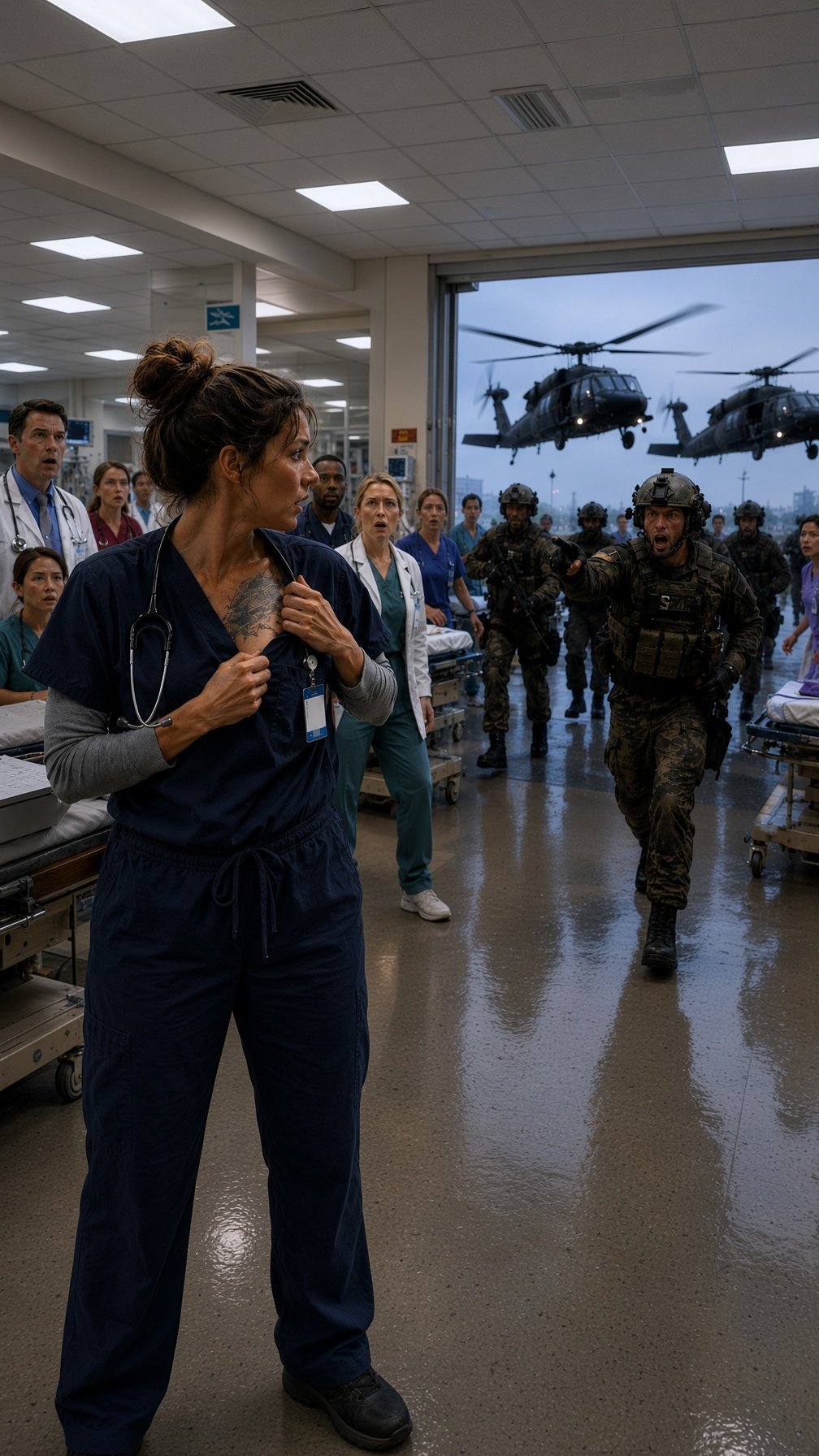
Nobody in that building knew her real name.
Mara Ellison was the nurse everyone at Saltbrook General in Wilmington, North Carolina, had quietly decided didn’t matter — and Dr. Colin Ashworth made sure the whole floor agreed with him every shift.
She wore long sleeves in a building where the air conditioning barely worked in August. Nobody ever asked why.
Then a hurricane parked itself over the coast.
Two blacked-out helicopters dropped into the hospital’s flooded parking lot, and the men who climbed out weren’t asking for a doctor.
They were asking for a call sign. Wren.
Nobody at Saltbrook had ever heard it — until the dying man on their table started slipping away faster than anyone could keep up with, and the nurse everyone laughed at walked in, rolled up her sleeve, and let the tattoo underneath do the talking.
The storm had been building for six hours before it showed its teeth.
Mara stood at the med station running an inventory she didn’t need to run. Sleeves down to her wrists like always.
Rain threw itself at the glass like it had a personal grudge. This one had already been upgraded twice.
Half the evening staff had called out, and the ones who’d made it in moved with the clenched energy of people who knew the real trouble hadn’t arrived yet.
She didn’t mind storms. Storms told you exactly what they were going to do, then did it.
People were the ones who smiled at you right before they made your life smaller.
“Nurse Ellison.”
The voice slid up behind her, and her shoulders folded inward before she could stop them.
Dr. Colin Ashworth had a gift for saying her name like the first line of a write-up.
Mid-forties, silver at the temples, handsome in the way of a man who’d spent decades agreeing with his own mirror.
He held a chart pinched between two fingers like it might stain him.
“You logged the potassium for bed nine at seven. Order was for six-thirty. Do you understand what a half hour of drift does to a cardiac patient, or do I walk you through it again — loud enough for the whole station to catch?”
The unit clerk found her keyboard fascinating.
“Pharmacy released it late,” Mara said, small and even — the voice she’d built over three years to give people nothing to grab. “I administered within five minutes and documented the delay.”
“You documented the delay.”
He savored it, performing for an audience he always assumed was watching. It wasn’t true, and every clinician in earshot knew it.
Five minutes on an oral electrolyte meant nothing. But Colin Ashworth had built a career on knowing exactly which accusations sounded fatal to people who couldn’t push back.
He leaned in, dropped his voice to the register he used when he wanted cruelty to sound like mentorship.
“Some people are built to take direction, Allison. Try to remember which one you are.”
Then he walked off, pleased with his own exit, and the station closed over the moment the way water closes over stone.
Nobody looked at her. Nobody ever did.
In three years at Saltbrook, Mara had built a reputation the way people build furniture — piece by piece, until it held weight. Quiet. Competent enough to keep. Invisible enough to overlook.
She never joined the after-shift drinks, never argued in a code, never rolled her sleeves up even in July.
Her left forearm was just skin. Her right forearm had ink. Small. Black. Precise.
A pair of folded wings wrapped around a single word, and beneath it a short column of numbers that meant nothing to a civilian and everything to a very short list of people scattered across the world.
Most alive. A few not.
She checked on Gus, a retired crane operator in bed six riding out pneumonia and the storm with the same flat patience.
He was the only patient who ever really looked at her.
“They always talk to you like that?”
Gravel dragged through a screen door. No pity in it. Just curiosity.
“Most days,” she said. “And I let them.”
“Easier than the alternative.”
He studied her the way old men study weather.
“Forty years running a crane, you learn the quietest guy on the crew already survived the worst fight of his life and doesn’t need another.”
He coughed, waved off her concern.
“You hold your shoulders like you’re trying to disappear. Most people don’t bother.”
Out in the hall, Renata Cole, the tired, decent charge nurse, called the floor together near the bay doors.
The storm had made landfall south of the county line. Roads were flooding. Two county units were down, and the regional trauma center’s helipad had gone dark — which meant anything serious offshore tonight was coming through civilian doors.
“Saltbrook’s the only lit trauma bay on this stretch until it passes,” Renata said.
Colin stood beside her, arms crossed. “Whatever comes through those doors comes to me first. Tonight this department runs on precision. Everyone operates at their level. Nobody operates above it.”
His eyes drifted across the room and landed on Mara.
“Everyone.”
Denise Callahan appeared at the end of the corridor, heels on wet tile, clipboard like a shield.
“Corporate flagged our staffing ratio. If anything goes wrong tonight, the paperwork needs to be flawless.” The clipboard tilted toward Mara without Denise ever quite looking at her. “That includes her — the one Dr. Ashworth keeps writing up.”
“Mara Ellison hasn’t had a single complaint in three years,” Renata said flatly.
“Dr. Ashworth disagrees, and he brings this hospital four million a year.”
Denise was already walking away. “This institution runs on reputation.”
Mara restocked the trauma bays and let it slide off her.
The way she’d trained herself to three years ago, in a different life, with a different posture.
She’d once been screamed at over a radio by men whose disapproval could end careers and start funerals. And now her professional survival depended on the mood of a man who’d never seen worse than a fender bender and a woman who thought a binder was a weapon.
Four years since the mission that officially never happened.
Four years since a casualty report with her old call sign was filed and quietly never corrected — because correcting it was more dangerous than the lie.
Four years since a debrief room in Virginia, a stack of documents she wasn’t allowed to keep, and a new name, a fake nursing school, a state she’d never lived in.
They’d offered to remove the tattoo. She’d sat in the little clinic, looked at the laser, and rolled her sleeve back down instead.
She’d never been able to explain why — except that seven names lived in her head with nobody left to remember them, and the ink was where she kept them safe.
Somewhere over the black water south of the coast, a helicopter full of men was losing a fight with the same storm.
Metal had already met metal in the dark. Hard men with no names stitched anywhere were doing arithmetic about fuel and blood and distance, and coming up with one answer that kept their brother breathing.
That answer had a trauma bay attached, a flooded parking lot, and a nurse whose sleeves were always down.
Mara felt it before she heard it. Pressure shifting in the air.
A low harmonic underneath the thunder that wasn’t thunder.
Her body answered before her mind gave permission. Weight to the balls of her feet. Eyes lifting to the black windows.
Rotor blades. Heavy ones. Two aircraft, low and fast through weather that had grounded everything else — which meant whoever flew them had stopped caring about regulations, which meant someone in back was dying.
The windows rattled, and Mara stood very still while the two halves of her life came screaming toward each other through the rain.
The first Black Hawk came down like the sky had given up holding it.
Into the visitor lot, because the helipad was built for lighter aircraft and the pilot had made a one-second call that regulations could wait.
Water sheeted off the rotor wash. A shopping cart cartwheeled into the dark.
The second aircraft stayed up, orbiting, visible only when lightning turned the sky the color of a week-old bruise.
Inside, people froze, then drifted toward the glass.
“Is that military?”
“They can’t land there.”
They already had.
Six men came out with rain gear over fatigues, no name tapes, no patches. Two carried a litter with the broken jog of men who knew exactly how much jostling a dying friend could survive.
One cleared the path. One covered the rear out of habit. And one — tall, gray-eyed, beard going early silver — moved beside the litter with a hand on the wounded man’s shoulder, talking low, keeping him tethered to the world.
The bay doors burst open with a storm.
The gray-eyed man swept the room once, cataloging exits and staff faster than most people find a light switch, and said the sentence nobody at Saltbrook was prepared for.
“I need one answer before anything else. There’s a story going around our community about a nurse in this hospital. Where’s Wren?”
Renata blinked at him. “Sir, I don’t know what that means. We have your patient — let us work. What’s his status?”
For one moment, the gray-eyed man’s jaw tightened around something enormous. Then the litter was moving into Trauma One, because the man on it had chosen that second to start dying faster.
His name, one of the team offered, was Wade. Twenty-nine.
Their aircraft had gone down hard on the water during a night training run. A piece of the airframe had opened his chest, and the storm had swallowed every better option.
The nearest military trauma center was dark for flight ops. Saltbrook was the only lit runway in a drowning world.
Dr. Colin Ashworth walked in like applause had just died down. “Everyone back. Give me the picture.”
Mara watched from the shadow between two supply carts, and the old, cold arithmetic woke up whether she wanted it or not.
Wade was gray around the mouth, chest rising wrong.
The trauma team was genuinely competent, and they were drowning. Storm staffing had left them thin. Injuries like this showed up at a civilian coastal hospital maybe once in a career.
And Colin gave orders the way an actor delivers lines — for effect, not outcome.
“Chest tube tray. Somebody get imaging moving.”
Rone, the gray-eyed man, stood against the wall, understanding the same thing Mara did: the man on the table didn’t have an imaging trip left in him.
A younger operator didn’t have that discipline. “He doesn’t have time for pictures, doc. Fix it now.”
“I don’t take clinical direction from soldiers,” Colin said without looking up. “Get them out of my bay.”
Nobody moved to make that happen, because nobody could have.
At the edge of the bay, one operator listened to a radio the hospital couldn’t hear, and his face sent Rone across the room.
Mara read it and assembled the rest herself. The crash on the water hadn’t produced one casualty. It had produced several — worked on by an exhausted flight medic in a shaking helicopter, and the ground wasn’t ready yet.
Inside, it went sideways all at once.
The alarm changed pitch. Wade’s hand rose off the litter, blind, and the young operator grabbed it and said his name again, in a voice that had stopped being a warrior’s and become the voice of a twenty-five-year-old watching his best friend leave.
“Pressure’s dropping,” the nurse at the head of the bed said, no longer pretending calm.
Colin asked for the tray again, louder, and Mara saw his confident hands develop a tremor.
Because he’d built his kingdom in a hospital where the worst nights were car wrecks. And the ocean had just handed him a piece of a war.
Rone saw the tremor too. He swept the department one more time for a ghost the frequencies had told him might be here.
And his eyes crossed the shadow between the supply carts and stopped.
Mara never remembered deciding.
There was only a dying twenty-nine-year-old with wings on his shoulder and salt water in his boots, and eleven meters between him and the only person in the building who’d done this exact work in worse light, with fewer tools, under actual fire.
Her body moved before permission arrived, and her famous trembling hands went still as a winter lake.
The door didn’t bang open. It opened with a controlled economy that silenced the room more completely than a gunshot, and the quiet night nurse walked through it.
Everyone felt something wrong about the picture before they could name it.
The shoulders that always curled inward were square. The eyes that lived on the floor swept the scene with a flat, professional read.
The monitor. The lagging side. The tray. The tremor in the attending’s hands.
“Tension pneumothorax,” she said, quiet in a way that rearranged the room around it. “He needs a needle decompression right now. Not imaging. Doctor, you have about ninety seconds to be the one who does it.”
Colin’s head came up with the fury of a man interrupted mid-legend. “Get her out of here. Allison, you’re finished. Security to Trauma One.”
“Ninety seconds,” Mara repeated, already gloving — and the trauma team made room for her the way rooms do for people who clearly know what they’re doing.
“Then I do it,” Colin said, “and you spend your career explaining why a nurse had to. You don’t have the authority.”
Rone crossed the room in three steps and put himself between Colin and the bed. “Let her work, doctor, or you can explain to the United States Navy why you didn’t.”
Ninety seconds later, Wade took a breath. A real one. Deep, ragged, whole.
The falling numbers slowed. Stopped. Turned.
The sound that moved through Trauma One wasn’t a cheer. It was an exhale — a dozen people discovering they hadn’t been breathing either.
Mara worked without looking up, no hesitation anywhere in her hands, and the two most experienced trauma nurses found themselves anticipating her, falling into her rhythm the way musicians fall in behind a conductor.
Somewhere in the last four minutes, she’d pushed her sleeve to the elbow.
The young operator saw it first — the one whose voice had cracked. His eyes caught the black wings on her forearm, and his breathing changed from four feet away.
He looked at Rone.
Rone was already looking. Gray eyes fixed on the ink, with the expression of a man watching a grave open and someone he knew climb out of it.
The rest of the team caught it off him, one by one, until five hard, quiet men stood at parade stillness around a hospital bed, staring at a nurse’s arm.
Wade’s eyes found their focus, wandered the ceiling, found the woman working above him.
Confusion — and then something that wasn’t confusion at all.
His lips moved. Nothing the first time. The second time cracked and salt burned, but every person in the bay heard it.
“No way,” he whispered. “You’re dead.”
“Not tonight,” Mara said quietly, eyes on her work. “And neither are you. Stay with me, sailor.”
Colin stood pressed against his own wall, watching his kingdom change hands and being intelligent underneath everything else he was.
He began to understand the size of what he’d spent three years standing on.
“She’s a floor nurse,” he said to no one. “I checked her file myself.”
Rone turned to him. Renata would say later this was the moment she’d remember when she was old.
“Nobody moves like that in a hospital,” Rone said. “That’s muscle memory from somewhere none of you have been.”
He looked back at Mara.
“We came here chasing a rumor on a frequency. Looking for a call sign our community stopped saying out loud four years ago.”
The storm threw itself at the windows.
“It’s good to see you, Wren.”
The word moved through the room like a change in pressure.
Mara finished securing her work, checked the monitor, and raised her eyes to Rone.
Whatever passed between them had years inside it, and grief, and at least one unmarked grave.
“Radio your command,” she said. “Tell them Wren’s asking how many others were on that aircraft. Because if it’s more than one, this hospital’s about to have a very long night. And I’m going to need everyone doing exactly what I say.”
The story moved through the department faster than any code alarm.
“The sleeve — did you see it?”
Renata stood in the doorway, rereading three years of memory and finding a different story underneath every page.
The timid charting. The night a combative patient somehow ended up with his arm controlled before security arrived, and Mara apologizing afterward, saying she’d slipped.
Everyone had believed her, because believing her had always been easier than the alternative.
Denise arrived at the bay doors with the flushed authority of an administrator who had just heard helicopters and lawsuit in the same minute.
“Who authorized a military aircraft on hospital property? Someone explain why a suspended floor nurse is performing procedures at that bedside.”
Rone didn’t turn his head. One of his men moved without hurry and stood in the doorway in front of her, polite as a wall.
“You’re going to want to make some coffee,” he said, almost gently. “It’s going to be a long night.”
Down the hall, Gus had levered himself up to watch through his open door, laughing to himself.
“Folded,” he said, settling back. “Not weak. Told her. Forty years on the cranes.”
Inside, Mara stripped her gloves, reached for fresh ones, and didn’t roll her sleeve back down.
Outside, the second Black Hawk was coming in.
It flared hard over the flooded asphalt, landing light carving a white tunnel through the rain.
Mara was already at the edge of the bay, reading the aircraft the way other people read headlines.
The side door opened on a flight medic braced with one knee on the deck, face gray with forty minutes of compressions and arithmetic.
Behind him, three litters. One moving too much. One moving the right amount. One not moving at all.
“Three inbound,” she called.
And the department — sixty seconds earlier a collection of stunned civilians — found itself already moving to obey her before anyone decided to.
“Renata, strip beds two, three, four. Crash cart to the center, not the wall. We’re sharing it tonight. Marcus, bed three when it lands. Dana, warm blankets and pressure bags. Every unit of O negative in the building comes to this floor now.”
The staff had heard every rumor about the quiet night nurse. In the next four minutes, they learned something none of the rumors covered.
She knew all of them. Their names. Their strengths.
Three years of standing invisible in the corner of every code — the entire time doing exactly what she’d been built to do. Watching. Building a roster for a night she’d hoped would never come.
The litters came through the rain at a run.
The first carried Toa, a broad-shouldered crew chief, thigh wrapped, a tourniquet placed perfectly in the dark, in the water, upside down in a sinking airframe.
The second carried the co-pilot, burned hands wrapped in cling film, apologizing to everyone she passed as if the storm had been her fault.
The third carried Beckett — and one look at him made the cold arithmetic in Mara’s skull start doing math she didn’t like. A belly wound, low right side. The kind that whispers for an hour and then shouts.
The flight medic, Castillo, had two lines running and the look of a man handing over a debt he couldn’t pay.
“He was talking twenty minutes ago,” Castillo said, hands shaking with fatigue, not fear. “Pressure keeps sliding. He needs a surgeon.”
“He’ll get one,” Mara said, not adding that the nearest trauma surgeon was stranded behind a drowned interstate.
“Bed four. Toa to two. Keep that tourniquet, note the time on his skin, not the chart. Co-pilot to three. Castillo, you’ve done your job — sit down, drink something with sugar, be ready to walk me through every intervention when I ask.”
“I can still work.”
“I know. That’s why I’m saving you for when I need you.”
The department became a machine. Not smooth — but running, because at its center stood a small woman who never raised her voice and never looked at a problem a second longer than it deserved.
Rone posted his men without being asked, one to each litter, and the sight of quiet armed men obeying hand signals from the night nurse rewired something permanent in everyone who saw it.
It was into this machine that Denise inserted her clipboard again — a red binder embossed Emergency Operations, held like driftwood.
“Stop. This is an unauthorized mass casualty intake. Dr. Ashworth is attending of record, and Ellison, you’re relieved of duty. Touch another patient and you’re legally exposed.”
The room froze — not from intent to obey, Mara understood, but because civilians under colliding authority freeze. And every second belonged to the man on bed four, whose pressure was quietly leaving the building.
So she didn’t argue.
“There are four American service members alive in this room right now, and they will not stay that way on protocol and imaging. You’ve got two choices. Write down everything I do and use it against me in the morning — I’ll sign every page. Or stand in that doorway and cost this hospital a body.”
She was already turning back to bed four.
“Doctor Ashworth, I need your orders on record for everything we’re about to do. You can be the doctor who saved four sailors in a hurricane, or the doctor who watched. I know which one you’ve been for three years. Tonight, you get to pick again.”
It was the strangest mercy anyone there would ever witness. She had every reason to bury him, and instead handed him back a single unearned chance to matter.
Colin stepped past Denise without looking at her. “Bag another unit,” he said hoarsely. “Get the on-call surgeon on the phone. Whatever she asks for, order it.”
Denise’s security officer, Manes, arrived, took in the litters and the small woman with black wings inked on her arm, and switched off his radio.
“I’ll be at the door if anyone needs me,” he said, and posted himself at something close to parade rest.
On bed four, Beckett’s pressure slid and didn’t come back.
“He’s crashing,” Castillo said.
And because catastrophe never arrives in single file, the doors banged open on the county’s own contribution — a roofer named Odell, chest and shoulder crushed by his own carport. His teenage son white-faced and running alongside the gurney, because nothing was going to make him let go of the rail.
Behind that, a pregnant woman from the evacuation shelter, whose labor had decided a hurricane was exactly the right time.
A hospital with one attending, four military casualties, and a crew running on adrenaline should have folded right there.
But the small nurse at the center of the floor had once run casualty points where the wounded arrived faster than anyone could count. And to her, a crushed roofer, a baby in a hurry, and a bleeding sailor weren’t chaos.
They were a queue that hadn’t been sorted yet.
“Dana, take the mother to the birthing suite. Wake up obstetrics even if you have to call a home line. Marcus, chest films on the roofer the second he’s stable. Watch his breathing on the left. Somebody get that boy a dry blanket and a chair where he can see his father.”
She moved between beds, hands and eyes on Beckett, voice on everything else.
“Castillo, back on the clock. Bed four is second line. Dr. Ashworth, chest wall injury on the roofer, possible pulmonary contusion. That’s squarely yours, and he needs an attending’s eyes more than this bed does right now.”
Colin, to the astonishment of everyone, said, “On it,” and went — and was, for the next forty minutes, a genuinely excellent doctor, as if some jammed mechanism inside him had finally been struck at the right angle.
The teenage boy sat where he was told and watched the whole impossible night revolve around a small woman with black wings on her arm.
Years later, in a college essay, he’d write that on the worst night of his life he’d watched someone refuse to let a single stranger be alone in that building. And that he decided before sunrise what he wanted to do with the rest of his life.
“He’s crashing,” Castillo said again.
And the machine Mara had built roared into its highest gear while the storm threw everything it had left at the little hospital — as if the night itself wanted to know exactly who Wren used to be.
There’s a kind of fight with no fists in it, and Saltbrook’s staff spent the darkest hour learning its shape.
A nurse calling numbers in a voice that never changed pitch. Blood going in one line while it left through somewhere nobody could see. A flight medic and a civilian respiratory tech, strangers an hour earlier, moving like a single organism because Mara had paired them on instinct.
Beckett died twice that hour. Both times, the machine dragged him back.
The second time, Mara stood with two fingers on his carotid through the longest ninety seconds of the hospital’s life, while Deacon — the Texan who’d held Wade’s boot — did compressions with the ruined desperation of a man keeping his brother’s heart moving with his own arms.
“Stay on rhythm, Deacon. He needs every stroke to count.”
“You know my name.”
His voice came apart.
“Rone said it once. Names matter.”
A pulse flickered under her fingers. Faded. Held.
“There he is. Stop compressions.”
The monitor found its voice, and the room exhaled again. Deacon stood over his friend until Mara pressed his hand flat against the blanket.
“He came back. Look at the monitor. He came back.”
The surgeon problem broke at four in the morning, when the on-call trauma surgeon turned out stranded in three feet of floodwater and Beckett’s belly couldn’t wait for daylight.
Renata begged the county for anything with wheels high enough. Rone spoke thirty words into a radio to someone whose name he never said.
Eleven minutes later, a National Guard high-water vehicle came growling through the flood with a barefoot trauma surgeon named Dr. Adisa Enwasu in the back — pajama pants, rain jacket, boots in her hands.
She took one look at the monitor, one at the wound, one at the small nurse whose orders every person was clearly moving on.
“What do you need from me?”
“A surgeon. The rest is done. He’s had four units holding pressure by his fingernails. He needs your table in thirty minutes.”
“Then he’ll have it.”
At the doors, she stopped. “Where did you train?”
“Somewhere with worse lighting.”
Enwasu looked at her one long second — the sleeve, the ink, the five silent men arranged like standing stones — and went to work, asking nothing further, because thirty years teaches you to recognize a story that isn’t yours to open.
The wait outside surgery was its own kind of weather.
Mara used the hour resetting the pod and walking Castillo through his own timeline until the shake went out of his hands.
When Enwasu came out, cap in hand, she didn’t make the hallway wait.
“He’s stable. Somebody bought that man exactly enough time, and I’ve never in thirty years gotten in that clean from a civilian floor. You can all breathe now, gentlemen. That’s a medical order.”
The eye of the storm reached the coast a little before five, and an unnatural stillness dropped over the flooded world.
Deacon fell asleep on the corridor floor, hand wrapped around Wade’s bedrail. Toa, waiting his turn for surgery, ate four puddings and told increasingly implausible stories about how the helicopter had really gone down, until the unit clerk laughed despite herself.
It was in that stillness that Wade woke properly and asked the nurse checking his chest tube a question — and she went and found Mara, because the question was for her.
He looked younger awake than dying. Twenty-nine going on nineteen. Watching her cross the room with an expression she’d seen exactly once before, on exactly one other face — in photographs she’d made herself stop keeping.
“They told me your cover name,” Wade said. “Sandpaper and helium. I’m not going to use it.”
“I knew the second I saw your jaw, sailor. You have his jaw.”
Mara pulled the chair to the bedside and sat, which she hadn’t done all night in anyone’s room.
“Eli used to show me pictures of a skinny kid holding fish too big for the story attached to them.”
The laugh cost him tube and all, and he paid it gladly.
“He wrote about you.”
“Letters. Real paper ones. Mom made him. Best medic God ever wasted on the Navy.”
“He wrote that more than once.”
His eyes shone, and he let them.
“We were told there was nobody left to ask.”
“My mother wrote the Navy for a year, asking if he was scared. If somebody was with him.”
The monitor tapped along under the silence.
“Was somebody with him?”
Mara, who’d carried the answer alone for four years, leaned forward and gave a dying man’s little brother the truth — all of it that was hers to give.
That it had been fast where it mattered and slow where it didn’t.
That Eli’s hands had stayed steady right up until they weren’t, because he’d been holding pressure on another man’s wound and refused twice to let go.
That the last thing he said hadn’t been about pain.
That she’d been eleven inches away.
That her face was the last thing he saw, and she’d said his name so he wouldn’t go into it alone.
“He wasn’t scared,” she said. “He was busy. Your brother died the way most men only manage to live.”
Wade wept then, carefully, around the tube, and she stayed until it passed, and neither of them counted the minutes.
Because some debts don’t get paid in minutes.
On her way back, she passed Gus, awake against orders, grinning through his oxygen line.
“Folded. Told you. Forty years on the cranes.”
“Go to sleep, Gus.”
“Charge nurse someday. Mark me.”
He closed his eyes, supremely satisfied. “The quiet ones. Always the quiet ones.”
In the waiting room, Rone found her at the window with two coffees, watching the calm ice sit over the drowned lot where his aircraft rested, rotors tied down.
“Four years,” he said finally. “There was a report. A casket with a flag on it. Wren, I helped carry it.”
“I know, Rone.”
“Two hundred people stood in the rain at Arlington and watched your name go into the ground.”
“I know.”
“I wrote three letters that year and burned all three. The mission went wrong in a way that had important names attached to it. The kind that don’t go to prison. The kind that make problems disappear instead. I was the problem. I’d seen it and could prove none of it.”
“The man who signed my casualty report told me very calmly that Wren could die a hero on paper or a traitor in a hearing room, and either way the seven were staying dead. So I took the hero option and disappeared. It kept my mother safe. It kept your team safe. It kept the last promise I was in any position to keep.”
The names on her forearm sat between them in the fluorescent light.
“Wade recognized you from a photograph,” Rone said. “His brother kept one taped inside his locker. Tonight he woke up bleeding in a civilian hospital in a hurricane, and the dead woman from his brother’s locker put her hands inside his chest and ordered him to live.”
“How did you find me? You asked for Wren before I ever touched him.”
“Nine months ago, a corpsman rode along with a county crew, watched a nurse do a needle decompression exactly the way our schoolhouse teaches it, then apologized to the attending for overstepping. He told the story in a bar the way sailors tell ghost stories. Took nine months to reach me. Tonight our bird went into the water, the storm took every military option off the board, and Saltbrook was the closest lit trauma center.”
He drank his coffee.
“I’d like to tell you I chose this hospital for Beckett. Truth is, I chose it for the ghost story.”
Down the hall, Denise’s voice came through a door, brittle on the phone about liability.
Rone’s jaw set. “They’re going to come after you in the morning. You could let me make a call. By noon there’d be a public affairs officer and a Navy Cross citation, and no administrator in America would touch you.”
“I know. That’s why I’m asking you not to. I buried Wren for a reason, and the reason hasn’t changed. But there’s one call I’ll let you make. And one uniform I want in this building by morning. Let me be the one who explains it to this hospital.”
Rone smiled for the first time since his aircraft had come screaming out of the storm.
“Whatever you’re about to do to that man, I want a seat in the front row.”
Morning came the way mornings come after hurricanes — indecent in its beauty, sky scrubbed blue.
Two Black Hawks in a flooded lot with their rotors tied like sleeping animals.
The day shift heard it in pieces at the time clock. Helicopters. Special operations. Four saved. Surgery through the eye of the storm.
Braided through every version: the quiet one. The mouse Dr. Ashworth used for target practice. Sleeves up. Running the entire floor. And the soldiers obeyed her.
The emergency meeting convened at nine, called by Denise, who’d spent the hours since dawn assembling a case with tabs.
Present: the chief medical officer, the director of nursing, two board members on speakerphone, Renata, Colin, and Mara — sleeves still at her elbow, who hadn’t slept and didn’t appear to need it.
Denise opened with catastrophic breach of protocol and billed for eleven minutes. Unauthorized aircraft. Unauthorized intake. A nurse performing physician-level interventions. Liability that made the board members shift in their chairs.
“Effective immediately, we’re terminating Nurse Ellison and reporting her to the state board.”
“May I ask one question before the vote?” Mara said.
Dr. Foster, the chief medical officer, nodded.
“Is the reputation of this hospital better served by the story in that binder, or by the four service members alive upstairs? You only get to tell one. And the United States Navy is about to help you choose.”
The knock came so precisely on cue that Renata would always half suspect Mara had timed it.
Manes opened the door, standing straighter than anyone had seen him, and through it came a Navy captain in service khakis, silver eagles on his collar, trailed by Rone — who posted himself against the back wall with the expression of a man promised theater.
“Captain Alderman, United States Navy. I’m here on two errands. First, to convey the gratitude of the Navy and four families who get their people back because of what this hospital did last night. There will be a letter. Possibly considerably more than a letter. Because this is the story the country’s starving for, and it happened under your roof.”
Denise’s posture performed a complicated maneuver, hostility and hunger colliding.
“Second errand is personnel.”
He laid a folder on the table, unopened.
“Somewhere in this building is a former naval officer whose record I’m not at liberty to discuss. Certain events four years ago have been quietly revisited, and certain people who signed certain documents are no longer in any position to sign anything.”
His eyes moved to Mara.
“There’s a paper in this folder correcting the record of an officer declared dead. Restoring, quietly, at her own request, her name, her rank, and her honor. She was never a floor nurse hiding from a mistake. She was a decorated special operations medical officer protecting other people from the truth, at the cost of her entire life. The Navy didn’t deserve her silence. It intends to deserve her from this morning forward.”
Nobody moved. On the speakerphone, someone quietly closed a laptop.
Colin stood up. He’d aged years in a night.
The room braced for the counterattack, because that was who he’d always been.
Instead, he stood with his hands flat on the table, looking at them like they belonged to someone else.
“Every intervention she called last night was correct. Faster than I’d have called them. Several I wouldn’t have had the nerve to call at all.”
He made himself look at her.
“I’ve spent three years telling this hospital you were nothing because it made me feel large. You let me stand at that bed and be a doctor when you had every right to put me through the wall. And I don’t understand why.”
He gathered his coat.
“At the door, without turning: The potassium was never anything. I always knew it was never anything.”
And he was gone.
The vote wasn’t close, and the binder didn’t survive contact with the morning.
Denise didn’t resign, because people like Denise never do. But by the end of the week, the board had quietly restructured emergency operations authority out from under her, and a real mass casualty plan replaced the red binder.
When the paper ran its front page — “Hospital in the Storm” — Denise gave the interview and used the word “we” eleven times. And Mara, reading it in the break room, found she minded not at all.
The work had always lived somewhere else.
The two young nurses who’d studied their charting screens through three years of humiliation came to her to say they’d watched and said nothing, and were ashamed.
She told them the truth — that silence in the ranks flows downhill from whoever’s in charge. And the debt they owed her should be paid forward to whoever got cornered next.
Manes took to nodding at her in the corridors. No words required between two people who’d both worn the anchor.
The team said goodbye at midday, cleaned up and unrecognizable.
Toa shook her hand with a grip that could crush a radio and told her that in his family, when someone saves your life, you gain a relative — and to expect Christmas cards forever.
Deacon hugged her, which violated every custom of the community, and nobody said a word about it.
Wade couldn’t leave with them. His fight had weeks left in it. But he was sitting up when she came by, a photograph taped to his rail — a younger Wade and a grinning man with his jaw.
“My mother’s flying in Thursday. I told her there was somebody with him.”
He had to stop and manage his breathing.
“She said, ‘Tell her she has two sons now.’ My mother doesn’t say things she doesn’t mean.”
“Understood,” Mara said, and found her voice needed a moment.
They found her that evening at the edge of the flooded Shore Park, where the Gulf lay flat and gold under the sunset, littered with shingles and torn fronds in the peaceful debris of spent violence.
Mara Ellison, Lieutenant Commander, restored and unannounced, stood at the waterline, sleeve rolled up, and read the seven names aloud. Slowly.
The way they were meant to be read — by someone still alive who’d been there.
When she finished, the water came in and went out, and something four years old finally went out with it.
Rone and Deacon and the walking members of the team found her there, as she’d known they would, and stood with her, and nobody performed anything, and it was exactly enough.
The Navy had offered her everything — reinstatement, a training command, a public decoration.
She’d asked instead for the one thing on no list. To stay. To go back on shift at a small flooded coastal hospital that now knew exactly what walked its halls at night. And to teach it — one nurse, one doctor, one storm season at a time — to be worthy of the worst night it might ever have.
Dr. Foster had approved the trauma readiness program before the conference room finished emptying.
“You know what the kid asked me this morning?” Rone said, watching the water.
“Deacon asked what your call sign meant. Why Wren?”
Mara smiled at the Gulf. “What did you tell him?”
“The truth. That a wren’s small enough to get overlooked its whole life, and stubborn enough to come back and build in the same burned-out tree the year after the fire. Like it was never going anywhere else.”
They’d gone looking for a call sign. What they found was the woman who’d earned it.
The tide turned. The seven names stayed with her — ink and memory in equal parts. Her sleeves, from that night on, stayed wherever she happened to leave them, which was its own quiet kind of victory.
And when the schedule went up the following Monday, the night shift had a new charge nurse — and every single person on the roster had asked to work it.