
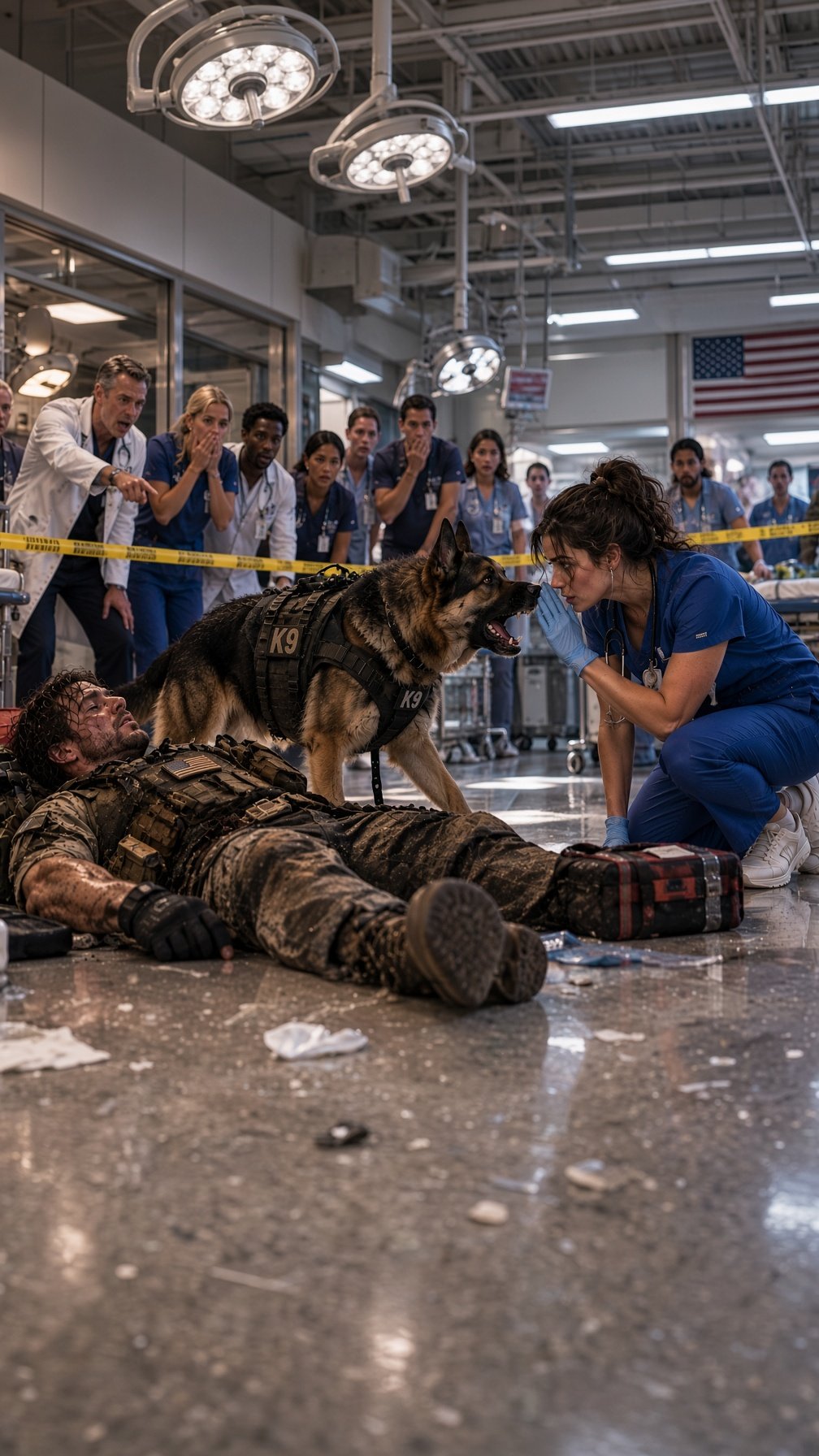

A wounded SEAL lies on the emergency room floor, and his canine will not let anyone get close.
The dog snarls at every doctor and nurse while the physician shouts orders and points his finger.
Everyone crowded behind the yellow tape. The soldier’s time is running out, and nobody knows what to do.
Then the nurse everyone ignored kneels in front of the dog, unafraid, and whispers a single word no one there recognizes, and the dog barks.
How does she know that call sign? And what does the dog see in her that no one else sees?
“Nurse Roark, are you deaf or just slow?”
Dr. Grant Halvorson snapped his fingers an inch from her face.
Jenna Roark kept her eyes on the floor. “Sorry, doctor. Bed six is done.”
“Done late. Again.”
He turned to the whole bay so everyone could hear. “Nine months at Naval Medical Center, and she still moves like she’s afraid of the equipment.”
A few nurses looked away. One resident smirked into his coffee.
Jenna said nothing. Her shoulders stayed curved. Her chin stayed low. Her hands trembled as she tucked a loose brown curl back into her messy bun.
It was a good act. She had practiced it for nine months.
Halvorson was the chief of emergency medicine. He was forty-six, polished, and terrified of being wrong.
Everyone in the ER knew it. He never stood near a crashing patient if a resident could stand there first. He corrected nurses loudly and praised himself quietly.
He disliked Jenna most of all. She was thirty-three, plain, and silent. She never argued.
Yet whenever a patient crashed, the room always seemed calmer near her.
“Fix the IV in bed nine,” Halvorson said. “Then restock the trauma bay. Try not to break anything.”
“Yes, doctor.”
She walked away with her head down.
Nobody noticed her eyes. They swept the bay like a guard checking a perimeter. Two exits east. One loading door north. Cameras in the corners. Fire alarm by the supply room.
She did it without thinking. She had done it for eleven years.
Near the waiting area, an old veteran in a wheelchair gasped. His service dog, a nervous black Labrador, had slipped its leash.
The dog bolted toward the automatic doors and a crying toddler.
Jenna did not run. She raised one flat palm, low and steady.
“Down,” she said, barely above a whisper.
The Labrador dropped to the floor at once. It stared at her, trembling, and waited.
The waiting room went quiet.
Jenna clipped the leash back on, handed it to the old man, and smiled gently. “He’s just scared, sir. He’s a good boy.”
Her sleeve had ridden up. A ring of pale, curved scars circled her left forearm. Teeth marks. Old and deep.
Jenna tugged the sleeve down before anyone could look.
Nurse Bethany Cole stared at her. “How did you do that? That dog listened to you like you were his handler.”
“Lucky, I guess,” Jenna said.
“Lucky,” Bethany repeated. She did not sound convinced.
Jenna turned away. A thin line above her right eyebrow itched the way it always did when she felt watched.
She had another name once. A call sign. A partner with four legs. A life she had folded into a box and buried at the back of her closet.
She wanted it to stay buried.
“Don’t let him get to you,” Bethany said, following her to the supply room. “He’s a coward. Everybody knows it.”
“He’s scared, that’s all.”
“Of what?”
Jenna slid a box of tourniquets onto the shelf. “Of being found out.”
The overhead radio crackled.
Every head in the ER turned.
“Naval Medical Center, this is Medic 4. Inbound with a blast casualty. Navy SEAL, male, thirty-eight. Traumatic injury, right lower leg. Tourniquet in place, but pressure is dropping fast. ETA four minutes.”
Halvorson straightened. He loved the word SEAL. It made him feel important.
“Trauma Bay 1. Everyone in position.”
The radio crackled again.
“Also, doctor, be advised. The patient has a canine with him. German Shepherd. Tactical vest. The dog will not leave his side.”
Halvorson laughed sharply. “A dog in my emergency room? Absolutely not.”
Jenna’s hand stopped over the shelf. Her heart gave one hard thump against her ribs.
“What breed did he say?” she asked quietly.
“Does it matter, nurse?” Halvorson snapped. “Get to your station.”
She stepped into the hallway. Her fingers were shaking again. This time it was not an act.
Outside, tires screeched. The ambulance doors banged open. And from inside the ambulance came a low, terrible growl.
The stretcher rolled through the doors at a run. Two paramedics pushed it. A young corpsman in dusty desert camouflage jogged beside them, pressing both hands against a soaked bandage.
“Chief Petty Officer Daniel Kessler,” the corpsman shouted. “Blast injury during a training exercise. Right leg below the knee. Tourniquet applied forty minutes ago. I think it slipped in transport.”
The patient was massive. Mud caked his beard and vest. His face was gray. Blood dripped off the stretcher rail and painted the white floor in bright red dots.
Beside the stretcher, matching every step, a German Shepherd trotted in a black tactical vest marked K9.
The dog was limping. He did not care.
The moment the paramedics tried to lift the chief onto the trauma bed, the Shepherd exploded.
He lunged, teeth flashing, and clamped onto the sleeve of a paramedic. The man screamed and yanked free.
“Back up!” someone yelled. “Everybody back up!”
The dog planted himself over the chief’s chest. His ears were pinned. His lips were peeled back. A deep rumble rolled from his throat, and every person in the room felt it in their bones.
“Get that animal out of here!” Halvorson shouted from behind a gurney.
“Sir, he’s on guard,” the corpsman gasped. “His name is Koda. He’s been like this since the blast. Nobody can touch the chief unless Koda releases him.”
“I don’t care what his name is. He’s a dog. Security!”
Two security officers hurried in. One held a catch pole. The other had a taser on his belt.
Koda swung his head toward them and barked once. A thunderclap.
Both men stopped cold.
Jenna stood near the back wall with a tray of instruments. She did not move.
She was looking at the dog’s left ear. A tiny notch cut the edge, old and neat.
She knew that notch.
She had seen it when he was eight weeks old. A fat, clumsy puppy with oversized paws.
No, she told herself. It can’t be.
Then she saw the dog’s collar tag under the vest. Three letters worn nearly smooth. She could not read them from here. She did not have to.
“Vitals!” Halvorson barked, pretending to be in charge from twenty feet away.
A nurse read the monitor aloud. “Blood pressure 70 over 40. Heart rate 140. Oxygen 90 percent. He’s bleeding out.”
The corpsman’s voice cracked. “Please. Somebody has to get to him.”
Halvorson pointed at security. “Tranquilizer dart. Call animal control or the base vet. Someone.”
“Sir, the base vet is thirty minutes out,” a security officer said.
“Then use the taser.”
“Doctor, you can’t,” Jenna said. Her voice came out soft and shaky. “If he gets hit, he’ll attack. He’ll kill someone.”
Halvorson spun on her. His face was red. “Stay in your lane, nurse. This is not your call.”
“Yes, doctor.”
“Do not speak unless I ask.”
Security hung yellow tape across the bay to keep staff back. Doctors, nurses, and residents crowded behind it, whispering, hands over their mouths.
The chief’s blood spread across the floor in a slow, dark pool.
Sixty seconds passed. Ninety.
The corpsman dropped to his knees at the edge of the tape. “Please,” he begged. “He’s my chief. He carried me out of a burning building once. Don’t let him die on this floor.”
Nobody answered him.
Halvorson stared at the dog, and the dog stared back.
“Pressure 68 over 36,” the nurse called.
Jenna looked at the blood. She looked at the dog. She looked at the tape and the scared faces behind it.
Her hands stopped shaking.
Eleven years of discipline told her one thing. Stay hidden. Stay quiet. Let him be the doctor.
Another voice, older and stronger, told her something else. A man is dying. The dog is protecting him. And you are the only person in this room who can stop both from becoming a tragedy.
Jenna set down the tray. She unclipped her stethoscope and laid it on the counter.
Slowly, she pulled the tie from her hair. Then she pulled it up again, tight and clean. A military bun with no loose curls.
Nurse Bethany Cole saw her straighten. She saw her shoulders drop back. She saw her chin lift.
“Jenna,” Bethany whispered. “What are you doing?”
Jenna did not answer.
She ducked under the yellow tape.
“Nurse Roark!” Halvorson shouted. “Get back here. That is an order.”
She kept walking.
The bay went silent.
Koda’s head snapped around. His growl deepened. He shifted his weight, muscles bunching, ready to spring.
Jenna stopped six feet away. She lowered herself to one knee. She kept her palms open at her sides and her eyes softly down. Never a challenge. Never a threat.
“Easy,” she breathed. “Easy, big man.”
The dog’s lips lifted higher. A single tooth glinted.
“Somebody stop her,” a resident hissed.
Nobody moved.
She inched forward on her knees. Five feet. Four. The growl grew louder, until the instrument trays rattled with it.
Her heart hammered, but her face stayed calm. Three feet.
She looked at the dog’s eyes. Amber. Wet. Terrified. Not angry. Terrified.
He was not guarding a stranger. He was guarding his whole world.
She leaned in until her lips were an inch from his notched ear. Her voice dropped to a whisper only he could hear.
“Koda,” she said. “Sable Two. Stand down.”
The room held its breath.
The growl broke off mid-note. The Shepherd froze. His ears rose, twitched, and swiveled toward her. His nostrils flared, drinking in her scent.
Then Koda barked. A single, sharp, joyful bark.
He stepped off the chief’s chest, sat on the wet floor, and pressed his shoulder against her knee.
A resident dropped a clipboard.
Somewhere behind the tape, someone gasped.
“Good boy,” Jenna whispered. Her eyes burned. “Good, good boy. I’ve got him. I’ve got your chief.”
The voice that came next was not the voice of the nurse they knew. It was steady, clear, and carried to every corner of the room.
“Bethany, I need a combat application tourniquet, two units of O negative, and two grams of tranexamic acid. Now.”
Bethany was already running.
Jenna moved to the chief’s leg.
The old tourniquet had slid down over his calf and loosened. Blood pulsed from the torn artery behind the knee.
She locked her left hand around the thigh, pressing hard against the vessel.
“Cut his pants,” she ordered. “Someone get me a light.”
A trauma tech hacked the fabric away.
The lower leg was mangled. The foot twisted at a terrible angle. Blood soaked her sleeves to the elbow. She did not flinch.
Bethany slapped the tourniquet into her palm. Jenna slid it high on the thigh, two inches above the wound. She cranked the windlass, turning it until the pulsing stopped.
Then she placed a second tourniquet right beside the first and cranked it tight.
“Bleeding controlled,” she said. “Write the time on his forehead. 14:52.”
The corpsman scrawled it with a marker, staring at her like she had grown wings.
“Pulse in his foot?” she asked.
“None.”
“Good. That means it’s tight enough.”
Blood arrived. She hung the first unit and pushed the tranexamic acid, two grams over ten minutes.
“Calcium gluconate, one gram,” she said. “Warm blankets. Keep him hot. Cold kills him faster than the bleed.”
Everyone moved. Nobody argued. They just moved.
“Pressure,” she said.
“84 over 48,” the nurse said. Then, seconds later, “90 over 58. Heart rate coming down.”
The corpsman put his face in his hands.
The chief’s chest rose and fell in a steady rhythm. His color slowly turned from gray to pink.
Halvorson came around the tape at last. His voice shook. “Who authorized that? Nurse Roark, who told you to do that?”
“You wanted him alive, doctor,” Jenna said without looking up. “He’s alive.”
“Where did you learn that? That’s not nursing. Nobody learns that.”
Jenna pressed two fingers to the chief’s neck. She said nothing.
Behind the tape, the whispers rose like a tide. “Did you hear what she said to the dog? Sable Two. What does that mean? Who is she?”
The corpsman looked up at her. His eyes were wide and wet. “Ma’am,” he said softly. “The chief talked about a Sable Two. He said she taught him everything about Koda. He said she was a legend.”
Jenna closed her eyes. She knew it was over.
Halvorson turned to the charge nurse, furious. “Pull her personnel file right now. I want to know exactly who she is.”
Koda lay down at Jenna’s feet and rested his chin on her shoe. He did not take his eyes off her.
“Take him to surgery,” she told the team quietly. “Move fast. I’ll be right behind you.”
Halvorson stood in her path. “You are not going anywhere. You are going to explain yourself to administration now.”
“Doctor, the chief needs a nurse in the OR.”
“Not you.”
Two security officers stepped up, one on each side of her.
Jenna looked at Koda. Koda looked at the security officers. A low warning rolled out of his chest.
“It’s all right, boy,” she said. “Stay.”
He stayed. His ears never left her.
Twenty minutes later, she sat in a glass conference room off the ER, still in bloody scrubs.
Across from her sat Commander Alan Price, the hospital’s deputy administrator. He was a soft man in a pressed uniform who had never worked a trauma bay in his life.
Halvorson sat next to him, arms folded, jaw tight.
“Nurse Roark,” Price began, “you crossed a security line, ignored a direct order, and performed procedures outside your scope.”
“The tourniquet is in every nurse’s scope, sir.”
“The way you applied it isn’t.” Halvorson leaned forward. “Nobody learns to do that in a classroom. Where were you trained?”
“Nursing school, doctor.”
“Liar.”
The word hung in the air.
Jenna met his eyes. Her posture was straight now. Her hands lay flat and still on the table.
Halvorson noticed. He shifted in his chair.
“I’m going to have your license reviewed,” he said, “and I’m going to have that dog removed from the building.”
“Koda stays with the chief.”
“You don’t give orders here.”
“I’m not giving orders, doctor. I’m telling you what’s going to happen.”
Commander Price cleared his throat. “Nurse Roark, we have a legal risk here. A civilian employee handled a military patient without authorization. The captain will hear about this.”
“Good,” Jenna said. “I’d like her to.”
Halvorson’s jaw flexed. He had expected tears. He had expected an apology.
Instead, the silent woman across the table looked at him the way a sergeant looks at a recruit who has forgotten his rifle.
Someone knocked on the glass. Bethany stood outside, pale. She held up her hand and pointed down the hall.
Halvorson opened the door impatiently. “What is it?”
“Doctor, it’s Koda. He isn’t in the waiting area anymore.” Bethany swallowed. “He’s in the trauma bay. He won’t stop staring at the wall.”
Jenna was on her feet before anyone could speak.
She walked out of the conference room fast, and this time nobody tried to stop her.
Koda stood alone in the empty trauma bay, rigid as stone.
His nose was pointed at a canvas bag leaning against the wall. It was the chief’s gear bag, tossed there when the paramedics cut off his vest.
The dog’s body was locked. His tail was straight and still. He did not bark. He did not growl.
He sat slowly, without ever taking his eyes off the bag.
Jenna knew that posture. She had taught it to a hundred dogs.
It was a passive alert. It meant one thing.
Explosives.
“Everyone out of this room,” she said, very calmly. “Right now.”
“Nurse Roark, this is ridiculous,” Halvorson scoffed, stepping in behind her. “It’s a bag.”
“Doctor, step back.”
“Don’t you dare tell me—”
He reached for the canvas strap.
Jenna’s hand shot out. She caught his wrist in a controlled lock, turned it, and walked him three steps backward before he could blink. She released him at once.
It took less than a second.
“Do not touch that bag,” she said. Her voice was low and flat and absolutely certain. “That dog has never been wrong. Not once.”
Halvorson rubbed his wrist. His mouth opened and closed.
“Corpsman,” she called. “What was the chief carrying in the exercise?”
The young corpsman appeared, breathless. “Live-fire drill, ma’am. Breaching charges and training grenades. Everything was accounted for.”
“Was it? The blast that hurt him. Did it come from something on his own kit?”
His face went white. “He said one of his grenade pouches took a piece of shrapnel. He said it felt wrong. He shoved it in the bag, and then he—”
He stopped.
Jenna turned to the charge nurse. “Pull the fire alarm. Announce a code yellow, bomb threat, east wing only. Call base security and Naval EOD. Tell them a live fragmentation grenade is in Trauma Bay 1.”
“Nurse, are you sure?”
“Move.”
The alarm screamed. The nurse ran.
“Dr. Halvorson,” Jenna said. “Clear this bay and the hallways to the east. At least five hundred feet. Every patient, every visitor. Walk them, don’t run them. Use the north doors.”
“I am the chief of emergency—”
“Then act like it.”
Something in her face made him nod.
Jenna cracked open the bag zipper an inch with the eraser end of a pen. She did not touch anything else.
Inside, she saw a grenade pouch torn open. A round steel body sat inside. The pin ring was bent. A crushed fragment of metal had jammed the safety lever half open.
One wrong bump, and it would arm.
She sealed the zipper again.
“Nobody touches this bag,” she said. “Nobody drops anything near it. Nobody runs in this hall.”
Staff began evacuating. Nurses pushed wheelchairs. Residents carried monitors. Security guided visitors toward the north exits.
It was calm, and it was fast.
“Wait,” Bethany said. “The chief is in the OR. That’s two corridors from here.”
Jenna’s stomach tightened. “How far?”
“Three hundred feet, maybe less.”
“Is the surgery team still working?”
“He’s on the table.”
Jenna thought fast. Blast radius. Fragments. Brick walls. Corridors. Three hundred feet was close, but not deadly if the walls held.
“Get me a heavy cart,” she said, “and every sandbag from the disaster closet. Build a barrier around the bag. Two feet thick. Go.”
Six staff members formed a line. The sandbags moved hand to hand. Jenna set each one herself, stacking them in a tight ring around the bag.
Koda sat beside her the whole time, calm and focused, never leaving her side.
Ten minutes passed. Sweat ran down her spine. Her arms ached. She did not stop, because a single crooked sandbag could mean a single wrong fragment.
Naval EOD arrived in a gray truck with flashing lights.
A wiry chief in a green bomb suit walked in and stopped short at the doorway.
“Who called this in?”
“I did,” Jenna said. “Fragmentation grenade. Damaged safety lever. Pin bent. Contact with the pouch is unsafe. K9 alerted before anyone saw it.”
The chief looked at her hands. He looked at the sandbags. He looked at the dog.
“Ma’am, who taught you to build a blast barrier?”
“A long time ago.”
“It’s textbook.” He shook his head. “You bought us a lot of safety. Everyone out. We’ll take it from here.”
She stepped back. Koda pressed against her leg.
Behind them, the EOD team lowered the bag into a containment vessel and rolled it out through the loading door.
Thirty seconds later, a muffled thump shook the floor.
The EOD chief keyed his radio. “Render safe complete. Controlled detonation. No casualties. Well done, everybody.”
The staff exhaled together.
In the OR, the surgery went on.
The chief’s leg was saved below the knee. A miracle the trauma surgeon credited entirely to the tourniquet and the calm hands that had placed it.
Jenna sat alone in the empty hallway, her back against the wall, Koda’s head in her lap. Her hands finally began to shake.
“It’s okay, boy,” she murmured. “It’s okay. We did it.”
He licked her wrist. He knew.
The front doors opened.
Captain Ruth Maddox strode into the ER.
She was the hospital’s commanding officer. Gray-haired, sharp-eyed, and wearing the uniform of the Navy Nurse Corps. Two officers followed her. One carried a thin, sealed folder.
The whole staff snapped to attention.
Maddox stopped in front of Halvorson. “Doctor, I understand we had an incident.”
“Captain, this nurse—” Halvorson started. “She acted outside her authority. She disobeyed my orders. She—”
“She evacuated my hospital from a live grenade and saved a Navy SEAL.” Maddox’s voice was ice. “I read the report in the car. But her file—”
She held up the folder.
“Sealed. It came from the Air Force this morning. Forty minutes before this happened, someone recognized her name on the SEAL’s incident report.”
She turned to Jenna, still on the floor with the dog.
Maddox’s face softened.
“Technical Sergeant Roark. On your feet, if you’re able.”
Jenna rose slowly. Her spine straightened. Her shoulders went back. Her eyes lifted, clear and steady.
The nurse who had hidden for nine months was gone. In her place stood a soldier.
“Ma’am,” she said.
Maddox opened the folder and read aloud so every person in the hall could hear.
“Technical Sergeant Jenna Roark. United States Air Force Security Forces. Military Working Dog Handler and Instructor, Lackland Air Force Base. Call sign: Sable Two.”
The hall was silent.
“Three deployments to Helmand Province. Bronze Star with Valor. During a night ambush near Sangin, she carried two wounded Marines a quarter mile under fire while her dog, Sable, cleared the route ahead. Sable died shielding her from a roadside bomb. She was wounded, decorated, and honorably discharged. She never asked for a parade.”
Nobody spoke. Somebody sniffled behind the desk. A resident stared at his shoes.
“She trained the first litter of the Navy’s Shepherd program,” Maddox continued. “One of those pups grew up to be Koda.”
The dog lifted his head and thumped his tail against the floor.
Jenna’s eyes filled.
“Ma’am, I left the service because I couldn’t do it anymore. After Sable, I couldn’t look at another dog. I thought I’d earned a quiet life.”
“And instead, you kept saving people,” Maddox said gently.
“I didn’t know how to stop.”
Halvorson stood frozen. His face had gone from red to white.
“Captain, I didn’t know—”
“No,” Maddox said. “You didn’t ask. For nine months, you shouted at the best asset in your department because she was quiet. She did not raise her voice. She did not need to. You told a nurse to stay in her lane while a man bled out and a dog protected him. You reached for a live grenade. Doctor, you will report to my office at eight tomorrow morning. I am opening a formal review of your conduct and your leadership.”
Halvorson’s shoulders sagged. “Yes, Captain.”
He turned to Jenna. He opened his mouth, closed it, and tried again.
“Sergeant Roark, I was wrong. I’m sorry.”
She looked at him for a long moment.
“Everyone’s afraid of something, doctor. Learn to ask for help. It’s the bravest thing a leader can do.”
He nodded and walked away without another word.
A weak voice drifted down the corridor.
A gurney rolled out of recovery, pushed by a nurse. Chief Daniel Kessler lay pale on the pillow, his eyes barely open.
“Koda,” he rasped.
The Shepherd surged forward and rested his head on the chief’s chest.
Kessler looked past him and found Jenna. A slow, tired smile crossed his face.
“Sable Two,” he whispered. “Thought that was you. Knew that voice from the ambulance. Nobody else could get through him.”
“Rest, Chief,” Jenna said, resting a hand on his arm. “You’re going to keep the leg.”
“You taught me everything about that dog. I never thanked you.”
“You just did.”
His eyes closed. He slept.
Maddox waited until the hall emptied.
“Sergeant, I have a proposal. The Navy has no formal program for combat casualty care of military working dogs or for their handlers. Teams lose animals and men every year for lack of it. I want you to build one.”
“Ma’am, I’m a nurse.”
“You’re both. That’s exactly why.”
Jenna glanced at Koda, who stood watching her with bright, patient eyes.
She thought of Sable. She thought of every handler who had ever knelt in the dirt beside a wounded partner.
“I’ll need a reserve commission,” she said, “and Koda.”
“Done and done.”
She smiled, small and tired. “Then I’ll stay.”
That night, the staff who had watched her from behind yellow tape lined the hallway as she walked out.
Bethany squeezed her hand. The trauma tech who had cut the chief’s pants saluted, awkward and proud.
Nobody said a word. Nobody needed to.
For the first time in eleven years, Jenna did not hide her face.
Weeks later, a new sign hung in the hospital corridor.
K9 and Handler Combat Care Program.
Under it, a photograph showed a woman in Navy scrubs kneeling beside a Shepherd. Her hair pulled tight. Her head high.
Some people are not quiet because they have nothing to say. They are quiet because they have already said everything in places you will never see.
Real strength does not shout orders or point a finger. It kneels, listens, and speaks softly.
And when the moment comes, even a frightened dog knows whom to trust.