

“Get out of my way, nurse.”
Major Grace Holloway did not move.
She just lowered her eyes the way she had trained herself to do for three years.
Three years of standing in hallways while men in flight suits walked past her like she was furniture.
Nobody at Ror Air Reserve Base knew what she used to fly.
Nobody knew she had once looked down at the curve of the Earth from 240 miles up, breathing recycled air through a visor cracked by micrometeorite dust.
They only saw the badge. Blue scrubs. Tired eyes. A woman who changed IV bags and said yes, sir, to men half as qualified as she used to be.
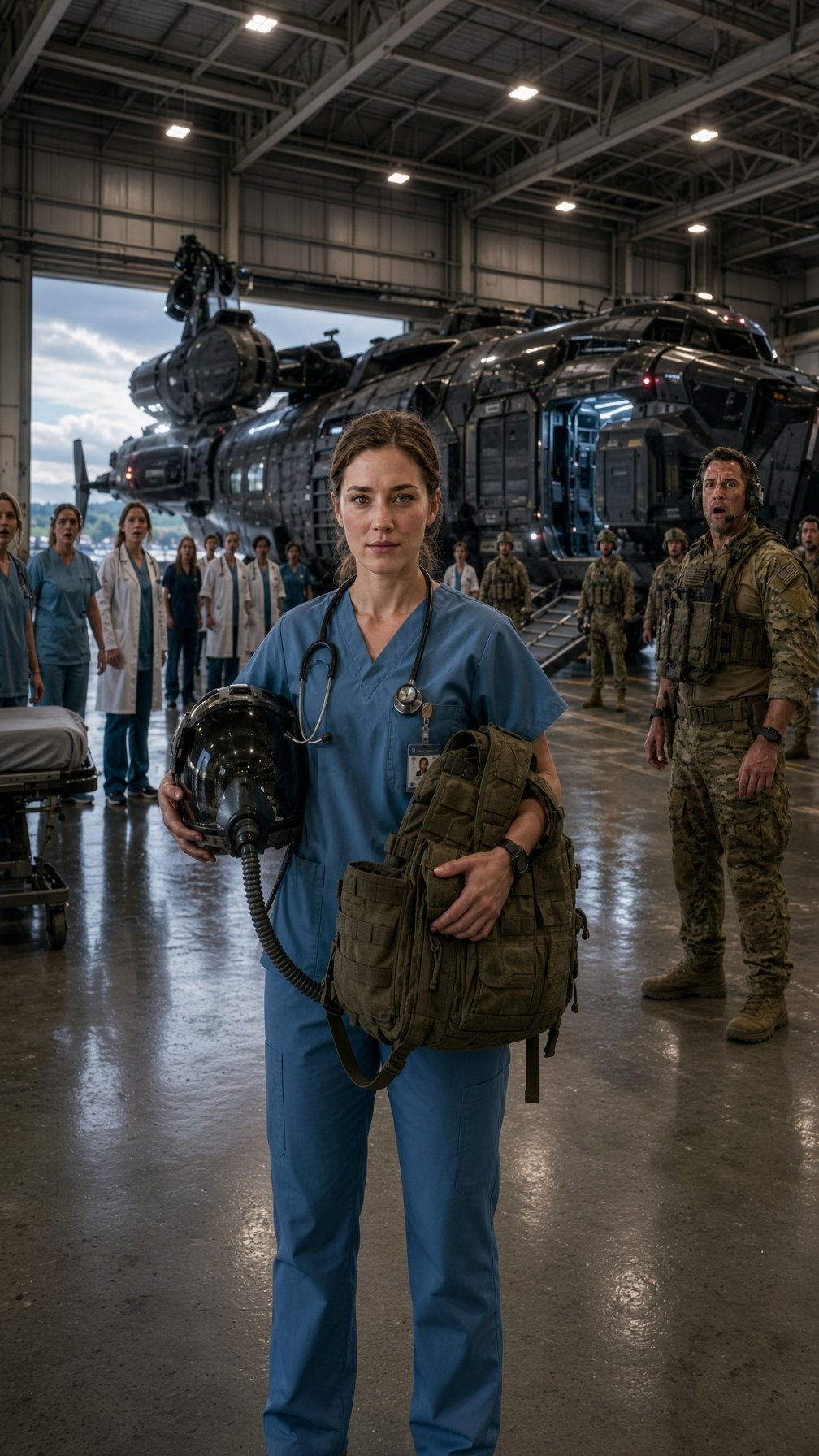
Then the reactor truck rolled through the gate with its containment seal breached, and the only aircraft in the state built to fly straight into a live radiation plume needed a pilot nobody could find.
The SEAL team leader standing in that hangar had no idea the answer was standing three feet behind him, holding a flight helmet she was never supposed to touch again.
“Get out of my way, nurse.”
Grace stepped back against the wall.
The corridor at Ror Air Reserve Base smelled like machine oil and burnt coffee.
Master Sergeant Dale Pruitt shoved past her with a clipboard, not bothering to look at her face. He never did.
She had been at Ror for fourteen months.
Fourteen months of quiet shifts in the joint medical bay that served both the small civilian hospital wing and the reserve base attached to it.
Fourteen months of being handed the wrong charts, the wrong instructions, the wrong respect.
Her hands did not shake when she picked up the clipboard he dropped.
They used to. Not anymore.
Three years of practice had taught her stillness.
“Copy that,” she said, and filed it without reading it, because she already knew what it said. Routine drill schedule. Nothing that mattered. Nothing that would ever matter here in this life she had built for herself out of blue scrubs and silence.
Her ID badge read Grace Holloway, RN.
It did not say Major.
It did not say United States Space Force, Detachment 3, Aerospace Medicine and Flight Operations.
It did not say 240 miles, six months, one catastrophic re-entry burn that ended a career nobody was allowed to know existed.
She adjusted her badge and walked toward the nurse’s station, shoulders curved slightly forward, chin down. It was a posture she had practiced in a mirror. Small. Unremarkable. Safe.
The scar behind her left ear itched sometimes, right where the pressure helmet strap had cut into her skin during an emergency depressurization drill that went wrong four years ago.
She touched it without thinking and then made herself stop.
“Holloway.”
The charge nurse, Denise, waved her over. “Bed six needs vitals. And can you deal with the pilots in the break room? They’re driving me insane.”
“Copy,” Grace said again.
It was a word she used too much. A habit from another life that had never quite worn off.
The break room held four men in flight suits, laughing too loud, boots up on furniture that wasn’t theirs.
Captain Whitfield, the youngest, looked up when she walked in.
“Hey, you’re the one who does the flight physicals, right?”
“Sometimes,” Grace said.
“You ever seen the inside of a cockpit?”
She almost smiled. “Almost. Once or twice.”
He laughed like she’d made a joke.
She let him think that.
At the far end of the room, a man she hadn’t seen before stood near the window, arms crossed, watching the hangar bay through the glass.
He wore no name tape, no unit patch she recognized, just plain multicam and a coyote-brown holster rig that sat too low and too practiced to belong to a support soldier.
Special operations.
She knew the silhouette the way other women knew perfume brands.
He turned his head slightly when she entered. Just enough.
His eyes moved over her the way trained eyes move over a room, cataloging exits, cataloging people, filing her under harmless before he’d even finished the sweep.
Then he looked back out the window.
She felt that dismissal land somewhere old and familiar.
It didn’t sting the way it used to. It just registered. Filed. Forgotten.
“That’s Chief Reyes,” Whitfield said, following her glance. “SEAL liaison. Something’s happening out at the Comstock Ridge reactor site. Convoys inbound.”
Grace kept her face neutral. “What kind of something?”
“Above my pay grade,” Whitfield said, and went back to his coffee.
She finished bed six’s vitals in eleven minutes. Blood pressure normal. Pulse steady.
She wrote the numbers in handwriting that had once signed off on re-entry checklists for a spacecraft worth $400 million, and now signed off on a seventy-one-year-old man’s discharge paperwork instead.
This was the life she had chosen. She reminded herself of that every single day.
Chosen, not lost.
There was a difference, even if some mornings it didn’t feel like one.
By 1400 hours, the atmosphere in the medical bay had changed.
She noticed it the way she noticed pressure drops in a cabin, in her skin before her mind caught up.
Radios crackled differently. Doors that were usually propped open were shut. Denise was on the phone, knuckles white around the receiver.
“What’s going on?” Grace asked.
“Comstock Ridge,” Denise said, hand over the mouthpiece. “Some kind of containment failure. They’re bringing casualties here instead of the civilian trauma center because of exposure control protocols.”
Grace’s pulse did not spike. It settled, the way it always had in the moments that mattered. The moments she wasn’t supposed to be good at anymore.
“Radiological?” she asked.
Denise nodded, eyes wide. “That’s what they’re saying. I don’t know details. Nobody’s telling us details.”
Grace already knew more than she should have.
Comstock Ridge was not a commercial plant.
She had seen it once, years ago, on a classified briefing slide about experimental micro-reactor technology being tested for orbital and lunar power systems.
If Comstock Ridge had a containment failure, this was not a normal hazmat call. This was the kind of event that used to land directly on her desk, back when she had a desk with three stars stenciled on the door outside it.
She said nothing.
She had learned to say nothing a long time ago.
Chief Reyes walked past the nurse’s station at a pace just short of running. Phone against his ear, jaw tight.
“I don’t care what the manifest says. I need a qualified pilot for that airframe in the next ninety minutes or we lose the whole northern basin,” he said, and then he was gone through the double doors, boots echoing.
Grace watched him go.
Something cold moved through her chest, familiar and unwelcome.
She recognized the shape of the problem before she had any right to. She recognized it the way a person recognizes their own handwriting on a page they don’t remember writing.
Ninety minutes. A pilot. An airframe that only one program in the country actually operated.
She told herself it wasn’t her problem anymore.
She told herself that every day, and most days it was true.
At 14:30, the first ambulance convoy arrived.
Grace was in the triage bay when the doors slammed open, and the smell hit her first.
Ozone and scorched metal and something underneath it that made the hair on her arms rise. A smell she remembered from a training exercise gone wrong in a chamber three atmospheres deep.
The man on the gurney wore a tan flight suit with a patch she recognized instantly, though nobody else in the room would have.
Program insignia. Restricted access.
A patch that meant this man had trained in the same six-week qualification course she had, years apart. Same instructors. Same impossible standards.
His name tape read COLE.
His face was gray. An IV line already ran into his arm, but his vitals on the monitor were sliding in a direction that made every nurse in the room move faster.
“Radiation exposure, partial-thickness burns to the hands and forearms, possible internal contamination,” the paramedic called out. “He’s the primary pilot for the extraction bird. He went down at the containment perimeter trying to get the vehicle prepped.”
Grace’s stomach dropped in a way it hadn’t in years.
The only aircraft capable of flying directly into an active radiological plume, sealing it, and delivering a containment charge to the reactor core before full meltdown was sitting on the tarmac outside with no one qualified to fly it.
She looked at the monitor. She looked at Cole’s hands, wrapped now in sterile gauze, hands that would not be gripping a control yoke for a very long time.
Chief Reyes burst back through the doors, radio in hand, eyes scanning the room like he was counting inventory instead of people.
“Where’s the flight surgeon? I need someone who can clear a replacement pilot in the next hour. And I need to know if there’s anyone on this base rated for the Firebird platform.”
Nobody answered.
The room stayed silent except for the monitors.
Grace stood very still at the edge of the bay, holding a chart she wasn’t reading. Watching a man she had once respected the way soldiers respect gods bleed out his flight status onto a gurney sheet.
She felt the old instinct rise in her chest like something clawing at a door that had been welded shut for three years.
She thought about her badge. Blue scrubs. RN. Nothing else.
She thought about the shoulders she had trained herself to curve forward, the eyes she had trained herself to lower, the voice she had trained herself to soften into agreeable nothing.
Then she thought about the northern basin and the small town twenty miles past it, and the reactor core counting down toward a number she understood better than almost anyone alive.
“Chief Reyes,” she said.
Her voice came out steadier than she expected. It came out in a register she hadn’t used in three years. The one that used to carry across a control room and stop conversations cold.
He didn’t turn at first. Nobody turned for the nurse.
“Chief Reyes,” she said again, and this time something in her tone made him stop.
He looked at her the way he had looked at her in the break room. Cataloging. Filing.
Except this time, the file didn’t close so fast.
“I’m a little busy,” he said.
“You need a pilot rated on the Firebird platform,” Grace said. “You need someone in the next ninety minutes or the containment window closes.”
His eyes narrowed. “How do you know the airframe designation?”
Grace didn’t answer that. Not yet.
Behind her, Cole’s monitor let out a single warning tone, and the room surged toward him.
And for one more moment, Grace Holloway stood exactly where she had stood for fourteen months.
Small. Unremarkable. Safe.
The moment did not last.
“How do you know the airframe designation?” Reyes asked again.
Grace looked at Cole’s monitor. The warning tone had settled back into a rhythm, but a bad one.
She had maybe ninety seconds before this conversation stopped mattering, because there would be nobody left to save at all.
“Because I flew it,” she said.
Reyes stared at her the way a man stares at a door that has just spoken to him.
“You flew it,” he repeated.
“Firebird Two. Tail number 0417. Qualification course, Detachment Three, four years ago.”
She kept her voice level, clinical, the way she once briefed generals. “I logged one hundred forty hours on that airframe before my status was pulled.”
“Your status was pulled,” Reyes said. “Meaning what?”
“Meaning it’s not something I’m cleared to discuss with a chief petty officer in a hospital corridor,” Grace said.
And for the first time in three years, she heard her own command voice come out of her own mouth without permission, without apology.
“Meaning you have ninety minutes, a dying pilot, and one other qualified body in this building, and you’re wasting time asking me questions instead of getting me to that tarmac.”
Denise had stopped moving. Whitfield had stopped moving.
Everyone in the triage bay had gone still except the monitors.
Reyes’s jaw worked once. Twice.
He had spent fifteen years reading people under pressure, and something in his gut told him the woman in front of him was not lying, even though every visible fact about her said she had to be.
“Prove it,” he said.
Grace crossed to the counter, grabbed a pen and the back of a discharge form, and drew the Firebird’s cockpit layout from memory in under twenty seconds.
Primary flight display. Containment charge release toggle, guarded, top left of the center console. Radiological shielding indicator. Manual override sequence for the payload bay doors, four digits, a code that changed monthly and that she should not have still remembered and did anyway, because some things a body does not forget.
She slid the paper across the counter.
Reyes looked down at it. His face did not change, but something behind his eyes did.
“That’s classified,” he said quietly.
“I know,” Grace said. “I helped write half of it.”
For three full seconds, nobody in the room breathed.
Then Reyes’s radio crackled, a voice reporting containment integrity dropping another two percent.
And the moment broke apart into motion.
“Move,” Reyes said. Not to her. Through the radio, to his team, to the world. Then to her, quieter. “You’re with me.”
They ran.
The hangar bay doors were already open when they reached them, and the Firebird sat under floodlights like something that did not belong on Earth.
All matte-black plating and radiation shielding and rotors folded tight against a fuselage built for a different kind of sky.
Grace had not stood this close to one in three years.
Her body remembered the shape of it before her mind finished processing that she was really here.
Ground crew scattered around the aircraft, running checklists they only half understood, because the only man who fully understood them was on a gurney with burned hands.
“She’s rated,” Reyes announced to the crew chief, jerking his thumb at Grace. “Get her a suit.”
The crew chief, a stocky woman named Alvarez, looked Grace up and down with open disbelief. “She’s a nurse.”
“She’s whatever gets that bird in the air in the next eighty minutes,” Reyes said. “Move.”
They shoved a radiation-rated flight suit into Grace’s arms.
She stripped off her lab coat right there on the tarmac, pulled the suit on over her scrubs, hands moving through a sequence they had not forgotten, even though she had spent three years pretending they had.
Zipper. Seal check. Glove lock. Helmet.
Her fingers found the strap that had once cut a scar behind her left ear and did not hesitate.
Whitfield had followed them out, jogging to keep up, staring at her like he was watching a magic trick performed in reverse.
“You said you’d seen the inside of a cockpit once or twice,” he said.
“I did,” Grace said, snapping the last buckle into place. “I flew this one out of a live reactor fire in the Aleutians two years before you got your wings.”
He said nothing else after that.
Reyes stood at the base of the boarding ladder, watching her climb, his expression unreadable in a way that felt to Grace almost like respect trying to find room to exist inside disbelief.
“Why didn’t you tell anyone?” he said. It wasn’t quite a question.
“Because the program that trained me doesn’t exist on paper,” Grace said, one boot on the ladder. “And because I promised the people I served with that it never would. On paper or otherwise. I’m only breaking that promise right now because there is no version of this where I let a town die because I was scared of what people would think of me.”
Reyes held her gaze for one long moment.
“Copy that,” he said, and for the first time, he did not say it the way people said it to a nurse.
He said it the way soldiers said it to each other.
Inside the cockpit, the world narrowed the way it always had.
Down to switches and numbers and the particular silence that came right before ignition.
Grace ran the startup sequence from memory, hands steady, breath even.
Three years of pretending peeled away layer by layer with every checklist item.
Primary power green. Rotor engagement green. Shielding integrity ninety-eight percent. Payload bay armed.
Through the headset, a controller’s voice crackled in.
“Firebird Two, be advised. Plume density at Comstock Ridge has increased. Wind shift expected in eleven minutes will push contamination toward township of Ashford, population four thousand one hundred. You are cleared for immediate departure.”
“Copy. Departing now,” Grace said, and her voice did not shake.
And somewhere behind her in the hangar, Reyes stood watching the aircraft lift off the tarmac with an expression that told the entire ground crew this was not the day they thought it was going to be.
The Firebird climbed hard into a gray afternoon sky, engines screaming, and Grace Holloway, who fourteen hours ago had been a nurse nobody looked at twice, banked toward a live reactor plume with a payload of containment foam and a training she had sworn to never use again.
Below her, the hospital shrank into a gray rectangle.
Somewhere inside it, Cole was fighting for his own life on a gurney, and Denise was probably still standing frozen at the nurse’s station, and word was already beginning to move through the base the way word always moves through places built on secrets.
The nurse who disappeared this afternoon had a name nobody there had ever heard.
Ahead of her, the horizon glowed the wrong color.
Grace adjusted her heading, checked her shielding readout one more time, and flew directly into it.