

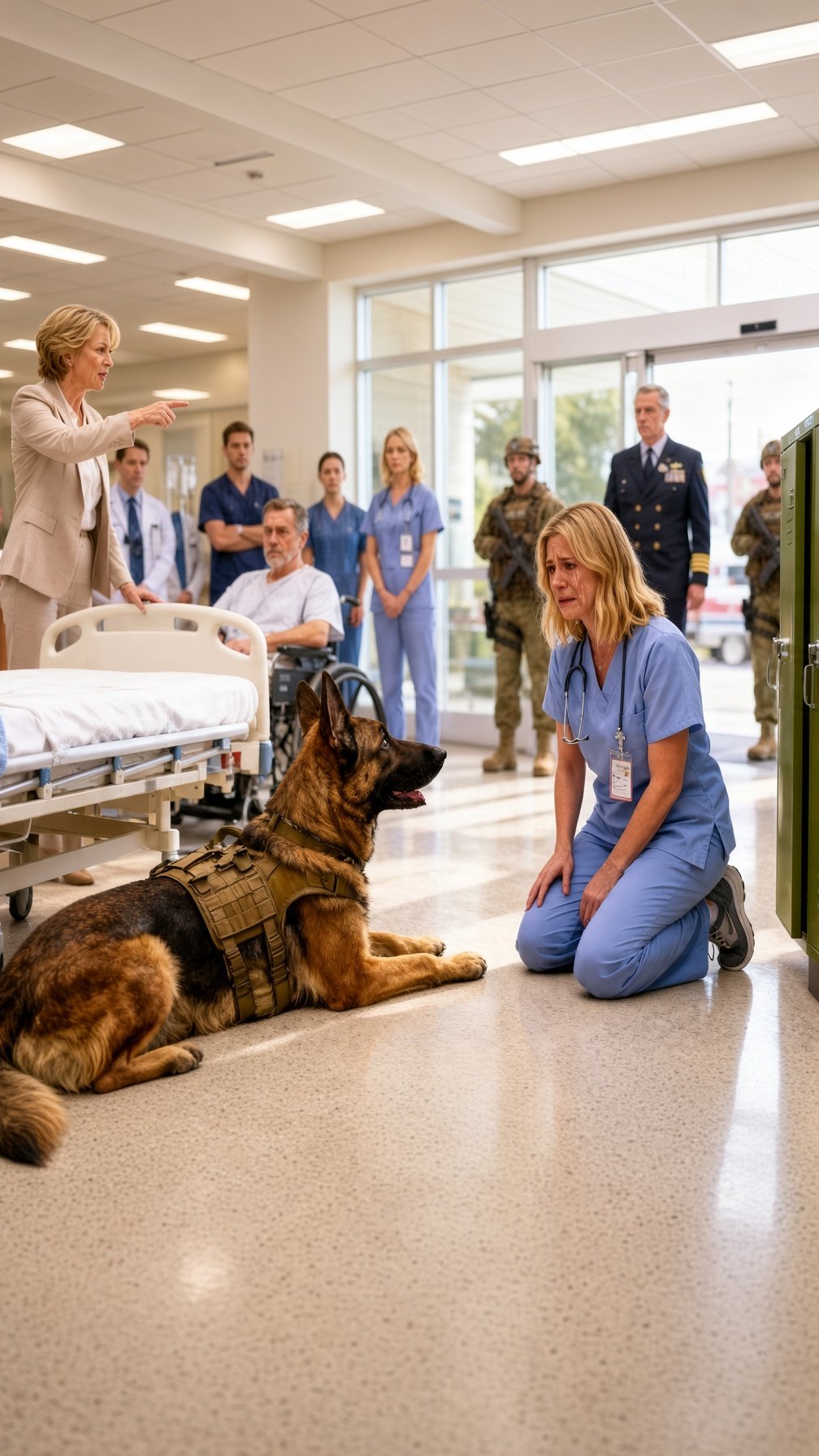
K9 Refused to Eat After the SEAL Was Killed — Until a NURSE Uncovered His Final SECRET
The dog hadn’t eaten in six days.
Rex, ninety-four pounds of Belgian Malinois, decorated K9 with four combat deployments, lay pressed against the empty hospital bed like he was waiting for a command that existed somewhere between this world and whatever came after it.
The ward nurses had tried everything.
Chicken, beef, his handler’s old training treats smuggled in by a staff sergeant who didn’t know what else to do.
Rex wouldn’t touch any of it.
He just stared at the wall where Commander Nolan Voss’s bed had been, ribs beginning to show beneath his tactical vest, eyes fixed on something no one else could see.
Then on the morning they came to drag nurse Evelyn Carter out of the building, badge revoked, belongings in a cardboard box, two security guards flanking her like she’d stolen something, Rex lunged off that bed with a sound that stopped every person in the corridor cold.
He didn’t go for the guards.
He didn’t go for the door.
He went straight for the locker.
If you’ve stayed with me this long, I need you to do something before this story goes any further.
Hit that follow button.
Drop a comment telling me what city you’re watching from.
I want to see how far this story travels.
Like this if you want to know what was inside that locker, because what Evelyn Carter found in the next twenty minutes was going to unravel something that powerful people had spent a great deal of money trying to keep buried.
Now let’s go back to where this actually started.
Evelyn Carter had been assigned to the Brierwood Military Medical Center as a contract nurse three weeks before Commander Voss was brought in.
And she had known, in the particular way that people who’ve spent years in field hospitals know things, that something about his admission was wrong.
Not medically wrong.
Medically, the paperwork was immaculate.
Almost too immaculate.
The kind of clean that took effort.
Penetrating trauma to the chest, left side.
Hemothorax partially evacuated in the field.
Bilateral contusions consistent with blast exposure.
The official summary from the extraction team said he’d been caught in crossfire during a routine reconnaissance op that went sideways.
That his team had done everything right.
That Commander Voss had simply been in the wrong position at the wrong moment and taken a round that no amount of training could have prevented.
Evelyn had read that report twice and felt something in her stomach go sideways.
She hadn’t said anything right away.
That was the thing about being the new contractor.
You learned fast which hills were worth dying on and which ones would just get you buried quietly.
She’d been a traveling nurse for fourteen months by then, cycling through hospitals the way some people cycle through cities, never staying long enough to collect enemies or friends with any real loyalty in either direction.
It was easier that way.
After eight years of Army nursing, two combat deployments, and one IED that had taken four people she’d known by first name, easier had started to feel like a reasonable life goal.
But she’d read that report a third time, and then she’d pulled Commander Voss’s admission vitals, and the numbers didn’t line up the way they should have.
The wound pattern was inconsistent with the stated distance of engagement.
She wasn’t a ballistics expert, but she’d treated enough gunshot wounds in enough field conditions to know what they looked like when someone was shot from the front versus from close range.
The angle of entry, the tissue damage noted in the initial assessment, the burn signature around the entry point that the admitting physician had documented and then apparently decided not to follow up on.
It all pointed somewhere the official report refused to go.
She’d brought it to Dr. Harlon Price, the ward’s senior attending, in the most careful way she knew how.
Not an accusation.
A question.
“These notes seem inconsistent. Is there a secondary assessment I’m missing?”
Price had looked at her the way men in his position tended to look at contract nurses who asked questions that weren’t in their job description.
It was a look that managed to be simultaneously bored and hostile, like she was a minor inconvenience he’d been forced to acknowledge.
“You’re here to manage post-op recovery protocols,” he said.
“Not to second-guess trauma assessments made by physicians with twenty-three years of military medicine.”
“I understand that. I’m just noting that—”
“Miss Carter.”
He’d said it with a particular flatness that was meant to remind her of the distinction between her and the doctor.
“Commander Voss is deceased. His family has been notified. The investigation is closed. Your job is to manage the remaining patients in this ward. And if that’s something you can’t do without inserting yourself into matters that don’t concern you, I’ll have a conversation with your placement agency this afternoon.”
She’d let it go.
Or she tried to.
The problem was Rex.
The K9 unit had been brought to Brierwood three days after Commander Voss’s body was transferred, because nobody in the military bureaucracy could figure out what else to do with a working dog whose handler was gone.
The official plan was to hold Rex at the medical center temporarily while the K9 division processed his reassignment paperwork.
A formality that was supposed to take forty-eight hours and had stretched into a week because, as the kennel sergeant put it with visible discomfort, Rex isn’t cooperating with the intake process.
What that meant, Evelyn discovered when she wandered past the kennel on her second day, was that Rex had bitten through his third collar, destroyed a crate rated for dogs twice his size, and was refusing all food and water with a consistency that was starting to alarm the veterinary staff they’d called in.
She’d stood at the kennel door that day and watched him.
And Rex had watched her back.
There was something in the dog’s eyes that Evelyn recognized in the abstract but couldn’t quite name.
Something that lived in the same territory as grief but wasn’t quite that either.
It was more like waiting.
The sustained physical attention of a trained animal who believed the person he was waiting for was still coming and who would continue to believe it with his entire body until something proved him otherwise.
“How long has he been like this?” she’d asked the kennel tech.
“Since they brought him in.”
The tech, a young specialist named Dobbins who looked like he’d rather be anywhere else, shrugged with his shoulders and his whole face.
“He’ll drink a little water if we push it through, but food, nothing. Vet says another few days and we’re looking at IV nutrition.”
“Has he responded to anyone?”
“Not really. I mean—”
Dobbins paused, looking uncomfortable.
“He’s not aggressive. He just ignores everyone. Except he keeps looking toward the east wing.”
The east wing was where Commander Voss’s room had been.
Evelyn had reached through the kennel slats without really thinking about it, the way you did sometimes when an animal was in distress and your hands moved before your judgment caught up.
She’d expected Rex to ignore her the way Dobbins said he ignored everyone.
Instead, Rex had pressed his nose against her palm and stood very still.
“Huh,” said Dobbins.
She’d started visiting the kennel every morning after that.
Not officially.
It wasn’t anywhere near her ward responsibilities, and she’d gotten an appointed look from the nursing supervisor the one time she’d been spotted going that direction during shift hours.
But before her shift, and sometimes after, she’d spend twenty minutes with Rex.
Not doing anything in particular.
Just being there.
He’d started eating small amounts by the fourth day.
Not enough, but some.
On the fifth day, she made the mistake of asking questions again.
It started with the supply order.
Evelyn had been filing post-op medication logs for three patients in the east ward when she noticed a discrepancy in the controlled substance inventory from the night of Commander Voss’s death.
Nothing dramatic.
A small gap between what had been logged as administered and what the pharmacy had actually dispensed.
The kind of gap that happened in busy hospital environments all the time when nurses were rushing and documentation got compressed.
Except the gap was in the sedative category.
And the timing aligned precisely with the window during which Commander Voss’s condition had been listed as stable before it had suddenly, without the nursing staff being paged, collapsed into critical.
She’d mentioned it to the charge nurse, Dolores Hamby, who’d been with Brierwood for eleven years and had the particular weariness of someone who’d survived multiple administrations by learning when to look away.
“That’s a documentation error,” Dolores said, not looking up from her computer.
“We get those. I’ll flag it for pharmacy review.”
“The timing is—”
“I’ll flag it for pharmacy review,” Dolores repeated, in a tone that made it clear the conversation was finished.
Evelyn had written her concern in the nursing notes anyway.
It was the smallest act of resistance she could manage without crossing a line she couldn’t uncross.
A factual observation buried in the administrative record.
The kind of thing that could be dismissed as a routine notation or, if anyone came looking later, could be found.
She didn’t know that flagging the controlled substance discrepancy would trigger an automatic administrative review.
She didn’t know that the administrative review would land on the desk of Marcus Theelin, Brierwood’s chief operations officer, within forty minutes.
And she didn’t know that Marcus Theelin would immediately pick up a phone and make a call to someone who was not in the hospital.
She found out about all of that later.
What she found out first was that she was being suspended.
The COO himself delivered the news, which told her something.
COOs didn’t personally handle contract nurse suspensions.
They had three layers of administration for exactly that purpose.
He came to the nursing station at 7:42 in the morning with his assistant and a man from hospital security.
And he had the careful, practiced pleasantness of someone who’d made a career of delivering bad news in ways that were legally defensible.
“Miss Carter,” he said.
“We’re going to need your badge.”
She’d stared at him for a moment.
“Excuse me.”
“Effective immediately, your contract is being suspended pending an administrative review. You’ve been flagged for accessing patient records outside your assigned caseload and for making unauthorized notations in military-sensitive documentation.”
“Those are nursing notes. That’s my job.”
“Those are documentation entries concerning a military patient whose records are under the jurisdiction of the armed services. And your contract does not include authority to make clinical observations about that case.”
He held out his hand for her badge with the patience of someone who had already decided how this was going to go.
“This isn’t a termination. It’s a suspension pending review. You can collect your personal belongings from the staff locker room, and my assistant will escort you out.”
Evelyn felt something hot move through her chest.
Not surprise exactly, but the particular anger of someone who’d expected this and still somehow hoped to be wrong.
“The discrepancy I noted is real,” she said.
“The pharmacy records will be reviewed by qualified personnel.”
Theelin’s expression didn’t change.
“Your badge, Miss Carter.”
She gave it to him.
She didn’t have a choice.
She’d walked to the staff locker room and stood at her locker for a long moment, pulling out the things that were hers.
A change of clothes, her personal stethoscope, a thermos, a photo she’d taped to the inside of the door of her sister’s kids at the beach last summer.
She put everything in the box the security escort had produced, and she thought about eight years of Army service, about field hospitals in conditions that would have made Brierwood’s sterile corridors look like a resort, about the two deployments and the commendations that were currently sitting in a folder in her apartment twenty minutes away.
You’re a nurse, not an investigator.
She picked up the box.
That was when the alarm went off.
Not a medical alarm.
A facility alert.
The kind that meant something had breached containment somewhere in the building.
The security escort looked at his radio, looked at Evelyn, and made the decision that whatever was happening was more important than watching her walk out the front door.
“Stay here,” he said, and went.
Evelyn stood in the locker room with her cardboard box and listened to the sound of running feet in the corridor outside.
And then she heard something else.
A sound she’d spent the past five days learning to distinguish from the general noise of the ward.
Nails on linoleum.
Fast.
Rex came around the corner of the locker room at a dead run, trailing a snapped lead that someone had obviously clipped to him in a hurry without engaging the secondary lock.
He skidded on the tile, found his footing, and stopped directly in front of Evelyn with an intensity that made her take an involuntary step backward.
Then he turned around, looked back at the corridor, looked at her.
“Rex?”
Her voice came out steadier than she felt.
“What are you— How did you get out?”
He made a sound she hadn’t heard from him before.
Not a bark, not a whine.
Something lower and more urgent.
The communication of an animal who’d been trained to operate without verbal commands when necessary and was now using every tool available to him.
He turned toward the corridor again, took two steps, stopped, looked back.
“You want me to follow you,” she said.
It wasn’t really a question.
She’d worked with enough military dogs to know what a directional indication looked like.
She set down the cardboard box.
She knew in a clear-eyed way that following a K9 through a hospital she’d just been suspended from was not a decision that was going to help her in any review process.
She knew that the security escort would be back.
She knew that whatever Rex was leading her toward was something that the people who’d just taken her badge did not want her to find.
She followed him anyway.
Rex moved through the facility with the particular confidence of an animal who had memorized a route.
Which meant he’d been this way before.
Possibly multiple times.
Possibly while everyone assumed he was locked in his kennel going quietly catatonic.
He didn’t hesitate at corridor junctions.
He took two turns and a stairwell, moving toward the east wing, and Evelyn kept up with him in the flat-footed, efficient way she’d learned to move through cramped field hospitals, where running drew attention and walking with purpose got you everywhere.
The east ward was technically cleared.
Commander Voss’s room had been stripped and sanitized.
The bed reassigned to a new patient who hadn’t yet arrived.
The corridor was quiet in the specific way of hospital wings that had recently been made to feel normal again after something bad happened in them.
Rex stopped outside Room 114.
Not Voss’s room.
The one across the hall.
A supply staging area that was used for temporary equipment storage when overflow from the main supply room backed up.
The door had a standard keypad lock.
Rex sat in front of it and looked at Evelyn with absolute conviction.
“I don’t have the code,” she said.
Rex had apparently anticipated this problem, because he immediately dropped to his belly and pressed his nose against the gap at the bottom of the door, then looked back at her with an expression that translated roughly as, I’m telling you it matters. Figure out the door.
Evelyn stood there for a moment, running through options.
Then she thought about the supply requisition she’d filed for the east ward over the past three weeks.
And she remembered that the staging room code was rotated on a monthly cycle and that the current code had been included in the orientation packet that nobody had thought to retrieve from her when they took her badge.
She still had the orientation packet on her phone.
She pulled it up.
She entered the code.
The door opened.
The room was standard supply staging.
Wire shelving units, boxes of PPE and sterile draping, a portable IV stand in the corner, fluorescent light that buzzed slightly when she hit the switch.
Along the far wall, six personal storage lockers.
The standard-issue kind provided to long-term ward patients or station personnel to secure valuables during extended stays.
Most of them had combination locks.
One of them had a different kind of lock.
A keyed military-issue padlock.
The kind that came with personnel property bags from active-duty assignments.
Rex went to it without hesitation and sat.
His tail moved once, twice.
Not happy exactly, but something.
Yes. Here.
Evelyn approached the locker slowly.
Up close, she could see what she hadn’t been able to see from across the room.
The frame of the locker along the left edge of the door had fresh scratches in the paint.
Not the casual scratches of regular use.
These were deeper, more deliberate, clustered around the gap between the door and the frame in the pattern of an animal that had been trying repeatedly to pry something open with a paw.
Rex had been here before.
Possibly many times.
She examined the padlock.
Military-issue meant it was keyed to a specific tag number, and she didn’t have the key, and there was no clean way to—
Rex nudged her hand.
She looked down.
He was pushing something toward her with his nose.
A small item he’d apparently been carrying in his mouth this whole time, which she hadn’t noticed because she’d been focused on following him.
She picked it up.
A key.
Small, military-tagged, attached to a piece of olive drab paracord.
It had been tied to Rex’s tactical vest, she realized.
Hidden in the webbing somewhere in the folds where a casual inspection wouldn’t find it.
Commander Voss had put it there.
Evelyn stood with the key in her hand for a moment and felt the particular weight of a situation that had become something she hadn’t expected when she woke up that morning.
Then she unlocked the padlock.
The locker held Commander Voss’s personal effects bag, a set of civilian clothes on a hanger, and a worn paperback with its spine broken in four places.
Standard.
The kind of thing any long-term patient kept within reach.
She almost missed it.
The interior wall of the locker, the back panel, was slightly warped.
Not much.
Just enough that someone who wasn’t looking for it would see a slightly imperfect piece of metal and keep moving.
Evelyn pressed her fingers against it and found the edge where it didn’t quite meet the frame, and she felt the give of something that wasn’t riveted, but hinged.
She pulled.
The false back opened on a four-inch-deep compartment, just wide enough to hold what was inside.
A tactical field drive.
The kind used for secure data transport in military operations.
Its casing cracked along one corner and stained dark brown in a color that Evelyn recognized from eight years of combat nursing without needing to be told what it was.
Wrapped around it, tied with the kind of careful knot that took practice to learn, was a bandage.
Military field dressing.
The same dark stain, older and dried completely.
She stood there looking at it, the drive in both hands.
Rex pressed against her left leg with the stillness of a dog who had finally, after six days, done the thing he was supposed to do.
She could hear footsteps in the corridor outside.
More than one person moving fast.
She looked at the drive.
She looked at the door.
Then the door opened.
And it wasn’t the security escort.
It was four people in civilian clothes who moved like they were anything but.
Two ahead, one flanking, one holding back at the threshold in the covering position.
And the woman in front had a badge out before the door had fully swung.
A badge with a classification header Evelyn didn’t recognize but that had the weight and format of something that lived several floors above the agencies most people knew about.
“Evelyn Carter,” the woman said.
Not a question.
Her eyes dropped to the drive in Evelyn’s hands, and something moved across her face.
Relief, Evelyn thought, though it was compressed and professional and gone in an instant.
“Don’t let go of that.”
In the corridor behind them, Evelyn could see the edge of something else.
Through the east ward’s floor-to-ceiling windows, three black SUVs were pulling into the parking structure.
And the people getting out of them were moving with the organized urgency of people who had been waiting a very long time to arrive somewhere.
Rex made a sound at Evelyn’s side.
Low.
Certain.
She tightened her grip on the drive.
The woman’s name was Special Agent Dara Okonkwo, and she said it once, fast, while her team moved through the staging room with the practiced efficiency of people who didn’t need to talk much to function.
She was maybe forty, compact, with close-cropped hair and the kind of eyes that were always doing two things at once.
Watching Evelyn’s face.
Cataloging everything else in the room simultaneously.
“How long have you had the drive?” she asked.
“Thirty seconds,” Evelyn said.
“Maybe less.”
“Did you open it?”
“It’s a tactical field drive. I don’t have the equipment to—”
“Did you attempt to open it?”
“No.”
Okonkwo held out her hand.
And Evelyn felt a pull in her chest that surprised her.
A reluctance to let go of the thing she’d just spent twenty minutes and her entire employment status to find.
She handed it over anyway.
Okonkwo passed it to the agent on her left without looking, who slid it into a hard-shell case that appeared from somewhere and sealed it with a click that sounded very final.
Rex watched all of this without moving from Evelyn’s side.
When the agent with the case moved toward the door, Rex’s head tracked the motion, but his body stayed put.
Pressed against Evelyn’s leg with a weight that she was starting to understand was intentional.
He wasn’t guarding the drive anymore.
He was staying with her.
“I need to know everything you observed in this ward over the past three weeks,” Okonkwo said.
“Starting now.”
“I was just suspended,” Evelyn said.
“Twenty minutes ago. Your timing is—”
“I know.”
Something shifted in Okonkwo’s expression.
Not quite apology, not quite acknowledgment.
Somewhere in between.
“The suspension is a separate problem. Right now, you’re the only civilian in this building who’s actually touched that locker. And I need your account before the scene gets any more contaminated than it already is.”
Evelyn looked at the false back panel, still open, the empty compartment where the drive had been.
She thought about Theelin’s hand extended for her badge that morning, his assistant standing just behind him with a clipboard, the particular kind of smug administrative efficiency of someone who believed they had already won.
“The controlled substance discrepancy,” she said.
“That’s what started this. I logged it in the nursing notes yesterday, and this morning I was suspended.”
Okonkwo was already writing.
“What discrepancy?”
Evelyn told her all of it in the precise, abbreviated way she’d learned to deliver medical information under pressure.
No hedging, no unnecessary softening.
Just the facts in the order they occurred.
The wound pattern inconsistency she’d noticed on admission.
The sedative gap in the pharmacy records.
The timing relative to Voss’s deterioration.
The conversation with Price and the conversation with Dolores, who’d stared at her keyboard and promised to flag things for review.
Okonkwo let her talk without interrupting, which Evelyn appreciated.
When she finished, the agent looked up from her notepad.
“The attending, Price. How long has he been here?”
“Eleven years, I think. He mentioned it when he—”
Evelyn paused.
“When he was explaining why my opinion didn’t matter.”
Okonkwo made a note.
“And Theelin, the COO. Had you had prior contact with him before this morning?”
“He introduced himself at the all-staff meeting my first week. That’s it. I’m a contract nurse. I’m not exactly in his orbit.”
“He came personally to collect your badge.”
“Yes.”
“That doesn’t strike you as unusual?”
“It struck me as exactly as unusual as it was,” Evelyn said.
“I just didn’t have anywhere to go with it until now.”
One of the other agents appeared in the doorway, the one who’d been at the corridor threshold, still holding the covering position even though the corridor was clearly empty.
He caught Okonkwo’s eye and made a small, deliberate gesture that Evelyn wasn’t sure she was supposed to see.
Okonkwo saw it.
Her jaw tightened by a fraction.
“We need to move,” she said.
And then, to Evelyn, “You’re coming with us. Don’t argue about it.”
“I wasn’t going to,” Evelyn said.
They moved her to a conference room on the administrative floor that the team had apparently commandeered at some point before Evelyn’s involvement.
Because when they arrived, there were laptops already open, and a man she hadn’t seen before was on a call that he ended the moment they walked in.
Rex came without being invited and lay under the table at Evelyn’s feet with his nose on his paws, watching the room.
The man from the call was introduced as Commander Elliot Hos, a Judge Advocate General military legal authority, which told Evelyn that whatever was happening had crossed from investigative territory into something with legal dimensions that were already in motion.
He was in civilian clothes but carried himself in the specific way of someone who had been in uniform long enough that it had restructured his posture.
He looked at Evelyn the way people sometimes looked at her when they’d just received information they hadn’t expected.
Not unkindly.
More like recalibrating.
“You were Army,” he said.
“Eight years combat medical specialist, then RN through the Army’s nursing program. Two deployments. I separated fourteen months ago.”
“Honorable?”
“Yes.”
He nodded, something settling in his expression.
“I’m going to be direct with you because we don’t have a lot of time and I think you’ll respond better to direct. We’ve been tracking that drive for nineteen days. We knew it was somewhere in this facility. We did not know Commander Voss had managed to secure it before he died, and we did not know about the compartment. The only reason we found it today was because your nursing notes triggered a review that panicked someone into making phone calls that we were already monitoring.”
Evelyn absorbed this.
“You were watching the phones.”
“We’ve been watching a lot of things. The suspension this morning, that wasn’t hospital administration protecting its processes. That was someone inside this facility trying to move you out of the building before you found something.”
“Before Rex found something,” she said.
Hos looked at the dog under the table.
“Yes. We think Voss trained Rex specifically for this contingency. The key in the vest, the route to the storage room. That wasn’t an accident. That was a dead man’s instruction.”
The room got quiet in the specific way rooms got quiet when a thing was said out loud that everyone had been thinking but hadn’t yet named.
Evelyn looked at her hands on the table.
She thought about the drive wrapped in that field dressing, the stain she hadn’t let herself think too hard about in the storage room because she needed to stay functional.
“He knew he wasn’t going to make it,” she said.
“He knew someone was going to make sure of it.”
Hos said, “There’s a difference.”
The next hour was one of the more disorienting of Evelyn’s life, which was saying something given that she’d once spent seventy-two hours in a field hospital during a dust storm that took out communications for the entire forward operating base.
Okonkwo’s team worked in the organized, low-noise way of people who did this regularly.
Pulling building access logs, cross-referencing pharmacy records with security footage timestamps.
Setting up, in the corner of the conference room, a portable forensic unit that the agent with the hard-shell case was now running the drive through carefully with gloved hands and equipment Evelyn didn’t recognize.
Evelyn sat and answered questions when questions were directed at her and tried not to get in the way and watched the operation find its shape around her.
She was used to this.
Being inside a moving system that was larger than any one person’s view of it, contributing what you could contribute and trusting that the rest was being handled by people who knew their jobs.
But at the forty-minute mark, something changed in the room.
The agent at the forensic unit said something quiet to Okonkwo, who crossed to look at the screen, and something moved through her posture that she controlled but not quite fast enough.
She looked at Hos.
Hos came to look.
They stood together reading something for long enough that the other agents in the room noticed and went carefully still.
“What is it?” Evelyn said.
Nobody answered immediately.
She’d spent enough time in institutions to know that the non-answer was itself information.
And what it was telling her was that whatever was on the drive was worse than they’d expected, and they were deciding right now how much to tell her.
“The extraction route,” Okonkwo finally said, not turning from the screen.
“We had intelligence indicating it was compromised before the OP. What we didn’t have was confirmation of how it was compromised.”
She turned then.
“The drive has communications timestamped between someone with access to classified operational planning and an outside party connected to a private defense contracting group.”
“Someone sold the route,” Evelyn said.
“Someone sold the route,” Hos confirmed.
“For a figure that I’m not going to put in this room until we have the drive properly secured and the warrant language tightened. But yes. Commander Voss didn’t just die in crossfire. He was put in a position where crossfire was guaranteed.”
Evelyn sat with that for a moment.
She’d known something was wrong from the admission records.
She’d known it in the abstract, academic way of a nurse who’d seen enough trauma to read wound patterns and felt something not adding up.
But knowing in the abstract and knowing that someone had sold a man’s location to people who would use it to kill him were different weights.
“The person he was communicating with,” she said.
“The one who sold the route. Are they in this building?”
The look that passed between Okonkwo and Hos lasted less than a second.
“We believe so,” Okonkwo said.
The next piece of it came from an unexpected direction, the way the worst complications usually did.
Evelyn had been given access to a hospital terminal in the conference room to pull the nursing documentation she’d referenced in her account.
The specific notes, the pharmacy cross-reference, the admission vitals that had first made her uncomfortable.
She was pulling the files while Okonkwo’s team worked around her when she noticed something in the access log that hadn’t been there two hours ago.
Someone had tried to access Commander Voss’s medical records seventeen minutes ago.
The attempt had failed.
The records were now under federal hold, and the system had kicked back an unauthorized access error.
But the attempt had been logged, and the user ID attached to the log wasn’t one of Okonkwo’s team members.
It was an administrative credential.
Senior level.
She turned the screen so Okonkwo could see it.
Okonkwo looked at the credential ID, looked at her team’s liaison running the building access log, and said one name in a flat, careful tone.
“Theelin.”
The liaison pulled the concurrent building access records at the same timestamp as the failed medical record attempt.
Marcus Theelin’s key card had logged him into the administrative server room on the third floor.
“He’s trying to access something,” the liaison said.
“Looks like an archive.”
He typed fast.
“He’s going for the security footage from the east ward the night of Voss’s admission.”
Okonkwo was already moving for the door.
“Lock the archive. Full hold.”
She pointed without stopping at the agent nearest Evelyn.
“Stay with her.”
And then she was gone, taking two of the team with her, moving with the quiet, urgent momentum of someone who’d just watched a trap close around the right person from the right direction.
The conference room felt larger with fewer people in it.
Evelyn looked at Rex, who had lifted his head at the sudden movement and was watching the door.
She looked at the screen, at Theelin’s credential blinking in the access log.
She thought about him standing at the nursing station that morning with his hand out for her badge, the practiced pleasantness, the assistant with the clipboard.
She thought about how calm he’d been.
And whether that calm came from confidence that he’d already managed the situation or whether it was the performance of a man who’d been managing things for long enough that the performance had become instinct.
Her phone buzzed.
She looked at it.
A text from a number she didn’t recognize.
No name.
“Don’t say anything about the medication variance until I call you. There are people in that building working against you. I can help.”
D.H.
Dolores Hamby.
The charge nurse who’d told her twice that she’d flagged the pharmacy discrepancy for review and then apparently done nothing with it.
Evelyn stared at the text.
Dolores, who had been at Brierwood for eleven years.
Dolores, who had looked at her keyboard during that conversation in a way Evelyn had read as discomfort but could now read as something else.
Recognition, maybe.
The recognition of someone who’d already seen something they wished they hadn’t and had been carrying it in silence for longer than Evelyn had been in the building.
She was about to show the text to the agent stationed with her when the fire alarm went off.
Not a drill tone.
The emergency evacuation signal.
Three sharp bursts followed by the automated voice directing personnel to their designated exits.
The agent’s radio crackled immediately.
Two voices at once.
He pressed his earpiece and turned to Evelyn with an expression that was trying to stay professional and not quite getting there.
“That’s not a fire,” he said.
“No,” Evelyn agreed.
“Someone pulled an alarm to move people.”
He was already on the radio, talking low and fast.
Under the table, Rex was on his feet, and his posture had changed.
The shift from watchful to alert.
The difference visible in the set of his shoulders and the angle of his ears.
A dog who had been trained to respond to exactly this kind of unstructured chaos and was now waiting for direction.
The agent looked at her.
“I need you to stay.”
“If someone pulled the alarm to create movement, the server room is less protected right now,” Evelyn said.
“Okonkwo just went there. She needs to know about the text.”
He hesitated.
She could see him running the calculation.
His orders, which were to stay with her, against the operational reality she’d just described.
“Show me the text,” he said.
She held up her phone.
He looked at it, then pressed his earpiece and repeated the content in quick, precise language while Evelyn listened to the alarm continue and watched Rex pace the length of the conference room in short, controlled movements, burning energy without direction, waiting for someone to tell him what to do next.
Outside the conference room window, she could see the parking structure from an angle she hadn’t noticed before.
And in the parking structure, a black SUV that had been stationary since Okonkwo’s team arrived was now moving, working its way toward the exit level with the careful, unhurried speed of something trying not to look like it was in a hurry.
She stood up, crossed to the window, watched the SUV reach the exit ramp.
“Someone’s leaving,” she said.
The agent was still on his radio, and she could hear in the pattern of his responses that the information she’d just given him was colliding with something else coming through the earpiece.
Multiple pieces of a picture that were only now fitting together.
He turned from the window, and she saw something change in his face.
The specific expression of someone who’d been handed a problem that was above what their current position could solve.
“The drive,” he said.
“The forensic unit.”
He stopped.
His hand went to the hard-shell case on the conference table.
He unlatched it.
The drive was there.
Evelyn could see it.
She let herself breathe for half a second.
Then she saw what was underneath it.
What was in the case that shouldn’t be there.
And the breath stopped.
A small device.
Metal.
A status light that had, until approximately sixty seconds ago when the alarm started pulling building power into emergency systems, been blinking green.
It was blinking red now.
The red light didn’t pulse.
It held steady, which was worse.
Because a pulse meant the device was still cycling through a process, still doing something that could potentially be interrupted.
Steady meant it had already done what it was designed to do.
“What is that?” Evelyn said.
The agent, his name was Briggs, she’d caught it from Okonkwo’s briefing, was already on the radio.
His voice low and controlled in the specific register of someone who was scared and had been trained not to sound it.
“Conference room. We have a foreign device in the case. Repeat, foreign device in the evidence case. Drive status unknown.”
The response from the other end was fast and not reassuring.
Briggs listened, said, “Copy,” and looked at the hard-shell case with the expression of a man who’d just been told to do something he didn’t want to do.
“I need to know if the drive is intact,” he said, mostly to himself.
“Don’t touch the device,” Evelyn said.
“If it’s a signal jammer, touching it completes the circuit. If it’s something else—”
She stopped.
She didn’t want to finish that sentence, and she could tell from Briggs’s face that she didn’t need to.
He didn’t touch it.
He leaned close enough to look at the drive beneath it, checking the casing, the seals on the data port.
“It looks intact physically. Whether it’s been wiped remotely is a different question.”
“Yes,” he said.
“Yes, it is.”
The fire alarm was still going.
Through the conference room wall, Evelyn could hear the sound of the building moving.
Footsteps, voices, the specific organized shuffle of a facility evacuation that wasn’t quite orderly enough to be a real drill but not chaotic enough to be a genuine emergency.
Someone had calibrated the alarm carefully.
Enough disruption to move people, thin out the corridors, create cover.
Not enough to trigger lockdown protocols that would have frozen building access and made escape impossible.
This had been planned.
Not this specifically.
Not a response to Okonkwo’s team being here today, because nobody could have anticipated Evelyn finding the drive this morning, Rex escaping his kennel, all of it.
But someone had a contingency.
Someone had thought through what to do if the drive was ever found.
And the contingency involved a device placed inside a forensic case in a conference room that, until forty minutes ago, had been a standard hospital administrative space.
Which meant someone had been in this conference room after Okonkwo’s team set up.
“The device was placed after you arrived,” Evelyn said.
“Someone came in here while you were deploying.”
Briggs looked at her.
Then he looked at the case, at the position of the device relative to the drive, and she watched him work through the same logic and arrive at the same destination with his jaw tight and his eyes doing the thing Okonkwo’s eyes did.
Cataloging.
Processing.
Reassigning threat levels in real time.
He got back on the radio.
Okonkwo came back into the conference room four minutes later, and she was not the same as when she’d left.
She’d been precise and controlled before.
The kind of composure that came from training and repetition.
Now she was precise and controlled and furious, and the fury was visible in the set of her shoulders and the way she looked at the device in the case like she was committing it to a list.
“Server room was clear when we got there,” she said.
“Theelin’s credential logged out forty seconds before we arrived. We pulled security footage.”
She paused.
“The camera in the east wing corridor was looped. Has been looped for the past eighteen minutes. Someone with facility system access ran a recorded feed.”
“The alarm,” Briggs said.
“Pulled from a station on the second floor. The station is in a blind spot between two cameras. Whoever did it knew the coverage map.”
She looked at Evelyn.
“The text from Hamby. I need to know exactly what it said.”
Evelyn showed her the phone.
Okonkwo read it, and something in her expression shifted in a direction Evelyn couldn’t quite read.
Not skepticism, but something adjacent to it.
The careful weighing of information from a source whose motivations weren’t yet established.
“Dolores Hamby has been at this facility for eleven years,” Okonkwo said.
“Our background on her is clean. No flags. But eleven years is a long time to see things and decide not to report them.”
“She might not have understood what she was seeing,” Evelyn said.
“Not until I started asking questions and things started moving fast.”
“Or she’s been part of it, and she’s trying to position herself ahead of the collapse.”
Okonkwo handed back the phone.
“Don’t respond to the text yet.”
“I wasn’t planning to.”
Okonkwo looked at her for a moment.
A different kind of look than before.
Something more considered.
Then she turned to the forensic agent who had been working on the drive since the moment she came back.
Gloved hands moving with deliberate care.
Equipment producing data on a tablet screen that Evelyn couldn’t read from her angle.
“Status,” Okonkwo said.
“Drive is intact,” the agent, Marsh, a woman with a technical stillness about her that suggested she could work through a building collapse without losing her count, said without looking up.
“The device in the case is a signal suppressor, not a wiper. It was blocking remote access, not initiating an erase. Someone wanted to prevent the drive from being transmitted, not destroy it.”
“They wanted to take it,” Briggs said.
“Or take what’s on it.”
“Yes.”
Marsh looked up now, and her expression had something in it that resolved the texture of the room slightly.
“The data is intact. Encrypted, but intact. And I’m starting to peel the first layer.”
“How long?” Okonkwo asked.
“The outer encryption is military standard. I have the protocols. Thirty minutes, maybe less, for the accessible sectors.”
“Work fast,” Okonkwo said, which was not particularly useful advice, but Marsh nodded anyway because she understood it wasn’t really advice.
It was a statement about what the room needed to hear said aloud.
Rex, still moving in his contained circuit of the conference room, stopped in front of Evelyn and pressed his head against her knee.
It was the first time he’d done that.
Not the side press, not the alert posture, but the specific heavy contact of an animal that was tired and choosing to lean.
She put her hand on his head without thinking, and he stayed there, weighed against her, both of them occupying the same uncertain moment.
It took Marsh twenty-two minutes.
In that twenty-two minutes, the building evacuation reached the point where the administrative floor was largely clear of non-essential personnel, which gave Okonkwo’s team more freedom of movement and less cover for anyone trying to move through the building undetected.
Hos got on a call that lasted eleven minutes and left him looking like someone had added a significant weight to his shoulders that he was now redistributing across his skeleton.
Two of Okonkwo’s agents conducted a sweep of the third-floor server room and found, behind a secondary rack unit, a wireless transmitter that had been installed recently enough that the mounting adhesive hadn’t fully cured.
Something placed within the past forty-eight hours by someone with facility IT access.
Evelyn sat.
She answered questions when asked.
She watched Rex, and she thought about Commander Voss lying in the bed across the hall from the staging room, injured and aware that he was running out of time, hiding a drive in a false-backed locker and putting a key in his dog’s vest and trusting that Rex would know what to do when the moment came.
She thought about what it cost to make that calculation.
To know that the system meant to protect you had been compromised.
That the people who should be trustworthy weren’t.
And to build a contingency out of the only thing left that you were certain of.
A dog who would remember.
“Carter.”
She looked up.
Marsh was watching her from across the table.
“I need you to look at something,” Marsh said.
Evelyn crossed to the forensic station.
On the tablet, Marsh had pulled the first decrypted sector.
Not communications, not financial data, but medical records.
Specifically, a set of files that had been formatted to look like standard field medical documentation.
Triage assessments, treatment logs, the kind of administrative output that combat units generated in enormous volumes and that nobody outside the medical chain typically reviewed carefully.
Embedded inside the formatting, visible only if you knew what you were looking at and knew how to look for it, was a second layer of data.
Not encrypted in the conventional sense.
Encoded in the structure of the documentation itself.
In the specific sequencing of medications listed, the timestamps, the patient identifiers that weren’t quite standard and would read as clerical error to anyone not familiar with the specific protocol Evelyn had learned during her second deployment.
She stared at it for a moment.
“This is field medical notation,” she said.
“From the Army’s emergency communication protocol for use when secure comms are compromised.”
She looked at Marsh.
“Voss embedded data in fake medical records using a protocol that only Army medical personnel would recognize.”
Marsh’s expression didn’t change much, but something sharpened in it.
“Can you read it?”
“I can read the structure.”
Evelyn pulled the tablet toward her slightly and looked at the sequence.
Her hands were not quite steady.
She felt the unsteadiness in her wrists and made a conscious effort to rest the tablet on the table so it wouldn’t show.
“He used a modified version. I need a minute.”
She took the minute.
She read the sequence three times, translating the embedded pattern into its underlying content, the way she’d been trained to do in a context that now felt both very distant and very immediate.
When she looked up, Okonkwo was standing at her shoulder.
“He named someone,” Evelyn said.
“Inside the facility. Not in the communications on the drive. He put this separately in the encoded layer so that if the communications were found and the obvious data was accessed, this part would still require someone with the right background to read.”
She set the tablet down.
“He didn’t know who he could trust in the military chain, so he documented it in a format that could only be decoded by someone like him. A medic. A field nurse. Someone from that world.”
Okonkwo was very still.
“Who did he name?”
Evelyn looked back at the tablet.
The name Voss had encoded in the modified emergency communication protocol, cross-referenced with two specific dates and a file designation that corresponded to the classified operational planning period before his final mission, was Dr. Harlon Price.
The arrest order for Price took eleven minutes to come through from Hos’s contact.
And in that eleven minutes, Dr. Harlon Price, who had continued to move through the hospital’s partial evacuation with the unhurried professionalism of a senior attending managing a disrupted shift, reached the physician’s parking garage.
Evelyn wasn’t in the corridor when it happened.
She was still in the conference room, Briggs keeping her there with slightly more insistence than before, the room now the nexus point of a situation that was moving faster than any single person could track in its entirety.
She heard it on the radio.
Two communications from the two agents Okonkwo had redirected to the parking level.
A vehicle, a brief escalation.
Then Okonkwo’s voice, flat and certain.
“We have him.”
What Evelyn heard in the conference room in the subsequent minutes was edited by distance and the one-sided nature of radio communications, but the shape of it came through.
Price had not gone quietly.
He’d attempted to use his key card on a service exit that had already been locked by Hos’s authority.
He’d argued.
He’d invoked his credentials, his years of service, his relationship with the facility’s board, the legal complications of detaining a physician without the proper chain of notification.
He’d said, “You have no idea what you’re dealing with,” in the specific way of someone who had convinced themselves they were still the most powerful person in any room they entered.
He wasn’t in a room anymore.
He was in a parking garage with two federal agents and the full weight of what was on that drive bearing down on everything he’d built over twenty-three years.
Evelyn sat in the conference room and felt something settle in her chest that wasn’t satisfaction.
Not quite.
It was closer to the feeling of a long-held breath being released.
The physiological relief of a body that had been braced for impact finally getting the signal to stand down.
Rex lifted his head from her knee and looked toward the door.
Then the complication arrived.
The complication was Dolores Hamby, which was both surprising and not.
She appeared in the conference room doorway with Briggs one step behind her, and she looked like someone who had been moving very fast and had just stopped.
The specific post-exertion look of someone whose legs had caught up with her head.
She was still in her nursing uniform, her ID badge slightly askew, and she was holding her phone with both hands in a grip that was more about having something to hold than actually using it.
“I texted her,” Dolores said to Evelyn, ignoring everyone else in the room with the tunnel vision of someone who’d made a decision and was committed to it.
“I texted you because I didn’t know who else.”
She stopped, looked at the room, took it in.
The agents, the forensic equipment, the federal authority of it.
And recalibrated visibly.
“I should have come forward earlier. I know that.”
“Tell me what you know,” Okonkwo said from across the room.
Dolores looked at her, looked at Evelyn.
She seemed to make another decision.
“I saw Price in the east wing the night Voss died. Not unusual. He was the attending. But the timestamp on his badge access was after the nursing staff had documented Voss’s condition as stable. He went in. He was in there for fourteen minutes. When the code was called, Price was the first responder, and he ran the resuscitation.”
She swallowed.
“I’ve run enough codes to know when someone is running one with the intention of succeeding and when someone is going through the motions.”
“Why didn’t you report it?” Briggs asked from behind her.
“Because I wasn’t certain. Because Price has been here longer than I have and has relationships that—”
She stopped again, and this time the stopping had a different quality.
The quality of someone confronting a story they’ve told themselves until it wore smooth and is now looking at the original.
“Because I was afraid. That’s the honest answer. I convinced myself I wasn’t sure enough to say something, and the truth is I was sure enough, but I was afraid.”
The room held that for a moment.
Nobody moved to fill it quickly, which Evelyn appreciated.
“You’re sure now?” Okonkwo asked.
“Price called Theelin at 11:47 the night Voss died. I saw him on the phone in the corridor outside the nursing station. Theelin arrived at the hospital at 12:23 a.m. and went directly to Price’s office. I know because I was on a late charting shift, and I logged them both without thinking about why I was doing it.”
She pulled up something on her phone and held it out.
“I took a photo of the log. I don’t know why. I just— I took it.”
Okonkwo crossed the room and looked at the phone.
Something in her expression shifted in a direction that closed a gap.
“You’re going to need to give a formal statement,” she said.
“Tonight.”
“I know,” Dolores said.
“I know that.”
She looked at Evelyn then.
Directly.
And there was no performance in it, no self-justification, no attempt to reframe what she’d done or hadn’t done.
Just the look of someone who’d waited too long and was aware of the exact shape and weight of that.
“I told you I’d flag it for review,” Dolores said.
“I’m sorry I didn’t. I should have.”
Her voice didn’t break, but it went thin at the edge.
“He was a good man, from everything I saw. He deserved better than what happened in that room.”
Evelyn looked at her for a moment.
She thought about saying several things.
And then she thought about the field dressing on the drive and the key in Rex’s vest and the encoded message that could only be read by someone who’d spent time in exactly the kind of places that changed how you looked at everything afterward.
“Tell them everything,” she said.
“That’s what helps him now.”
The next ninety minutes were the most operationally dense of the situation, and they moved with the particular compressed-time quality of high-stakes events that would take days to fully process but demanded immediate response.
Marsh completed the decryption of the drive’s primary sectors.
And the picture that emerged was worse in its specifics than what Okonkwo had described to Evelyn earlier, which was already bad.
The communications on the drive between an account traced to Price and an encrypted channel connected to a defense contracting entity operating under three layers of corporate structure documented eleven months of information exchange.
Not just Commander Voss’s extraction route.
Personnel deployments, operational timing windows, vulnerability assessments.
Voss’s mission had been the one Price chose to monetize most directly because Voss had become a threat.
He’d noticed the pattern.
He’d started documenting it.
He’d taken the drive before he deployed because he knew that if he came back with it in his hands, it would be easier to suppress than if it was already hidden somewhere no one would think to look.
He trusted Rex to find someone worth trusting.
A thin thread.
An insufficient plan.
The kind of plan you made when you were out of better options.
The thin thread had held.
The financial record sectors took longer to crack.
Marsh pulled in a second toolkit and worked through two additional encryption layers while Okonkwo coordinated with Hos on arrest authorization expanding to include four individuals outside the hospital whose names appeared in the communications as transaction recipients.
Theelin’s name appeared in the financial records not as a primary actor but as a facilitator.
He’d provided access, protected Price’s movements within the facility, and received payment in an amount that Marsh read aloud with an expression that suggested it had bought a great many things Theelin would now not be keeping.
Price was in custody in the parking garage.
Theelin had been located in the server room.
He’d never made it out of the building, his exit cut off by the access lockdown Hos had implemented.
And two agents had him in an administrative office on the third floor, where he was sitting with the specific stillness of a man who had just watched the architecture of his position collapse and was calculating whether any part of it was salvageable.
It wasn’t.
But that calculation was something he needed to arrive at himself.
Evelyn knew this was all happening because the radio traffic in the conference room told her the shape of it.
She was not in the parking garage.
She was not on the third floor.
She was in the conference room with Briggs and Marsh, technically a witness and technically a civilian, occupying an in-between position that nobody had quite found the official language for yet.
Rex was still beside her.
He’d eaten half of a nutrition bar that Briggs had offered him from his pack.
Field nutrition, the kind that wasn’t optimized for palatability, and had done it with the careful, deliberate quality of an animal that was choosing to maintain itself rather than experiencing hunger.
There was something almost clinical about it, something that reminded Evelyn of the way people in high-stress situations sometimes ate without tasting, maintaining the body’s function as a practical matter.
She understood him, she thought, more than she’d expected to when this morning started.
It was Marsh who said, quietly, in the absence of anyone else talking.
“You knew the encoding system.”
“I was trained in it,” Evelyn said.
“Second deployment. Our comms were compromised twice in six months. We needed something that could move information in plain sight.”
“He had to have counted on someone knowing it,” Marsh said.
“He put that layer in specifically. He wasn’t just hiding data. He was leaving a message for the right kind of reader.”
“He was leaving it for a medic,” Evelyn said.
“He didn’t know which one. Just that the person Rex brought to the locker would have to be someone Rex trusted. And Rex wasn’t going to trust anyone who hadn’t spent real time in the kind of environment his handler understood.”
Marsh was quiet for a moment, the tablet data running in her peripheral focus.
“Rex trusted you on day two.”
“Day one,” Evelyn said.
“When I reached through the kennel.”
She didn’t say anything else about it, because there wasn’t anything clean or tidy to add, and she’d learned a long time ago that the things that couldn’t be made tidy were often the most true.
The radio went active again.
Okonkwo’s voice.
And something in the texture of it was different.
Tighter.
And then, immediately after, sharper.
Briggs straightened.
His hand went to his radio.
“What happened?” Evelyn said.
He held up a hand, listening.
His face did the thing faces did when information was arriving faster than the muscles could fully process.
“Price,” he said.
“He’s talking.”
He paused.
Another transmission through the earpiece.
“He’s saying there’s a fifth person. Not in the financials, not in the communications. Someone who’s been in the building all day.”
Briggs looked at her.
“Someone who knew Okonkwo’s team was coming before they arrived.”
The conference room felt suddenly very loud in its silence.
“The device in the case,” Evelyn said.
“It was placed after your team set up. That means someone had access to this room in a window after you arrived. An interior person. Someone with a reason to be in administrative space without triggering attention.”
She looked at the door.
“Someone who’s still in the building.”
Briggs was already on the radio, voice clipped and fast.
“We need a full personnel sweep. All non-evacuated staff, cross-reference with badge access to administrative floor.”
He stopped, listened.
“What do you mean the badge records are—”
Another stop.
Longer.
His expression changed in a way that bypassed professional control entirely and went straight to the face underneath.
The facility’s badge access records for the past two hours had been deleted.
Not corrupted, not inaccessible.
Deleted.
From a terminal that Hos’s team was now attempting to locate, which meant someone had anticipated the exact nature of the forensic response, had waited for the moment when attention was concentrated on Price and Theelin and the drive, and had quietly, methodically removed the record of their own movements from the building’s memory.
The alarm had been the distraction.
Price’s parking garage attempt had been the distraction.
Even Theelin in the server room had been, Evelyn realized now, a distraction.
Something to catch and process, something that looked like resolution, while the actual exit was being prepared somewhere else entirely.
She looked at Rex.
He was on his feet now, and his head was angled toward the door with the precise attention of a dog who was receiving information through senses that didn’t need badge records or cameras.
“Rex,” Evelyn said, very quietly.
He looked at her.
Held it.
Then he turned back to the door and made the low, certain sound she’d heard in the locker room.
Not aggression, not alarm, but the communication of an animal telling you that what you were about to face was real, and he was ready for it, and you needed to be, too.
The conference room door opened.
The person standing in it was not Okonkwo.
It was not Hos or Briggs’s backup or any of the personnel whose presence in that doorway would have meant the room was safe.
It was a woman Evelyn recognized from the administrative floor.
Someone she’d seen twice in the hallways during her three weeks at Brierwood and had registered without cataloging, the way you registered background people in environments where most people were background.
Mid-fifties.
Institutional bearing.
The kind of forgettable professional appearance that Evelyn now understood was not incidental.
She was holding a phone, and she was looking at the hard-shell case on the table.
“I need that,” she said, with the calm of someone who had a reason to be calm that Evelyn couldn’t yet see.
Rex went rigid beside her.
Every muscle locked.
Training holding him at the edge of response, waiting for the command that would release him or the command to stand down.
Both of them pointed at the same woman.
Both of them understanding, in their different ways, that the situation in the doorway had just become the situation that everything else had been built to obscure.
Briggs had his hand on his weapon.
The woman looked at it, looked at Evelyn, and said, “You don’t want to do that.”
And then Evelyn saw what the woman had in her other hand.
The hand she’d been holding against her side.
The hand that had been out of frame until she stepped fully through the door.
And the room reconfigured itself entirely around what it contained.
It was a detonator.
Not a weapon in the conventional sense.
No barrel, no trigger, nothing that required aim or proximity or the willingness to look someone in the eye while you used it.
Just a handheld transmitter, the commercial kind that could be sourced through six different intermediaries and left no meaningful trace, with a green activation button under a safety cap that was currently flipped open.
Evelyn’s threat assessment happened in the time it took her to exhale.
Not because she was exceptional at it, but because she’d spent years in environments where reading a situation wrong had consequences that didn’t offer second attempts.
The woman in the doorway wasn’t panicked.
Her hand was steady.
Her thumb was resting beside the button, not on it, which meant she wanted something more than she wanted to press it.
And that gap between wanting something and being willing to destroy it was the only space in the room worth working with.
“Put the weapon down,” Briggs said, his voice doing the controlled-flat thing that trained personnel did when they were managing their own adrenaline.
“It’s not a weapon,” the woman said.
“It’s a guarantee.”
She looked at the hard-shell case.
“Slide the case to the door. I walk out. Nobody gets hurt.”
“What’s it connected to?” Evelyn said.
The woman’s eyes moved to her.
There was something in them that was almost professorial.
The look of someone who’d spent a career being the most prepared person in any given room and had learned to find other people’s improvisation mildly interesting.
“There are three charge packages in this building,” she said.
“Placed over the past eight days. Not large. Enough to compromise the server infrastructure and two structural points in the administrative wing. The kind of damage that takes a facility offline for months and buries evidence under rubble and insurance claims.”
A pause.
“Or I walk out with the case and none of that happens.”
“You won’t make it out of the parking structure,” Briggs said.
“I’ll make it further than that case will if you don’t move it in the next thirty seconds.”
Evelyn looked at Rex.
He was still locked.
Not forward, not retreating, holding the line between trained restraint and the response his body was built for.
She could feel the tension in him from two feet away.
The vibration of a coiled thing.
She looked at the woman, at the thumb beside the button, at the way the woman’s eyes kept returning to the case with the particular hunger of someone who understood exactly what was inside it and what its absence would mean for her.
“You’re not the fifth person,” Evelyn said.
The woman’s expression shifted.
Fractional.
“But there is one. Price named a fifth person.”
Evelyn continued.
“Someone who knew Okonkwo’s team was coming. Someone senior enough to have placed three charges in this building over eight days without raising a flag. You’re not senior enough.”
She watched the woman’s face.
“You work for the fifth person. And right now, you’re the one standing in a doorway with a detonator while whoever sent you is already gone or trying to be.”
The silence that followed had a particular texture.
The texture of a calculation being run and finding unexpected variables.
Briggs used it.
Not much.
Two inches of lateral movement, weight redistributing, the micro-adjustment of a man whose training was telling him that the geometry of the room was about to matter.
Evelyn saw it and understood it and did her own small thing.
She shifted her left hand to Rex’s vest.
Not gripping, just contact, her thumb finding the handle at his shoulder the way she’d learned the handle sat.
“Thirty seconds is up,” the woman said.
But her thumb still wasn’t on the button.
“You haven’t pressed it,” Evelyn said, “because the drive is the only thing keeping you relevant to whoever you’re working for. Without it, you have no leverage. And if you destroy this building, you’re destroying the only reason they’d take you with them when they leave.”
The woman looked at her for a long moment.
“Tell us where the charges are,” Evelyn said.
“That’s the only offer that’s actually on the table.”
Something moved through the woman’s face.
Not surrender exactly, but the recognition of a wall she’d run into that she hadn’t anticipated finding.
She’d expected fear.
She’d expected negotiation from a position of her choosing.
She hadn’t expected someone on the other side of the room to disassemble the architecture of her leverage while it was still in her hand.
Her thumb moved.
Not toward the button.
Away from it.
A centimeter, maybe two, but in the wrong direction for detonation.
Briggs crossed the room in three steps, and Rex went forward on the half-second that Evelyn gave him with the handle.
And the woman didn’t press the button, because by the time the decision was fully formed in her nervous system, there were two separate forces arriving from two separate directions.
And the transmitter was in Briggs’s hands, and Rex had her wrist between his jaws with the measured, unerring grip of a dog who’d been trained to stop without destroying.
She made a sound.
Pain and surprise in equal parts.
And didn’t fight it, which was the right decision.
Rex held.
Briggs got the transmitter.
The safety cap snapped closed.
The room settled into the after-shape of a thing that had almost gone differently.
“Where are the charges?” Okonkwo said.
She was in the doorway behind the woman.
She’d come from the corridor, silent, arriving in the space of the last thirty seconds with two agents at her back.
She’d heard enough.
Her voice had the quality of something that was going to be asked once.
The woman looked at the floor, at Rex, still holding her wrist with professional gentleness, at Briggs with the transmitter, at the math of her situation, which had resolved itself cleanly and entirely against her.
“Medical records storage, sublevel two,” she said.
“East IT hub. And the HVAC junction on the third floor, north side.”
Okonkwo had people moving before the last location was finished.
The charges were real.
That was the thing that stayed with Evelyn through the next forty minutes.
Not the detonator in the doorway, not the woman now in federal custody, zip-tied to a chair in the corner of the conference room, but the confirmation that the three packages were exactly where she’d said.
Placed with enough professional care that the sweep team’s first pass had missed the sublevel unit entirely and only found it on the second pass with the specific coordinates.
Eight days of preparation inside a military medical facility by someone who moved through it without attracting attention.
The woman’s name, pulled from her facility credentials and confirmed against federal databases in under ten minutes, was Renata Forsythe.
She held a position as a contract administrative consultant with a firm that provided operational support services to eight military medical facilities across three regions.
She had a clearance level that was lower than what she’d actually accessed in this building, which meant someone had elevated her permissions from the inside and then removed the elevation from the logs.
She had no criminal record.
No flags.
A professional history that read as completely unremarkable.
And she’d been inside Brierwood for six of the past nine days on a facilities audit that nobody had thought to cross-reference with anything else until now.
Evelyn listened to this being assembled in pieces from the radio traffic and from Hos, who was moving between the conference room and the corridor with the focused energy of a man who was simultaneously managing four active legal threads and trying not to let any of them tangle.
“The fifth person,” Okonkwo said to Evelyn, not for the first time.
“Forsythe won’t give us a name. She knows it’s the only card she has left.”
“She said he was already gone,” Evelyn said.
“We’re trying to be. We have exits covered. We have the parking structure. He or she is still in the building if they haven’t found a gap.”
Okonkwo looked at the door.
“The badge records being deleted tells us they’re technical. The charge placement tells us they’re patient and detail-oriented. The fact that they’ve stayed dark this long in an active federal operation tells us they’re experienced.”
“And Forsythe won’t talk,” Evelyn said.
“Not yet.”
Evelyn looked at Rex, who had returned to her side after the controlled release.
His training holding him at stand-down the moment Briggs had the situation.
No excess.
No performance.
He sat now with his eyes on Forsythe across the room, maintaining the watch with the sustained attention of an animal that had learned never to fully stop.
She thought about what Forsythe had said.
You work for the fifth person.
And Forsythe hadn’t corrected her.
Hadn’t said there is no fifth person, or you don’t know what you’re talking about.
She’d just shifted infinitesimally in the way of someone who’d heard an accurate thing.
“The drive,” Evelyn said.
“The financial records sector. Marsh said there were four transaction recipients. Four names.”
“Yes.”
“Price, Theelin, and two outside the building. Who are the outside two?”
Okonkwo looked at her with the particular expression of a federal agent deciding how much to give a civilian witness.
Then she apparently decided that Evelyn had earned a somewhat different classification than civilian witness, because she answered.
“A logistics coordinator at the defense contractor that received the operational data. And a money transfer facilitator, essentially a financial routing node. The kind of person who moves funds between entities and keeps their own name out of the transaction records. We have warrants moving on both.”
“Four people,” Evelyn said, “in a network that required operational access, medical access, facility infrastructure access, and financial movement. That’s not a flat structure. Somebody organized it. Somebody who understood all four domains well enough to recruit people who covered them.”
Okonkwo was quiet.
“Military medicine background,” Evelyn said.
“Long enough to understand Voss’s encoding protocol. Technical enough to manage the badge record deletion. Experienced enough to run this without leaving a direct trace in eleven months of communications.”
She stopped.
“You already know this.”
“We have a profile,” Okonkwo said.
“We don’t have a name.”
“But you have the building.”
“We have the building.”
Rex made a sound.
Not the alert sound, not the directional sound.
Something else.
Something Evelyn hadn’t heard from him before.
Lower.
More complex.
She looked at him.
He was looking at the door, but not with the locked intensity of a target.
He was looking at the corridor beyond it with the attentiveness of a dog following something through the air.
“Rex,” she said quietly.
His ear rotated toward her voice.
His body didn’t follow.
He was tracking something, and he was tracking it from where he sat.
And whatever he was tracking was moving.
Evelyn told Briggs.
Briggs told Okonkwo.
Okonkwo made the call to do something that she later described in her report as an unconventional evidentiary technique, which was a formal way of saying she let the dog lead.
Rex moved through the administrative floor with the unhurried focus of an animal that wasn’t following a command but following information.
Nose low in the first corridor, then head up at the stairwell, then low again on the second-floor landing in a pattern that told Evelyn he was working scent that had been laid down over time.
Not fresh.
Whoever he was tracking had moved through this space before.
Recently, but not in the last hour.
Three agents moved with them.
Okonkwo and Evelyn directly behind Rex.
Two agents fanned wide on the flanks.
Everyone quiet.
Everyone giving Rex the space to work without interference.
Evelyn had done exactly one K9 operation in her Army service, a sweep for IEDs during a base perimeter check.
And the thing she remembered most clearly was that the hardest part for most people was trusting the dog.
The impulse to direct, to interpret, to impose human logic on what the animal was doing.
It was almost irresistible.
But the dog was working with information you didn’t have.
And the moment you tried to help was the moment you introduced noise into a signal you couldn’t read.
She kept pace and kept quiet and let Rex work.
He took them to the second-floor physician’s wing.
The long corridor of private offices that housed senior medical staff.
Largely evacuated now.
Doors closed and locked.
He passed Price’s office without stopping, which told its own story.
He moved to the far end of the corridor, past the last office, to a door that Evelyn had marked in her mental map of the building as a dictation and private consultation room.
Small interior.
No window.
Used by physicians who needed to make calls or record patient notes without being in the main office flow.
Rex sat in front of it.
Set.
Certain.
Okonkwo gestured.
One agent on the far side of the door.
One covering the corridor.
She moved to the handle, looked at Evelyn, and in the look was something that was both professional and human.
The moment before a thing resolved, when the resolution could still go either way.
She opened the door.
The room was nine feet by eleven.
A desk, a recording terminal, a single chair.
A man standing at the far wall with his back to the door, which told Evelyn immediately that he’d heard them coming and had decided to face the wall rather than the door because he was still, even now, in the process of deciding something.
He was in his sixties.
Gray at the temples.
The kind of physical bearing that took decades to develop and looked like it cost something to maintain.
He was in civilian clothes, but there was nothing civilian about the way he occupied the room.
The stillness was military.
The posture was military.
The decision to stand rather than sit and face the wall rather than the door was military.
The calculation of a man who’d spent enough time in command positions that his instinct, even at the end of everything, was to manage the staging of his own exposure.
He turned around.
Evelyn didn’t recognize him.
She would learn his name in the next twenty minutes, and the name would carry weight.
Brigadier General Harrison Doyle, retired.
Currently a senior operational adviser to three defense contracting firms, one of which had a corporate relationship with the entity that had received Commander Voss’s extracted operational data.
She would learn that he’d served for twenty-eight years, that he’d been decorated four times, that his retirement had been handled with the kind of quiet speed that in retrospect indicated something had been managed at the senior level.
She would learn all of this later.
Right now, she just looked at a man in a small room who had run out of building to disappear into.
And was now doing the thing people in his position sometimes did.
Looking for a version of the next moment that his mind could accept.
“General Doyle,” Okonkwo said.
He looked at her.
Then at Evelyn.
Then at Rex, sitting in the doorway with an attention that was not aggressive and not passive.
The attention of a dog who had completed a mission and was maintaining position until stood down by someone authorized to do so.
Doyle looked at the dog for a long moment.
“Voss trained him for this,” he said.
Not a question.
“Yes,” Evelyn said.
Something moved through Doyle’s face that she couldn’t fully name.
Not remorse.
It wasn’t positioned right for remorse.
More like the recognition of a thing he should have accounted for and hadn’t.
The professional’s acknowledgment of a gap in the plan.
He put his hands in front of him.
Wrists together.
It wasn’t surrender exactly.
It was something more controlled than that.
More deliberate.
The gesture of a man who was going to manage how this looked, even if he couldn’t manage what it meant.
Okonkwo cuffed him and read him his rights in the flat, professional cadence of someone who’d done it many times and was doing it correctly rather than theatrically.
Rex watched the whole thing without moving from the doorway.
The processing of Harrison Doyle’s arrest took the remainder of the afternoon and extended into the early evening, during which time Evelyn Carter sat in the commandeered conference room, drank two cups of coffee that someone produced from somewhere, answered questions from three different people in overlapping jurisdictions, and attempted to calibrate how she felt about a day that had started with a cardboard box and was ending with a retired general in federal custody and a K9 unit asleep across her feet.
Rex had finally fully released, not in the conference room, but in the corridor outside, once Doyle was being transported and the tactical tension of the day had begun to decompress through the building.
He’d done a full-body shake, the kind dogs did to physically reset, and then he’d come back to Evelyn and pressed his whole side against her leg and stayed there.
And she’d felt the weight of him settle into her hip like ballast and hadn’t moved away from it.
Now he slept with his head on her right foot.
She could feel his ribs expand and contract.
Hos sat across from her.
The warrants were through.
The contractor arrests were underway in two other cities.
The charge packages had been safely removed and were in evidence.
The facility was moving through a structured re-entry process for essential personnel, and the floor-level administrative staff, the people who’d been filing paperwork and managing supply chains and doing the daily maintenance work of a military hospital without any knowledge of what had been running underneath it, were starting to come back to a building that looked the same but had been fundamentally reorganized in a single day.
“Price has a lawyer,” Hos said.
“He’s not talking. Theelin is cooperating. Is too strong a word. He’s calculating, trying to identify how much he can give us that reduces his exposure.”
A pause.
“Doyle hasn’t said anything since the room.”
“He won’t,” Evelyn said.
“Not right away. Men like that spend the first period of custody reconstituting their position, figuring out what leverage they have and what they can trade. He’ll talk eventually, but it’ll be a transaction.”
Hos looked at her with the faint expression of someone who was recalibrating a prior assessment.
She was getting that look from more people today.
She’d stopped finding it satisfying around the third time and had landed somewhere more complicated.
Not resentment exactly, but the awareness that being recognized after being dismissed had a particular texture that wasn’t as clean as it looked from the outside.
“The evidence is solid regardless,” Hos said.
“The communications, the financial records, the charges Forsythe placed, Price’s movements on the night of Voss’s death, which the recovered security footage now confirms. The loop was forty-two minutes, not eighteen, and the footage preceding the loop shows Price entering Voss’s room. We don’t need Doyle to talk to build the case.”
He paused.
“We need him to talk to understand how deep the network goes.”
“It’ll go deeper,” Evelyn said.
“Yes. It usually does.”
She looked at her coffee cup.
“What happens to the case against me? The suspension, the unauthorized record access.”
“There is no case,” Hos said.
“The suspension was retaliatory and procedurally irregular. The notation you made in the nursing record was within standard clinical documentation practice and triggered exactly the kind of review it was designed to trigger.”
He said it evenly, without particular emphasis, as if it were simply a factual correction.
“Your placement agency has been notified. The facility administrator, the actual one, not Theelin, has been briefed. Your credentials are restored as of this afternoon.”
She nodded.
She’d expected something like this.
The procedural reinstatement, the official correction of the record.
And she found that what she felt about it was less than she’d thought she would.
Not nothing, but the thing she’d spent the day actually doing had reorganized what mattered in a way that the badge and the paperwork couldn’t quite reach.
“Commander Voss’s family,” she said.
“His official record, the cause of death.”
“That process has started,” Hos said.
“It won’t be fast. Military records correction takes time, and there are review stages that can’t be compressed. But the evidence is clear. His record will reflect what actually happened. The mission report will be corrected. His family will be formally notified.”
He stopped.
“What he died doing.”
“What he died doing was protecting information about people who’d sold the location of his team,” Evelyn said.
“What he died doing was refusing to let that disappear.”
What he died doing, and this was the thing that Evelyn kept returning to and couldn’t find a clean place to put, was trusting a system that had already decided not to trust him.
Not the institution, but the idea underneath it.
The idea that someone eventually would look at the thing he’d left and understand what it meant.
He’d been right.
It had just cost him everything first.
Dolores Hamby gave her formal statement to Hos’s team at 4:00 in the afternoon in the same conference room while Evelyn waited in the corridor outside.
Dolores came out after forty minutes looking smaller than she had going in.
Not diminished exactly, but compressed the way people looked after they’d released something heavy they’d been carrying for too long.
The weight was gone, but the body hadn’t readjusted yet.
She stopped when she saw Evelyn.
“How are you doing?”
It came out tired and genuine, which was the best combination for that question.
“I don’t know yet,” Evelyn said.
“I’ll find out when this stops moving.”
Dolores nodded like that made sense.
“I told them everything. The night Voss died, the things I’d noticed before that. There were more things than I realized I’d been filing away.”
She looked at her hands.
“I’d been telling myself I wasn’t sure. But when I sat in there and started saying it out loud, I understood that I’d been sure for a while. I just hadn’t been willing to pay the cost of being sure.”
Evelyn didn’t say anything that would smooth that down.
Some things should stay a little rough.
“You were the one who said something,” Dolores said.
“You’d been here three weeks.”
“I’d had practice not fitting in,” Evelyn said.
“Makes it easier to say the thing that doesn’t fit.”
Dolores almost smiled.
It didn’t quite make it, but the structure of it was there.
“Price called me once, you know. About a week before you arrived. Said he needed my help managing some documentation inconsistencies. He framed it as a clerical cleanup.”
She paused.
“I didn’t help him. But I didn’t report the call either. I just let it sit there.”
“Did you tell them that?”
“First thing.”
“Good,” Evelyn said.
It was the right word and the only word, and Dolores accepted it that way.
They stood in the corridor together for a moment with the afternoon light coming through the windows at an angle that was starting to go golden.
The hospital sounds beginning to normalize around them.
Carts moving, voices at regular volume, the building re-entering its own rhythms after a day that had interrupted them completely.
“The dog,” Dolores said, nodding at Rex, who had followed Evelyn into the corridor and was sitting at her heel in the precise manner of a dog who had decided she was where he was supposed to be.
“You really ate today?”
“Half a bar,” Evelyn said.
“But yes.”
“That’s something,” Dolores said.
And she meant it.
The additional arrest came at 6:47 in the evening, and it came from a direction nobody in the building had been tracking because the direction had been established before the day started.
The logistics coordinator at the defense contracting firm, a man named Paul Greer, forty-one, with seventeen years in military procurement, had been placed under surveillance before Okonkwo’s team arrived at Brierwood.
The surveillance had been running for nine days, long enough to establish patterns and identify communication channels, but not long enough to produce actionable evidence without the drive.
The drive had changed that.
When the warrant executed, Greer’s office yielded a secondary encrypted device that he hadn’t disposed of, which told Evelyn something about the psychology of people who committed this particular kind of crime.
They held on to things.
Not for sentimentality.
For insurance.
The belief, persistent to the end, that the leverage they’d accumulated might still be useful.
That the situation might still resolve in their direction if they had the right card available.
Greer’s device contained communications that weren’t on Voss’s drive, not because Voss hadn’t known about them, but because they post-dated his death.
Eleven months of network activity that Voss had documented, and then two weeks of accelerated movement after his death, as the network had tried to determine whether the drive existed, where it was, and how to eliminate it before anyone found it.
Okonkwo walked Evelyn through the highlights at 8:00 in the evening, because by that point Evelyn had been inside the situation long enough that excluding her from the picture felt, on Okonkwo’s part, both logistically and ethically awkward.
“Doyle coordinated the initial recruitment,” Okonkwo said.
“He had the contacts. Price from a previous assignment, Greer from his contracting relationships, the financial facilitator through a third party he’d used on a previous matter that we’re now reviewing. Theelin was later. Theelin was brought in specifically when they needed reliable facility access to manage Voss.”
“When they realized Voss had figured it out,” Evelyn said.
“Voss identified the pattern approximately four months before his death. Based on the encoded files, he’d been collecting evidence for three of those months.”
Okonkwo’s expression was neutral in the way of someone who had learned to hold certain information at professional distance.
“He knew he was in danger. He knew reporting through normal channels was compromised. He made choices about how to protect what he knew.”
“He made the choices he had available,” Evelyn said.
“Yes.”
A pause.
Outside the conference room window, the parking structure lights had come on, and the black SUVs that had arrived that morning were being repositioned by agents who’d been on-site for over twelve hours and were beginning to show it in small ways.
Coffee cups, posture, the particular tiredness of people running on competence and adrenaline with the adrenaline starting to metabolize.
“You said the case doesn’t need Doyle’s testimony,” Evelyn said.
“The evidence is solid.”
“The case doesn’t. The network investigation does. What we have closes these actors. What we need to understand is whether there are more.”
Okonkwo turned from the window.
“Doyle’s advisory relationships extend to seven contracting firms. We need to know how many of those relationships were operational.”
“You’ll find out,” Evelyn said.
“When the cost of not talking exceeds the cost of talking. That’s the calculation.”
Rex stirred at Evelyn’s feet.
He’d been in a half-sleep for the past hour.
Not the deep sleep of a dog fully at rest, but the lighter register of an animal still on duty with the volume turned down, monitoring the room with half his attention while his body recovered.
Now he raised his head, looked at the door, and the tip of his tail moved once.
Okonkwo watched him do it.
“What’s he responding to?”
Evelyn looked at the door.
Nothing visible in the corridor glass panel.
Then she listened and, through the administrative floor quiet, she could hear the specific sound of the elevator arriving on this floor.
The tone.
The doors.
Footsteps.
More than two people.
The door opened and the man who came through it was in uniform.
Not the civilian clothes that had characterized the day’s operations, but actual military dress.
And he was followed by two others in the same.
He was in his mid-fifties, the rank on his uniform above Okonkwo’s paygrade, and he looked at the room with the eyes of someone who’d been briefed on route and was now seeing the thing in person for the first time.
He looked at Evelyn specifically.
It was a different look than she’d been getting all day.
Not the recalibrating look, not the reassessment look.
Something more direct that arrived at its destination without the journey.
“Nurse Carter,” he said.
“Yes.”
“I’m Deputy Commander Whitfield, Joint Medical Command. I’ve been on the road since eleven this morning.”
He said it not as a complaint, but as context, establishing the distance he’d covered to be standing in this room.
“I’ve read the operational summary. I need to hear it from you directly.”
A pause.
“Starting with what you saw in the wound documentation when he was admitted.”
She looked at him.
This was a different species of conversation than the day had offered so far.
Not investigative, not legal, not the careful exchange of an agent managing a witness.
This was someone in the chain of authority that should have caught what happened to Voss, sitting down to understand how it hadn’t, with the particular weight of a person who was both demanding an account and receiving one that was going to cost something to hear.
She told him all of it.
From the admission vitals, the wound pattern, the controlled substance gap.
She was precise and she was complete, and she didn’t soften the parts about Price dismissing her or Theelin taking her badge, because softening them would have been a kindness to a chain of command that hadn’t earned one.
Whitfield listened without interrupting.
When she finished, he was quiet for a moment.
“How long have you been on this ward?” he said.
“Three weeks.”
“Prior service?”
“Eight years, two deployments. I separated fourteen months ago.”
He nodded.
The nod of a man who was integrating information and reaching a conclusion that he was going to sit with before he acted on it.
“You’re aware,” he said, “that the facility suspended your contract this morning?”
“Yes. I was there.”
Something crossed his face that was close to but not quite the movement of the muscles around the eye that indicated a kind of humor.
“The suspension will be formally withdrawn and expunged from your record. That’s already in motion.”
He paused.
“I want to ask you something that isn’t procedural. You don’t have to answer.”
She waited.
“When you filed that nursing notation,” he said, “when you documented the discrepancy, knowing it might cause problems. Did you expect anything like this to come of it?”
Evelyn thought about it honestly.
“No. I expected to be ignored.”
“But you filed it anyway.”
“It was true,” she said.
“What I’d observed was true. The documentation exists so that true things have somewhere to go. Whether they go anywhere from there—”
She stopped.
“That’s not in my control. What I put in the chart is.”
Whitfield looked at her for a moment in a way that suggested the answer had landed somewhere specific in him.
Then he looked at Rex, still watching the room from the floor beside Evelyn’s chair.
“The dog,” he said.
“He’s been with you all day.”
“Yes.”
“He hasn’t responded to me or my staff since we walked in.”
“No. But he’s fine with you.”
“He’s been fine with me since the second day,” Evelyn said.
“I don’t entirely understand why. I think Voss chose whoever Rex chose. And Rex chose me before either of us knew it mattered.”
Whitfield was quiet.
He looked at Rex, and Rex looked back with the attentiveness of a dog who had evaluated this person and reached a verdict that he would not be overriding.
“Commander Voss left a secondary file,” Marsh said from across the room.
Evelyn looked at her.
Marsh had been running background processes on the drive for hours, and something in her voice had a quality that made the room pay attention.
“Not in the encoded medical notation. In a separate sector I just finished decrypting.”
She looked at her tablet.
“It’s a video file.”
The room went quiet in the specific way rooms went quiet when something arrived that everyone understood was going to matter.
“Play it,” Whitfield said.
Marsh connected the tablet to the room’s display screen, and the image that came up was low-quality field camera, dim light, the specific resolution of something recorded on tactical equipment in a space that wasn’t designed for recording.
A man sitting on the edge of a hospital bed.
The same bed, Evelyn realized, in the same room.
Room 114’s counterpart.
Or room 114 itself, recorded at night when the corridor outside was dark.
He was injured.
She could see it in the way he held his left side.
The careful management of breath that she recognized clinically as someone with chest trauma maintaining function through controlled positioning.
He was in a hospital gown, but his posture was the posture of a man who’d spent enough time in difficult environments that discomfort had become just another operating condition.
He looked directly at the camera for a moment before he spoke, and in the look was something that had nothing to do with tactics or evidence or encoded files.
He was checking himself.
Making sure he was as clear as he could be.
Then he spoke.
And the room around Evelyn disappeared in the specific way things disappeared when something became the only thing in it.
He spoke for four minutes and twenty-two seconds.
His voice was steady for most of it and not steady at the end, and he didn’t edit the not-steady part, which told Evelyn something about the kind of person he’d been.
He covered what he knew, what he documented, who he suspected and why, and what he’d put in the locker and how Rex was trained to find it.
And then at the end he said something that nobody in the room had known to expect.
Something that explained, with the clarity of a man who’d had time to think and not enough time left to waste any of it, exactly what the final file on the drive contained.
Something he’d kept separate from everything else.
Something that wasn’t evidence about Doyle or Price or the network or the money.
Something personal.
Addressed to a specific person by name.
That he’d recorded in the belief that whoever opened the locker would find a way to deliver it.
The name he said was not Okonkwo.
It was not Hos’s or Whitfield’s or anyone in the chain of authority who’d spent the day closing in on the truth he’d worked so hard to leave behind.
The name he said was Evelyn Carter’s.
And Evelyn sat very still while he said the rest of it.
And Rex lifted his head from the floor and looked at her with the dark, quiet attention of a dog who had been waiting for exactly this moment since the sixth day of a vigil that had just finally reached its end.