

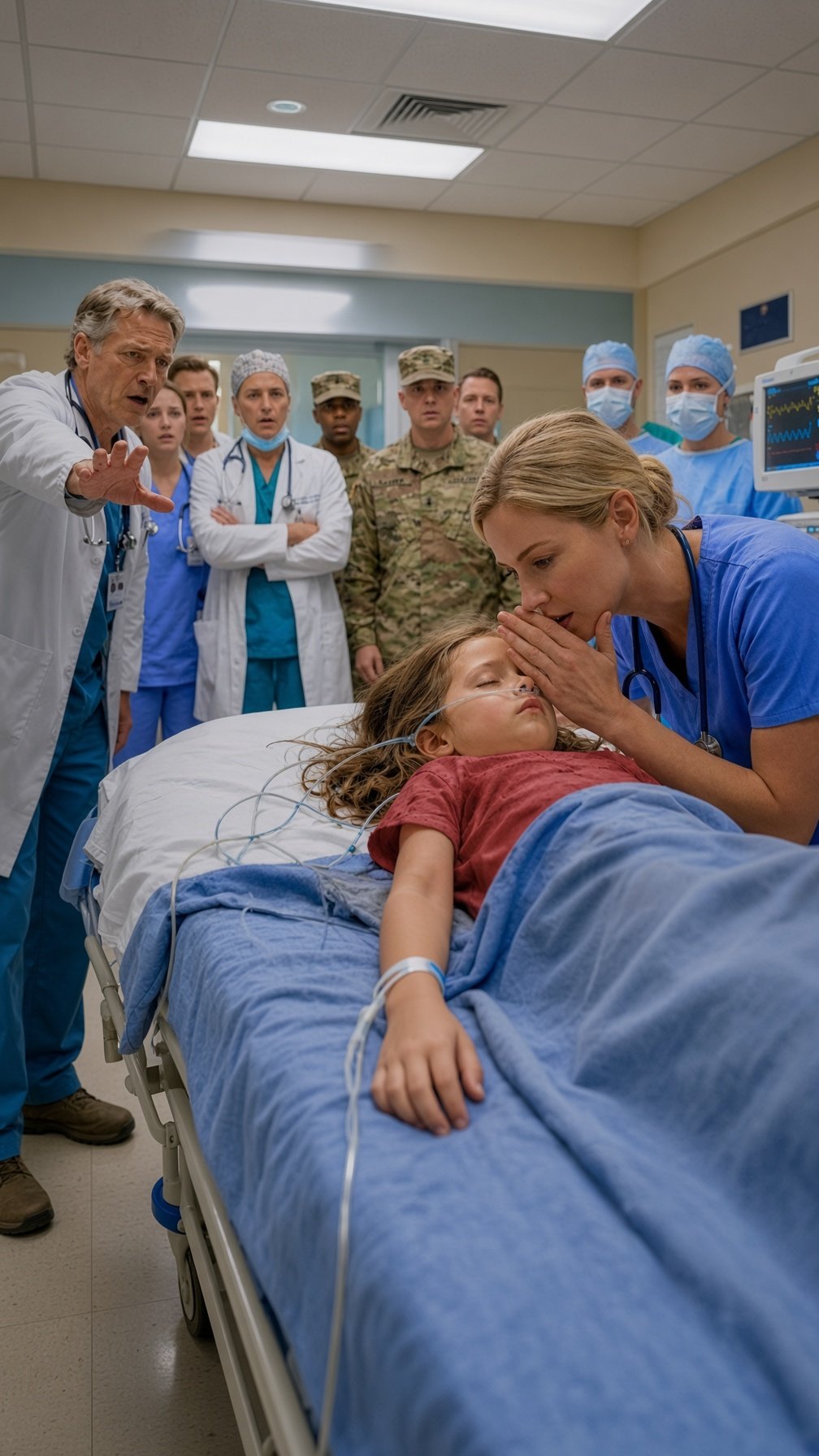
Stand back.
She just signs the schedules, the doctor said, not even looking at her.
Sarah lowered her head and stepped back, the way she always did.
Then she leaned over the little girl and whispered five words, and the entire room went still.
The man who had humiliated her seconds earlier couldn’t speak.
No one in that room knew what she had done in the cold years ago, far from that hospital.
Hit like, drop a comment telling us where in the world you’re listening from, and subscribe if hidden heroes and second chances hit home for you.
Welcome to Emergency 911 Stories.
Stand back.
She just signs the schedules.
Dr. Whitfield didn’t look at her when he said it.
He never did.
Sarah Kessler kept her eyes on the floor and stepped back anyway.
Three steps.
Always three.
The pediatric ICU at Naval Medical Center hummed with its usual late shift rhythm.
Monitors beeped.
A ventilator hissed in bay four.
Somewhere down the hall, a mother was crying softly into a paper cup of coffee.
Sarah adjusted an IV line, checked a chart, said nothing.
She had worked this unit for two years.
Punctual.
Quiet.
Competent enough to be trusted with the schedule, not competent enough in Whitfield’s eyes to be trusted with an opinion.
Kessler doesn’t say much, one of the residents had told a new nurse last month.
Keep it that way.
Whitfield likes it that way.
Sarah had heard him say it.
She hadn’t corrected him.
Her scrubs were bright cobalt blue, standard issue, a size too loose.
Her hair was pulled into a low, tight bun that never moved no matter how long the shift ran.
A thin white scar traced the edge of her left eyebrow, barely visible unless the light caught it right.
Nobody asked about the scar.
Nobody asked about her hands, either, the faint rope burn lines etched into both palms, pale against her skin.
If they had, she would have said gym equipment.
She had the answer ready.
She always did.
Tonight her hands were steady on a chart, the letters neat and small.
Steady hands.
Too steady, if anyone had been paying attention.
Nobody was.
Whitfield swept past her toward the nurses’ station, white coat snapping behind him like a flag.
He was tall, gray at the temples.
The kind of doctor who introduced himself as doctor before he said his name.
Kessler, restock bay six and tell radiology I need those films before end of shift, not whenever they feel like sending them.
Yes, Doctor.
She said it the way she said everything to him.
Flat.
Small.
Invisible.
But her eyes moved.
They always moved.
Across the monitors.
Across the doorway.
Across the parking lot visible through the window, where headlights swept the wet pavement in long yellow arcs.
She noticed the ambulance bay lights change color before anyone else did.
Amber to red.
A status shift that meant something was coming in hot.
She noticed the way her own pulse didn’t change.
It never did.
Some part of her, some old trained part, simply switched a setting from home to work without asking permission.
The overhead radio crackled.
All units, incoming trauma, ETA four minutes.
Pediatric, near drowning, cold water immersion.
CPR in progress, prolonged submersion time unknown.
Repeat, prolonged submersion, cold water.
The nurses’ station went still for half a second.
The particular stillness of people who had heard those words before and knew what they usually meant.
Whitfield exhaled through his nose.
Call it.
Cold water, prolonged submersion, they’re bringing us a body for the paperwork.
Nobody argued.
Nobody ever argued with Whitfield.
Sarah’s hands went cold in a way that had nothing to do with the room’s temperature.
Not fear.
Recognition.
A frequency she hadn’t heard in three years.
A signal from a life she had folded up and put away in a drawer she didn’t open anymore.
Cold water, prolonged submersion.
She had heard those exact words shouted over rotor wash once, on a gray morning off the Alaskan coast, from a radio clipped to her own vest.
She had been the one going down into the water that time, not the one waiting at the door.
Her jaw tightened, just slightly.
Nobody saw it.
Kessler.
Whitfield’s voice cut through her thoughts.
Bay six.
Now.
Yes, Doctor.
She turned toward the supply closet, footsteps quiet on the tile, posture curved slightly forward, shoulders rounded.
The posture of a woman who took up as little space as possible.
Behind her, through the ambulance bay doors, red and blue light began to strobe across the wet asphalt.
A gurney would come through those doors in under four minutes.
On it would be a little girl the paramedics had already, unofficially, stopped trying to save.
Sarah didn’t know that yet.
Not the details.
Not the name.
But something in her chest had already started counting down, the way it used to on the deck of a Jayhawk helicopter, half a world and a whole lifetime ago.
She restocked bay six with hands that did not shake.
She was very good at not shaking.
It was, she sometimes thought, the only skill from her old life that had followed her cleanly into this one.
The doors of the ambulance bay burst open.
Wind and rain and noise came in first, then the gurney, then four paramedics soaked to the skin, moving fast, faces set in the particular blankness of people running a code they no longer expected to win.
Whitfield stepped forward, already reaching for his stethoscope, already forming the sentence that would end this before it began.
Sarah stood very still in the doorway of Bay 6, a box of gauze forgotten in her hands, and watched the water dripping off the gurney wheels, and felt, for the first time in three years, the old cold certainty rising in her chest like a tide.
Not dead.
Not yet.
Not until warm.
She just didn’t know yet how loudly she would have to say it.
The girl on the gurney couldn’t have been more than seven.
Her lips were the color of ash.
Her hair, soaked and tangled, stuck to a face with no color left in it at all.
A paramedic straddled her on the moving gurney, compressions still going, counting under his breath in a voice gone hoarse.
Lily Reyes, age seven, pulled from Fenwick Lake after approximately forty minutes submerged.
No pulse on scene.
CPR initiated immediately.
Continuous since.
Core temp seventy-nine point four.
Whitfield’s hand went up before the paramedic finished.
Seventy-nine point four and forty minutes down.
Stop compressions.
Sir, family’s on route.
Her father’s a.
I don’t care whose daughter she is.
Time of death.
Don’t.
The word came out of Sarah before she decided to say it.
Flat.
Quiet.
But it carried, the way a single dropped instrument carries across a silent operating room.
Whitfield turned.
Irritation flickering across his face like he’d stepped on something.
Excuse me?
Sarah didn’t answer him.
She was already moving, already at the gurney, already looking at the numbers on the portable monitor with an attention that had nothing to do with charting.
Seventy-nine point four.
Forty minutes.
Fixed, dilated pupils.
Any warm water drowning at that temperature and that timeline was a body.
Any experienced physician in this room would call it exactly that.
But this wasn’t a warm water drowning.
Sarah’s mind did something it hadn’t done in three years.
Slid sideways into a place she kept locked.
And for one half second, she wasn’t standing in a fluorescent-lit trauma bay in Virginia.
She was kneeling on black ice off Kodiak Island, her hands blue inside soaked gloves, screaming a name into wind that ate the sound before it left her mouth.
Danny.
Nineteen years old.
Forty-one minutes in water colder than this.
She had pulled him out at minute forty-two.
They had called it too.
Someone had reached for the sheet.
She had knocked the sheet out of his hands and kept working.
And forty minutes after that, Danny Ferris had opened his eyes and asked in a slurred, furious voice why everyone was staring at him like he was a ghost.
He’d walked out of that hospital on his own legs six days later.
Sarah blinked.
And she was back in Virginia.
And a little girl named Lily was dying in exactly the same silence Danny almost had.
She’s not dead, Sarah said, louder now.
She’s cold.
She has no pulse, Whitfield snapped.
No respiration.
Fixed pupils.
That is dead, Nurse Kessler, whatever else you’d like to call it.
In warm water, yes.
Sarah’s voice had changed.
Flattened out into something almost unrecognizable, stripped of the careful smallness she wore like a second uniform.
In cold water, at this core temperature, those signs mean nothing.
You cannot call time of death on a hypothermic patient until you’ve rewarmed her.
Not until she’s warm and dead.
She isn’t warm yet.
The room had gone very quiet.
The paramedic who’d been running compressions looked at her like she’d just spoken a password he half recognized.
Whitfield’s face reddened.
This is not the time for a nursing school theory session.
I have a body and a family walking through those doors in the next ninety seconds, and I’m not going to explain to an admiral why we kept running a code on his dead daughter.
Then don’t explain it, Sarah said.
Let me run it.
Somewhere behind her, a resident actually laughed.
A short, disbelieving bark, immediately swallowed when nobody else joined in.
Whitfield stepped toward her, close enough that she could smell the coffee on his breath, close enough that the message was unmistakable.
You restock supply closets, Kessler.
You do not run codes in my trauma bay.
Sarah didn’t step back this time.
That, more than anything she had said, was what made two of the younger nurses stop moving entirely.
Core temp eighty and rising means nothing changes yet, Sarah said, eyes on the monitor, voice level, already reaching for the warm saline she knew with total certainty would be sitting exactly where cold weather protocol required it to be kept.
Continue compressions.
I need warmed IV fluid, forty-two degrees, wide open, both arms.
I need the bear hugger on this bed in the next thirty seconds.
And I need someone to page respiratory for a warmed air circuit, now.
Nobody moved.
They were all watching Whitfield, waiting for permission that hadn’t come from the person actually giving orders.
The paramedic straddling the girl looked between the two of them, arms shaking with fatigue, and made his own decision.
He kept compressing.
Someone get her the bear hugger, he said, before I do it myself.
Whitfield’s mouth opened and closed, and opened again, and no sound came out at all, because the compressions had never stopped, and the numbers on the monitor had, almost imperceptibly, begun to climb.
Eighty point one.
Sarah leaned down over the small, still face, close enough that only the girl, if any part of her could still hear anything at all, would catch the words.
I’ve got you, she whispered.
You’re not done yet.
Neither am I.
Behind her, for the first time in two years, the entire trauma bay was looking at Sarah Kessler like they had never actually seen her before.
Eighty point one became eighty point six in four minutes.
Sarah counted the minutes the way she used to count them on a hoist cable, out loud in her head, a metronome that never let her lose track of how long a body had been fighting.
Gentle handling only, she said, catching a resident’s wrist before he could shift the girl’s arm.
Hypothermic myocardium is irritable.
Rough movement can throw her into V-fib we won’t shock out at this temperature.
Move her like glass.
The resident froze, then nodded.
Sarah’s hands worked with total economy.
She placed the warming pads herself.
Torso.
Groin.
Axillae.
The core zones, not the extremities.
Warm the hands and feet first, and cold acidic blood from the periphery comes rushing back to a fragile heart and stops it.
Core first, she said, half to the room, half to herself.
Always core first.
Where did you, a nurse started.
Compressions, Sarah said, cutting past the question.
Keep going.
Don’t stop for anything short of return of pulse.
The paramedic, arms trembling, kept going.
At eighty-two degrees, the monitor’s flatline trembled, just barely, a jagged flicker that vanished almost as fast as it appeared.
There.
Sarah’s eyes didn’t leave the screen.
That’s her heart trying to remember how.
Don’t shock yet.
It won’t hold at this temperature.
You’ll waste the current and buy nothing.
Whitfield had stopped protesting, though nobody noticed exactly when.
He stood back now, arms crossed, watching a woman he’d called a schedule keeper move through his trauma bay like she’d run a hundred of these.
Warmed air circuit, Sarah called.
Fourteen breaths a minute, no faster.
Over-ventilating drops her CO2, and that can trigger arrhythmia just as easily as rough handling.
Slow and even.
Respiratory therapy adjusted the vent without questioning the number.
At eighty-four degrees, the jagged flicker on the monitor became a rhythm.
Weak.
Chaotic.
But a rhythm.
V-fib, someone said, alarmed.
I know, Sarah said.
Now we shock.
Charge to two hundred biphasic.
She’s a kid, that’s an adult.
She’s thirty-one kilos and colder than any adult in this building has ever needed to be shocked at, and I’ve done this exact protocol before.
Charge to two hundred.
The resident charged the paddles.
Nobody looked at Whitfield for permission this time.
They looked at Sarah.
Clear.
The small body jumped once under the pads.
The line on the monitor stuttered, scattered, and then, impossibly, steadied into something ragged but real.
A heartbeat.
Weak.
Fast.
Irregular.
But hers.
Sinus rhythm, unstable, Sarah said.
And for the first time in the last six minutes, something like relief moved across her face before she smoothed it away again.
Keep the warming going.
I want her at ninety before anyone in this room says the word stable out loud.
A silence settled over the bay, broken only by the uneven blip of a heart that, ten minutes earlier, had been asked to give up.
Who, Whitfield said slowly into that silence, taught you that protocol?
Sarah didn’t answer right away.
She was checking the girl’s pupils with a penlight, watching them react, sluggish but reactive to the light.
Pupils reactive, she said instead.
That’s a good sign at this temperature.
Get me a repeat core temp in five.
Nurse Kessler.
Whitfield’s voice had lost its earlier edge entirely.
What replaced it was something more careful, almost wary.
That is not standard nursing protocol.
That is not standard anything protocol.
Where did you learn hypothermic cardiac management like that?
Every set of eyes in the trauma bay turned toward her at once.
Sarah felt the old familiar instinct rise in her chest, the one that said duck your head, say nothing, let it pass.
Three steps back and silence.
It had kept her invisible for two years.
It had kept a door closed that she had promised herself would stay closed.
But the girl on the table was breathing on her own now.
Ragged little breaths fogging the inside of the oxygen mask.
And somewhere down the hall, a man in a navy dress uniform had just come through the doors at a dead run.
And Sarah understood with total clarity that the door had already opened whether she liked it or not.
Continuing education, she said instead, which was true and also nothing at all.
Nobody in the room believed her.
She could see it in every face turned toward her.
In the particular quality of silence that follows a person who has just done something extraordinary and refused to explain how.
The doors of the trauma bay swung open again.
A tall man in navy service dress, silver eagles on his shoulders that Sarah’s eyes clocked and translated automatically out of habit before her brain caught up, stopped dead in the doorway and stared at the small, ragged heartbeat blipping across the monitor.
That’s my daughter, he said.
Someone tell me she’s alive.
Sarah looked up from the girl’s face for the first time since the doors had first opened.
And for one unguarded second, something in her posture straightened that had nothing to do with nursing at all.
She’s alive, sir, Sarah said.
Barely.
But she’s fighting.
And so am I.
The admiral’s eyes moved past his daughter, past Whitfield, and settled on Sarah with a flicker of something that looked almost like recognition.
Though neither of them could have said in that moment, recognition of exactly what.
The chief of staff arrived nine minutes later, summoned by a page from Whitfield that Sarah hadn’t seen him send.
Dr. Patricia Voss was small, precise, and did not waste time on pleasantries.
I’m told a nurse is directing resuscitation in my trauma bay.
She’s not directing anything, Whitfield said quickly, before Sarah could answer.
She’s overstepped her scope, repeatedly.
And I want it documented before this goes any further.
The patient’s heart is beating, Voss said, glancing at the monitor.
It wasn’t when I read the initial call sheet.
Explain to me why documenting that is your first priority.
Whitfield’s jaw tightened.
Because if this child doesn’t survive, I am not going to be the physician of record who let a floor nurse run an unapproved protocol.
Approved by whom?
Voss’s eyes moved to Sarah.
Nurse Kessler, where does this protocol come from?
Sarah kept her hands moving, checking the warming pads, watching the drip rate on the IV, buying herself half a second she didn’t get.
Search and rescue medicine, she said finally.
Cold water immersion.
It’s standard for anyone who pulls hypothermic patients out of open water for a living.
You’re a pediatric ICU nurse.
Now I am.
Voss’s expression didn’t change.
But something behind her eyes sharpened.
We’ll finish this conversation later.
Right now, keep her alive.
That, Sarah said, was already the plan.
Voss turned to Whitfield.
Doctor, if you have concerns about scope of practice, write them up after the patient is stable, not during.
I’ve read enough incident reports written in the middle of a code to know they’re worthless.
Whitfield’s mouth thinned into a hard line, but he said nothing.
He had learned in the last fifteen minutes that arguing with the numbers on that monitor cost him more credibility than staying quiet ever would.
Whitfield opened his mouth again, and the monitor cut him off.
Ninety-two point one dropped without warning to eighty-nine point six.
The ragged heartbeat that had steadied over the last ten minutes stuttered, slowed, threatened to scatter again.
After-drop, Sarah said, already moving.
Cold blood from the extremities finally reaching the core.
I told them, core rewarming only, and someone adjusted the leg wrap.
A nurse near the foot of the bed went pale.
I thought she looked cold.
I just wanted her comfortable.
I know.
It’s the instinct everyone has, and it’s the wrong one.
Sarah pulled the leg wrap off in one smooth motion, kept her voice even, kept the panic that wanted to rise in her chest exactly where it belonged.
Buried.
Useful only as fuel.
Watch the rhythm.
If it goes chaotic again, we shock at the same setting as before.
Hold.
Behind her, in the doorway, Admiral Marcus Reyes stood frozen, one hand braced against the frame, watching his daughter’s heartbeat scatter across a screen for the second time in twenty minutes.
Do something, he said, voice cracking on the second word.
Somebody do something.
We are.
Sarah didn’t turn around.
Couldn’t afford to.
Not with her eyes locked on the monitor, willing the rhythm to hold the way she’d once willed a rope not to fray, a hoist not to fail, a wind not to win.
Sir, I need you to step back to the wall and let us work.
I promise you, I am not going to let go of her.
Something in the certainty of it, more than the words themselves, reached him.
He stepped back, shoulders sagging against the wall like a man finally allowed to stop holding something up alone.
Sarah had seen that posture before, on parents at the edge of rescue scenes.
Helplessness had a universal shape.
The fastest way through it was competence, calmly stated, repeated as often as necessary.
The rhythm scattered once more, jagged, then agonizingly slow, began to knit itself back together.
Sarah’s mind slid sideways again, unbidden.
Back to black ice and a boy named Danny, whose heart had done exactly this, scattered and knit and scattered again three times before it finally held.
She had knelt over him for eleven minutes that felt like eleven years, refusing to accept the word the paramedics kept reaching for.
She would not accept it now, either.
Ninety point four, she said, watching the numbers climb again, slower this time, more honest.
Rhythm holding.
Everybody breathe.
I need you to breathe, too, sir.
It helps.
I promise.
A short, disbelieving laugh escaped the admiral, half sob, half genuine surprise at being spoken to so plainly.
Whitfield had gone very quiet in the corner, arms still crossed, but the posture had changed.
The crossed arms no longer a wall so much as something to hold on to.
Voss watched Sarah work for a long moment, then pulled a small notebook from her coat pocket and wrote something down that had nothing to do with insubordination.
Nurse Kessler, she said quietly, almost to herself.
Search and rescue medicine.
She looked up, and for the first time since walking into the room, something like a question formed fully behind her eyes, a question with a shape Sarah recognized instantly because it was the exact shape of a question she had spent two years making sure nobody in this building ever had reason to ask.
Who are you, really?
The monitor beeped.
Steady now.
Ninety-one point two and climbing.
Sarah exhaled, just once, and did not answer the question nobody had spoken aloud yet.
There would be time for that.
There was, for the moment, only the girl and the numbers and the long, narrow road back from the cold.
Ninety-four point one.
Ninety-five point six.
The numbers climbed the way a tide comes in.
Slow, then all at once.
By the time Lily’s core temperature crossed ninety-six degrees, her small hand had twitched against the sheet, fingers curling weakly around nothing.
She’s reaching, a nurse whispered.
She’s fighting, Sarah corrected.
And something in her own voice cracked just slightly, just once, before she caught it and smoothed it flat again.
A man in navy khakis had followed the admiral into the bay somewhere in the last half hour and stood quietly near the door, watching Sarah work with an intensity that had nothing to do with the patient.
Chief Petty Officer Hale, he said finally, stepping forward.
I’m the admiral’s aide.
I served eleven years Coast Guard before I transferred over.
His eyes hadn’t left Sarah’s hands, the practiced economy of them, the exact angle at which she’d positioned the warming pads.
Ma’am, I have to ask.
Rescue swimmer training program, Kodiak Sector, four, five years back.
There was a story that went around every unit on the West Coast.
A swimmer who pulled a kid off black ice after forty-one minutes down and refused to let anyone call it.
They still teach that case in the schoolhouse.
The trauma bay had gone very quiet again.
Quiet in the particular way it went quiet whenever Sarah did something nobody could explain.
I don’t know what story you’re talking about, Sarah said, and it was the first lie she told all night, and it came out badly, thin and unconvincing even to her own ears.
Petty Officer Sarah Kessler, the aide said slowly, like he was assembling the pieces out loud as he found them.
Aviation Survival Technician.
Kodiak, then Alaska Sector Command.
You separated three years ago.
Nobody could ever get a straight answer why.
Some people said you lost someone after Kodiak.
Someone the case study doesn’t mention.
Sarah’s jaw tightened, but she didn’t deny it.
There had been a second name after Danny’s, a winter later.
A call she’d answered four minutes too slow because the weather had grounded the helicopter she should have been on.
She had carried that name out of the service with her, quietly, the way she carried everything.
Sarah’s hands didn’t stop moving.
That was the one thing she had left.
The one piece of training that never abandoned her under pressure.
Hands that kept working no matter what was happening above them.
Ninety-seven point two, she said instead, eyes on the monitor.
She’s nearly out of the danger window.
I need everyone to keep their voices down and their movements slow.
She’s going to start coming up toward consciousness soon, and I don’t want her waking into chaos.
Nobody moved to obey immediately.
They were all still looking at her.
Admiral Reyes crossed the room in four steps and stood directly in front of her, close enough that she had to look up to meet his eyes.
You’re Coast Guard, he said.
Rescue swimmer.
I was.
You pulled a boy out of water colder than this and kept him alive for forty minutes before anyone else believed he could be saved.
That’s not exactly.
I read the case study.
His voice had gone rough.
Every officer candidate in three services reads that case study.
I didn’t know the name behind it.
I definitely didn’t know she’d be standing over my daughter tonight in a pediatric ICU pretending to be nobody.
I wasn’t pretending to be nobody, Sarah said quietly.
I was trying to be somebody who didn’t have to talk about Kodiak anymore.
Or about the winter after it.
Nobody in the room pressed her further.
Something in her voice made it clear that door, however far open it had swung tonight, wasn’t opening all the way.
The honesty of it landed in the room like a dropped instrument.
Even Whitfield, still standing near the wall, seemed to have run out of arguments.
Lily’s fingers curled again, tighter this time, and a small, cracked sound came from beneath the oxygen mask that might almost have been a word.
Dad.
The admiral’s composure broke completely.
He was at the bedside in an instant, one hand hovering over his daughter’s, not quite touching, afraid of doing damage with something as simple as contact.
I’m here, baby.
I’m right here.
Sarah stepped back, just slightly, the way she’d been trained to step back the moment a rescue crossed from crisis into recovery, making room for the people the rescue had actually been for.
Ninety-seven point nine, she said, voice steady, though something in her chest had gone loose and unfamiliar.
An old weight shifting for the first time in three years.
Pupils reactive, withdrawing from stimulus, vocalizing.
She’s coming back, sir.
All the way back.
Whitfield finally moved from the wall, crossing the room slowly, stopping a few feet from Sarah with an expression she had never once seen on his face in two years of working under him.
It looked unmistakably like shame.
Nurse Kessler, he said.
I owe you an apology I don’t know how to give properly.
You can give it later, Sarah said.
Right now, she still needs both of us.
For the first time since Sarah had started at this hospital, Whitfield nodded at her like a colleague instead of a subordinate, and turned back to the bed, ready, finally, to actually help.
Lily Reyes opened her eyes fully forty minutes later, asked for water in a small, cracked voice, and cried when she saw her father’s face, which everyone in the room agreed was the best possible sound they had heard all night.
By then, word had traveled through the hospital the way it always did, faster than any official announcement, faster than paperwork.
The nurse who signed the schedules had pulled an admiral’s daughter back from clinical death using a Coast Guard rescue protocol nobody in the building had ever heard of, and Dr. Whitfield, feared by three consecutive classes of residents, had stood at the wall and watched her do it.
Dr. Voss found Sarah in the supply closet an hour later, restocking bay six exactly as Whitfield had ordered her to at the start of the shift, as though nothing at all had happened in between.
You could have told me, Voss said, when I asked.
I could have, Sarah agreed.
I’ve spent three years telling as few people as possible.
Why?
Sarah set down a box of gauze, considered the question honestly instead of reaching for the easy answer.
Because when people find out, they stop seeing a nurse.
They start seeing a story, and I came here to stop being a story for a while.
Tonight ended that.
Tonight ended that, Sarah agreed.
Admiral Reyes found her twenty minutes after that, standing in the hallway outside his daughter’s recovery room, and did not bother with a handshake.
He simply stood in front of her, silent for a long moment.
The particular silence of a man who has run out of easy words and refuses to reach for insufficient ones.
Petty Officer, he said finally.
Just Sarah, sir.
I’m a nurse now.
You’re the reason my daughter is asking for apple juice down that hallway instead of lying in a morgue.
His voice roughened.
I don’t care what you call yourself.
I know what you are.
Whitfield appeared at the end of the hallway before Sarah could answer, moving slower than his usual clipped stride, and stopped a respectful distance away, waiting to be acknowledged rather than demanding it, which was, Sarah thought, possibly the first time she had ever seen him wait for anything.
I filed nothing, he said.
The report I started earlier, I tore it up.
You don’t have to explain that to me.
I think I do.
He rubbed a hand over his face, looking for the first time since Sarah had met him genuinely tired rather than simply impatient.
I spent two years deciding what you were capable of based on how quietly you carried a chart.
I was wrong about almost everything that mattered.
You weren’t entirely wrong, Sarah said.
I am quiet.
I like being quiet.
I’m just also the other thing when it’s needed.
Then let it be needed on purpose, Voss said, arriving in time to catch the end of the sentence.
I want a cold water and hypothermic emergency protocol built for this hospital, written by the person who clearly already has it memorized.
Training sessions, quarterly.
Every resident, every nurse, every EMS crew that rotates through here learns what you did tonight properly before the next Lily comes through those doors.
I’ll need real equipment, Sarah said.
Not the training pads you’ve got in that closet.
And I’ll need people to actually show up, not just sign an attendance sheet.
You’ll get both, Voss said, starting with him.
She nodded once toward Whitfield.
I’ll be at the front row, Whitfield said, taking notes like a first-year resident if that’s what it takes.
Sarah looked past all of them, down the hallway, toward the room where a seven-year-old girl was laughing weakly at something her father had said, a sound that three years ago, on a different coast, in a different winter, Sarah had once believed she would never get to hear again from a child she had worked that hard to save.
I can do that, she said.
Not instructor as escape from nursing.
Instructor as the bridge she had spent three years pretending she didn’t need between who she used to be and who she had decided, quietly, without ceremony, to become instead.
She thought of Danny, alive somewhere, probably in his thirties now, unaware his rescue had trained the very team that just saved another child a decade later.
She thought of the name she still didn’t say out loud, the one she’d lost the winter after him, the reason she’d left the water at all.
Grief and skill could apparently live in the same set of hands.
It had simply taken her three years and one small girl’s stubborn heartbeat to believe it again.
For what it’s worth, Whitfield said before he turned to go, you were right about all of it.
Not dead until warm and dead.
It’s a rule that saved more people than I can count.
Sarah said, it took losing someone for me to fully believe it applies to people, too.
Not just patients.
The people who save them.
She didn’t explain further, and nobody asked her to.
Some doors, once opened, didn’t need to be thrown wide to matter.
They only needed to stop being locked.
Sarah picked up the box of gauze again and finished restocking basics, hands steady, the way they had always been.
Except now, for the first time in three years, everyone in that hospital finally understood exactly what that steadiness had cost and what it was worth.
There is a lesson in Sarah Kessler’s story that has nothing to do with rescue swimmers or hospitals at all.
We decide, constantly, who deserves our attention based on how loudly they announce themselves.
The doctor with the white coat and the confident voice gets believed instantly.
The quiet nurse restocking a supply closet gets overlooked, sometimes for years, simply because she never raised her voice to prove she belonged in the room.
But competence rarely announces itself.
It waits, usually in the last place anyone thought to look, until the moment it’s needed most.
Sarah didn’t fold up her old life because she was ashamed of it.
She folded it away because grief, real grief, the kind that follows you out of a job you loved and a person you couldn’t save, doesn’t always know how to sit quietly beside pride.
Sometimes the only way to carry both is to go silent for a while, to let the world see less of you until you’re ready to let it see all of you again.
It took a stranger’s daughter, a countdown against the cold, and a roomful of people who assumed they already knew exactly who she was, for Sarah to remember that surviving her own past didn’t mean burying every part of it.
The people who quietly know the most are rarely the ones performing the loudest.
Whitfield learned that the hard way, standing at a wall he’d once used to keep her small.
Voss learned it by asking the right question and actually listening to the silence that followed it.
And Sarah learned, maybe for the first time since Kodiak, that being seen again wasn’t the same thing as being exposed.
The next time someone in your life seems too quiet to matter, too ordinary to be extraordinary, consider the possibility that you simply haven’t yet seen what they’re capable of because nobody has needed it enough to ask.
Some of the strongest people you’ll ever meet are the ones who never once told you what they used to be.
They just showed you when it counted and let the moment speak for them.
The end.
If Sarah’s story reminded you that the quietest person in the room might be carrying the most, hit like, tell us in the comments where you’re listening from, subscribe, and consider joining the channel as a member so you never miss the next hidden hero on Emergency 911 Stories.