

Look at how tired that nurse looks.
The SEAL admiral smirked under his breath.
But karma wasn’t going to wait.
He turned back to the table, and with the slightest touch, his wine glass tipped.
His hand locking before he could finish the toast, and Clare’s voice cut through the silence.
Don’t sign anything.
Your translator is lying.
Roth’s smug smile collapsed into confusion, his own words suddenly foreign in his mouth.
Behind her, calm, a voice from eight years and one dead asset ago was already counting the seconds he had left.
What happened next stunned everyone in that room full of diplomats.
If you’re new here, welcome to Emergency 911 Stories.
Tell us in the comments where you’re listening from.
Hit like if hidden heroes get you every time, and subscribe so you never miss the next one.
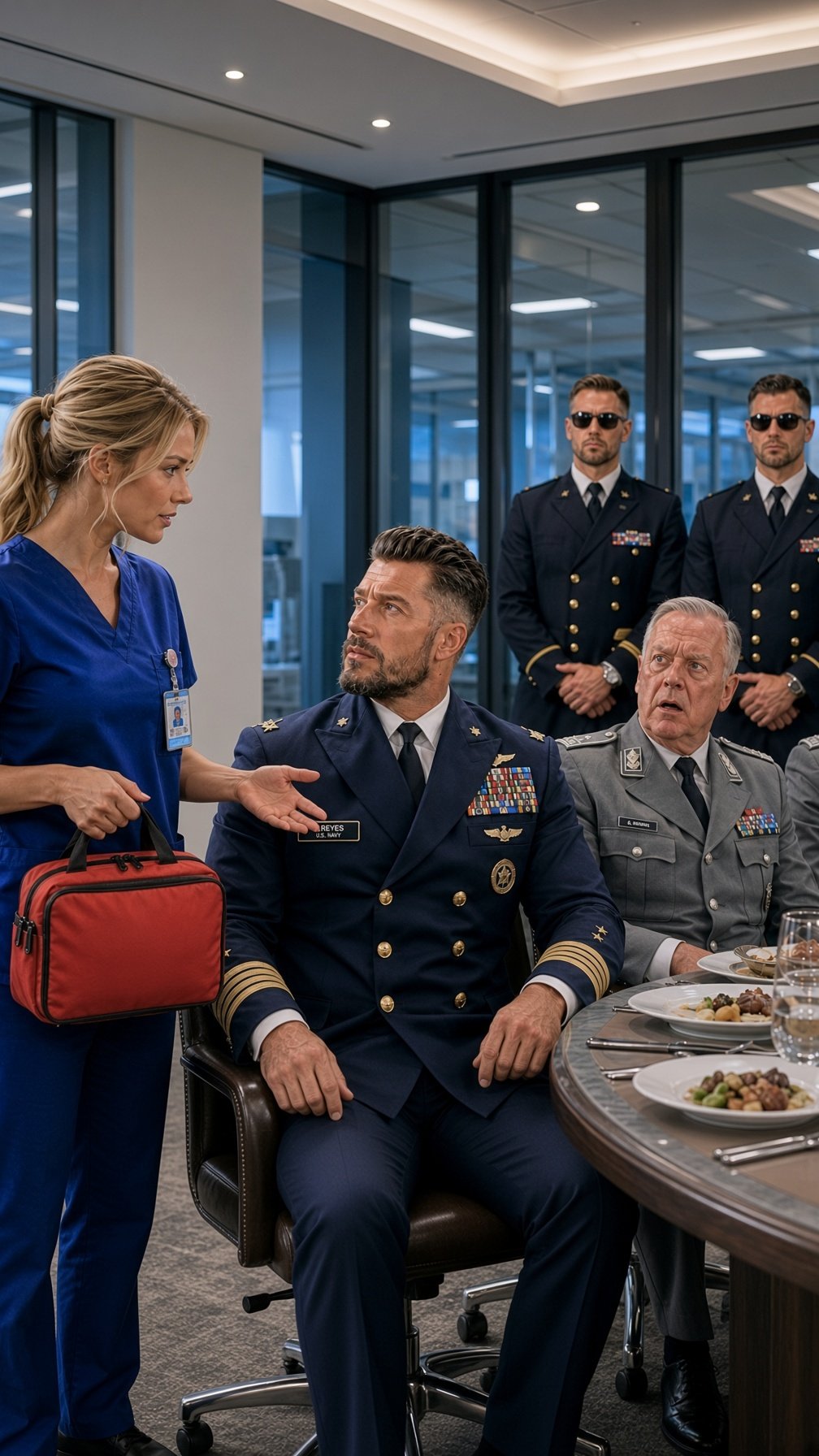
Look at that tired little nurse.
Admiral Reyes said it low.
Not really to her, more to the German general seated beside him.
Clare Bennett kept her eyes on the strap of her first aid bag.
She did not answer.
She did not need to.
The room did not feel like a hospital.
Long table, white linen, wine glasses catching the light off the harbor.
Behind the glass, a gray destroyer sat at anchor, waiting to find out who would build its replacement.
Clare had been posted here four years.
Naval Medical Center, Norfolk.
On call whenever protocol required a corpsman or a nurse in the room.
Tonight it was a dinner, not a surgery.
A joint procurement dinner between the U.S. Navy and a visiting German defense delegation.
Radar systems.
Whole contracts.
Numbers with too many zeros.
She was not supposed to speak unless someone bled.
Klaus Richter stood at the head of the table translating for the German officers.
Tall.
Precise.
Silver at the temples.
The kind of interpreter who made himself part of every sentence he touched.
General Dieter Braun sat closest to him, nodding at whatever Richter murmured in his ear.
General Rolf Hoffman sat further down, quieter, watching the room with old soldier’s eyes.
Richter’s gaze flicked to Clare once.
Something behind it was not politeness.
It was calculation.
She filed it away and said nothing.
She’s here in case one of you old men has a heart attack.
Reyes said it louder now, drawing a thin laugh from the aide behind him.
Two men in dark suits and sunglasses flanked the door.
Navy protective detail.
Unmoving.
Clare’s jaw tightened for half a second.
Then it relaxed.
She had trained herself out of reactions like that a long time ago.
She adjusted the strap on the red first aid kit.
Her hands did not shake.
Not yet.
Four years ago, she had learned to disappear inside a role.
Bright blue scrubs.
Soft voice.
Eyes down.
Nobody in this room looked at a nurse and saw anything except a nurse.
That was the point.
That had always been the point.
Petty Officer Hale, the young aide running the dinner, caught her eye and gave her an apologetic look.
Clare shook her head slightly.
It was nothing.
It was always nothing until it wasn’t.
Richter cleared his throat and began the toast, translating Admiral Reyes’s opening words into German for General Braun.
Clare listened without meaning to.
Her German was rusty from disuse, she told herself.
Then Richter said something that did not match.
Reyes had said the radar upgrade clause was contingent on a joint testing window in the spring.
Richter told General Braun it was already finalized.
No testing required.
Signed as final.
Clare’s stomach turned cold.
She told herself she had misheard.
She told herself four years of scrubs and shift changes had dulled a language she used to think in.
She kept her face still and her hands folded and watched Richter’s mouth form words that were wrong on purpose.
A server refilled the wine glasses.
Reyes lifted his for the toast.
General Braun raised his in response, smiling the practiced smile of a man who believed the deal was already sealed exactly the way Richter had told him it was.
Clare’s eyes moved across the table without her permission.
Old instinct.
Read the room.
Read the hands.
Read who is not drinking and who cannot stop watching the door.
Richter was not drinking.
He had a glass in front of him, full, untouched, positioned like a prop.
His right hand rested near Reyes’s glass a beat too long while refilling it.
A motion so smooth it would have meant nothing to anyone untrained to notice it.
Clare was trained to notice it.
She looked away before he caught her looking.
Somewhere behind her calm face, a version of herself she had buried under years of shifts stood up and started paying attention.
She hated how easily it came back.
Eight years ago, she had sat at a table like this one in Stuttgart, watching everything, saying nothing.
A source named Ivo Kessler had trusted her with information that could end a war before it started.
Two weeks later, he was dead in a parking garage.
The report said heart failure.
Clare knew better.
She had said nothing because saying something meant admitting who she really was.
She had left the agency not long after.
She became a nurse because nurses save people in daylight, in front of witnesses, with nothing to hide.
To continued partnership, Reyes said, lifting his glass higher.
General Braun echoed him in German.
Badly translated confidence dressed up as certainty.
Clare counted the seconds it would take her to cross the room if she needed to.
Eleven steps.
She always counted.
She had never stopped counting.
She had only stopped telling anyone that she did.
Richter smiled at the admiral.
It did not reach his eyes.
Reyes brought the glass toward his lips.
Clare’s hand tightened on the strap of the first aid kit hard enough to whiten her knuckles.
Hard enough that the thin scar across her palm pulled tight under the skin.
Admiral, she said before she could stop herself.
Every head at the table turned.
Reyes paused, glass an inch from his mouth, one eyebrow raised at the nurse who was not supposed to speak unless someone bled.
Sorry, Clare said quickly, dropping her eyes, folding back into the shape the room expected of her.
Nothing.
Sorry, sir.
Reyes gave a small, dismissive laugh and looked back to Braun.
Richter’s eyes found Clare’s for one cold second, and in that second, she understood that he knew exactly what she had almost said, and that he was not going to let her say it a second time.
The admiral drank.
Thirty seconds after the toast, Admiral Reyes’s hand would not open.
He set the glass down wrong, knuckles white, fingers curled tight around nothing.
He tried to laugh it off.
Tables slanting, he said, but his words came out soft at the edges, one syllable dragging into the next.
General Braun frowned and asked something in German.
Richter translated it smoothly, too smoothly, as if he had rehearsed the sentence before it was ever spoken.
The general asks if the admiral needs a moment, Richter said in English, voice calm, eyes not on Reyes at all.
They were on Clare.
Reyes tried to stand and caught the table edge instead.
His right hand hung useless at his side.
Sweat broke fast along his hairline, too fast for a warm room.
Get Dr. Vance, Petty Officer Hale said, already moving.
Commander Owen Vance arrived from the hallway in under a minute, a flight surgeon more used to certifying pilots than treating flag officers mid-collapse.
He checked Reyes’s pupils, checked his grip strength, called for a stroke kit and oxygen.
Facial droop, slurred speech, one-sided weakness, Vance said, mostly to himself.
Get me a gurney.
We’re activating a stroke code.
Clare’s whole body went still in the way it used to go still before a breach.
Not fear.
Focus.
It was not a stroke.
She had seen this pattern once before, years ago, in a briefing room she was never supposed to remember out loud.
Fast onset.
Hand locking before the face.
No droop on the correct side for a stroke.
Droop that came a beat after the hand instead of with it.
Sweat without fever.
A field officer had called it cold current in a report she had read only once and never forgotten.
A slow-acting compound designed to mimic cardiac and neurological failure long enough to kill the man and confuse the room before anyone thought to ask why.
It’s not a stroke, Clare said.
Nobody looked at her.
Vance was already prepping the gurney, calling the timeline into his radio, doing exactly what his training told him to do for exactly the wrong emergency.
Ma’am, we need the room clear, one of the security aides said, moving toward her.
Clare’s instincts screamed at her to step in, to take Reyes’s arm, check the injection site she was already certain existed somewhere on his hand or wrist.
Start the countdown she knew by heart.
Four years of discipline screamed louder.
Stay a nurse.
Stay invisible.
Let the doctor be the doctor.
She hated every second of standing still.
Reyes’s breathing changed.
Shallow.
Fast.
His good hand now trembling, too.
General Hoffman rose from his seat, alarmed, saying something sharp in German that Richter did not bother translating at all.
Clare caught the words anyway.
Rusty.
Buried.
But there.
Hoffman had said something is wrong with his hand, not his heart.
Almost the exact clinical distinction Clare herself had just made, and Richter had simply let it die in the room, untranslated, unheard by the Americans who needed to hear it most.
That was two lies now.
The contract clause and this.
Vance called for epinephrine, standard protocol for a cardiac event layered under stroke suspicion.
Clare watched a nurse from the medical center’s on-call team, someone she did not recognize, prep the injection with steady, well-meaning, completely wrong hands.
Epinephrine on top of cold current would speed the compound through his system, not slow it.
Clare’s feet moved before her mind finished deciding.
Don’t, she said, louder this time, cutting across the room.
Vance turned, annoyed.
Excuse me?
If you push epinephrine right now, you will kill him faster.
Clare’s voice came out different than it had all evening.
Flat.
Certain.
The voice of someone used to being obeyed in rooms exactly like this one.
She heard it leave her mouth and could not call it back.
The room went quiet in the particular way rooms go quiet when something shifts and everyone feels it before they understand it.
I’m sorry, Vance said.
Who are you?
Check his right hand, Clare said instead of answering.
Between the fingers, there will be a mark.
Small.
Easy to miss.
Already closing.
Vance hesitated a half second too long.
Reyes’s breathing hitched, a wet catching sound that made General Braun go pale across the table.
Clare crossed the eleven steps she had already counted twice that evening and knelt beside the admiral without asking anyone’s permission.
Her hands, which had trembled on cue for four years of disguise, were now perfectly, terribly steady.
She found the mark between his second and third fingers exactly where she expected it.
A pinprick already bruising purple at the edges.
The kind of injection site made by someone who knew precisely how much pressure not to leave behind.
There, she said, showing Vance without looking up.
Not a stroke.
Not cardiac.
This is toxin.
Richter’s face for just a fraction of a second showed something that was not confusion.
Clare caught it.
She filed it the way she used to file everything and did not let herself react.
General Hoffman’s eyes moved from the mark on Reyes’s hand to Clare’s face to Richter, standing very still by the head of the table, and something old and suspicious woke up behind the general’s expression.
Reyes’s eyes rolled halfway back.
His mouth tried to form a word and failed.
I need atropine.
Activated charcoal if he can swallow.
And I need everyone who is not medical staff out of this room right now, Clare said.
And for the first time all night, nobody argued with her.
Vance stared at her for one full second before his training kicked back in and he started moving.
Atropine, point five milligrams, IV push, Clare said, already tearing open the crash bag Hale had dragged in from the hallway.
Charcoal only if his airway stays clear.
Watch for aspiration.
Sixteen-gauge line in the left arm.
The right one’s compromised near the injection site.
You’re a nurse, Vance said.
Not quite a question, drawing up the atropine with hands that were finally doing something useful.
Tonight I am, Clare said.
She worked the way she used to work in places with no names on any map.
Calm inside chaos.
Three steps ahead of the room.
She checked Reyes’s pulse against a mental clock, watched his pupils, timed his breathing against the atropine’s expected onset, the way she had once timed things far worse than this in far worse places.
Sats dropping, Hale said, voice cracking.
He’s not desaturating from the toxin.
He’s desaturating because he’s panicking and hyperventilating on top of it, Clare said.
James.
She used the admiral’s first name deliberately, cutting through the fog of rank and protocol, anchoring him to something human.
Look at me.
Slow your breathing down.
In for four.
Out for four.
Reyes’s glassy eyes found her face.
Something in him, some old instinct of his own, recognized command voice when he heard it, even through the chemical fog closing over his mind.
His breathing slowed.
Ragged.
But obedient.
Good, Clare said.
Stay with me.
General Braun had gone white, hovering uselessly near the door, until Hale steered him back with the calm authority of a man glad to have something small to do.
General Hoffman did not move at all.
He stood with his back straight, watching Clare work with an expression that had stopped being about the admiral entirely.
The atropine hit.
Reyes’s breathing caught, then evened.
Color that had drained from his face began slowly to return.
His hand, still curled tight, loosened by a fraction, then another.
Pulse stabilizing, Vance said, disbelief threading through the relief in his voice.
How did you know it was atropine and not epi?
How did you know where to look for the mark?
Clare did not answer immediately.
She kept two fingers on Reyes’s wrist, counting, buying herself a second she did not actually need.
Training, she said finally.
What training?
It was Hoffman’s voice this time, in careful accented English, the first words he had spoken directly to her all evening.
Clare looked up and met his eyes.
Old soldier’s eyes.
The kind that had seen enough battlefield medicine to recognize when someone was working from more than a hospital textbook.
Nursing school covers toxicology, Clare said.
Nursing school does not cover injection site concealment technique, Hoffman said quietly, almost to himself.
Or which compound responds to atropine faster than epinephrine kills.
I have seen field medics who did not know that.
Richter, still standing near the head of the table, laughed.
A short, brittle sound with no humor in it.
She got lucky, he said.
Adrenaline.
Instinct.
It happens.
It was not luck, Hoffman said, not looking at Richter at all.
Reyes’s eyes had cleared enough now to track the room.
His gaze found Richter, then Clare, then drifted back to Richter with the first spark of real suspicion Clare had seen from him all night.
What did you tell him? Reyes rasped, looking at Richter.
About the testing window.
Richter’s face did not change, but something behind it recalculated fast.
The look of a man running numbers he had not expected to need tonight.
I translated exactly what you said, Admiral, Richter said smoothly.
No, Clare said.
You didn’t.
Every head turned to her again.
And this time, nobody told her to be quiet.
The admiral said the radar clause was contingent on a spring testing window, Clare said, her voice level, precise.
No trace left of the soft-spoken nurse who had spent four years perfecting exactly that disguise.
You told General Braun it was already finalized.
No testing required.
Silence dropped over the room like a dropped tray.
That’s a serious accusation, Richter said, and for the first time his accent thinned, the polished diplomatic cadence cracking at the edges into something rougher, something older.
I speak German, Clare said fluently.
I heard exactly what you said and exactly what you didn’t.
General Braun turned to Richter, rapid German spilling out of him now, sharp with the particular fury of a man who has just realized he may have been made a fool of in front of people who could ruin him for it.
Richter answered in German, too fast for most of the room, but not too fast for Clare, and not, she suspected, too fast for Hoffman either.
Vance stood slowly from beside the admiral, staring at Clare the way a man stares at a colleague he has worked beside for months and suddenly does not recognize at all.
Who exactly are you? he asked her.
Quiet.
Careful.
The question the entire room seemed to be holding its breath around.
Clare looked down at Reyes’s steadying pulse under her fingers, then up at Hoffman’s watching eyes, then finally at Richter, whose composure was coming apart one German syllable at a time.
Someone who needs everyone in this room to stop talking about the deal for one minute, Clare said, and start talking about who put a needle in the admiral’s hand.
Base security arrived nine minutes later, followed closely by a woman in an NCIS windbreaker who introduced herself as Special Agent Karen Shaw and immediately treated Clare like a second suspect instead of the person who had just kept an admiral alive.
You identified an injection site before anyone called it a poisoning, Shaw said, notebook out, eyes sharp.
You knew the compound responded to atropine before toxicology confirmed anything.
Where does a civilian nurse learn that?
I told you, Clare said.
Training.
That’s not an answer.
It’s the only one I’m giving you right now, Clare said, because the man standing by that door translated a legal contract wrong on purpose thirty seconds before the admiral he was standing next to got a needle in his hand, and nobody in this room seems interested in that.
Richter had gone very quiet.
He stood near the head of the table with his hands folded, the picture of wounded dignity, occasionally murmuring something reassuring in German to General Braun, who no longer looked reassured by anything Richter said.
Shaw turned toward Richter.
Sir, I’ll need you to stay in the building.
Of course, Richter said smoothly.
I have nothing to hide.
He reached casually for the phone in his jacket pocket.
Clare’s eyes tracked the motion the way they tracked everything now, without permission.
Don’t let him make that call, she said quietly to Shaw.
Shaw hesitated exactly long enough for Richter to get the phone halfway out of his pocket before one of the security officers stepped in and took it from him, more startled by Clare’s tone than by any actual threat.
Richter’s jaw tightened, the first crack in his composure all evening.
This is insulting, he said.
I am a licensed interpreter for the German delegation.
I have worked with this Navy for six years.
Six years is a long time to build trust you were planning to spend tonight, Clare said.
General Hoffman stepped closer, speaking low and fast in German directly to Richter.
A private accusation Clare caught in fragments.
Who paid you?
When?
How long?
Richter’s answers were clipped, defensive, and increasingly unconvincing even to a room that mostly could not understand the words.
He said Pham, Clare told Shaw.
Pham Dynamics.
German defense contractor.
They lost the last two contract bids to this partnership.
If this deal collapses tonight in scandal, in poisoning, in translation fraud, Pham picks up the pieces next quarter.
Shaw’s pen stopped moving.
How do you know that name?
Clare did not answer.
A commotion started near the hallway before she had to.
A man in a delivery uniform, clipboard in hand, badge that would not have survived a second look from anyone actually paying attention, pushed past the outer security checkpoint, claiming a scheduled equipment delivery for the medical center loading dock.
Clare saw him through the open doorway and knew, the way she used to know things in rooms with no names on any map, that he was not there for equipment.
Hale, she said, low and urgent.
Lock that inner door.
Now.
Hale did not question her.
He hit the release, and the heavy door swung shut a half second before the man in the delivery uniform reached it, his hand slamming flat against the glass panel hard enough that everyone in the room flinched.
Who is that? Shaw demanded, hand moving toward her own weapon.
Insurance, Clare said.
Richter’s handler doesn’t leave loose ends.
He came to collect Richter or silence him, and either way, he’s not walking out of this building without both of us noticing.
Richter’s face had gone the color of old paper.
The man outside tried the door once more, found it locked, and turned to scan the hallway with the flat, assessing eyes of someone deciding how many seconds he had left before this stopped being quiet.
Clare moved before anyone told her to.
She crossed to the crash cart Vance had wheeled in earlier, pulled the portable defibrillator free of its mount, and set it unopened on the table beside her, close enough to reach in one motion.
You expecting to need that? Shaw asked.
I’m expecting him to try the loading dock next, Clare said.
And I’m expecting your team to be thirty seconds too slow, because that’s how tonight has run so far.
She was already moving toward the hallway exit as she said it, Hale a half step behind her, security scrambling to catch up to a plan nobody had briefed them on yet.
Behind her, General Hoffman said something quiet in German that Clare didn’t need translated.
It was not a question this time.
It was recognition.
The hallway split toward the loading dock on one side, the main lobby on the other.
Clare took it without slowing, mapping exits she had never needed to map before tonight in this building.
You’ve done this before, Hale said, half out of breath, keeping pace.
A long time ago, Clare said, in a different uniform.
The loading dock door stood propped open six inches, a supply card abandoned halfway through it.
The kind of careless detail a man leaves behind when he is more focused on what is ahead of him than what is behind.
Clare slowed, palm raised, and Hale stopped instantly, security a step behind him doing the same.
Through the gap, she could see him, phone pressed to his ear, speaking low, fast German.
She caught only fragments.
Package compromised.
Extraction now.
He was not talking about equipment.
She held up two fingers toward Shaw, then pointed wide, flanking, quiet.
Shaw, to her credit, did not argue this time.
Clare went through the loading dock door low and fast, the way she had been trained to move a decade before anyone here had ever heard her name.
The man turned, phone dropping from his hand, his other hand already reaching under his jacket.
He was fast.
He was not fast enough for someone who had spent eight years being paid to be faster than men exactly like him.
She closed the distance before he cleared the weapon, her forearm driving into his wrist, redirecting the motion up and wide.
The gun clattered against the concrete and skidded under a supply cart.
He twisted, tried to drive an elbow into her ribs, and found only air because Clare was already inside the strike, using his own momentum to put him face first against the loading dock wall.
Federal officers, Shaw shouted from behind her, weapon raised, security flooding in around the edges.
On the ground now.
The man went down.
Clare stepped back, breathing hard but steady, hands finally, visibly no longer disguising anything at all.
Shaw stared at her across the man now zip-tied on the concrete.
Who taught you that?
The Defense Intelligence Agency, Clare said.
Eight years ago.
Human intelligence.
Field operations.
Mostly Central Europe.
The words landed in the loading dock like something physically heavy.
Hale, arriving a step behind Shaw, stopped dead in the doorway.
Somewhere behind them, General Hoffman had followed the commotion this far and stood at the edge of the light, watching Clare with an expression that had finally settled into certainty instead of suspicion.
I knew it, Hoffman said quietly in English this time, for her benefit.
The eyes.
The counting.
I served with people who moved like you.
I did not think I would meet one working as a nurse.
I stopped, Clare said, after an asset I recruited was killed because I couldn’t protect him fast enough.
I didn’t want to be responsible for anyone else’s life on a scale like that again.
And yet, Hoffman said, glancing at the man on the ground, then back toward the dining room where Reyes was recovering.
Here you are again.
Responsible for exactly that.
Clare didn’t have an answer for that one either.
Back inside, Richter had not run.
He hadn’t tried to.
He stood exactly where they’d left him.
And when Clare walked back into the dining room with Shaw and two zip-tied men in custody behind her, something in his posture finally completely collapsed.
Pham Dynamics offered me one million dollars, he said, quiet, almost relieved to finally say it out loud.
If this contract failed publicly enough to end the partnership for good.
A mistranslation alone wasn’t enough.
It needed to look like an accident.
A scandal.
Something that would make the Germans distrust American security for a generation.
And the admiral, General Braun said, his voice shaking with fury now instead of confusion.
Was disposable to you.
He was supposed to survive, Richter said.
Impaired.
Embarrassed.
A story about American incompetence, not American murder.
The compound was calculated for that.
I did not know he would react so severely.
You didn’t know, Clare repeated, flat.
Because you never actually understood what you put in that glass.
You just trusted someone else’s math.
Reyes, sitting up now on the gurney, color returned, voice steadier, looked between Richter and Clare with the particular clarity of a man who had almost died twice tonight.
Once from poison, and once from his own carelessness with the people protecting him.
You’re the nurse I insulted an hour ago, he said to Clare.
Yes, sir.
You’re also the reason I’m alive, and apparently the reason this entire negotiation didn’t collapse into an international incident.
Also, yes, sir.
Reyes closed his eyes briefly, something between a laugh and a wince crossing his face.
I owe you an apology that’s going to take longer than tonight.
You owe General Braun an apology first, Clare said.
He almost signed a contract that would have cost this Navy the testing window that protects every sailor who serves on whatever gets built from that radar system.
General Braun looked at her for a long moment, then extended his hand, not to Reyes, but to Clare.
Frau Bennett, he said carefully, using the name he had heard Vance use earlier.
On behalf of my government, thank you.
Also, I apologize.
I misjudged this room from the moment I sat down in it.
Clare shook his hand.
Her grip did not shake at all.
Shaw stepped closer, notebook finally closing.
I’m going to need a full statement.
A very full statement.
And I’m going to need to make some calls tonight about exactly who you used to work for.
I expected that, Clare said.
Behind her, Richter was led out in cuffs, still talking, still trying to negotiate terms with people who had stopped listening to him the moment the truth left his own mouth.
Clare watched him go without any satisfaction in it at all, just relief that the admiral’s pulse was steady, and that the men in this room had finally started listening to the right people.
General Hoffman lingered a moment longer than the others.
Eight years is a long time to disappear, he said.
What will you do now that this room knows who you were?
Clare looked at Reyes, still on the gurney, alive because she had refused to keep disappearing tonight.
She looked at Hale, still shaken but standing straighter than he had all evening.
She looked finally at her own hands, steady, uncovered, no longer pretending to be anything other than exactly what they were.
I honestly don’t know yet, she said.
Three days later, Clare sat in a conference room that was not nearly as well decorated as the one she had almost died in, across from a man named Director Whitfield, who had driven down from Washington specifically to meet her.
Human Intelligence Officer Clare Bennett.
He read off a file that was thicker than she remembered her service ever being.
Eight years with the agency.
Central Europe rotation.
Recruited and ran the Kessler network until its compromise.
Officially separated from service six years ago for personal reasons.
That’s the file, Clare said.
The file doesn’t mention that you spent the last four years hiding inside a nursing badge at a naval hospital, Whitfield said.
Or that you single-handedly stopped an eleven-million-dollar sabotage operation from destroying a defense partnership two administrations worked to build.
I wasn’t hiding, Clare said.
I was healing.
There’s a difference, even if it looks the same from the outside.
Whitfield studied her for a long moment.
Admiral Reyes, seated beside him, still moved his right hand carefully, a lingering stiffness that his doctors promised would fade completely within a month.
He had insisted on being in this meeting.
Had, in fact, insisted on several things over the last three days, most of them apologies Clare had eventually asked him to stop making.
The agency would like you back, Whitfield said.
Full reinstatement.
Field rank restored.
We have three open postings in Central Europe that could use someone with your specific skill set and your specific fluency.
Clare thought about Stuttgart.
About Ivo Kessler’s face across a table exactly like this one, trusting her with his life the week before he lost it.
She thought about four years of twelve-hour shifts, blue scrubs, patients who needed steady hands and quiet voices.
Work that had put something back together in her that fieldwork had slowly worn away.
No, she said.
Not full reinstatement.
Not back to the field.
Reyes leaned forward slightly.
Clare.
But I’ll consult, she said.
Part-time.
Cases exactly like this one, where medical knowledge and field experience need to sit in the same room together and nobody else has both.
I keep my nursing license.
I keep my patience.
You call me when something like Thursday night happens again, and I hope to God it doesn’t happen often.
Whitfield exchanged a glance with Reyes, then nodded slowly.
We can work with that.
Later that afternoon, Clare walked back through the Naval Medical Center corridor toward the ward where her actual patients were waiting.
People with broken bones and post-surgical fevers.
None of them poisoned by a foreign intelligence operation.
General Hoffman was waiting near the entrance, out of uniform now, a civilian coat over his shoulders, catching a flight home within the hour.
General Braun wanted me to give you this, he said, handing her a small velvet box.
Inside was a medal she did not recognize.
German script engraved along its edge.
For services to the Federal Republic.
Unofficially, of course.
Officially, none of this happened.
Officially, I’m a nurse who got lucky, Clare said.
Officially, Hoffman agreed, allowing himself something close to a smile.
But I have met very few lucky people who count exits in every room they enter.
That habit does not come from luck.
It comes from every mistake luck refused to forgive you for.
Clare closed the box and did not open it again in front of him.
Take care of yourself, Frau Bennett, Hoffman said.
The next table you sit at might not need saving.
I hope for your sake it doesn’t.
He walked away down the corridor, and Clare stood there a moment longer, holding a medal from a government that officially did not know her name, in a hallway belonging to one that officially had never let her fully go.
Richter’s case would take months to resolve.
Federal charges layered on top of foreign bribery statutes nobody had needed to invoke in years.
Pham Dynamics issued a statement denying any knowledge of his actions.
The kind of statement companies issue when they intend to survive a scandal by outliving it.
Clare suspected that was not the end of it.
She suspected very little, in her experience, ever truly was.
She pushed through the ward doors and found Petty Officer Hale waiting for her with a clipboard and the same nervous, apologetic energy he’d carried since the first night she met him.
Except now it was aimed at a patient chart instead of an admiral’s bad joke.
Bed four’s asking for you specifically, he said.
Says the last nurse who helped him made him feel like someone actually had his back.
Clare took the chart, scanned the notes, and let herself feel, for the first time in eight years, that the two halves of who she was might not need to stay strangers to each other after all.
Courage isn’t always loud.
Sometimes it’s the quiet decision to keep showing up as exactly who you are, in whatever role the world hands you, until the moment finally arrives that needs the truth of you instead of the disguise.
That moment always arrives.
The only question worth asking is whether you’ll be ready when it does.
The end.
If this story reminded you that quiet strength is still strength, drop a like and tell us where in the world you’re listening from.
Subscribe if you want more stories like Clare’s.
And if you want to go further, join the channel and become a member.
Your support is what keeps these stories coming.
Share this one with someone who needs a reminder that the truth always finds its moment.