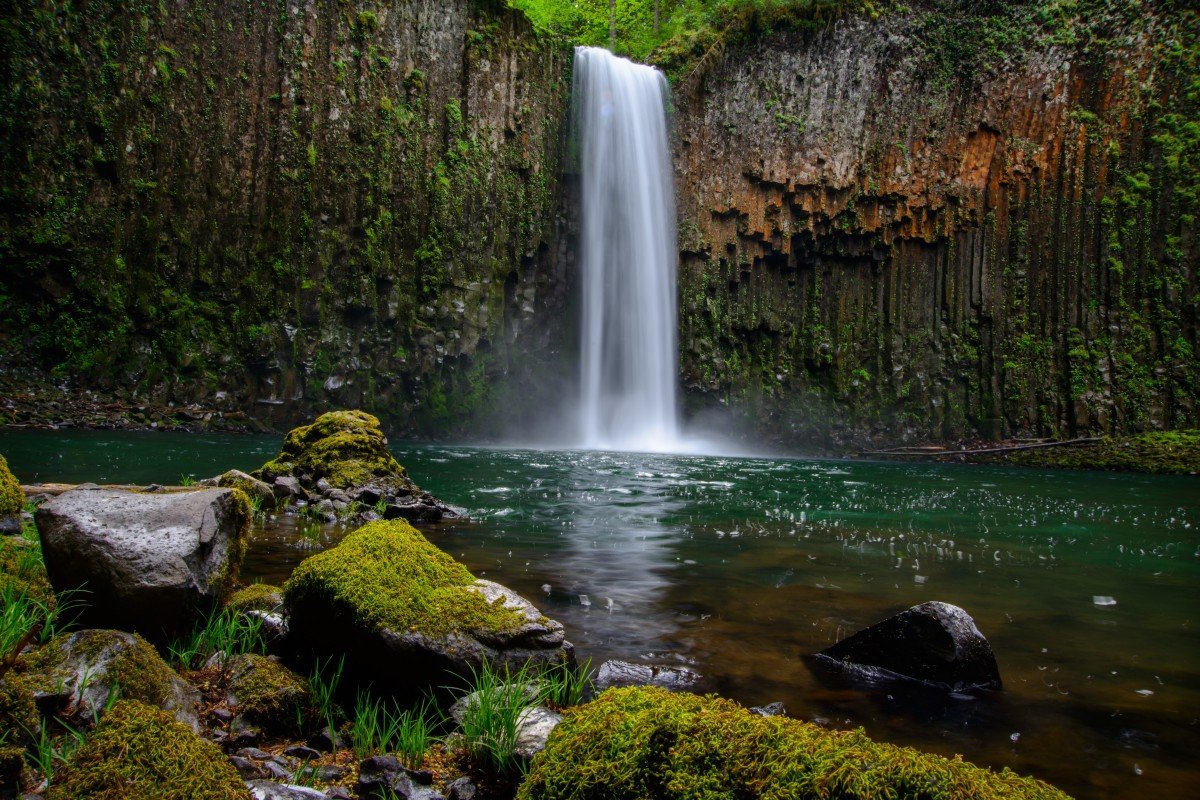

The snow was falling in heavy, wet sheets, blanketing the jagged shoreline of Brightwater Cove in a silence that felt less like peace and more like a held breath.
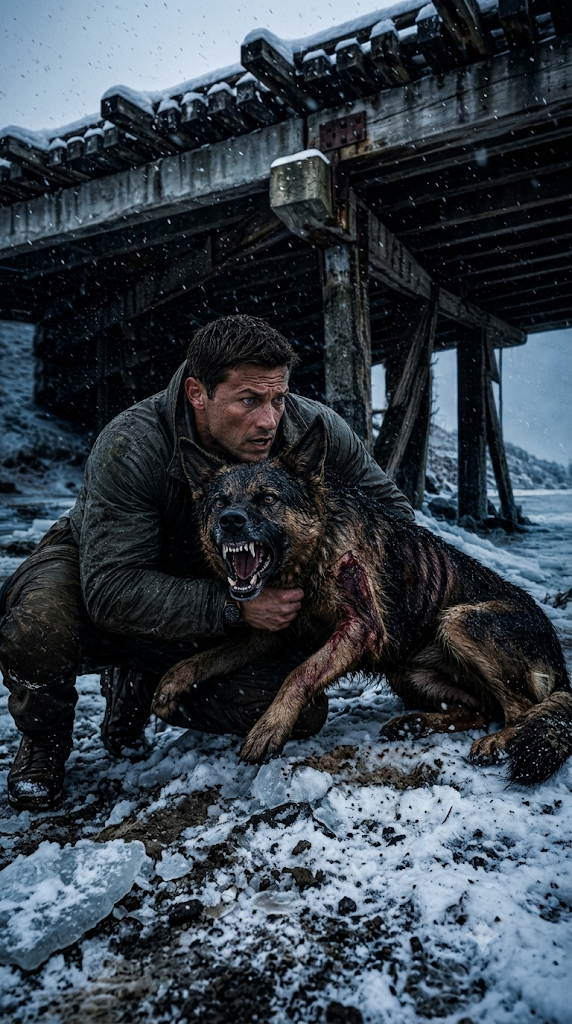
Dawson Whitaker stood beneath the rotting timbers of the old pier, his breath pluming in the freezing air, his hands slick with freezing mud and something far darker.
He was thirty-three, a Navy SEAL on mandatory leave, carrying the kind of weight that had nothing to do with his rucksack and everything to do with the ghost of a twenty-two-year-old kid named Luke Mercer.
He had come to this quiet town to disappear, to find a punishment that looked like peace, but the universe had a cruel sense of humor.
A low, guttural growl vibrated through the wooden supports, stopping him dead in his tracks.
It wasn’t a warning.
It was a sound of pure, unadulterated agony.
Dawson dropped to a crouch, his tactical instincts overriding his exhaustion, and peered into the dark wedge of space beneath the pier.
At first, he saw nothing but a mound of filthy snow and broken ice.
Then the mound moved.
A German Shepherd, black and tan, matted with salt, mud, and frozen clumps of ice, lay curled against a support beam.
Its ribs were a stark, skeletal cage beneath the fur, and one front leg was bent at a sickening, unnatural angle, swollen and trembling.
But it was the eyes that stopped Dawson’s heart.
They were amber, intelligent, and filled with a terrifying mix of fear and fierce, unyielding protection.
The dog wasn’t just guarding itself; it was guarding a small, dented brass whistle lying in the snow beside its paws.
“Easy,” Dawson whispered, his voice barely audible over the wind. “I’m not here to hurt you.”
The dog tried to bare its teeth, but the effort was too much, and it let out a broken, pitiful whimper.
Dawson felt a hot, dangerous surge of anger in his chest, a feeling he hadn’t allowed himself in months.
Someone had left this animal here.
Not lost.
Left.
The rope tied to the dog’s collar was weathered, but the knot was deliberate, anchored to the beam.
Dawson pulled his knife, cut the rope, and wrapped his heavy olive-gray combat jacket around the shivering animal.
The dog flinched, then collapsed against him, too weak to resist.
As Dawson lifted the shepherd, the dog used the last of its strength to stretch its neck toward the whistle.
Dawson understood.
He picked it up, tucked it inside the jacket, and the dog finally stopped struggling.
He carried the dog to his truck, the weight of the animal a familiar, grounding pressure against his chest.
Halfway there, the dog’s eyes opened and fixed on Dawson’s face with a strange, solemn focus.
Then, it pressed its cold nose against the face of Dawson’s old military watch.
It was the same watch Luke Mercer had once joked was “too ugly to die.”
Dawson froze in the storm, the bridge and the snow falling away, leaving only the weight in his arms and the unbearable thought that some abandoned things still knew how to recognize another.
Then the dog went limp.
Dawson moved.
The veterinarian clinic sat at the edge of town in a white clapboard building with blue shutters.
Dr. Elaine Porter, a practical woman in her fifties with steady hands and a no-nonsense demeanor, took one look at the dog and ordered Dawson to the exam room.
For the next hour, Dawson stood by the wall while she worked, warming the dog slowly, checking the injured leg, and cleaning the raw, deep wound beneath the collar.
“Male German Shepherd,” she said at last. “Around seven years old. Severely underweight, dehydrated. The leg isn’t broken, but it’s badly sprained. This didn’t happen overnight.”
“How long was he out there?” Dawson asked, his voice tight.
“Hard to say. Weeks, maybe longer. He’s been surviving rough. That’s not luck. That’s endurance.”
By evening, Dawson had brought the dog back to his rented cabin.
He told himself it was temporary, just a few days of warmth and food until he could figure out where the animal came from.
But when he set the shepherd down near the wood stove and watched those amber eyes follow him, he knew the lie had already failed.
“You need a name,” Dawson said.
The dog blinked slowly.
Outside, the wind swept off the lake, and the abandoned lighthouse stood far across the frozen shoreline.
Dawson followed the dog’s gaze.
“Harbor,” he said quietly. “That’s what I’ll call you.”
That night, Dawson tried to sleep in the chair beside the stove.
Harbor lay on the rug, wrapped in an old blanket, his paws twitching as if running through dreams too cold to escape.
Near midnight, Dawson woke to a low sound.
Not a growl, not a whimper, but a grief so soft it barely had a voice.
Harbor was sitting upright, staring at the window.
Beyond the glass, the abandoned lighthouse stood on its rocky point, its tower dark.
Dawson felt Luke’s name rise in his chest.
He had spent six months telling himself the dead were gone and the living had to move on.
But Harbor watched that lighthouse like a soldier waiting at an extraction point that would never come.
Near the stove, Harbor’s old leather collar lay on the table.
Dawson reached for a cloth and began cleaning it slowly, more to steady his hands than anything else.
Mud came away first, then salt, then a layer of black grime from a small metal nameplate.
He angled it toward the firelight.
At first, the letters were only scratches.
Then the words emerged, faded, nearly lost, but still there.
*Elias North, Saint Elian Light.*
Dawson looked from the collar to the dog, then toward the dark lighthouse beyond the window.
Harbor had not been waiting for shelter.
He had been waiting for someone.
Dawson woke before sunrise to find the cabin door slightly open and the rug beside the stove empty.
His military instincts kicked in before his thoughts did.
He grabbed his boots and stepped outside into the blue morning light.
A single trail of paw prints led away from the cabin, across the frozen shoreline, and toward the rocky point.
Dawson followed.
The St. Elian Lighthouse stood against the pale horizon, weathered by decades of wind and salt.
Harbor sat outside the rusted gate, his injured leg trembling, his amber eyes fixed on the tower.
Dawson stopped several feet away.
“Harbor.”
The dog glanced back, his tail moving once, then returned his attention to the tower.
The dog wasn’t guarding a building.
He was guarding a memory.
Brightwater Cove was the kind of town that looked peaceful enough to belong on a postcard, but the moment Dawson started asking questions about Elias North, the mask slipped.
He stopped at a bait and tackle shop near the docks.
The owner, a stocky man in his sixties named Walter Briggs, was repairing fishing reels until Dawson mentioned Elias.
The old man’s smile vanished instantly, his hands stopping mid-motion.
“What do you want with that name?” Walter asked, his voice dropping.
“Just asking,” Dawson replied.
“Should leave it alone,” Walter said, looking toward the window. “Dead men don’t need company.”
Then he changed the subject completely, as if the conversation had never happened.
Over the next few hours, the pattern repeated.
A dockworker claimed Elias was a drunk.
A waitress said he was crazy.
A mechanic insisted he had wandered off years ago.
Yet every story sounded rehearsed.
Too simple, too neat.
Nobody had specifics.
Nobody looked Dawson in the eye.
At noon, Harbor returned to the lighthouse again.
Dawson followed, watching as the dog walked directly to a half-buried wooden bench beside the rusted gate.
Harbor began digging frantically, snow flying behind him, his injured legs shaking from the effort.
Dawson knelt beside him and brushed away the remaining snow.
His fingers struck metal.
Together, man and dog uncovered a small, rusted key, old and heavy.
Harbor sat back, breathing hard, his eyes fixed on the lighthouse beyond the gate.
As if he had just remembered something important, or perhaps as if someone had left that key there for the day another loyal soul finally came looking.
The key fit the lock on a narrow metal door attached to the side of the lighthouse.
The lock resisted, then gave way with a metallic click.
The room beyond was small and dark, filled with maintenance equipment and the smell of dust, old wood, and salt.
Harbor didn’t search randomly.
He moved with certainty, past the tools and shelves, like someone returning home.
They climbed the spiral staircase, the wood creaking beneath Dawson’s boots.
At one level, the dog paused and sniffed an old door frame.
At another, he lingered beside a window overlooking the lake.
Higher still, he stopped entirely.
His tail wagged once, just once, then he continued upward.
Near the middle level, they entered what had once been living quarters.
A narrow bed, a rusted stove, a small wooden desk.
Everything remained exactly where it had been left, covered in dust, yet the room didn’t feel abandoned.
It felt interrupted.
Harbor approached the bed and lowered himself beside it, looking peaceful for the first time since Dawson had met him.
Dawson began searching the room, finding nothing until he noticed the wooden desk sat slightly away from the wall.
He moved it carefully, revealing a loose wooden panel.
Inside rested a leather-bound journal wrapped in oilcloth, protected deliberately.
The cover bore a single name: *Elias North.*
Hours passed.
The journal proved far more detailed than Dawson expected.
The earliest entries described weather conditions, fishing vessels, and maintenance work.
Then the tone changed.
A particular year appeared repeatedly—the year of the shipwreck.
According to official records, a cargo vessel named the Meridian Star had crashed offshore during heavy fog.
Equipment failure, poor visibility, a tragic accident.
End of story.
Except Elias clearly disagreed.
His entries became increasingly disturbed, recording unusual observations, lights visible where they shouldn’t have been, signals interrupted without explanation.
The more Dawson read, the more uncomfortable he became, because Elias sounded sane, precise, careful, rational.
Nothing like the drunken madman the townspeople described.
As Dawson turned another page, Harbor suddenly lifted his head.
The dog stared toward the window, completely still, ears forward.
Dawson looked up.
Far below, near the shoreline, a dark vehicle sat parked beside the access road.
The engine wasn’t running.
No one exited.
No one moved.
Yet the vehicle remained there, watching.
Minutes passed.
Then, without warning, it slowly turned around and disappeared beyond the trees.
Harbor continued staring long after it was gone.
Dawson returned to the journal.
The final sections became darker.
Elias described discovering information omitted from official reports.
According to harbor records, the Meridian Star had carried only cargo.
According to Elias, that wasn’t true.
There had been passengers.
Undocumented passengers.
Families, workers, people whose names never appeared anywhere.
When the ship crashed, many vanished from history entirely.
No investigations, no memorials, no records.
Elias became convinced someone wanted those people forgotten.
He began collecting evidence: copies of manifests, witness statements, personal observations.
Entry after entry revealed growing fear.
He believed he was being watched, followed, silenced.
Several pages had been torn out completely.
One page carried what looked disturbingly like dried blood.
Near the end of the journal, Dawson discovered a name written repeatedly, sometimes underlined, sometimes circled, sometimes mentioned alongside warnings.
*Graham Voss.*
The next morning, Dawson visited Marian Bell’s diner.
The elderly woman greeted him warmly, her gentle brown eyes noticing everything.
Eventually, Dawson mentioned Owen North, Elias’s great-grandson, whom he had met the day before—a young fisherman carrying the heavy burden of a family shame he didn’t understand.
Marian sighed.
“Poor boy. He hates Elias because that’s what he was taught.”
Dawson leaned forward.
“You knew Elias, didn’t you?”
The old woman looked down at her coffee.
“The man people describe and the man I knew weren’t the same person.”
That afternoon, Dawson visited Owen North at the harbor.
The young man was repairing traps, his pale blue eyes immediately reminding Dawson of old photographs of Elias.
The resemblance was impossible to ignore.
Unfortunately, so was the hostility.
“You’re asking questions about my great-grandfather,” Owen said, his jaw tight.
“Trying to learn what happened,” Dawson replied.
“Because I don’t think the official story makes sense.”
Owen laughed bitterly.
“Official story. The man abandoned his family and disappeared.”
Dawson studied him carefully.
The anger felt genuine.
Not rehearsed.
“Sounds like you’ve already made up your mind.”
Owen’s jaw tightened.
“My grandmother spent her whole life waiting for him. He never came back.”
There it was.
Not hatred, disappointment.
A wound passed down through generations.
Owen wasn’t protecting a lie.
He was protecting himself from hope, because hope could still hurt.
That evening, Dawson visited the diner again.
As he prepared to leave, Harbor suddenly lifted his head from beneath the table.
His body stiffened, not aggressively, fearfully.
The German Shepherd’s ears flattened, his breathing changing.
Then the bell above the diner door rang.
A man entered—tall, well-dressed, calm, the kind of man who never needed to raise his voice because people listened anyway.
Harbor quietly backed away until his body pressed against Dawson’s chair.
The reaction shocked him.
This wasn’t fear of a threat.
It was recognition.
The newcomer smiled politely.
“Dawson Whitaker, I assume.”
The man extended his hand.
“My name is Graham Voss.”
In person, Graham appeared older than Dawson expected.
Mid-fifties, tall and lean, silver beginning to spread through carefully combed dark hair.
He looked more like a respected professor than a powerful businessman.
Yet Dawson immediately understood why people listened to him.
There was confidence in every movement.
Control.
Graham sat across from him.
“I hear you’ve developed an interest in local history.”
Dawson remained cautious.
“You could say that.”
The older man smiled.
“History is complicated. Sometimes people spend years trying to heal from old tragedies.”
His eyes briefly moved toward Harbor, then returned to Dawson.
“And sometimes reopening those wounds creates more pain than truth is worth.”
The statement wasn’t a threat, which somehow made it more unsettling, because Graham genuinely seemed to believe it.
Dawson remembered something from military service: the most dangerous people were rarely the ones who thought they were villains.
They were the ones convinced they were protecting something.
That night, Dawson returned to the lighthouse and found a narrow compartment hidden beneath an old wardrobe.
Inside lay several folded documents—copies of harbor reports, insurance records, correspondence.
Proof.
The official account of the Meridian Star disaster had been altered.
Dates no longer matched.
Witness statements had been rewritten.
Entire sections were missing.
As Dawson gathered the papers, a small photograph slipped free from between two folders.
The image was faded with age, creased along the edges.
At first, it appeared ordinary.
Then he noticed the subject—a baby, only a few months old, wrapped in a blanket.
No writing, no name, no explanation.
Just an infant staring toward the camera.
And somehow Elias had hidden the photograph with the evidence.
The photograph stayed on Dawson’s table for two days.
A faded image, a nameless infant wrapped in a blanket.
No date, no explanation, no clue except the fact that Elias North had hidden it among documents connected to the Meridian Star disaster.
That alone made it important.
Dawson knew it.
Harbor seemed to know it, too.
Three days later, Dawson met Marian Bell before sunrise.
The diner was still closed, only the kitchen lights glowing through the windows.
Marian sat alone at a corner booth with a mug of coffee.
Harbor immediately crossed the room and lay beside her booth.
The old woman smiled softly, stroking the dog’s head.
“You know,” she said, “he always did like people who were lonely.”
Dawson paused.
“Always?”
Marian looked surprised by her own words.
Then she nodded.
“I remember Harbor from years ago.”
The admission caught Dawson’s attention.
He placed the photograph on the table.
The old woman stared at it.
At first, there was no reaction.
Then something changed.
Her expression tightened.
Not recognition.
Something deeper.
“I’ve seen this blanket before,” she whispered.
Dawson leaned forward.
“What do you mean?”
“I don’t know. My adoptive mother had one exactly like it.”
Later that afternoon, Dawson showed Owen North copies of several journal pages.
The young fisherman read them silently, his hands trembling slightly.
“He wrote all this? Every word?”
Owen stared toward the harbor.
“My grandmother used to say he wasn’t a bad man.”
Dawson remained quiet.
Owen laughed bitterly.
“Nobody listened.”
For several moments, neither spoke.
Then Owen looked directly at him.
“If he didn’t abandon us…”
The sentence remained unfinished because both men understood what followed.
If Elias had not abandoned his family, then someone had spent years making sure people believed he had.
The breakthrough came from an old church archive.
Owen remembered his grandmother once mentioned a baptism performed quietly after the Meridian Star disaster.
No public announcement, no family listed, only a baby.
The church records still existed, hidden among boxes no one had opened in decades.
The priest who helped them, Father Raymond Keller, was a gentle man in his seventies with kind blue eyes and a soft voice shaped by years of comforting grief.
Together they searched the archives.
Hours passed.
Dust filled the air.
Then Father Keller stopped.
“I found something.”
The room fell silent.
The old priest slowly unfolded a yellow document.
A baptism record.
No parents listed, only a note: *Infant survivor delivered by Elias North. Placed into care of the Bell family.*
The world seemed to stop moving.
Marian stared at the page, then read it again and again.
Her hands began shaking.
“No.”
The word came out barely audible.
Father Keller lowered his eyes.
“I’m sorry.”
The old woman pressed trembling fingers against her mouth.
For seventy-two years, she had believed she belonged to one story.
Now that story was gone.
Harbor quietly stood.
No barking, no excitement.
The German Shepherd simply walked to Marian and rested his head against her chest.
For several seconds, she did not move.
Then tears began falling.
Slowly, silently.
Even Dawson felt unable to speak, because Harbor’s gesture seemed strangely intentional.
Not like comfort offered to a stranger, but like recognition, as if the dog somehow understood that the frightened infant Elias had once protected had finally been found.
The revelation shattered Marian and healed something at the same time.
Piece by piece, the evidence aligned.
The impossible truth became undeniable.
Marian Bell was the unidentified child, the baby from the photograph, the infant Elias had rescued.
The survivor no one was supposed to find.
For Owen, the discovery was equally devastating.
His entire understanding of Elias collapsed.
The selfish coward he’d spent years resenting no longer existed.
Instead, there was a man who had sacrificed his reputation protecting a child.
A man willing to become the villain in everyone’s story if it kept someone alive.
Late that evening, Owen visited Elias’s grave marker overlooking the lake.
For the first time, he removed his cap, not out of obligation, out of respect.
Meanwhile, Dawson found himself thinking less about evidence and more about memory.
He sat outside the cabin as darkness settled across Brightwater Cove.
Harbor rested nearby.
For months, Dawson had obsessed over what happened during that mission, over the men he couldn’t save, over Luke.
But watching Harbor remain loyal to someone gone for years forced him to confront a difficult truth.
Maybe remembering mattered.
Maybe honoring mattered.
Maybe grief wasn’t a chain.
Maybe it was a responsibility.
When Dawson woke several hours later, something felt wrong immediately.
The cabin door stood open.
Cold air flooded the room.
Snow drifted across the floorboards.
His pulse surged.
He reached for the lamp.
The blanket beside the stove was empty.
Harbor was gone.
Dawson searched the cabin, then outside, then the shoreline.
Nothing.
No barking.
No tracks he could immediately follow.
No sign of struggle.
Only one thing remained: lying in the snow just beyond the doorway, Harbor’s old collar.
The same weathered collar that had led Dawson to Elias North, now abandoned, alone, and suddenly far more terrifying than any threat Dawson had faced since arriving in Brightwater Cove.
The search began before sunrise.
Unlike the desperate panic he felt inside, Dawson approached the problem with military discipline.
He carefully examined the snow around the cabin.
There were bootprints, large, heavy.
At least two individuals.
A vehicle had also been present.
Tire marks led toward the harbor district.
Owen North insisted on helping.
The young fisherman arrived carrying a thermos and a determined expression.
For once, the anger that once defined him was gone.
In its place stood loyalty.
“We find him,” Dawson nodded.
“We find him.”
By afternoon, Dawson and Owen reached the industrial edge of the harbor.
Most of the old warehouses had long been abandoned.
The trail led toward warehouse 14, a decaying structure hidden behind stacks of shipping containers.
Its roof sagged, its paint peeled.
The building was silent, too silent.
Dawson signaled Owen to remain outside, then entered alone.
The interior smelled of rust, damp wood, and old fish.
For several minutes, Dawson heard nothing, then a faint bark, weak, distant.
Harbor.
He moved deeper into the warehouse.
Another bark, closer now, then a scratching sound.
A desperate scraping against metal.
Dawson followed it to a locked storage room.
Inside sat Harbor.
The German Shepherd looked exhausted.
A metal cage surrounded him.
His coat was dirty, his body thin once again after missing meals.
Yet the moment he saw Dawson, his ears lifted, his tail moved just once.
Relief, pure and simple.
Dawson knelt beside the cage.
“I’m here.”
The words felt heavier than expected, because years earlier, he hadn’t been able to say them.
Not to Luke.
Not in time.
This time, he could.
Within moments, the lock gave way.
Harbor stumbled out, immediately pressing against Dawson’s side.
Then Harbor did something strange.
He didn’t head toward the exit.
Instead, the German Shepherd crossed the room and began scratching furiously at a section of concrete wall.
The behavior wasn’t random.
It was purpose.
Dawson exchanged a glance with Owen.
Neither spoke, but both felt the same thing.
Harbor wasn’t trying to leave.
He was trying to show them something.
The wall concealed a hidden compartment.
Years earlier, someone had built a false partition behind old shelving.
The space beyond contained boxes, dozens of them, dust-covered, undisturbed, waiting.
Dawson opened the first box: financial ledgers.
The second: property records.
The third: audio cassettes.
The fourth: witness statements.
His stomach tightened.
This wasn’t evidence.
This was an archive.
A complete archive.
Every piece connected to the Meridian Star cover-up.
Names, transactions, payments, land acquisitions, insurance claims.
Everything.
The deeper they searched, the clearer the picture became.
Powerful individuals had profited enormously from the disaster, and every trail eventually pointed toward one family: the Voss family.
A voice echoed through the warehouse.
“Impressive.”
Dawson turned instantly.
Graham Voss stood at the far end of the room alone.
No weapon visible, no bodyguards.
The older man looked tired, older than before, as if carrying a burden for too many years.
“I always wondered who would eventually find it,” Graham said.
Dawson remained silent.
Graham glanced toward Harbor.
The dog stepped closer to Dawson’s leg, not growling, not attacking, simply unwilling to go near him.
The reaction seemed to pain Graham more than Dawson expected.
Then the businessman sighed.
“My father helped bury the truth.”
The confession hung in the air.
“When the shipwreck happened, Brightwater Cove was dying. Jobs disappeared. Businesses failed. Families left. The money changed everything.”
Dawson felt his jaw tighten.
“People died.”
“I know.”
Graham closed his eyes briefly.
“My father convinced himself he was saving the town.”
“And you?”
The older man stared toward the harbor beyond the broken windows.
“I convinced myself protecting the lie protected everyone who came after.”
For the first time, Dawson understood.
Not agreed.
Understood.
Graham wasn’t defending greed anymore.
He was defending decades of self-deception.
The tragedy was that he genuinely believed it.
Then came the smell.
Smoke.
Harbor reacted.
First, his ears snapped upward.
A second later, Dawson saw it.
Flames at the far end of the warehouse.
Then another.
Then another.
Fire spread rapidly through the old wooden structure.
Someone had planned this.
Whether Graham knew it or not, the building was becoming a furnace.
Within moments, smoke filled the air.
Support beams groaned overhead.
Owen cursed.
“We need to move.”
The nearest exit was already blocked.
Burning debris crashed onto the floor.
The warehouse shuddered.
Harbor suddenly bolted, not away, forward toward the rear corner of the building.
The German Shepherd began barking, then scratching, then running back toward Dawson again and again, leading, guiding.
Dawson followed.
Behind stacks of rotting crates sat a narrow opening concealed beneath debris.
An old drainage tunnel, exactly the kind of hidden route Elias might have known.
The tunnel disappeared into darkness.
Behind them, flames consumed the evidence room.
The roof began collapsing.
Dawson grabbed as many documents as possible.
Owen followed.
Harbor entered first without hesitation.
Without fear.
Darkness surrounded them.
The drainage tunnel stretched deep beneath the harbor, narrow and damp, carrying decades of cold water beneath Brightwater Cove.
Dawson crawled forward with Harbor beside him.
Behind them, the abandoned warehouse groaned as fire consumed its aging wooden frame.
The heat followed them into the tunnel.
Smoke drifted through the darkness, but they kept moving.
One step, one crawl, one breath at a time.
Eventually, a faint glow appeared ahead.
Daylight.
The tunnel opened onto a rocky section of shoreline hidden beneath the cliffs below St. Elian Lighthouse.
Dawson emerged first.
Cold air filled his lungs.
For several seconds, he simply sat there, exhausted.
Harbor climbed out beside him.
His black and tan coat was dirty with soot and mud.
His breathing was heavy, but he was alive.
That was enough for now.
The sirens arrived less than twenty minutes later.
State police vehicles appeared along the harbor road.
Fire crews followed.
The warehouse burned for hours.
By then, Marian’s package had already reached the proper authorities.
The evidence Dawson rescued from the fire completed the picture.
Together, it became impossible to ignore.
The Meridian Star had not been an accident.
The records had been altered.
Witness statements had been rewritten.
People had disappeared.
Land had changed ownership.
Money had flowed through hidden channels.
And for decades, the truth had remained buried.
Not anymore.
The investigation dominated the following months.
Reporters arrived.
State investigators interviewed residents.
Archived documents were reopened.
Forgotten evidence resurfaced.
Some people resisted.
Others cooperated.
Many simply cried, because once the truth emerged, everyone realized how much of Brightwater Cove’s history had been built on silence.
Graham Voss surrendered peacefully.
When authorities arrived at his home, he offered no resistance.
The proud businessman looked older than Dawson remembered.
The confidence remained, but the weight of years finally showed.
Before entering the police vehicle, Graham paused.
He looked toward the harbor, toward the town, toward the lighthouse.
Then quietly said, “I thought I was protecting them.”
No one answered.
Because sometimes the saddest mistakes are made by people who truly believe they are doing the right thing.
As the investigation continued, the truth about Elias North finally emerged.
The official reports changed.
Public records changed.
History changed.
Elias had not abandoned his family.
He had not disappeared because of drunkenness.
He had not betrayed anyone.
Instead, he had spent his final years protecting evidence, safeguarding a child, and trying to expose a crime larger than himself.
For Owen North, the revelation felt like losing one grandfather and gaining another.
The young fisherman spent long evenings reading copies of Elias’s journal.
Sometimes he laughed, sometimes he cried, often both.
One evening he visited Dawson carrying a small wooden box.
Inside were family photographs.
Pictures no one had looked at in years.
One image showed Elias standing beside St. Elian Lighthouse.
A younger Harbor sat proudly beside him.
The dog looked stronger then, healthier, happy.
Owen stared at the photograph for a long time.
“I spent eighteen years being angry at a man I never understood.”
Dawson placed a hand on his shoulder.
“You know him now.”
The young man nodded.
For the first time, he smiled.
Months later, a memorial service took place near the harbor.
The entire town attended.
The forgotten victims of the Meridian Star finally received names.
Not numbers, not rumors, names.
Families traveled from distant states.
Some arrived carrying photographs.
Others brought flowers.
A few brought nothing except tears.
Marian Bell stood among them.
The elderly woman seemed smaller than usual that day, yet somehow stronger.
For seventy-two years, she had lived without knowing where she came from.
Now she knew.
She knew who had saved her.
She knew who had protected her.
And she knew who had paid the price.
When her turn came, Marian stepped forward and placed a white rose beneath a new memorial plaque.
Her voice trembled.
“Thank you, Elias.”
Nothing more.
Nothing else was needed.
Nearby, Harbor sat quietly beside her, like he belonged there, like he always had.
After the ceremony ended, Harbor wandered away from the crowd.
Dawson followed.
The dog climbed the hill leading toward the lighthouse slowly, without urgency, without purpose anyone could understand.
At the top, Harbor stopped beside the old lighthouse door.
Then he sat.
For several long moments, he stared toward the horizon.
The wind moved gently through his fur.
The lake shimmered below, and for the first time since Dawson had known him, Harbor did not look like he was waiting.
He simply looked at peace.
The sight struck Dawson harder than any speech that day, because some promises are carried for years.
And sometimes when they are finally fulfilled, the silence that follows feels different.
One year later, Brightwater Cove looked different.
Not transformed, healed.
The harbor remained busy.
The pine forest still surrounded the town.
Winter still arrived with heavy snow, but something fundamental had changed.
People talked openly now.
Children learned the true history of the Meridian Star.
Visitors stopped at the memorial.
The past was no longer hidden.
Most importantly, St. Elian Lighthouse stood proudly once again.
Fresh white paint covered its walls.
New windows reflected sunlight.
The lantern room had been restored.
Each evening, its beam swept across the lake, not because ships needed guidance, but because remembrance did.
Dawson never returned to his old life, at least not entirely.
The Navy granted him additional leave.
Then opportunities appeared, then choices.
Eventually, he remained in Brightwater Cove, not because he was running anymore, because he had finally found somewhere worth staying.
On land overlooking the shoreline, he established Harbor Light Haven, a modest retreat for struggling veterans and abandoned animals.
Nothing extravagant.
A few cabins, a therapy barn, walking trails through the pines, a small veterinary clinic, a warm kitchen, a safe place.
Word spread quickly.
Veterans arrived carrying burdens they rarely discussed.
Rescue animals arrived carrying scars of their own.
Somehow they helped each other, and Dawson understood why.
Broken things often recognize one another.
Harbor grew older.
The years became visible.
White fur appeared around his muzzle.
His steps slowed.
Cold mornings affected his joints.
Yet his eyes remained bright.
His loyalty remained unchanged.
The biggest difference was where he spent his time.
No longer beside the lighthouse gate.
No longer watching roads.
No longer searching shorelines.
The waiting had ended.
The promise had been kept.
One autumn evening, long after the last visitors had gone home, Dawson climbed the hill beside St. Elian Lighthouse.
Harbor followed at his usual slower pace.
The sky glowed orange and gold above the lake.
The restored beacon rotated overhead, its light sweeping across water, trees, and distant hills.
Dawson sat on a wooden bench.
Harbor settled beside him.
For several minutes, neither moved.
Neither needed to.
The wind carried the scent of pine and water.
The same scent that had greeted Dawson on the day he arrived.
Only now, it felt different.
Less lonely.
Less heavy.
He looked toward the horizon, toward the town, toward the lighthouse, toward the dog who had changed everything.
Luke Mercer still mattered.
The pain never completely disappeared.
Neither did grief.
But Dawson finally understood something important.
Healing was not forgetting.
Healing was remembering without being destroyed.
Harbor rested his head against Dawson’s leg.
The lighthouse beam swept across the lake once more.
Far below, Brightwater Cove glowed peacefully beneath the evening sky.
And for the first time in a very long time, everything that needed to be remembered had finally found its place.
The greatest miracle was never the hidden evidence, the restored lighthouse, or even the truth finally coming to light.
The miracle was a starving, abandoned dog refusing to give up on someone he loved.
In a world that often tells us to move on quickly, Harbor reminds us that loyalty still matters, that love still matters, and that remembering someone is not weakness.
It is one of the purest forms of devotion we can offer.