
The first light of morning had only begun to reach the eastern edge of the Sierra Nevada when Gunnery Sergeant Ethan Cole turned his pickup onto a narrow mountain road outside Bridgeport, California.
Fresh snow covered the shoulders in clean white layers, and pine branches bent beneath the weight of the previous night’s storm.
Pale winter sunlight slipped between the trees, turning patches of ice along the asphalt into small mirrors, and traffic was almost non-existent.
Ethan preferred it that way.
At thirty-four, he stood a little over six feet tall, broad through the shoulders with the compact, athletic build of someone who had spent most of his adult life training his body to work when it was tired.
His dark brown hair was cut close in the regulation Marine style, and his face carried the controlled seriousness people often mistook for anger.
He was rarely angry, mostly Ethan was simply quiet.
Years in the United States Marine Corps had taught him to observe before speaking, prepare before acting, and keep personal problems separate from whatever job was directly in front of him.
Those habits made him dependable at work, yet they also made him difficult to know.
That morning, Ethan was returning from an early training period near the Marine Corps Mountain Warfare Training Center.
His camouflage utility uniform was still neat despite several hours outside, though dried snow marked the lower edges of his boots.
His truck heater hummed steadily, a paper cup of coffee sat untouched in the center console, and his phone rested beside it with three unread messages from Marines in his unit.
The newest had arrived twenty minutes earlier. Dinner at Matt’s tonight, it read, don’t disappear again.
Ethan had smiled slightly when he read it, then he placed the phone face down without replying.
He had become good at disappearing, not literally, he showed up early for duty, remembered birthdays when necessary, helped younger Marines move furniture, and stayed late whenever someone needed assistance.
But invitations outside work usually received the same answer. Long day, maybe next time, got things to finish.
There were rarely things to finish. Ethan rented a small furnished place outside Bridgeport where almost nothing on the walls belonged to him.
He ate simple meals, cleaned immediately afterward, and spent most evenings reading or preparing for the following day.
Six months earlier, one of his Marines had jokingly told him that his house looked like a place someone was preparing to leave, and Ethan had laughed.
The remark stayed with him longer than he expected.
He rounded a bend where the road passed between a steep forested slope and an old piece of unused property, and that was when something dark against the snow caught his attention.
Ethan slowed, at first thinking it was a fallen branch, but then the shape moved.
He pressed the brake, and the pickup rolled to a stop along the shoulder about forty yards ahead.
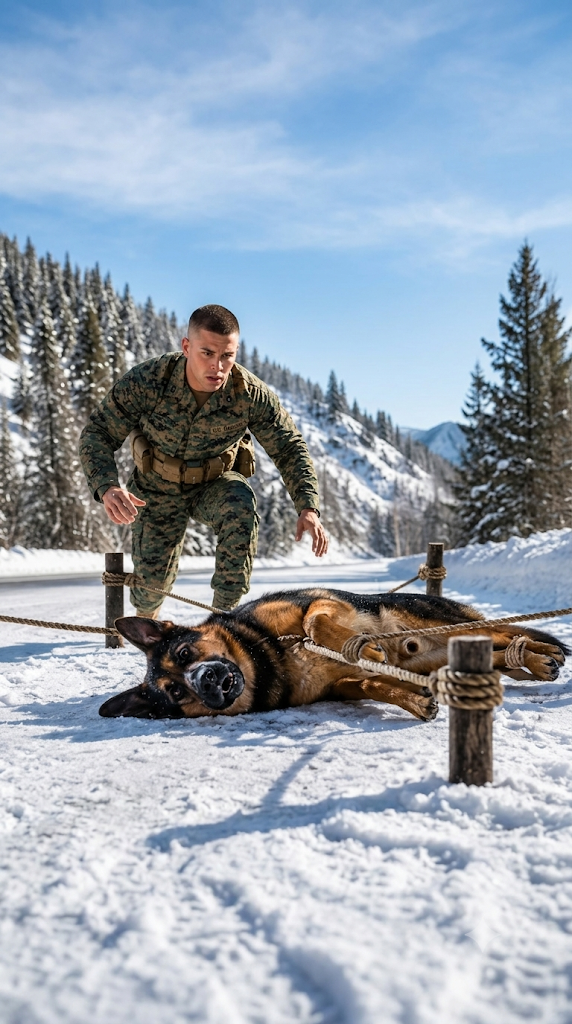
Several short wooden posts stood in an uneven rectangle beside the road, and old rope had been tied between them, probably left from some long-forgotten attempt to mark the edge of the property.
In the middle of it lay a German Shepherd.
Ethan stared through the windshield for several seconds. The dog was large, black and tan fur stood out sharply against the snow, and even from a distance, Ethan could see gray beginning to spread across its muzzle.
One ear remained upright while the other leaned slightly outward, and the shepherd lifted its head but did not try to stand.
Ethan switched off the engine, murmuring, “All right,” before stepping outside.
Cold air immediately replaced the dry warmth of the truck, and the German Shepherd watched him as Ethan stopped well before reaching the posts.
Up close, the situation became clearer. Several lengths of old rope had shifted from their original positions, and the dog appeared to have moved through the marked area sometime earlier and become tangled while trying to pass between them.
Nothing about the scene suggested Ethan should rush, so he didn’t.
The shepherd was probably nine years old, perhaps a little older, and its coat was thick but damp along the underside from contact with snow.
The dog still had the broad chest and heavy frame typical of a strong adult German Shepherd, though age showed in the silver around its face and in the careful way it shifted its rear legs.
Its dark brown eyes followed every movement Ethan made, alert, tired, and very uncertain about the stranger walking toward it.
Ethan removed his gloves, then crouched several yards away. Morning, he said, and the shepherd’s ears moved.
Ethan waited.
He had grown up with dogs, though few people in Bridgeport knew that.
His family had owned a yellow Labrador named Cooper when Ethan was a boy, and Cooper had followed him through childhood, slept outside his bedroom door, and somehow always known when Ethan was about to leave the house before Ethan reached for his shoes.
Cooper had been gone for many years, but Ethan still carried his old identification tag, which hung from a small cord around the rearview mirror of the truck, scratched and faded enough that the Labrador’s name was difficult to read unless the light struck it correctly.
Ethan had never decided to keep it there, he had simply never removed it.
The German Shepherd lowered its head again, and Ethan moved one step closer.
The dog watched another step, still no growl, no sudden movement, just attention.
“All right,” Ethan said quietly, “I’m not going to make this complicated.”
He lowered himself again and waited.
Nearly two minutes passed before the shepherd slowly moved its nose toward Ethan’s extended hand, and Ethan allowed the dog to smell him.
Only then did he touch the side of its neck, and the shepherd flinched slightly before relaxing.
“Good,” Ethan said.
He examined the ropes, most were loose, and he worked patiently, lifting one length away from the shepherd’s front leg and another from beneath its chest.
A third had wrapped around one rear leg, but it came free without difficulty once Ethan created enough slack.
The dog remained remarkably still, which surprised him, as many frightened animals would have struggled against the unfamiliar hands.
This one seemed to understand that Ethan was trying to help, or perhaps it was simply too tired to object.
Within several minutes, the final rope fell away, and Ethan stepped backward.
For a moment, nothing happened, then the German Shepherd pushed itself upright.
Its hindquarters rose more slowly than its front half, and Ethan noticed a stiffness that suggested age rather than any obvious new injury.
The shepherd stood, looked at Ethan, looked toward the truck, then turned its head toward the forest.
Ethan followed its gaze, but nothing moved among the trees.
Come on, he said, taking several steps toward the road, but the dog did not follow.
Ethan turned around, and the shepherd was still standing beside the posts.
You’re free, Ethan said, but the dog slowly lowered itself back into the snow.
Ethan frowned and returned to crouch beside it, and only then did he notice the collar.
It was old brown leather softened by years of use, and there was no name tag, phone number, or county license, but something small hung beneath the dog’s throat.
Ethan brushed snow away from it, revealing a narrow metal plate where most of the lettering had been worn nearly smooth.
Only three letters remained clear: S A R.
Ethan studied them, wondering if they meant search and rescue, or perhaps they meant nothing. Who are you, he asked.
The shepherd looked past him toward the trees again.
Ethan slipped one arm beneath its chest and prepared to help it toward the truck, but the reaction was immediate.
The dog planted its front paws, not aggressively, but firmly.
Ethan stopped, and the German Shepherd turned its head toward the hillside, then pulled away from the truck and took two slow steps toward the forest.
Hey, Ethan called, and the shepherd looked back at him.
Ethan had the strange impression that it was waiting.
Then, somewhere beyond the first line of snow-covered pines, something made a faint sound.
Ethan went completely still and listened.
For several seconds, there was only the winter air moving through the trees, and then it came again, small, distant, almost too faint to hear.
The German Shepherd rose despite the stiffness in its legs, and this time it did not hesitate.
It started toward the trees, and when Ethan remained beside the road, the old shepherd stopped, turned around, and looked directly at him, waiting.
Ethan glanced once at his truck, then at the dark line of forest ahead.
Whatever this dog had been doing before it became trapped among those ropes, it had not been trying to leave the mountain, it had been trying to get back to something, and now it wanted Ethan to follow.
The old German Shepherd disappeared between the first two rows of pine trees before Ethan Cole had fully decided whether following him was sensible.
The snow beyond the road was deeper than it had looked from the truck, rising nearly to Ethan’s ankles in places and hiding roots beneath a smooth white surface.
Ranger moved slowly, favoring his rear legs, but there was nothing uncertain about his direction.
Every thirty or forty feet, he stopped, turned his silvered face toward Ethan, and waited until the Marine caught up.
“All right,” Ethan said after the third time, “I’m still here.”
Ranger turned forward again.
The farther they moved from the road, the quieter the mountain seemed.
Morning sunlight reached through gaps in the trees in narrow, pale bands, and snow occasionally slipped from overloaded pine branches and fell softly to the ground.
Ethan kept one eye on Ranger and the other on the terrain, as he had spent enough time training in mountain environments to understand how quickly a simple walk could become complicated in winter.
But Ranger was not wandering. The shepherd was following a route he appeared to know.
After several hundred yards, the trees opened around a narrow service track that had almost disappeared beneath the snow.
At the end of it stood a small maintenance cabin built against the slope.
The weathered wooden structure had probably once been used by utility or forestry workers, but the windows were boarded, the door leaned slightly on its hinges, and snow had collected against one side of the building almost to the bottom of the window frame.
Ranger quickened his pace, and Ethan noticed it immediately.
Easy, he said, but the old shepherd ignored him.
He moved toward the covered section beneath the cabin’s shallow roof, stopped several feet from a dark corner, and lowered his head.
Something moved there.
Ethan froze as two oversized ears appeared first, then a narrow black and tan face.
A German Shepherd puppy was curled beneath the protected edge of the building, pressed close to the wooden wall where the wind could not reach him directly.
He looked to be around five months old, though his large paws suggested he would eventually become a substantial dog.
His fur was soft and slightly uneven with the awkwardness of puppyhood, dark across the back with tan markings beginning to sharpen along his legs and face.
His right ear stood nearly straight while the left folded forward at the tip, and the puppy stared at Ethan with wide brown eyes.
He did not approach, he did not bark, he simply tried to make himself smaller.
Ranger stepped forward, and the change in the puppy was immediate.
He rose so quickly that his front paws slipped slightly in the loose snow, recovered, and hurried straight toward the older shepherd.
He pushed his head beneath Ranger’s chest, then pressed his entire body against Ranger’s front legs, and Ranger lowered his muzzle and touched the top of the puppy’s head.
Ethan stood several yards away watching, and suddenly the morning made sense.
Ranger had not refused the truck because he was confused, and he had not been trying to return to familiar territory.
He had been trying to get back to the puppy.
You could have left, Ethan said quietly, and Ranger looked at him while the puppy remained almost hidden against the older dog.
Ethan crouched but did not reach toward him.
The younger shepherd’s eyes immediately shifted to Ethan’s hands, and his body tightened whenever Ethan moved too quickly.
“Okay, you don’t know me,” Ethan said, and Ranger lay down beside the puppy.
Only then did the smaller dog settle.
Ethan waited several minutes before offering part of the emergency snack he carried in a pocket.
The puppy showed interest, but would not move closer, so Ethan placed the food on the snow and stepped back.
Ranger sniffed it first, and the puppy watched him.
When Ranger showed no concern, the puppy finally crept forward and ate.
That answers that, Ethan muttered.
He glanced toward the road somewhere beyond the trees.
Bringing one tired shepherd back to his truck had already been the plan, but bringing two made the walk slower.
Leaving the puppy behind was no longer an option.
By the time they reached the pickup, Ranger was moving more carefully, and Ethan lifted the older shepherd into the rear seat rather than asking him to jump.
The puppy stopped several feet from the open door, and Ranger looked down at him.
That was enough.
The puppy climbed in after him.
Forty minutes later, Ethan pulled into the parking lot of Bridgeport Animal Clinic, a small veterinary practice near the edge of town with a green metal roof and a row of snow-dusted shrubs beneath the front windows.
Dr. Claire Bennett met him in the examination room.
Claire was thirty-eight, medium height and lean, with dark blonde hair pulled into a practical ponytail and clear blue eyes that seemed to notice details before people finished explaining them.
She had practiced veterinary medicine in the Eastern Sierra for more than a decade and had developed a calm directness that came from treating everything from family pets to working ranch dogs during bad weather.
She was friendly without being overly sentimental and had a habit of speaking to worried owners in the same steady tone she used with frightened animals.
Ethan finished explaining where he had found the dogs, and Claire looked at Ranger. “And you followed him into the woods?”
He seemed fairly certain about it, Ethan replied.
Claire glanced at the puppy pressed beside Ranger’s shoulder. Apparently, he was.
The examination took time because Claire refused to rush either dog.
Ranger was tired from the cold and exertion, and his rear legs showed the stiffness of mild arthritis, but Claire found nothing suggesting a serious immediate injury.
What he needed most was warmth, rest, regular meals, and follow-up care for his joints.
The puppy was in better physical condition than Ethan had expected.
He was thin, but stable with no obvious major injuries, and Claire estimated him at about five months old.
He’s frightened more than anything, she said. Food, warmth, routine, and patience may do most of the work.
Ethan looked toward Ranger. And him?
Same things. Maybe more patience with those joints.
A veterinary assistant walked past the open door carrying a stainless steel tray, and somewhere in the hallway, another tray slipped against a counter and struck the floor with a sudden metallic clatter.
The puppy startled and backed away, but Ranger reacted before Ethan did.
The old shepherd stood and quietly positioned himself between the puppy and the doorway.
Claire stopped. Her expression changed slightly, not alarm, but interest.
Ranger looked toward the hall, remained still for several seconds, then relaxed once the noise stopped.
“You saw that?” Claire asked.
Ethan nodded. “I did.”
A little later, a staff member tried moving the puppy into a separate recovery space so Ranger could rest undisturbed, but the separation lasted less than five minutes.
The moment Ranger disappeared from view, the puppy began pacing along the front of the enclosure.
He ignored the blanket, ignored a toy, and repeatedly looked toward the door through which the older dog had vanished.
Claire watched for a moment. Bring him back.
When the puppy returned to the examination room, he went directly to Ranger and lay down against his side, and his breathing slowed almost immediately.
Ethan folded his arms. “That’s going to complicate things.”
“It may,” Claire said.
The person who arrived to discuss exactly how complicated was Megan Foster, a twenty-nine-year-old coordinator with Alpine County Animal Rescue.
Megan was small and energetic with curly chestnut hair gathered into a loose knot and a faded blue rescue jacket that appeared permanently covered with dog hair.
She spoke quickly but listened carefully, a habit she had developed after years of matching animals with families who sometimes wanted very different dogs from the ones they were actually prepared to care for.
She crouched several feet from the puppy rather than approaching directly.
No tags? she asked.
Nothing useful, Ethan said.
Claire showed her the worn collar and the metal plate, and Megan rubbed a thumb carefully across the faded letters. S A R.
That’s all we have, Ethan said.
Megan photographed both dogs for the rescue intake page.
Within an hour, the first inquiries began appearing on her phone, and nearly all of them asked the same thing.
How old was the puppy? Was the puppy available? Would the puppy be good with children?
No one asked much about the old shepherd.
Megan did not comment at first, she did not need to.
Ethan watched another message arrive. Interested in the young German Shepherd? Then another. Can we meet the puppy this weekend?
He looked toward Ranger, who had settled on a padded mat while the younger dog slept against his chest.
You’ll find them somewhere together? Ethan asked.
Megan hesitated. We’ll try.
That wasn’t what I asked.
Megan looked at him more carefully. Puppies are easier. Senior dogs take longer. Two large dogs together are harder still.
Ethan understood the arithmetic immediately.
The puppy was young enough to represent years ahead, while Ranger represented medication, slower walks, and an unknown amount of time.
It was a choice people made every day without believing they were making a cruel one, and Ethan disliked how much that bothered him.
Megan smiled faintly. You could foster them?
No.
The answer came too quickly, and Claire looked up from the counter.
Ethan noticed. I brought them somewhere safe. That’s the job.
No one said otherwise, Claire replied, but her expression suggested she had heard similar sentences before.
While Megan continued arranging temporary placement, Claire returned to Ranger.
She had been thinking about the shepherd’s reaction to the fallen tray, so she asked Ethan to try telling him to stay.
Ethan looked at her. Why?
Humor me.
Ranger was already sitting, so Ethan took one step backward. Stay.
The old shepherd did not move, and Ethan stepped farther away.
Ranger remained exactly where he was.
Claire’s eyebrows lifted. That could still be basic obedience.
Then she raised one hand, no words, just a small deliberate signal with her palm.
Ranger’s attention locked onto it instantly, and Claire changed the position of her hand.
The old German Shepherd lowered smoothly to the floor perfectly without hesitation.
Ethan stared at him while Scout remained curled beside the older dog, unaware that anything unusual had happened.
Claire slowly lowered her hand. “That,” she said, “wasn’t an accident.”
And for the second time that morning, Ethan found himself wondering exactly who Ranger had been before the mountain gave him back.
Three days after leaving the veterinary clinic, Ranger and Scout were transferred to Alpine County Animal Rescue, a modest facility surrounded by open ground, pine trees, and a fenced exercise yard where dogs could spend part of the day away from their kennels.
Megan Foster had arranged for the two shepherds to share a larger indoor run because separating them still made Scout uneasy.
She had also been the one to give the puppy his name.
He follows Ranger like a little Scout checking the trail, she had explained, and the name stayed.
Scout adapted to the rescue center quickly.
At five months old, with oversized paws, bright brown eyes, and one ear that still folded whenever he became excited, he attracted attention almost immediately.
Families stopped beside his kennel, children pointed at him through the viewing window, and within the first two days, Megan received several applications asking whether the young German Shepherd would be available for adoption soon.
Ranger received none.
The old shepherd seemed unconcerned, spending most mornings stretched across a thick blanket near the front of the shared run while Scout investigated toys, water bowls, corners, and anything else that appeared potentially chewable.
When visitors approached, Scout usually hurried forward, while Ranger lifted his silvered head, watched quietly, and gave a slow wag of his tail if someone spoke to him.
People often smiled at the older dog, then they asked about the puppy.
Ethan Cole noticed. He also noticed that he had somehow begun arriving at the rescue center almost every afternoon.
“I’m checking on them,” he told Megan the first time she raised an eyebrow at him.
“Of course.”
Two days later, she saw his truck again.
“Checking?”
“Exactly.”
By the end of the week, Megan stopped asking.
Ethan usually arrived still wearing his Marine utility uniform.
Scout learned the sound of his boots in the hallway and developed a habit of meeting him at the gate with a stolen object.
On Monday, it was a rope toy.
On Tuesday, it was a cleaning cloth someone had left too close to the kennel.
On Wednesday, while Ethan sat on a bench tying one boot after helping in the exercise yard, Scout grabbed the loose end of the lace and backed away with enormous satisfaction.
“Drop it!”
Scout pulled harder, and Ranger watched from several feet away with the tired expression of an older relative who had chosen not to become involved.
“You could help,” Ethan told him, and Ranger blinked.
Scout won the first round.
The next afternoon, the puppy managed to steal one of Ethan’s gloves from the bench.
Two days later, he reached through the open gate while Ethan was speaking with Megan and escaped, carrying Ethan’s camouflage utility cover in his mouth.
Megan laughed so hard she had to lean against the fence.
This is why I don’t foster puppies, Ethan said.
You aren’t fostering him.
Exactly.
Scout raced past them with the cap, and Ranger remained beneath a tree, watching.
That was when Ethan remembered Claire Bennett’s hand signal at the clinic, as he had thought about it several times since.
Ranger had responded too quickly and too precisely for the movement to have been coincidence.
Family dogs learned commands, and many learned hand signals, but something about Ranger’s attention had been different.
The old shepherd had not simply waited for a familiar word, he had watched Claire’s hand as though reading an instruction.
Ethan retrieved his cap from Scout and walked toward Ranger. Come on, old man.
Ranger rose carefully, and Ethan led him into the quieter section of the fenced yard.
Scout attempted to follow, but Megan distracted him with a tennis ball.
Ethan stopped. Ranger stopped too.
Without thinking much about it, Ethan took another step and gave the command. Heel.
Ranger moved immediately to Ethan’s left side, not somewhere near his left side, but exactly beside it.
His shoulder aligned with Ethan’s leg, his head remained forward, and when Ethan walked, Ranger matched his pace.
When Ethan stopped, the shepherd sat automatically.
Ethan looked down. Well, he said, and he walked again.
Ranger stayed with him. Stay, Ethan commanded, and he moved away.
Ranger remained fixed in place, watching him.
Scout ran past on the opposite side of the fence, chasing the tennis ball, and Ranger’s eyes shifted toward the puppy for half a second, but his body did not move.
Ethan returned. Good.
Megan had stopped playing with Scout and was watching now. That looks different from sit-for-a-treat training.
It is, Ethan said.
He removed one glove. Let’s see how different.
He let Ranger smell it briefly, then asked Megan to hold the old shepherd while Ethan walked toward the far side of the yard.
He placed the glove behind a low wooden barrier near the fence, returned by a different route, then took Ranger’s leash.
The shepherd looked at him.
Ethan hesitated before giving the command. Find it.
Ranger’s head changed position immediately, his nose dropped, and he moved across the yard slowly, working rather than wondering.
He passed the water station, ignored a pile of toys, paused near the fence, then changed direction.
Ethan followed several feet behind without helping.
Ranger reached the wooden barrier, circled it once, then stopped beside the hidden glove.
Megan stared. That dog knew exactly what you were asking.
Ethan picked up the glove. So did I.
Claire arrived later that afternoon after Megan called her.
She still wore pale blue veterinary scrubs beneath a winter jacket, her blonde hair pulled back and a pencil tucked behind one ear.
She listened while Ethan described the exercise, then watched Ranger perform several basic commands again.
“This isn’t proof of a specific job,” Claire said carefully, but somebody invested a lot of time in him.
Ethan showed her the worn metal piece from Ranger’s collar, and Claire turned it toward the light.
S. Search and rescue, Megan said.
Claire nodded slowly. That would fit better today than it did three days ago.
Megan decided to check the microchip again, as the original scan had produced old information with incomplete contact details, but the rescue organization had access to an additional registry service that sometimes retained archived records after phone numbers and addresses had expired.
While she worked, another visitor arrived with his grandmother.
The boy’s name was Noah Parker.
He was ten years old, thin and slightly short for his age, with straight sandy brown hair that fell across his forehead and gray-green eyes that seemed to examine every dog before he went anywhere near it.
Noah was the son of a Marine from Ethan’s unit and had begun visiting the rescue center with his grandmother after asking if he could help fold blankets.
He was polite, thoughtful, and unusually careful around animals.
Megan knew why.
When Noah had been younger, an excited large dog had knocked him down at a family gathering.
He had not been seriously hurt, but the surprise had stayed with him, leaving him uncomfortable whenever a big dog approached too quickly.
Scout was immediately too enthusiastic for him, and Noah stepped behind his grandmother when the puppy bounced toward the fence.
Ranger did something different.
He noticed Noah, then lay down. He did not approach.
Noah watched him from across the yard.
Over Ethan’s next several visits, the same small ritual repeated.
Noah came to help, and Ranger remained nearby without closing the distance.
Eventually, Noah began sitting on a bench several yards away.
One afternoon, he stood.
He walked toward Ranger one careful step at a time.
Ethan said nothing. Neither did Megan.
Ranger stayed where he was.
Noah stopped beside him and slowly placed one hand between the shepherd’s ears.
Ranger’s tail moved once across the ground, and Noah smiled.
It was a small moment, but Ethan remembered it.
Ranger had spent most of his time protecting Scout by staying close to him, but with Noah, he seemed to understand that sometimes helping meant doing exactly the opposite.
Megan emerged from the office before sunset, holding a printed page. I found something.
Ethan joined her at the desk.
The archived microchip record contained a name. Ranger.
So the name they had been using was not merely convenient, it was his.
Below it was an older registration entry, Walter Hayes.
There was a phone number attached, although Megan warned Ethan there was no guarantee it still worked.
Ethan called anyway.
Voicemail.
He left his name, explained that he was a gunnery sergeant stationed near Bridgeport, and said they had found a German Shepherd registered under the name Ranger.
Then he waited.
Nothing happened that evening.
The following afternoon, Ethan was leaving the rescue center when his phone vibrated.
Unknown number, he answered. This is Cole.
An older man’s voice came through the line, careful and quiet.
Are you the Marine who called me about a German Shepherd?
Ethan stopped beside his truck. “Yes, sir.”
There was a pause. “What did you say his name was?”
“Ranger.”
Silence followed, not the silence of a bad connection, but the kind created when someone hears something they stopped expecting years ago.
When Walter Hayes finally spoke again, his voice had changed. I thought I would never hear that name again.
The next morning, Ethan Cole drove south toward Bishop, beneath a clear winter sky that made the Sierra Nevada look close enough to touch.
Snow still covered the higher slopes, but the highway itself had been cleared, leaving long, dark ribbons of pavement between white fields and scattered stands of pine.
Ranger remained at Alpine County Animal Rescue with Scout, and Ethan told himself that the trip was simply about completing a missing piece of the dog’s history.
Walter Hayes had given him an address during their phone call.
It belonged to a small house on the northern edge of Bishop, set back from the road behind a row of cottonwoods and an old split-rail fence.
A faded wooden sign beside the driveway carried the outline of a German Shepherd and the nearly vanished words, “High Sierra Search Team.”
Ethan noticed that before he noticed the man waiting on the porch.
Walter Hayes was sixty-seven, tall but slightly stooped through the shoulders with thick silver hair cut short and a weathered face shaped by decades spent outdoors.
He wore jeans, a dark flannel shirt, and a brown canvas jacket polished pale at the elbows.
His left hand rested on a wooden cane, though he seemed to dislike depending on it, and often forgot to use it until his balance reminded him.
There was nothing fragile about Walter’s expression.
His pale gray eyes were direct and observant, and his handshake was firm.
“You look younger than you sounded on the phone,” Walter said.
“I get that sometimes.”
“I don’t.”
The corner of Walter’s mouth lifted, and Ethan liked him immediately.
Inside, the house explained the old sign outside.
Photographs covered one wall of the living room.
Search teams stood in snowfields, forests, and mountain passes.
Men and women in heavy jackets posed beside German Shepherds, Labradors, and border collies wearing working harnesses.
Shelves held old radios, maps, whistles, dog collars, and framed certificates.
Walter walked toward one photograph near the fireplace.
A younger version of him stood beside a black and tan German Shepherd.
Even without the silver muzzle, Ethan knew the dog.
“Ranger,” he said.
Walter nodded. He was three there.
The photograph had been taken after a winter search near Mammoth Lakes.
Ranger stood alert beside Walter, broad-chested and strong, wearing a red harness marked Search and Rescue.
Ethan looked at the faded metal plate on the harness. S.
Walter noticed. That answers your collar question.
For the next hour, he told Ethan the parts of Ranger’s life that had disappeared from the microchip records.
Walter had spent more than twenty years volunteering with a mountain search and rescue organization.
He had started as a ground searcher, then moved into canine work after watching a trained dog locate a lost hiker in terrain that had already been searched twice by people.
Ranger came to him as a young dog with more energy than patience.
He wanted to work before he understood what work was.
Walter said if you hid something, he believed the correct solution was to search the entire county.
Training had changed that energy into discipline.
Ranger learned scent work, directional commands, long stays, hand signals, and how to remain calm around unfamiliar people.
He worked winter searches, forest callouts, and mountain incidents where missing hikers had wandered away from marked trails.
During bad weather, Ranger sometimes traveled beside rescue crews for hours, then returned to the truck and behaved as though the entire event had been an ordinary afternoon walk.
Walter was careful not to turn those memories into legends. People like to make working dogs sound magical, he said, but they aren’t.
They train. They repeat. They make mistakes. Then one day, all those repetitions matter.
Ranger had been good because he was patient, that was the part Walter remembered most.
If a frightened person did not want a dog close, Ranger waited.
If another search dog became excited, Ranger stayed focused.
If Walter stopped, Ranger checked him.
Ethan thought of the snowy forest outside Bridgeport, of Ranger stopping every few yards, looking back, making sure Ethan was still following.
“What happened to him?” Ethan asked.
Walter’s expression changed.
Six years earlier, Walter developed a heart condition that ended his fieldwork almost immediately.
His doctor had been clear that long searches at altitude were no longer safe.
Walter resisted until an episode during training left him sitting beside a trail while another handler completed the exercise with Ranger.
That was when I finally understood stubbornness wasn’t the same as loyalty, he said.
He retired.
Ranger was still healthy and needed activity Walter could no longer provide, so a longtime acquaintance agreed to take him.
Walter visited when he could and believed the arrangement was stable.
Then the acquaintance moved, and Ranger went with him.
Later, there was another move, then a family change, then a phone number that stopped working.
Walter attempted to trace the registration, but the microchip information had never been updated after the first transfer.
Eventually, every lead ended.
I kept thinking somebody would call, Walter said. Then enough time passed that you stop expecting the phone to ring.
Ethan looked again at the photographs. You want to see him?
Walter’s answer came immediately. Yes.
They reached Alpine County Animal Rescue shortly after noon.
Megan Foster saw Walter’s face when he entered and did not ask many questions, she simply opened the door leading toward the indoor runs.
Scout spotted Ethan first, bouncing toward the gate carrying one of his favorite rope toys, then becoming distracted when he noticed the older man beside him.
Ranger was lying on a padded mat near the rear wall.
Walter stopped in the doorway.
He did not call Ranger’s name. He did not kneel.
For several seconds, he simply stood there, gripping the top of his cane with both hands.
Ranger lifted his head.
The old shepherd stared, and Ethan watched his ears move forward.
Then Ranger rose.
His hind legs took an extra moment beneath him, but once he was standing, he walked directly toward Walter.
Scout followed two steps, then stopped as though even he understood something unusual was happening.
Walter lowered himself carefully to one knee, and Ranger reached him.
The shepherd smelled Walter’s jacket, his hands, then the side of his face.
Walter did not speak.
Ranger pushed his head against the old man’s chest, and Walter closed both arms around him.
Ethan looked away for a moment, not because the reunion was dramatic, but because it was the opposite.
There was no barking, no excited jumping, no confusion, just an old man sitting on the floor with an old dog leaning into him as though several lost years had briefly folded together.
When Walter finally spoke, his voice was rough. You got gray.
Ranger’s tail moved slowly across the floor. So did I.
Scout approached a few minutes later and inspected Walter with the cautious curiosity he reserved for new people.
Ranger remained beside the older man, which seemed to settle the puppy immediately.
Walter watched the two shepherds together. “That one belongs to him.”
“Apparently,” Ethan said.
Walter smiled. “That sounds like Ranger.”
Later, they moved into the exercise yard.
Walter asked Ethan to show him what Ranger could still do.
Ethan demonstrated heel, stay, and a short search using a glove.
Walter observed without interrupting. He remembers. He’s slower.
He’s nine, maybe closer to ten now.
Slower is allowed.
Walter explained that Ranger’s old training could still be useful if treated as enrichment rather than work, short scent games, simple object searches, basic hand signals, nothing that required long distances or pushed his joints.
If you want, Walter said, I can show you how to keep his mind busy without asking his body to be young again.
Ethan looked at him. You think I’m keeping him?
Walter rested both hands on his cane. I think Ranger has already decided where he looks when he wants direction.
Ethan said nothing.
Walter glanced toward Scout, who was attempting to pull one of Ethan’s gloves from his back pocket. And that one appears to have made a decision, too.
That evening, Noah Parker arrived with his grandmother to help Megan prepare blankets and toys.
The ten-year-old now worked near Ranger without keeping the same careful distance he once had.
Scout repeatedly attempted to steal strips of fabric from the blanket pile, forcing Noah to retrieve them while laughing.
Ethan watched from the hallway.
Scout had somehow turned the rescue center into a place where Ethan knew people by name.
That bothered him less than it used to.
On the drive home, however, a practical problem returned.
Ethan opened the rental agreement on his phone after parking outside his house.
The pet section was short. One pet permitted with approval. Maximum weight fifty pounds.
Ranger was already well above that, and Scout would be soon.
Ethan leaned back in the driver’s seat.
Adopting one would be difficult. Adopting both would mean moving.
A larger place, a fenced yard, veterinary expenses, food schedules.
A life built around something other than his own convenience.
He looked through the windshield at the dark windows of the house he had never really made his.
For the first time, moving did not feel like the most inconvenient option.
Separating Ranger and Scout did.
His phone vibrated.
A weather alert filled the screen. Winter Storm Watch Eastern Sierra.
A powerful system was expected to reach the region within forty-eight hours with heavy snowfall, strong winds, and difficult travel conditions likely across the mountain roads.
Ethan read the alert twice.
Above Bishop, the first high clouds were already beginning to gather against the Sierra.
Winter was coming back, and this time, Ranger would not be facing it alone.
The storm reached Bridgeport almost twelve hours earlier than the forecast had predicted.
By sunrise, the eastern Sierra had disappeared behind a wall of blowing snow, and roads that had been clear the previous evening were already narrowing beneath fresh accumulation.
Wind pushed loose powder across open ground in long white sheets.
Visibility changed from one mile to a few hundred feet without warning, and county crews began closing the higher mountain routes before most residents had finished breakfast.
Gunnery Sergeant Ethan Cole had been awake since before dawn.
His unit was assisting Mono County emergency crews with communications, transportation, and road access support where military equipment could be used safely.
Ethan spent most of the morning moving between checkpoints, helping coordinate vehicles and confirming that nobody entered roads already marked closed.
He had worked in mountain weather often enough to respect how quickly conditions could change.
The safest rescue was always the one that did not create another person who needed rescuing.
Shortly after noon, a county radio message changed the pace of the day.
A vehicle connected to Alpine County Animal Rescue had become stranded near an older service road north of town.
Three volunteers had been transporting supplies before the route deteriorated.
They had abandoned the vehicle only after being directed toward a nearby emergency cabin.
Two reached the cabin. The third did not.
Ethan recognized Megan Foster’s name immediately among those involved.
He called the rescue center as soon as he had permission to step away.
Megan answered herself.
She was safe, shaken but calm, sheltering with another volunteer at the cabin while county search teams organized outside.
It happened fast, she told him. We stayed