

Nobody in the cardiology wing of Harrogate General paid much attention to the woman carrying a cardboard box out of the building at half past nine on a Tuesday morning, and that was the part that hurt most.
Not the dismissal itself, but how thoroughly unremarkable it looked to everyone watching.
Fiona Devereaux held the box against her hip with both arms, the way she had once held a field kit in the dark over terrain she couldn’t see.
Inside the box: a succulent plant she had kept alive through three Canadian winters on a windowsill that got maybe an hour of real sun per day, a worn copy of a pharmacology reference she had annotated in pencil over seven years, and a photograph of Lake Superior at dawn that she had taped above her locker on her first week because it reminded her that some things were bigger than whatever room you were standing in.
She kept her eyes forward. She did not look at the nurses’ station as she passed it.
Dr. Owen Prescott was sitting on the edge of Dr. Declan You’s desk doing what he always did when the shift went quiet—talking too loudly about something that had nothing to do with patient care.
Today it was Fiona.
He had his phone out showing You something on the screen, and his voice carried the particular pitch of a man who had never once in his life needed to check whether anyone nearby could hear him.
“Watch this one,” Prescott said, swiping to a clip. “Someone on nights recorded it last week. She tripped over the supply cart outside room fourteen and just stood there. Didn’t say a word. Didn’t apologize. Just picked up the gauze packs one at a time like she was diffusing a bomb.”
You laughed and shook his head. “She’s been like that the entire time I’ve been on this ward.”
“Seven years and the woman has never once made a sound above a moderate indoor voice. She filed a concern about my heparin order last month,” Prescott said, dropping his voice into a mock whisper. “Actually walked it up to the charge desk in writing. In writing. Like we’re still in nursing school.”
“What happened to it?”
“Nothing, because she was wrong.”
Fiona’s jaw tightened exactly one degree and then released.
She had learned how to do that—how to absorb the impact of a sentence and redistribute it without letting anything surface. She had learned it in a basement in Kandahar during a six-hour debrief that she still could not discuss under the terms of a non-disclosure agreement she had signed the same week she took off her uniform for the last time.
She kept walking.
The meeting with HR that morning had lasted eleven minutes. The administrator, a careful woman named Sandra Poe, had slid a termination notice across a laminated desk and said the words with the practiced efficiency of someone who had said them many times before.
The grounds cited were a pattern of documentation irregularities and a disputed medication concern that had, in the official record, been attributed entirely to Fiona rather than to the physician who had issued the order she had flagged.
Fiona had read the document twice, quietly, and then asked one question: whether Dr. Prescott’s verbal confirmation, which three nurses had witnessed, had been included in the review.
Sandra Poe had looked at the table and said the investigation had been thorough.
Fiona had signed nothing. She had simply stood, thanked Sandra Poe for her time in the genuine way she thanked everyone for their time, and gone to empty her locker.
Twenty-two feet behind her as she passed the nurses’ station, the automatic doors from the ambulance bay opened outward, and Brigadier General Constance Abar stepped through them.
Flanked by a captain in dress uniform and a civilian aide who had the particular look of a person managing seventeen things simultaneously and dropping none of them.
Abar was here for a ceremony. A young corporal on the third floor had received a commendation she had personally approved, and she had driven two hours from CFB Borden to put the ribbon in his hands herself because she believed, without any qualification, that people who do difficult things in terrible conditions deserve to have someone look them in the eye when they are recognized for it.
That was all this was supposed to be—a fifteen-minute stop, a handshake, a photograph, and then back on the highway before noon.
She heard the laughter before she fully registered the room.
Abar had a gift that certain people develop after enough years and enough bad situations—the ability to read a social environment in under three seconds with the same precision most people apply to reading a single face.
What she read in those three seconds at the entrance to Harrogate General’s cardiology ward was this: two men laughing at a video on a phone, a cluster of medical staff watching from a safe distance, and a woman in scrubs walking away from all of it with a cardboard box and the rigid, careful posture of someone who had decided a long time ago that the cost of reacting was always higher than the cost of absorbing.
She almost kept walking. The ceremony was the reason she was here.
Then the woman with the box turned slightly to navigate around a supply cart, and Abar saw her face in three-quarter profile, and something in her memory did not so much click as crack wide open.
She stopped walking.
Her aide, Captain Tremblay, nearly walked into her back and caught herself at the last second with the particular agility of someone who had learned to expect sudden stops.
“Ma’am,” Tremblay said quietly.
Abar did not answer immediately. She was looking at the face of a woman she had last seen through the scratched plexiglass of a transport helicopter in conditions that she had, in subsequent reports, described as the worst forty minutes of her operational career—which was saying something.
“General,” Tremblay tried again.
“Give me a moment.”
Abar’s voice, when it came, did not carry the way a shout carries. It carried the way certain silences carry—by eliminating every other sound in the room simply through the weight of its authority.
“Is someone in this hallway mocking Cypher Actual?”
The question arrived without preamble, without explanation, without any of the social softening that most public questions come wrapped in.
It landed in the middle of Prescott’s laughter like a blade dropped flat on a table, and the laughter simply stopped existing.
Every head in the corridor turned.
Fiona’s feet stopped moving before her conscious mind issued the instruction to stop, because there are certain phrases that bypass the decision-making parts of a person’s brain entirely and go straight to the body, and that particular call sign was one of them.
She had not heard it spoken aloud in six years.
She had, in fact, spent six years actively avoiding any situation in which it might be spoken aloud—which was part of why she worked a cardiology ward in a mid-sized Ontario city rather than anywhere she might have otherwise ended up.
She turned around very slowly.
Abar was already moving toward her, and the expression on her face was the particular expression of a commanding officer who has spotted something that should not be where it is and cannot decide whether she is relieved or furious or both simultaneously.
“What is a Cypher Actual?” Corporal Prescott said. He meant it as a mutter, but the silence had made the ward acoustically strange.
Nobody answered him.
Abar stopped in front of Fiona Devereaux and looked at her the way you look at someone you once carried out of a burning structure under fire—with the total attention of a person who needs to confirm that what they are seeing is real and not some product of exhaustion or proximity grief.
“It is you,” Abar said, not a question.
“General Abar,” Fiona said, and her voice came out level and quiet, the way her voice always came out.
But there was something underneath it now that had not been there thirty seconds ago—a faint vibration, like a wire pulled too tight.
“Someone want to explain to me,” Abar said, turning now so her voice reached the nurses’ station and the two doctors who had gone very still behind it, “why a woman with a Meritorious Service Medal and a classified operational citation is standing in this hallway holding a cardboard box?”
Prescott opened his mouth, then closed it, then opened it again. “She doesn’t—we weren’t aware of any military—”
“I didn’t ask what you were aware of,” Abar said. “I asked why she’s holding a cardboard box.”
Sandra Poe had appeared in the doorway of the HR corridor, drawn by the silence the same way people are always drawn by sudden silences in places where noise is the baseline. She had the look of a person rapidly recalculating.
“There was a termination this morning,” Sandra said, choosing her words the way someone chooses footing on uncertain ice. “A medication documentation matter.”
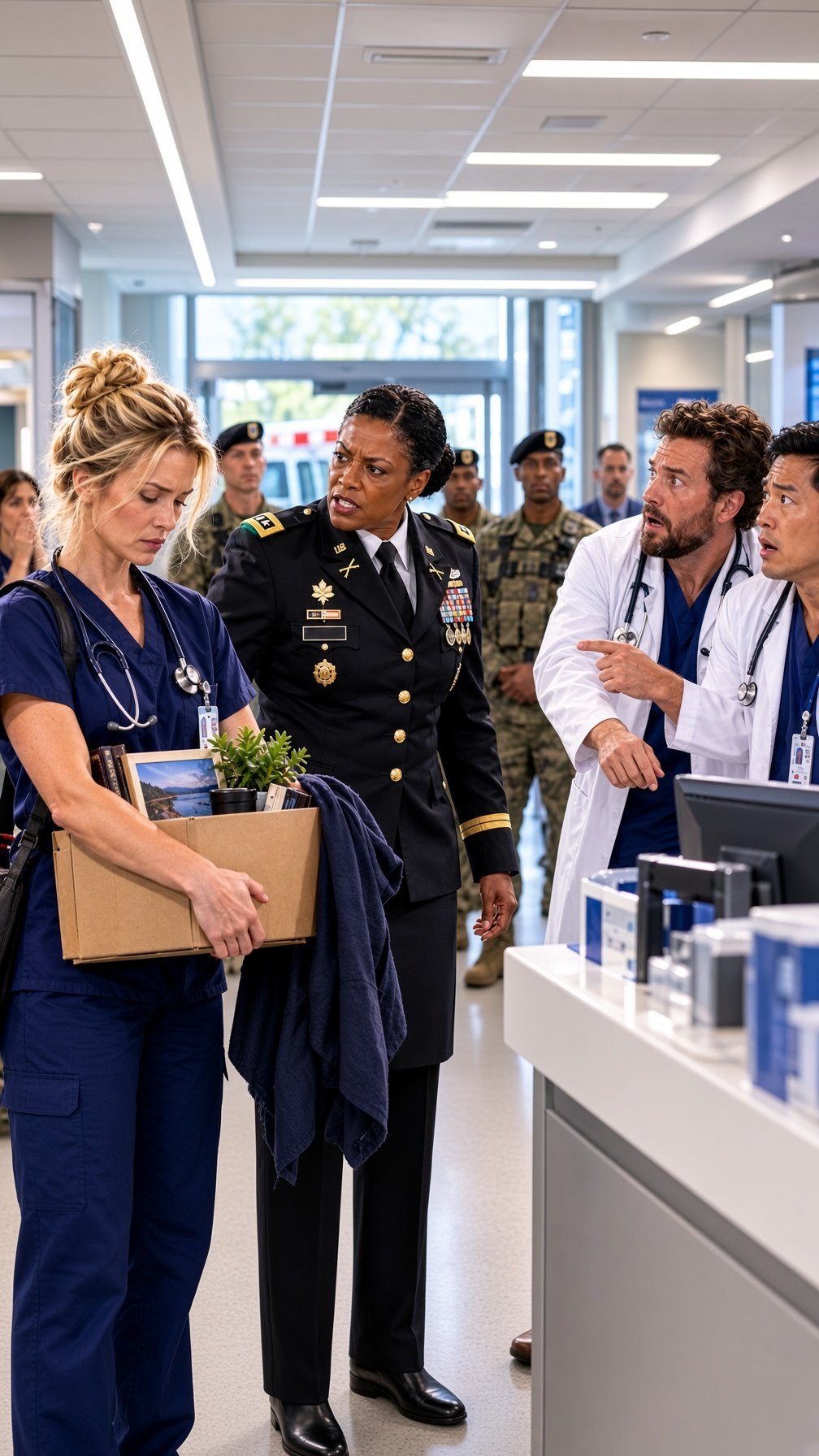
“The review was incomplete,” Fiona said, and the words came out of her the way a thing comes out of a person who has held it back for as long as holding it was useful and has now decided it isn’t.
“I flagged Dr. Prescott’s heparin order verbally on the fourteenth. Three nurses on the overnight shift heard it. His confirmation was verbal and is not in the chart. The adverse event documentation lists my name because I administered the corrected dose. The dose I administered was correct. The original order was not.”
The corridor was completely silent.
“That is an oversimplification—” Prescott said.
Abar’s voice cut through his sentence with the precision of a tool made specifically for that purpose. “I would encourage you very sincerely to stop speaking.”
He stopped speaking.
Fiona set the box down on the counter beside her because her arms had started a fine tremor that she recognized as adrenaline metabolism and not weakness, though it had been long enough since she had felt it that the distinction required a moment to confirm.
She pressed both palms flat on the counter and breathed once, deliberately, through her nose.
“You don’t have to do this,” she said to Abar, quietly enough that only Abar could hear it. “I had already decided to go.”
“I know you had,” Abar said, matching her volume. “That’s the part I have a problem with.”
Above them, the ward intercom chimed twice—the code for a mass casualty incoming to emergency, the kind of double chime that meant the department was calling for anyone available with the skills to move.
Abar’s eyes went to the ceiling speaker and then back to Fiona’s face with the efficiency of a woman who has spent three decades making rapid assessments.
“What did they say the count was?” she asked the nearest resident, who startled visibly at being directly addressed.
“Six incoming,” the resident managed. “Highway 17 collision, tractor-trailer versus two passenger vehicles, at least two critical, one pediatric.”
Abar looked at Fiona.
Fiona looked at the emergency department doors.
There are some arguments the body settles before the mind has finished making them, and Fiona’s body had already decided.
Seven years of standing in that building had not erased what had been built into her before she ever walked through its doors—the particular reflex of a person trained to move toward crisis rather than away from it, regardless of whether she was technically on the clock.
“I’m still in the building,” Fiona said, more to herself than to anyone else, and pushed off from the counter.
“You are,” Abar agreed, and something in her voice sounded quietly satisfied.
Fiona was through the emergency department doors before the first ambulance had finished backing in.
Dr. Rowan Finch, the attending on duty, looked up from a crash cart with the expression of someone who has just had more help arrive than they expected.
“Devereaux, you’re off today.”
“I’m here,” Fiona said simply, and pulled a pair of gloves from the dispenser. “What’s the status on the pediatric?”
Finch stared at her for exactly one second, then made the decision that experienced clinicians make when they recognize competence arriving in an unexpected package.
“Eight years old, blunt abdominal trauma, BP dropping, bay three.”
Fiona moved.
The girl in bay three was small and very frightened, and had the particular gray-white color of a child losing blood pressure faster than anyone wanted to think about.
Her name was Molly, according to the paramedic who had been holding her hand during transport, and she had stopped crying about four minutes ago—in the way that children stop crying when their bodies no longer have the energy for it, which is always a worse sign than the crying itself.
Fiona was at the bedside before the bay curtain had finished moving.
“Molly,” she said, and her voice dropped into a register she hadn’t used in years. Not softer, exactly, but calibrated—the way a tuning fork is calibrated—hitting a frequency that cuts through panic without adding to it.
“My name is Fiona. I’m going to put my hand on your stomach, and I need you to tell me if the pressure changes. Okay? Can you do that for me?”
The girl’s eyes found her face and held there. Children, in Fiona’s experience, always knew when an adult was actually present with them versus going through the motions of presence, and they always chose to trust the former over the latter, regardless of what the adult’s credentials said.
“Okay,” Molly said, very small.
The abdominal rigidity told Fiona what the ultrasound would confirm forty seconds later: a splenic laceration, significant, with internal bleeding that had been accumulating since the collision.
She called it out before the image finished loading on the screen—gave Finch the pressure reading, the heart rate trend, and the specific grade of laceration she suspected from the rebound tenderness pattern, all in the quiet, dense language of someone delivering a sitrep rather than a diagnosis.
Finch looked at the ultrasound and then at Fiona and said quietly and without any defensiveness at all, “How did you know the grade before the scan?”
“Hands,” Fiona said. “Machines are three seconds behind the patient.”
Finch nodded once and called for the surgical team.
In bay one, the critical adult patient—a man in his sixties whose chest had taken the full force of a steering column—was deteriorating faster than the monitoring equipment was reporting.
Fiona caught it while passing: the particular color change in the vascular beds of his hands that preceded a pressure crash by approximately forty-five seconds.
She turned back without breaking stride to tell the resident at his bedside exactly what was about to happen and exactly what to do about it.
The resident did it. The patient’s pressure stabilized.
Later, the resident would not be entirely able to explain to colleagues how they had known to act before the monitors showed anything worth acting on. They would say the nurse—the one in the dark blue scrubs who wasn’t technically supposed to be there—had told them. They would say she had said it the way someone says something they are simply reporting as fact rather than predicting.
Outside bay two, during a ninety-second pause while the surgical team moved in, Finch touched Fiona’s sleeve.
“You’ve done this before,” she said, not like a question.
“Different setting,” Fiona said.
“What setting?”
Fiona looked at the emergency department doors, where the last ambulance had just cleared and the pace was beginning to decelerate from crisis toward management.
“Forward operating,” she said, and left it there.
Abar had stayed in the corridor and watched through the bay windows with the expression of a woman for whom watching was, in certain contexts, its own form of testimony.
When Fiona finally came back through the doors, pulling off her gloves and folding them inside out the way medically trained people do without thinking, Abar was waiting.
“All six stable,” Fiona said.
“I know,” Abar said. “I was watching.”
Sandra Poe had materialized nearby. The termination folder now held somewhat less certainly than it had forty minutes ago. Dr. Prescott was standing further back, in the particular posture of a man trying to occupy as little spatial presence as possible without technically leaving the area.
“I’d like to revisit this morning’s action,” Sandra Poe said, and at least she said it without hedging.
“The medication record needs to be corrected,” Fiona said. “The source of the original order and the verbal exchange on the fourteenth both need to be documented accurately. That’s what I want. Not my position back. The record corrected.”
Sandra Poe looked at the folder in her hands, then at Prescott, then at Abar, and made several calculations simultaneously.
“I can initiate a full review by end of day.”
“Good,” Abar said, with the tone of someone closing an item on a list.
Prescott cleared his throat once—a sound that contained several things he appeared to be deciding not to say—and then said, “For what it’s worth—”
And then stopped.
“It’s worth documenting correctly,” Fiona said, not cruelly. Just precisely, the way she said most things.
Abar waited until Prescott had retreated and Sandra Poe had gone back to her office before turning to Fiona and dropping the formal register entirely.
“Why nursing?” she asked. “After everything, why here?”
Fiona was quiet for a moment.
Outside the emergency bay windows, an orderly was pushing an empty gurney back toward the storage corridor and whistling something tuneless, and the sound was the kind of ordinary that six years ago Fiona would have taken entirely for granted.
“I wanted to do the same work without the operational part,” she said finally. “The part where I can actually stay with someone. All the way through. No extraction window, no handoff, no leaving them on the tarmac and climbing back in the bird.”
Abar studied her.
“And the people who made it hard to stay?”
Fiona looked back through the window at bay three, where Dr. Finch was talking to a woman who was almost certainly Molly’s mother, and the woman was crying the way parents cry when the news is good and they have been holding their breath too long.
“Most people are small and frightened and doing their best,” Fiona said. “Some people are small and frightened and taking it out on whoever is standing still long enough to absorb it. I don’t know how to tell the difference in advance, so I try not to hold it permanently against either kind.”
Abar made a sound that might have been a laugh, contained quickly.
“That is either a very enlightened perspective or a very efficient one.”
“Probably both,” Fiona admitted.
They went upstairs after that.
The corporal with the commendation, Corporal Aaron Dufour, twenty-three years old, recovering from a training injury that had involved three surgeries and a prognosis his physiotherapist had described as ambitious, sat up straighter when Abar came through the door—wincing through the movement with the stubborn pride of a young soldier who was not going to let his general see him fail to come to attention regardless of the state of his collarbone.
“At ease,” Abar said immediately. “Please.”
She presented the commendation with the particular gravity that she brought to every commendation—which is to say, the gravity of a person who understood exactly what these small formal moments cost and what they were worth, and who refused to rush through either.
Fiona stayed near the door.
Dufour accepted the ribbon case with both hands and held it the way people hold things that have weight beyond their physical weight.
Then Abar said, “This is Nurse Devereaux. She’s a reason six people on a retrieval operation in 2019 came home instead of not.”
Dufour looked at Fiona with the specific attention that one person in a hospital bed gives another person who has clearly spent time on the other side of one.
“They told us about that operation in training,” he said slowly. “The helicopter that went in without authorization when command said the valley was too hot. The medic who worked two casualties simultaneously during the descent.”
Fiona said nothing.
“That was you?” he asked.
“It was a long time ago,” she said.
“My instructor said whoever did that was either the best field medic in the theater or completely out of their mind.”
“The two aren’t mutually exclusive,” Abar said, and this time she didn’t contain the sound.
Dufour grinned despite his collarbone, and for a moment the room felt like something other than a hospital room. It felt like the particular space that forms when two people who have been through different versions of the same hard thing recognize each other across it.
On the way back down the corridor, Tremblay appeared at Abar’s elbow and said, at a volume calibrated to be heard by one person, “Ma’am, the board chair has been asking if you’re available to speak to the quality review committee before you leave. Apparently the medication matter escalated while we were upstairs.”
Abar looked at Fiona.
Fiona shook her head once, a very small movement. “You don’t have to do that, either.”
“I know I don’t have to,” Abar said. “Tell the board chair I’m available in twenty minutes, Captain.”
Tremblay went to make the call.
The board convened quickly—the way institutions convene when someone wearing a great deal of visible authority is in the building and has expressed interest in a particular matter.
Six people around a long table, the kind of table that exists in every institution to make the participants feel the gravity of what is being decided in it.
Abar sat across from them with Fiona beside her and gave her account with the economy of a person who had testified in more difficult rooms than this one.
She described the operational record accurately and without embellishment. She described the commendation correctly attributed in the classified record that the board did not have clearance to read but would have to take her word on. She described what she had watched through bay windows forty minutes earlier.
She described what it meant in her professional assessment when a clinician with that level of field training and that number of years at that institution had never once been promoted, had never once been put forward for a leadership position, had never once had a documented concern taken forward through proper channels.
“She was invisible to you,” Abar said, “not because she failed to demonstrate competence, but because the people around her had decided without asking what she was.”
One of the board members, a man with the practiced neutrality of an administrator who had survived many such meetings, asked whether Fiona wished to be reinstated.
Fiona had been looking at the table. She looked up.
“I want the record corrected,” she said. “I want the heparin order source documented accurately, the verbal flag on the fourteenth documented by the three nurses who witnessed it, and Dr. Prescott’s orders flagged for a twelve-month review. Those things protect the next patient. Whether I’m in the building or not is a separate question.”
The board member looked at her for a moment with an expression that might have been surprise or might have been something closer to recognition.
“Those actions would be taken regardless of your employment status?”
“They should have been taken regardless of any of this,” Fiona said. “That’s the point.”
The review took two weeks.
Dr. Prescott’s orders received the flagged audit. The documentation on the fourteenth was corrected. Three nurses gave written statements without anyone having to ask them twice. The formal record of the adverse event was amended to accurately identify the origin of the error.
Fiona came back on a Wednesday morning in the third week because she had spent two weeks deciding whether the building was worth coming back to and had arrived at the conclusion that the building was not the issue.
The building was full of patients who had not done anything to deserve being abandoned by someone capable of helping them, and that, in the end, was the calculation that mattered.
She did not make an announcement. She simply came back.
Dr. Finch was at the nurses’ station when Fiona walked through the doors, and she looked up and said, “Bay four has a sixty-eight-year-old with atrial flutter and an allergy flagged in the system that doesn’t match the order that was just written. I’ve been waiting for someone to tell me I’m not imagining it.”
Fiona set her bag behind the desk and pulled up the chart.
“You’re not imagining it,” she said.
Finch let out a breath she appeared to have been holding since the order was written. “Thank god. What do we do?”
“We correct the order,” Fiona said, “and we document the correction and who flagged it and who confirmed it. All of it in writing, starting now.”
Finch nodded, already typing.
The ward settled around them—the particular morning rhythm of a clinical floor coming awake. Monitors chiming. Wheels on tile. The low murmur of handoffs happening in doorways.
Fiona moved through it the way she had always moved through it. Quietly. Precisely. Without announcement.
Prescott was on the afternoon shift now, a scheduling change that nobody had formally explained but that everyone on the ward had noticed.
When they passed in the corridor on his first day back on the floor, he stopped and said her name—not her first name, and not in the half-dismissive tone he had used it with before, but the way people say a name when they are starting over and are not entirely sure how.
She stopped.
He did not offer a long speech. He did not catalog his reasoning or explain his evolution. He simply said, “When you flag something, I’ll listen.”
Fiona looked at him for a moment.
“Good,” she said. “That’s all I ever wanted.”
And then she kept walking, because bay six had a patient whose color had changed in the last ten minutes and whose monitor hadn’t caught up yet, and someone needed to catch it.
Some months after all of this, Abar drove down from Borden again—this time without ceremony or uniform, just herself in a civilian jacket and the kind of afternoon that Ontario produces in late September, golden and slightly too warm for the season.
She found Fiona in the hospital cafeteria on her lunch break, reading a pharmacology update on her phone with the same focused quiet she brought to everything.
They sat together for an hour and talked mostly about nothing important. Abar’s daughter’s new apartment in Montreal. The particular aggravation of geese on the base road in autumn. The question of whether the cafeteria’s coffee had ever once in its institutional life been good, or whether everyone who drank it had simply lowered their expectations incrementally until the threshold of acceptable became unrecognizable.
Near the end of the hour, Abar said, “Dufour’s out of physio. They cleared him for full duty.”
“I heard,” Fiona said.
“He asked about flight medic applications.” Abar paused. “I told him I knew someone who could answer his questions better than I could. If she was willing.”
Fiona considered the laminate surface of the cafeteria table, the particular quality of the afternoon light coming through the window, the sound of the ward intercom chiming somewhere above them with the steady, unhurried beat of a hospital managing itself.
“Tell him I’m willing,” she said.
Abar nodded and looked satisfied the way a person looks when something that should have happened a long time ago finally, without drama, happens.
Outside through the cafeteria window, a medevac helicopter traced a clean line across the September sky toward the city’s trauma center, and Fiona watched it until it was gone the way she always watched them.
Not with grief. Not with longing. But with the particular regard of someone who knows exactly what is happening inside that aircraft and is at peace with having handed that work to whoever comes next.
There are people in every building you have ever walked through who are carrying something you have never once thought to ask about.
Fiona Devereaux had carried hers for six years through twelve-hour shifts and night rotations and a hundred small dismissals, and had never once asked for the weight to be acknowledged.
She had only ever asked to be believed when she said that something was wrong.
In the end, that was the whole story. Everything else—the general, the corridor, the box, the six lives stabilized on a Tuesday morning—was simply what happened when one person finally asked.