
“I Will Take All These Retired K9 Dogs,” A Navy SEAL Said — No One Expected What Happened Next!
When seven elite, combat-traumatized K9s were slated to be put down because no one could handle their lethal aggression, one heavily scarred Navy SEAL walked into the base commander’s office and made a crazy demand.
“I will take them all.”
But what happened on his isolated ranch shocked the world.
The halls of the 341st Training Squadron at Lackland Air Force Base, Texas, usually echoed with the sharp, disciplined barks of the world’s finest military working dogs.
But in Sector 4, the maximum-security quarantine wing, there was only a haunting, guttural silence, broken occasionally by the terrifying sound of heavy chain-link fences rattling under immense force.
Sector 4 was the end of the line.
Inside sat seven dogs.
They were Belgian Malinois, Dutch Shepherds, and one massive ninety-pound German Shepherd named Havoc.
Collectively, these seven canines had completed twenty-two combat deployments, sniffed out hundreds of improvised explosive devices in the dusty roads of Helmand Province, and saved countless American lives.
But war exacts a toll, and it does not discriminate between human and beast.
These dogs were broken.
Severe canine post-traumatic stress disorder, hyper-aggression, and unpredictable combat triggers had rendered them unadoptable.
Just three days prior, Havoc had nearly severed the arm of a senior handler when a medical evacuation helicopter flew low over the base.
The chopper’s rhythmic thumping had triggered a flashback, sending the dog into a blind, lethal panic.
The Pentagon had issued the final directive.
Euthanasia for all seven.
They were deemed loaded weapons with broken safeties.
Captain Gregory Mitchell sat in his sterile office, staring at the seven manila folders on his desk.
His pen hovered over the authorization forms.
Every signature felt like a betrayal, but he had no options left.
The heavy wooden door to his office suddenly swung open without a knock.
Standing in the doorway was Chief Petty Officer Nathaniel Rawlings.
Nate was a legend in the Naval Special Warfare community.
A former SEAL Team 6 operator who had retired a year earlier after a catastrophic IED blast in Ramadi left him with a titanium femur and a soul full of ghosts.
He looked rough, unshaven, wearing faded jeans, a heavy canvas jacket, and a stare that could freeze boiling water.
“Nate,” Captain Mitchell said, sighing as he put the pen down.
“You can’t just barge into my office. I’m in the middle of—”
“I know what you’re in the middle of, Greg,” Nate interrupted, his voice a low, gravelly rumble.
He stepped into the room and pointed a calloused finger at the manila folders.
“You’re about to put down heroes. I’m here to stop it.”
Mitchell rubbed his temples.
“Nate, please. You think I want to do this? I’ve reached out to every specialized sanctuary from Virginia to California. No one will take them. They are too dangerous. Havoc nearly killed Specialist Wyatt Evans on Tuesday. They cannot be rehabilitated.”
“I will take them all,” Nate said.
The room fell dead silent.
Mitchell stared at the retired SEAL as if he had lost his mind.
“You? Nate, you live alone on five hundred acres of frozen dirt in the Bitterroot Mountains. You are not a certified handler anymore. You have a bad leg. And these dogs are apex predators experiencing psychosis. They will kill you in your sleep.”
“Let them try,” Nate shot back, leaning over the desk.
“Greg, twelve years ago in Fallujah, a bomb dog named Buster took a bullet meant for my chest. I owe my life to a K-9. I have the land. I have the time, and I understand what’s in their heads better than any civilian behaviorist ever could. Give me the dogs.”
Mitchell looked into Nate’s eyes.
He saw the same haunted, hyper-vigilant look that he had seen in Sector 4.
Nate wasn’t just trying to save the dogs.
He was trying to save himself.
“If I do this,” Mitchell warned quietly, “it has to be completely off the books. A classified transfer of military assets to a private citizen. If one of these dogs gets loose and hurts a civilian in Montana, it’s my career and it’s your freedom.”
“Draft the paperwork,” Nate said.
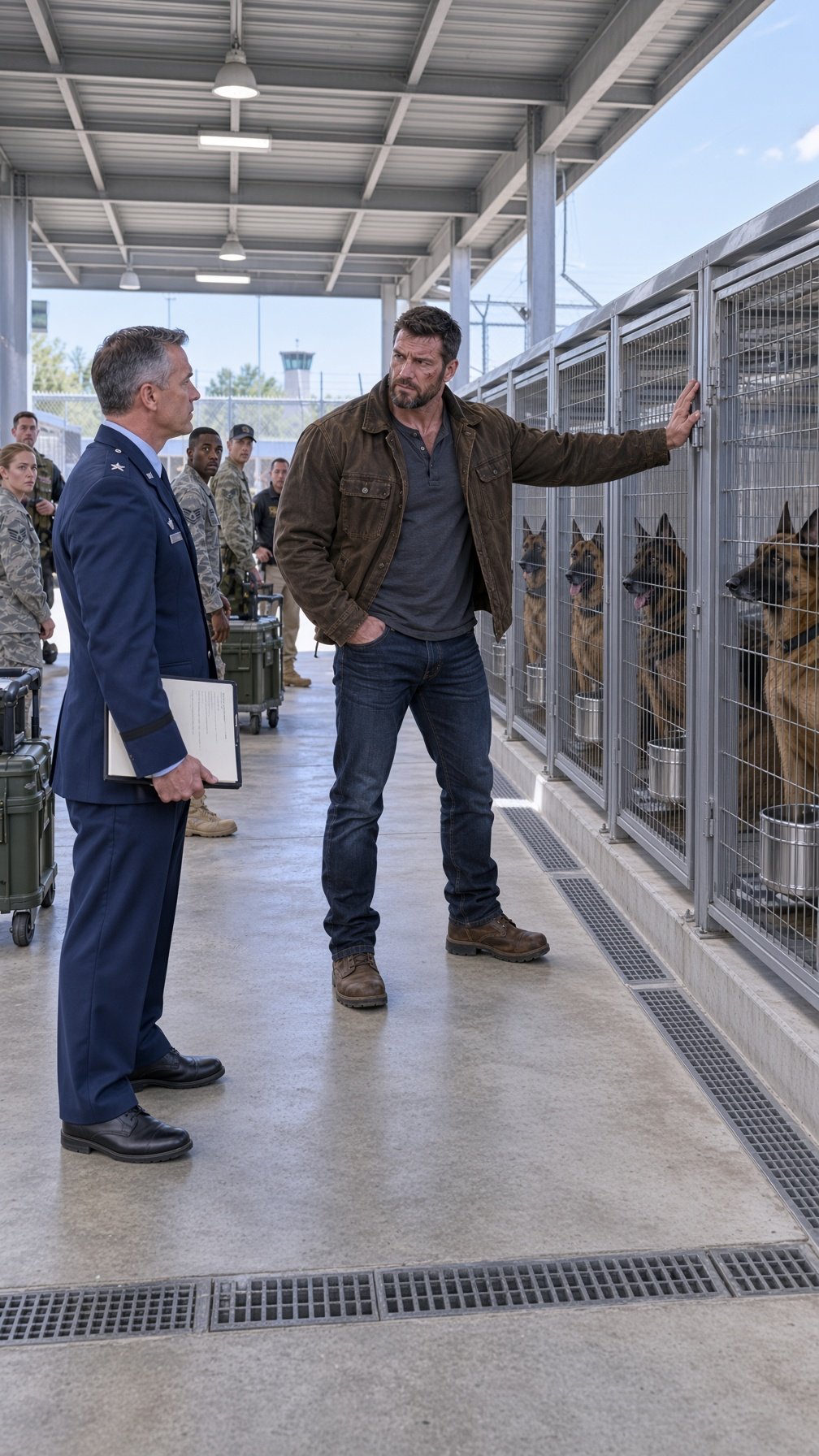
Before leaving the base, Nate demanded to see the dogs.
Specialist Wyatt Evans, his arm heavily wrapped in bandages, led the SEAL down the sterile bleach-scented hallway of Sector 4.
As they approached the heavy metal doors, the tension in the air was palpable.
“Chief Rawlings, you need to stay behind the red line,” Wyatt cautioned, his voice shaking slightly.
“Havoc is in the last run. He doesn’t bark. He just waits.”
Nate ignored the warning and walked straight up to the reinforced cage.
In the shadows of the kennel sat Havoc.
The German Shepherd was a terrifyingly magnificent creature.
His coat was a mix of dark sable and black, scarred from shrapnel along his left flank.
A deep notch was missing from his right ear.
The dog didn’t lunge.
He didn’t growl.
He just locked his amber eyes onto Nate’s.
It was an ancient, primal stare.
Havoc was assessing the man, looking for weakness, looking for fear.
Nate slowly knelt down on his bad leg, bringing himself to eye level with the lethal canine.
He didn’t speak a word.
He just placed his scarred hand against the cold steel mesh of the cage.
For a long, agonizing minute, neither man nor beast blinked.
Then, slowly, Havoc stepped forward.
The giant dog leaned his heavy snout against the chain link, resting it exactly where Nate’s palm was pressed.
Wyatt gasped softly.
“He hasn’t let anyone near him in six months without trying to tear the cage apart.”
“He knows,” Nate whispered, his voice thick with emotion.
“He knows I’ve been where he’s been.”
Transporting seven highly aggressive, traumatized military dogs across the country was a logistical nightmare.
Nate had retrofitted a massive climate-controlled horse trailer with heavy-duty steel dividers.
Loading them took twelve grueling hours.
Each dog had to be sedated by the base veterinarian just enough to be moved, but as the miles rolled on, the drugs wore off.
By the time Nate’s truck crossed the Montana state line, the trailer sounded like a war zone.
The dogs were slamming against their steel cages, triggered by the rumble of the highway, the passing of semi-trucks, and the general terror of the unknown.
Nate’s ranch was located at the end of a winding, treacherous dirt road deep in the Bitterroot Valley.
It was isolated, surrounded by dense pine forests and jagged peaks.
He had spent the last of his savings building a high-security, heavy-gauge steel kennel facility behind his log cabin.
The offloading process was terrifying.
It was just Nate moving one furious dog at a time using bite poles and Kevlar suits.
By the end of the second day, Nate was covered in bruises.
His bad leg was screaming in pain, and he had barely slept.
The pack dynamic was chaotic.
Though separated by steel mesh, the dogs challenged each other constantly.
But Havoc was different.
The massive German Shepherd didn’t waste energy barking at the others.
He paced his run endlessly, his eyes always tracking the treeline, always watching the sky.
He was still on patrol.
The real test came on the fifth night.
A massive, unseasonal storm rolled over the Bitterroot Mountains.
It started with a sudden, violent drop in temperature, followed by a low, rumbling thunder that felt more like distant artillery fire.
Inside the cabin, Nate felt his own chest tighten.
Thunderstorms were a trigger for him, too.
He immediately thought of the dogs.
Grabbing his heavy coat and a flashlight, he limped out into the driving rain.
The kennels were in total pandemonium.
The Belgian Malinois was spinning in frantic circles.
The Dutch Shepherds were tearing at the chain link.
But Havoc’s run was empty.
Panic seized Nate.
The reinforced steel gate to Havoc’s enclosure had been buckled outward.
The locking mechanism shattered by sheer desperate brute force.
“Havoc!” Nate roared into the howling wind, the rain blinding him.
He swept the beam of his flashlight across the compound.
Nothing.
He ran toward the perimeter fence, an eight-foot-tall barrier topped with angled wire.
If Havoc got over that, he would vanish into the thousands of acres of wilderness, becoming a lethal threat to anyone who stumbled across him.
Nate found him near the eastern edge of the property line.
But the dog wasn’t trying to jump the fence.
Havoc was digging frantically at the muddy earth at the base of a massive dead pine tree.
The dog was completely frantic, his paws tearing through roots and rocks, whimpering in a strange, high-pitched tone Nate had never heard a canine make.
“Havoc! Stand down!” Nate yelled, approaching carefully.
He reached out to grab the dog’s heavy leather collar.
The moment Nate’s hand made contact, Havoc spun around, driven by pure survival instinct and blind terror from the thunder.
The dog clamped his jaws down on Nate’s forearm.
The pain was explosive, even through the thick canvas of the jacket.
Nate felt teeth scrape against his bone.
He was thrown backward into the freezing mud.
Blood instantly mixed with the rain.
But instead of continuing the attack, Havoc let go.
The dog looked at the blood on his jaws, then looked at Nate.
The amber eyes suddenly snapped out of their combat trance.
Havoc realized what he had done.
But the dog didn’t retreat.
Instead, he grabbed the sleeve of Nate’s jacket in his teeth and began pulling him violently backward, away from the tree.
“Hey, stop!” Nate shouted, struggling to break free.
Crack.
The sound was deafening, louder than the thunder.
The massive dead pine tree that Havoc had been digging under snapped at its rotted base.
Caught by a violent gust of wind, the sixty-foot behemoth crashed to the earth, slamming into the mud exactly where Nate had been lying two seconds prior.
The impact shook the ground.
Nate lay in the mud, breathless, rain pouring over his face.
He stared at the massive trunk that would have crushed his skull.
Havoc stood over him, shivering, licking the blood off Nate’s torn arm.
The dog hadn’t been trying to escape.
His hypersensitive hearing had caught the microscopic splintering of the tree’s roots long before it fell.
He had been digging to relieve the pressure.
And when that failed, he dragged his new handler to safety.
“You saved me,” Nate whispered, wrapping his good arm around the soaking wet beast.
Havoc buried his massive head into Nate’s chest, whining softly.
Thirty minutes later, they were inside the cabin.
Nate had started a roaring fire and was sitting on the rug, wrapping a trauma bandage tightly around his bleeding forearm.
Havoc lay quietly by his side, exhausted, watching the flames.
“You’re a good boy, Havoc. You’re a damn good boy,” Nate murmured, reaching out to stroke the dog’s neck.
As Nate massaged the thick muscles behind Havoc’s right ear, his fingers brushed against something hard under the skin.
He paused.
It wasn’t a standard microchip.
Those were small, the size of a grain of rice, usually located between the shoulder blades.
This was different.
It felt like a small metallic disc, about the size of a quarter, embedded deep in the muscle tissue on the side of the dog’s neck.
A thick, faded, surgical scar ran perfectly straight over it, hidden entirely by Havoc’s dense fur.
Nate frowned.
He gently pressed the area.
Havoc didn’t flinch.
Using his phone flashlight, Nate parted the fur.
The skin around the scar was slightly discolored.
More disturbing, when he held the phone’s light directly against the skin, he could see a faint, rhythmic blinking coming from beneath the dog’s flesh.
A microscopic green LED.
It was an active transponder.
Nate felt a chill run down his spine that had nothing to do with the storm outside.
Standard military working dogs were chipped for identification, not wired with active, battery-powered hardware.
He stood up, walked to his desk, and pulled the dog’s medical file that Captain Mitchell had given him.
He flipped through the pages.
Vaccinations.
Deployment history.
Injury reports from Helmand.
Nothing about a surgical implant.
Nothing about an electronic transponder.
Nate pulled out his encrypted satellite phone, a leftover from his SEAL days.
He dialed a number he hadn’t called in three years.
It rang twice before a sleepy voice answered.
“Do you have any idea what time it is, Rawlings?”
“Dr. Carter. Emily. I need your help,” Nate said, his voice dead serious.
Dr. Emily Carter was a former DoD veterinary surgeon who had left the military to run a private clinic in Seattle.
She had patched up Nate’s dogs in Afghanistan on more than one occasion.
“Nate, are you okay? You sound like you’re bleeding.”
“I took in seven retired K9s from Lackland today. Euthanasia list,” Nate explained quickly.
“One of them, a shepherd named Havoc. He’s got hardware in his neck. Active hardware. Green LED. Quarter-sized disc.”
The line went completely silent.
Only the static of the satellite connection hissed in Nate’s ear.
“Emily, you there?”
When she finally spoke, her voice was trembling.
“Nate, tell me you didn’t file official adoption paperwork for a dog named Havoc.”
“Captain Mitchell pushed it through. Off the books, but yes.”
“Listen to me very carefully,” Dr. Carter whispered, her tone urgent and terrified.
“Three years ago, DARPA ran a black-book program called Operation Cerberus. They were trying to implant neural-link transponders into high-drive K9s to control them via satellite. The dogs went violently insane. The project was supposedly burned and all the assets destroyed. If Havoc has that disc in his neck, he’s not just a retired K9. Nate, he’s stolen government property from a highly illegal project.”
Before Nate could respond, a new sound cut through the noise of the storm outside.
It was the distinct, heavy crunch of tactical vehicle tires rolling up his long gravel driveway.
Nate looked out the window.
Through the rain, three black unmarked SUVs were pulling up to the perimeter of his ranch.
The headlights cut on, illuminating the cabin.
“They aren’t here for a rescue,” Nate whispered to himself, dropping the phone and reaching under his desk for his Glock 19.
Havoc stood up, the fur on his spine bristling into a razor-sharp ridge, and let out a low, terrifying growl.
The war wasn’t over.
It had just followed them to Montana.
The engines of the unmarked SUVs died simultaneously, leaving only the sound of the torrential Montana rain hammering against the cabin’s tin roof.
Through his thermal optics, Nate watched four men dismount from the lead vehicle, their movements sharply synchronized.
They carried suppressed, short-barreled rifles and moved with the undeniable fluidity of Tier 1 operators.
These were not local law enforcement or standard military police.
Based on the digitized desert camouflage and the heavy plate carriers, Nate recognized the distinct operational signature of a private military contractor.
Someone with deep pockets and zero government oversight had sent a black-ops retrieval team to his doorstep.
Havoc let out a low, rumbling growl, his amber eyes tracking the thermal heat signatures through the heavy rain.
The massive German Shepherd did not bark.
His military training overrode his K-9 instincts.
He knew this was an ambush.
Nate racked the slide of his Glock 19 and slung an SR-25 precision rifle over his broad shoulder.
His right leg throbbed violently, the titanium femur aching from the sudden drop in barometric pressure, but the cold surge of combat adrenaline drowned out the pain.
“Stay with me, Havoc,” he whispered into the darkness.
The dog pressed his heavy, wet shoulder against Nate’s good leg, signaling his readiness.
Nate slipped out the back door of the cabin, melting into the dense shadow of the treeline just as the front door was kicked violently off its hinges.
The splintering crash of wood echoed across the valley.
Suppressed gunfire followed immediately.
Quiet, rhythmic pops as the contractors swept the empty living room, firing into shadows.
“Target is not inside,” a deep voice crackled over an unencrypted shortwave radio frequency Nate had tuned his headset to.
“Check the kennel compound. Secure the primary asset. If the handler interferes, neutralize him.”
Nate’s jaw tightened.
They weren’t here to repossess the dogs.
They were here to cover up a felony.
Operation Cerberus was apparently far from over, and Havoc held the literal key to the conspiracy embedded in his neck.
Moving with practiced stealth through the freezing mud, Nate flanked the kennel perimeter.
The six other retired working dogs, the Malinois and Dutch Shepherds, were throwing themselves violently against their heavy steel cages, triggered by the smell of unfamiliar men and guns.
Their aggressive, deafening barks provided the perfect acoustic cover.
Two contractors approached the kennel gate holding heavy tranquilizer rifles and heavy-duty capture poles.
They were expecting broken, traumatized animals they could easily dart and drag away.
They were not expecting a highly coordinated defense.
Nate keyed a remote fob in his pocket.
The secondary electronic maglocks on the inner kennel doors disengaged with a loud mechanical clack.
He didn’t release the dogs into the open wild, but he opened their runs into the fully enclosed, heavily fortified half-acre training yard that the contractors had just stepped into.
Six apex predators, fueled by years of combat trauma and territorial instinct, exploded from their pens into the muddy yard.
It was absolute chaos.
The dogs did not attack the men directly.
Their training required handler commands, but they swarmed the intruders, circling them at blinding speeds, snapping at their tactical vests and creating a terrifying, swirling vortex of teeth and muscle.
“Fall back! Fall back!” one of the contractors screamed, dropping his tranquilizer rifle as a seventy-pound Belgian Malinois named Zeus launched himself off a wooden platform, slamming his heavy paws into the man’s chest plate.
While the intruders were completely disoriented by the pack, Nate moved.
He rounded the corner of the feed shed, raising his Glock.
He didn’t want to kill American citizens, even rogue mercenaries, on his property.
He fired three rapid shots into the mud directly beneath the second contractor’s boots, showering the man with freezing water and gravel.
“Drop your weapons now!” Nate roared over the storm and the barking dogs.
The contractor spun, raising his suppressed rifle toward Nate’s chest.
He was fast, but Havoc was faster.
Without waiting for a command, the massive German Shepherd launched himself from the shadows.
Havoc bypassed the thick Kevlar vest and clamped his powerful jaws directly onto the contractor’s forearm.
The bone-crushing pressure forced a scream from the man’s lungs.
The rifle clattered into the mud.
Havoc pinned the man to the ground, his teeth holding the wrist with terrifying precision.
One twitch from the mercenary and the artery would be severed.
Havoc looked to Nate for the final command, his amber eyes glowing in the ambient light of the compound.
Nate lowered his weapon slightly.
“Good boy, Havoc. Hold him.”
The first contractor, bleeding from a superficial bite on his shoulder, scrambled backward against the chain-link fence, raising his hands in surrender as Zeus and the other dogs continued their deafening, aggressive perimeter patrol.
Suddenly, a heavy spotlight snapped on from the treeline, blinding Nate.
The leader of the strike team had flanked them, stepping out from the pines with an assault rifle leveled squarely at Nate’s head.
“Call off the mutt, Rawlings!” the leader shouted, wiping rain from his tactical goggles.
“You’re in way over your head. You think this is about a rabid dog? That transponder in his neck holds the decrypted proprietary source code for a two-hundred-million-dollar neural weapons interface. DARPA lost the prototype in Helmand three years ago when a handler tried to blow the whistle and went off the grid. We’re taking the dog, and we’re cutting that chip out of his throat right here.”
Nate stepped directly in front of Havoc, shielding the dog with his own body.
“If you wanted this quiet, coming to a Navy SEAL’s ranch in the middle of the night with a hit squad was a massive miscalculation.”
“You’re one man with a bad leg, Chief. I have two more trucks coming up the mountain. It’s over.”
Nate smiled grimly, the rain dripping from his scarred chin.
“You didn’t do your homework. I don’t just live in the Bitterroot Mountains. I own the only access road for twenty miles.”
Before the strike team leader could comprehend the statement, a massive, concussive boom echoed from the valley below, shaking the very bedrock of the mountain.
A massive plume of orange fire illuminated the low-hanging storm clouds.
Nate had remotely detonated the rigged explosives on the solitary wooden bridge crossing the gorge at the base of his property.
The reinforcements weren’t coming.
They were completely cut off.
The team leader’s eyes widened in realization.
He lowered his rifle a fraction of an inch, distracted by the sudden isolation.
That fraction of a second was all Nate needed.
He closed the distance with terrifying speed, sweeping his heavy titanium leg through the mud and catching the mercenary behind the knees.
The man went down hard.
Before he could recover, Nate’s knee dropped onto his chest plate, pinning him, while the barrel of the Glock pressed firmly against the center of his ballistic helmet.
“Here is how this is going to play out,” Nate growled, his voice colder than the Montana rain.
“You are going to use your satellite radio. You are going to call whoever signed your contract, and you are going to tell them that Chief Petty Officer Nathaniel Rawlings has secured the DARPA asset.”
The mercenary groaned, spitting mud.
“They’ll kill you, Rawlings. The Pentagon doesn’t want this program exposed.”
“Exactly,” Nate replied.
“Which is why I already had Dr. Emily Carter upload high-resolution scans of Havoc’s subcutaneous hardware to a dead man’s switch server. If I don’t enter a localized passcode every twelve hours, the entire Operation Cerberus file, including the neural interface blueprints and the illegal deployment of mercenaries on U.S. soil, goes directly to the Washington Post, the Senate Armed Services Committee, and the Inspector General.”
The leader stared up at Nate, realizing the profound tactical trap he had walked into.
The retired SEAL hadn’t just prepared for a firefight.
He had orchestrated a geopolitical checkmate.
“What are your terms?” the contractor asked, defeated.
“You and your men walk off my mountain tonight. Tomorrow morning, Captain Mitchell at Lackland receives an official, highly classified directive from the Department of Defense granting full, irrevocable amnesty, medical retirement, and federal funding for all seven dogs on this property. Havoc stays with me. The chip stays with me until a military surgeon of my choosing removes it on my terms. If anyone so much as drives past my property line again, the data leaks.”
By dawn, the storm had finally broken, leaving a pale golden light washing over the jagged peaks of the Bitterroot Range.
The unmarked SUVs were gone, forced to carefully navigate the treacherous backtrails on foot to escape the valley.
Inside the cabin, the atmosphere was profoundly quiet.
Dr. Emily Carter had arrived via a chartered medevac helicopter just after sunrise, carrying a specialized surgical kit.
Havoc lay asleep on the massive rug in front of the stone fireplace, sedated under a heavy dose of anesthesia.
Nate sat beside him, gently stroking the thick sable fur along the dog’s spine.
“The extraction is complete,” Dr. Carter said softly, holding up a small stainless steel surgical basin.
Inside rested the quarter-sized metallic disc, stained with blood, its tiny green LED finally dead.
It was deeply embedded in the muscle tissue, wrapped in scar tissue.
“The handler who put this inside him in Afghanistan knew exactly what he was doing. He hid the drive in the toughest dog in the unit to ensure it made it back to American soil.”
Nate looked at the microchip, a profound sense of respect washing over him.
The handler had sacrificed everything to stop an unethical weaponization program, trusting his loyal K9 partner to carry the truth home.
Havoc hadn’t just survived the war.
He had won a silent battle no one even knew was being fought.
“Will he be okay?” Nate asked, his voice rough.
Dr. Carter smiled, packing away her instruments.
“He’s going to be sore for a few weeks, but physically he’s perfect. Mentally, he’s a combat veteran, Nate. He has scars. But looking at how he reacted last night, protecting you, he’s not broken. He just needed someone who understood his war.”
Three months later, the atmosphere at the Bitterroot Sanctuary was entirely different.
The federal funding secured through Nate’s leverage had transformed the rugged property into a state-of-the-art rehabilitation facility for specialized military working dogs.
The heavy steel chains were gone, replaced by sprawling open-air training fields and agility courses.
The six other dogs, Zeus, Titan, Valkyrie, Apollo, Ghost, and Ranger, were slowly showing signs of progress.
The hyper-aggression was fading, replaced by the structured discipline they craved.
They were learning how to be dogs again.
But it was Havoc who had changed the most.
The massive German Shepherd no longer paced endlessly along the fence line.
He no longer stared at the sky, waiting for helicopters.
Instead, he stayed glued to Nate’s side, an unwavering shadow.
It was late afternoon, and the Montana sun was setting behind the pines, casting long shadows across the valley.
Nate walked out onto the porch, carrying two steaming mugs of coffee.
He sat down heavily in his wooden rocking chair, his bad leg stretched out in front of him.
The pain was still there, but it was manageable now.
The ghosts of Ramadi were quieter.
Havoc trotted up the wooden stairs, his tail wagging softly, a sight that would have been unimaginable just months prior.
The massive dog sat beside the chair, resting his heavy chin affectionately on Nate’s thigh.
Nate reached down, scratching the healed surgical scar behind Havoc’s right ear.
The dog let out a contented sigh and closed his eyes.
They had both been labeled dangerous, broken, and beyond saving by a system that didn’t know how to handle the warriors it created.
They had been cast out into the cold.
But in the frozen wilderness of the Bitterroot Mountains, they had found something the military could never issue them.
They had found peace.
Nate looked out over the sprawling sanctuary, listening to the happy, normal barks of the pack echoing in the distance.
He took a slow sip of his coffee and smiled, knowing that for the first time in a very long time, he was exactly where he was supposed to be.