

The gate agent looked directly at Elena Voss and announced the flight was closed.
Elena was still twenty feet away, her forearm crutch grinding against the polished floor, her specialized leg brace stuttering with each step.
She had checked in on time. She had asked for assistance three separate times.
What nobody in that terminal knew — not the agent who turned her away, not the supervisor who shrugged, not the passengers who watched and said nothing — was that the brace locked around Elena’s left leg contained something that would bring down an entire criminal network operating inside the United States military rehabilitation system.
They ignored a disabled nurse. They had no idea what they had just activated.
The first thing Elena Voss did every morning was check the brace before she checked her phone.
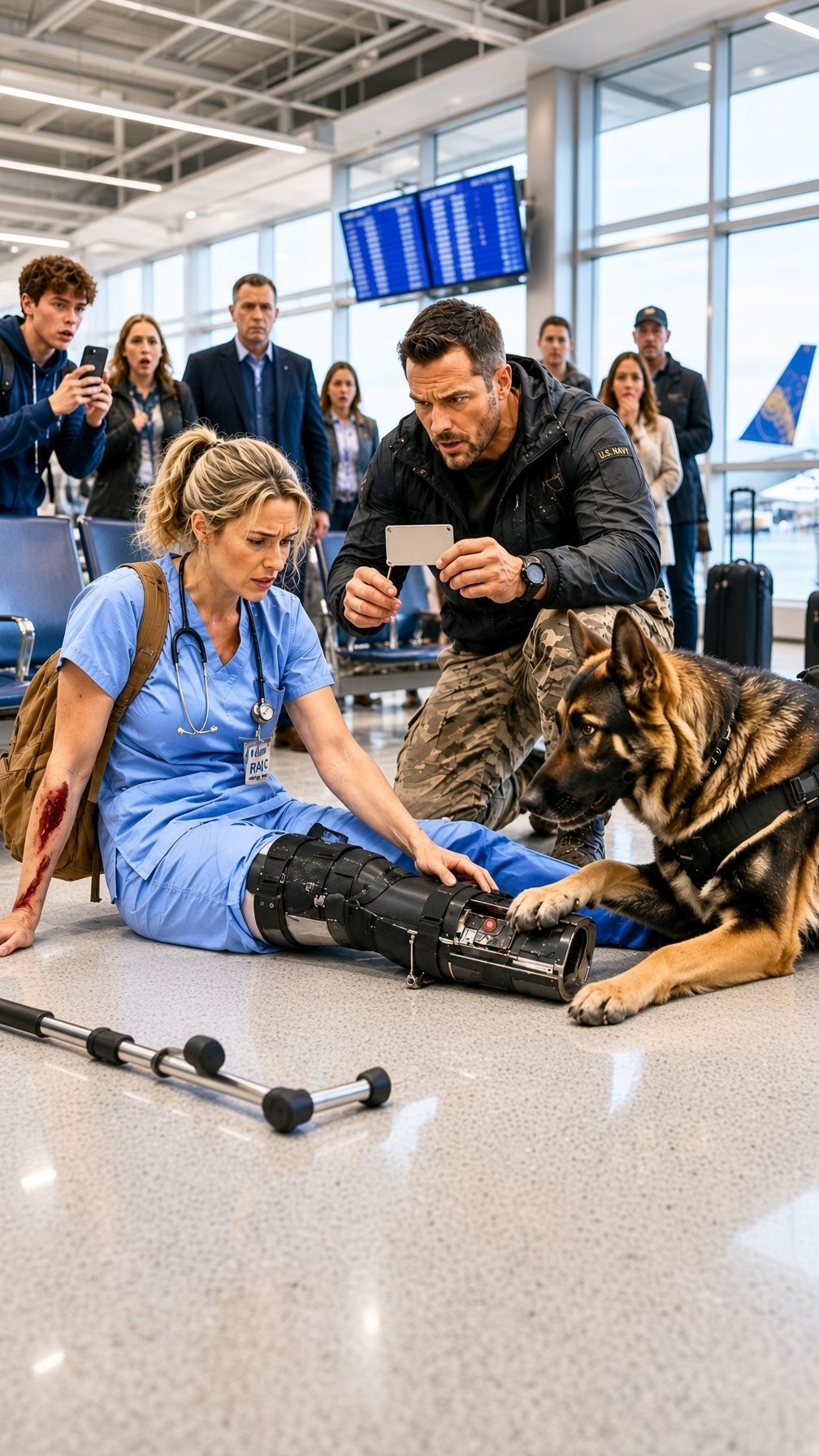
It was a habit she had built over three years, ever since the accident on the I-78 overpass outside Harlo City had taken forty percent of the functional strength from her left leg and replaced it with scar tissue, titanium hardware, and a medical device she had learned to treat like a second skeleton.
The brace was custom-fitted — a rigid outer shell of aerospace-grade polymer with an articulated ankle joint and a microprocessor-driven compression system that adjusted its tension depending on how she was walking.
It was not cheap. It was not simple. And it was the only reason she could move through the world without a wheelchair.
She strapped it on in the dark of her hotel room at 4:47 in the morning, working by feel because she had done it so many times that she no longer needed to look.
The buckles went in a specific sequence. Mid-shin first, then knee, then the thigh cuff. If you skipped the sequence, the pressure distribution was off for the entire day.
She had made that mistake once in her second month of recovery and spent six hours in enough pain to make her cry in a public restroom. She did not make it again.
The hotel was a mid-tier chain near Vaser Falls Regional Airport, the kind of place where the hallway carpet smelled faintly of industrial cleaning fluid and the bathroom mirror had a crack running diagonally across one corner.
Elena had stayed in worse. She had spent seven months in a Navy medical facility in Virginia where the ventilation system made a low cyclical grinding noise at three in the morning that nobody ever fixed. After that, a cracked mirror was nothing.
She dressed methodically. Dark navy travel pants with zip pockets, a long-sleeved thermal shirt, her identification lanyard with her nursing credentials, and her VA medical card.
She had learned to keep documentation accessible. People asked questions when they saw the crutch, and some of those questions were less curious than suspicious, as if a woman moving slowly through an airport must be doing something wrong.
Her bag was already packed. She had done that the night before, the way she always did. Everything rolled tight and placed in order of when she would need it, with her medications in a clear TSA pouch at the very top.
Elena was a trauma nurse by training and by instinct. She organized because disorganization cost people their lives. And that lesson had become so deeply embedded in her that it governed everything, even the way she folded her clothes.
She took the elevator down to the lobby, settled her crutch under her right arm, and walked through the automatic doors into the pre-dawn cold.
The airport was twelve minutes away. She had arranged for a rideshare the night before and confirmed it again at midnight.
The driver arrived on time — a quiet man in a gray sedan who nodded when she got in and did not ask about the crutch or the brace or any of the things that strangers sometimes felt entitled to ask about.
She appreciated that more than she could have explained.
Vaser Falls Regional Airport was a midsized facility, large enough to have three concourses and a food court, small enough that you could still find a parking spot on a weekday.
It handled regional connections and a handful of direct routes. And on a Thursday morning in late November, it was running at maybe sixty percent capacity.
The terminal was cool and fluorescent-lit, with that particular airport stillness that exists before the morning rush fills the space with bodies and noise and the smell of coffee from every vendor simultaneously.
Elena had a 7:15 flight to Caldwell, where she had a connecting flight to Merit Bay.
She was visiting her younger brother, Dominic, who had just had a second knee surgery and was living alone in an apartment that was not particularly accessible.
She had taken three days off from her nursing position at Harlo City Medical Center to go help him navigate the first week of recovery.
It was that simple. She was going to see her brother.
She approached the check-in counter at 5:30, which gave her plenty of time, or it should have.
The agent behind the counter was a young man named Ferris. His name tag said so in capital letters, yellow on blue, and he looked at Elena’s boarding pass, looked at the crutch, and then looked at her in a way that managed to communicate mild inconvenience without saying a single word.
“I have a request on file for pre-boarding assistance,” Elena said. “I filed it when I booked the ticket. Mobility assistance, gate to gate.”
Ferris typed something. Then he stopped typing. Then he typed something else.
“It’s not showing here,” he said.
“I have a confirmation email.”
“I understand that, but the system doesn’t have a flag on your reservation. You’d need to go to the accessibility desk to re-request.”
Elena looked at the accessibility desk. It was on the far side of the terminal, past two moving walkways and a security checkpoint.
“Where is it relative to security?”
“On the other side.”
“So I’d have to clear security, go to the desk, re-request assistance, and then what? How does that interact with my boarding time?”
Ferris looked at her with the expression of someone who had been asked a question slightly outside the boundaries of his training.
“I’d recommend going now, since the line isn’t too bad yet.”
Elena did not argue. She had learned through experience that arguing with frontline employees about procedural failures was a specific kind of futility.
They had not created the system. They were not empowered to fix it. And the energy spent fighting them was energy she did not have to spare.
She thanked him, which he did not seem to expect, and moved toward the security line.
Security went fine. The brace required a secondary scan, which it always did. She had the VA documentation and the manufacturer’s technical sheet in her travel folder, and she handed them over before anyone asked.
The TSA officer, a middle-aged woman with tired eyes who had probably processed a hundred people with medical devices, ran through it quickly and professionally. Elena was through in eleven minutes.
The accessibility desk on the concourse side was staffed by a single employee who was on the phone when Elena arrived. The conversation appeared to be personal in nature.
Elena stood at the desk and waited. Two minutes passed. Then three.
The employee, a woman in her forties whose name tag read Greta, eventually ended the call and looked up.
“I had a pre-boarding assistance request on my reservation that didn’t transfer to the system,” Elena said. “I need a gate escort and wheelchair assistance to the jet bridge.”
Greta pulled up the screen. “What’s the flight number?”
Elena gave it to her.
“I can put in a request, but the gate assistance team is already assigned. It might be tight for your boarding time.”
“My flight boards at 6:50. It’s already 6:10. I know what time it is. That’s why I’m here. Can you call ahead to the gate?”
Greta looked at the phone, then at her screen, then at Elena’s crutch with an expression that was not unkind but was something close to calculating — a quick, involuntary assessment that Elena recognized as the kind of look people gave when they were deciding how much of their morning this was going to cost them.
“I’ll put the request in,” Greta said. “Someone should meet you at the gate.”
“Should, or will?”
“Someone will meet you at the gate.”
Nobody met her at the gate.
Elena arrived at Gate 14B at 6:31, which was a twenty-minute walk from the accessibility desk at her pace — a pace she maintained by focusing on her breathing and her gait mechanics and refusing to acknowledge the low, steady ache building in her hip from the extended effort.
The waiting area was already crowded. She found a seat near the window and sat down, putting her bag in her lap and watching the gate agent desk.
There were two agents. One was a woman named Darby, name tag on a blue lanyard, working through a line of passengers with the mechanical efficiency of someone who had done it ten thousand times.
The other was younger, male, talking to a colleague near the desk partition.
Elena waited until the pre-boarding announcement came. Then she stood, adjusted her crutch, and walked to the desk.
“I have a mobility assistance request,” she said to Darby. “I’m supposed to have gate escort and jet bridge support.”
Darby scanned her boarding pass. “I don’t see a flag.”
“The accessibility desk said they called it in.”
“When?”
“About twenty minutes ago.”
Darby turned to the younger agent. “Did we get an assist request from ground ops for this flight?”
He shrugged. “I didn’t hear anything.”
Darby turned back to Elena with the particular facial expression of someone preparing to deliver disappointing information with as little responsibility as possible.
“We didn’t receive a request. You can board with general boarding, but—”
“I need jet bridge support. The incline on the jet bridge is a fall hazard without assistance. I filed for this before I booked the ticket.”
“I understand, but if the request wasn’t received—”
“Then someone dropped the request between the accessibility desk and your gate agent system, which is not something I control. What I need is for someone to walk with me down the jet bridge so I don’t fall.”
There was a pause. Darby looked at the line forming behind Elena. The silent calculus of it was visible on her face — the weight of the passenger queue against the weight of this particular complication.
“Let me see what I can do,” Darby said.
She did not do anything for seven minutes.
Elena stood to the side and watched as general boarding proceeded. Zone one. Zone two. She watched families with strollers board. She watched a man with a large carry-on that visibly exceeded the overhead bin limit board without comment.
Zone three began. Elena went back to the desk.
“My zone is boarding,” she said.
“We’re working on getting someone from ground ops,” Darby said without looking up. “There’s no one to spare. We’re short-staffed this morning.”
“I understand that, but I need—”
Darby looked up now, and her voice had acquired an edge. “I told you we’re working on it. If you’d like to take a seat—”
“I’ve been standing for thirty minutes. I can’t take a seat and then get up and walk the jet bridge in time. That’s not how mobility impairment works.”
Darby’s expression closed down. It was a specific kind of shutdown. Not hostile, exactly, but finished — the look of someone who had decided they were no longer going to engage substantively.
“Final boarding will begin shortly,” Darby said. “Please wait to the side.”
Zone four boarded. Then zone five.
Then Darby picked up the gate phone, said something Elena couldn’t hear, and hung up. She walked to Elena.
“I’m sorry, but we’ve just received closing authorization from the captain. The gate is sealed.”
Elena stared at her.
“The gate is—the flight is preparing to push back. I can rebook you on the next available—”
“I was here. I have been standing here for forty minutes. I asked for assistance that was never provided, and now you’re telling me I missed my flight because nobody did their job.”
“I understand this is frustrating.”
“Do you? Because from where I’m standing, I showed up on time, filed the correct request, followed every instruction I was given, and was systematically ignored until you ran out the clock.”
Elena’s voice was steady. That was something she had worked very hard to maintain. The steadiness. Not calm, exactly. Controlled.
“What is the process for filing a complaint about accessibility failures?”
Something in Darby’s posture shifted. Not guilt, necessarily, but awareness.
“You can speak to our customer service desk, which is—”
“I know where it is. I’m asking if you personally are going to document what happened here.”
“I’ll note it in the system.”
“I’d like your name for the record, Darby.”
Darby told her.
Elena wrote it down in the small notebook she kept in her jacket pocket — the same one she had used for eight years of nursing notes and patient observations.
Darby watched her write and said nothing.
Elena turned and began walking back toward the main concourse.
She made it seventeen feet before the brace failed.
It did not fail slowly or gradually. One moment it was functioning, the microprocessor cycling through its pressure adjustments the way it always did, and the next moment the articulated ankle joint locked at an angle it should not have been able to reach, and her left leg went rigid below the knee, and the redistribution of weight threw her balance completely, and Elena went down.
She hit the floor hard. Left hip, left elbow, the heel of her right hand.
Her crutch clattered away from her and slid three feet across the polished tile.
The impact was loud enough that the nearest passengers turned.
For a moment, nobody moved.
Elena lay on the floor of Gate 14B’s boarding lane and took stock with the clinical efficiency of someone who had spent years assessing injury.
Hip — bruised, not broken. The brace had absorbed some of the lateral impact.
Elbow — road rash equivalent, minor.
Hand — stinging, no structural damage.
Left leg — the brace was locked. The ankle joint pressed into a hyperextension position that was already generating real, specific pain.
She needed to get upright. She needed to release the brace’s emergency override and reset the microprocessor. She needed her crutch.
“Someone—” she started.
A man in a business suit stepped around her. Not over her. Around her. Like she was a piece of luggage someone had left in the corridor.
He did not look down.
A woman with a rolling carry-on stopped, looked at Elena for approximately two seconds, and then looked at her watch and moved on.
“Can someone pass me my crutch?” Elena said, louder this time.
A teenage boy, maybe sixteen, wearing headphones that were half off one ear, walked over, picked up the crutch without any expression of concern or curiosity, and handed it to her.
“Here,” he said.
Then he walked back to his seat and put the headphone back on.
She used the crutch to lever herself into a sitting position.
The ankle joint of the brace was still locked. She reached for the emergency release panel on the side of the device — a small, recessed button under a protective cover — and pressed it.
Nothing happened.
She pressed it again. The button depressed, but the joint did not release. She could feel the microprocessor attempting to cycle. There was a faint vibration in the device, but the reset was not completing.
Something was wrong with the brace. Not the fall. The fall had been caused by the malfunction, not the other way around.
Darby appeared at her elbow.
“Ma’am, you need to move out of the boarding lane.”
Elena looked up at her. “I fell because my brace malfunctioned. I need a moment to—”
“You’re blocking the lane.”
“There’s nobody in the lane. The flight is closed.”
“There are ground crew who need access. I need you to move.”
“I understand that. I am working on getting myself upright. If someone could call for a wheelchair or medical—”
“We can call a wheelchair, but you’ll need to move to the side first.”
Elena took a breath. “The brace on my left leg is locked in hyperextension. I cannot stand on it. I need assistance getting to the side, or I need you to bring the wheelchair to me.”
Darby’s expression had moved past impatience into something less comfortable — the specific unease of someone who realized the situation might carry consequences.
She turned and spoke quietly to the younger agent who had appeared behind her. He disappeared through the gate door.
Two ground crew members appeared from the jet bridge. They were large, efficient men who moved with the body language of people who dealt with physical problems as a job function, and they looked at Elena on the floor with straightforward assessment rather than pity or inconvenience.
“Can you put weight on the right leg?” one of them asked.
“Yes.”
“Arms around our shoulders. We’ll get you to the chairs.”
They moved her without ceremony and without gentleness, but without roughness either. The way skilled people move an injured person — efficiently and without drama.
She ended up in an airport chair near the gate windows, the brace still locked, her bag in her lap, watching the aircraft push back from the jet bridge outside.
Her flight. Gone.
She was trying to work the brace’s manual override — a secondary system that required a specific sequence of pressure points on the outer casing — when she heard the dog.
Not barking. It was a specific sound somewhere between a whine and a low, sustained vocalization. The kind of sound a dog makes when it has located something and is communicating the fact to its handler with extreme urgency.
Elena looked up.
The dog was a Belgian Malinois — large, dark-coated, with the muscular compactness and alert carriage of a working animal in peak condition.
It was on a lead, but barely. Every line of its body was straining toward Elena. And the handler, a tall man in civilian clothes, early thirties, with the specific kind of posture that did not come from a gym, was holding the lead with both hands and clearly surprised by what was happening.
“Atlas.” The man’s voice was low and controlled. “Atlas, halt.”
The dog did not halt.
It pulled steadily, without aggression, without any of the hackles tension of an alert that meant danger. It pulled the way a working dog pulls when it has found what it was trained to find. With certainty and focus and the absolute conviction that the human needed to follow.
The handler was being pulled directly toward Elena.
He let the lead out, controlled, deliberate, and the dog closed the last fifteen feet and pushed its nose directly against Elena’s brace.
Not her leg. The brace. The outer casing just below the knee, where the microprocessor housing was embedded.
The dog sat.
In working-dog language, a sit was a final indication. It meant: here. This.
The handler stood above Elena and looked at his dog. Then he looked at the brace. Then he looked at Elena with an expression that had moved very far from whatever expression he’d started the morning with.
“I’m sorry,” he said. “That’s never happened before. He’s trained for—”
He stopped. He crouched down, eye-level with the brace, and looked at the housing where the dog had indicated.
Elena watched his face change.
“Where did you get this brace?” he said.
“It was fitted through a veteran rehabilitation program about eight months ago.”
“Which program?”
She told him.
Something moved through his expression. Recognition, or something colder than recognition.
“My name is Mason Riker,” he said. “I’m with Naval Special Warfare. And I think I need you to tell me exactly how you ended up with this device, because what my dog just indicated on—”
He stopped again, and when he looked up at her, there was something in his eyes that was not confusion anymore. It was controlled urgency. The kind that belongs to people who have spent time in situations where information is the difference between recovery and catastrophe.
“What my dog just indicated on is not a medical component.”
Elena looked down at the brace locked around her leg. At the microprocessor housing she had pressed and pressed without result. At the device she had worn for eight months without question, because the program coordinator had been professional and the equipment had been provided through what she had believed were legitimate VA channels.
“What is it?” she said.
Mason’s jaw tightened.
“It’s a military-grade transmitter,” he said. “And based on the signal signature Atlas is responding to, I know exactly who put it there.”
Through the gate window behind them, the aircraft taxied slowly toward the runway. The terminal hum continued. Somewhere near the food court, someone’s coffee order was announced over a speaker.
Elena Voss sat in an airport chair with a locked brace, a bruised hip, and a transmitter she had been carrying in her leg for eight months.
And the man crouching beside her had gone very still in the way that people only go still when they have just found something they had stopped believing they would ever find.
“Who?” she said.
Mason looked at her. His hand moved to the communications device clipped to his jacket.
“Someone who’s been missing,” he said. “For a very long time.”