

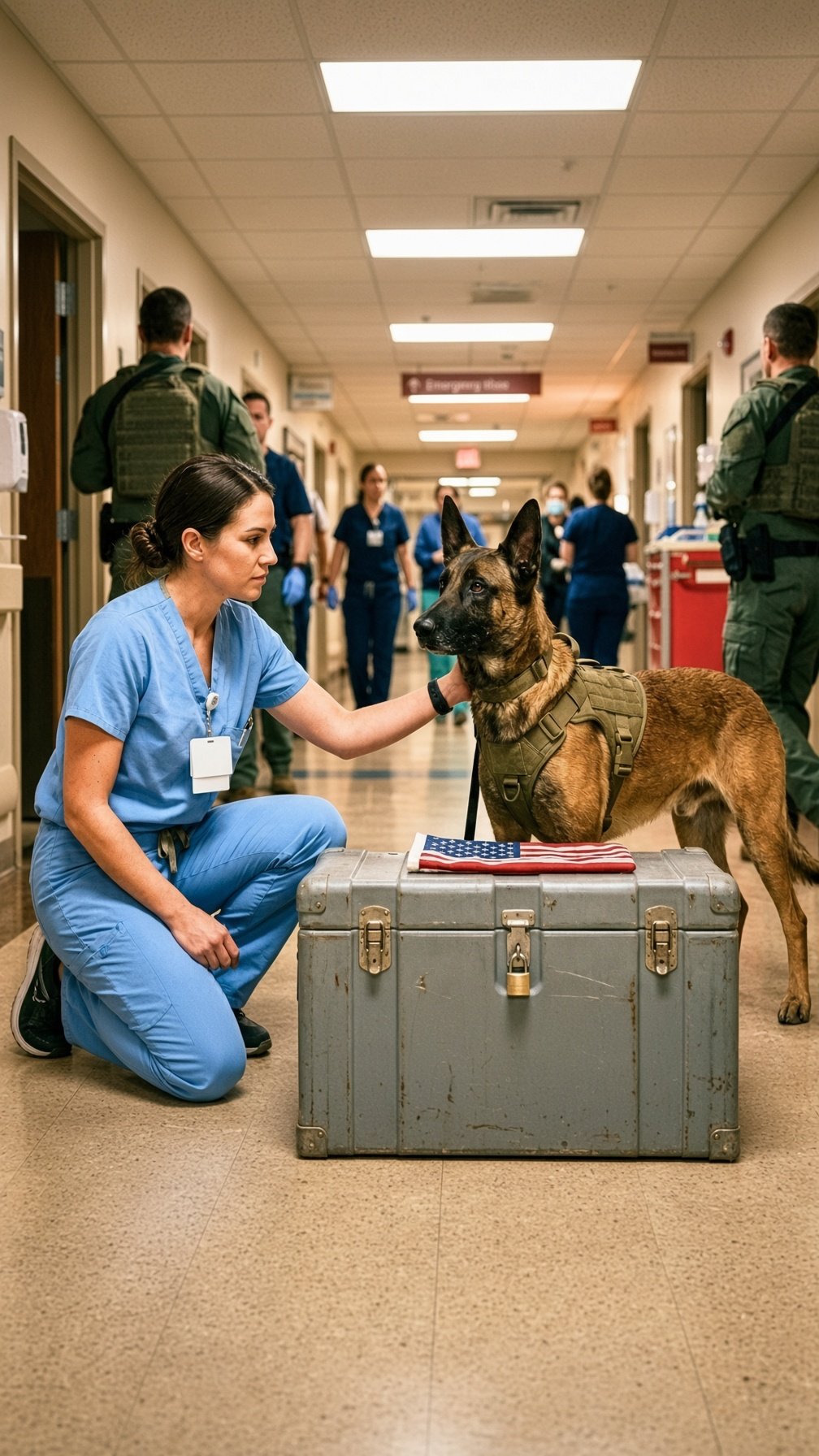
The dog hadn’t eaten in eleven days.
He sat at the end of the hallway like a stone carving, chest still, eyes fixed on a sealed military foot locker that no one was allowed to touch.
Staff had tried everything.
Treats.
Commands.
A veterinarian who spent forty minutes on the floor talking to him in a low voice before quietly packing her bag and walking away.
Nothing worked.
The Belgian Malinois named Rook had watched his handler get zipped into a body bag three weeks ago, and since that moment, he had decided the world could go to hell.
Nobody blamed him.
What nobody expected, what nobody in that emergency ward could explain even weeks later when they were asked to give statements, was the moment Rook lifted his head, stood up from the floor, and crossed the entire length of the hallway toward a night shift nurse who was carrying a tray of medication and paying absolutely no attention to him.
He pressed his nose against her hand and refused to move.
The tray hit the floor.
The hallway went silent.
And in the terrible stillness that followed, every person present felt something shift, the way the air changes just before a storm arrives and the birds stop singing.
None of them understood yet what the dog already knew.
Before we go any further, if this is the kind of story that makes you stop scrolling, hit follow and stay with me until the very end.
Drop a comment below telling me what city you’re watching from.
I want to see how far this story travels.
The night Rook chose her, Mara Callaway was twenty-two minutes into a shift that had already broken two people before her.
The ER at Kesler Point Medical Center didn’t slow down on Thursdays.
It never slowed down, actually.
Not during flu season.
Not during a transport accident on the interstate.
Not during the kind of late February cold snap that drove hypothermia cases through the sliding doors in clusters.
Mara had worked this floor for three years, and she still hadn’t found the rhythm of it the way some nurses seemed to.
She just kept her head down, moved fast, and tried not to get in anyone’s way.
That last part was easier said than done.
Callaway.
The voice came from behind her before she’d even reached the medication station.
Dr. Harlon Spruce, chief of emergency operations, didn’t look up from his clipboard when he said her name.
He almost never looked at her directly.
Room six needs to be prepped for a chest drain.
I told Yolanda to do it, but apparently you’re the one who scheduled the wrong transport this afternoon, so you can handle it.
Mara stopped walking.
The transport was scheduled correctly.
The relay system logged it wrong.
I’ve got the timestamp if you want to see it.
What I want, Spruce said, finally glancing up, is for the problem to be handled without excuses.
He turned away before she could respond.
She stood there for a half second longer than she should have.
It was a small act of private stubbornness, just long enough to remind herself that she was allowed to feel the anger before she folded it up and put it somewhere useful.
Then she turned and went to prep room six.
Mara had learned a long time ago that the anger didn’t go away.
You just got better at storing it.
She was thirty-one years old, built compact and efficient, with dark eyes that had a habit of cataloging exits whenever she walked into a room.
People who didn’t know her took the quiet for passivity.
People who knew her a little better took it for stubbornness.
Nobody at Kesler Point had bothered to look further than that.
To them, she was a reliable floor nurse with decent hands, no drama, and an odd tendency to stay calm during the worst cases.
The kind of calm that made newer nurses uncomfortable because it didn’t look like detachment.
It looked like something else entirely, though none of them could name it.
She had worked hard to make sure they couldn’t.
Her Army discharge papers were in a lockbox at her apartment, under a stack of tactical medicine textbooks she no longer needed to study because the information had long since become reflex.
The commendation letters were in the same box, including one from a two-star general that she had never shown to anyone, not even her mother.
She didn’t talk about Kandahar.
She didn’t talk about the eighteen months she spent as lead medic for a forward-deployed rapid response unit, the kind of assignment that didn’t come with a job description because the job changed every forty-eight hours.
She had learned emergency medicine in conditions that made this hospital look like a controlled environment.
And she had come home and decided that what she wanted, the only thing she wanted, was to be a nurse.
Not a veteran.
Not a war hero.
Not a cautionary tale.
Just a nurse.
So far, that had meant three years of being talked over in meetings, handed the worst shifts, and called by her last name by physicians who introduced themselves by first name to every male colleague on the floor.
It had meant watching Dr. Spruce take credit for a triage protocol she’d spent six weeks designing.
It had meant smiling when the hospital’s new administrator, a man named Roland Get, told her during her last performance review that she had strong potential and should consider a more visible role, which she had understood immediately to mean that he thought she was good enough to do more work for the same pay, not good enough to be trusted with authority.
She had smiled and thanked him.
The anger went into the box.
She was finishing the chest drain prep when the commotion started down the hall.
It wasn’t loud at first.
A low sound, almost like furniture being dragged.
And then a voice.
Male.
Arguing with someone at the security desk near the east entrance.
Mara didn’t stop moving.
Commotion at the security desk happened twice a week minimum.
She laid out the drain equipment in order, checked the seal on the sterile packaging, and was reaching for the second set of gloves when one of the intake nurses, a young man named Eli, appeared in the doorway with an expression she recognized.
That expression meant the commotion was unusual.
There’s a dog, Eli said.
I can hear that.
No, I mean it’s a military dog.
Like an actual.
He’s got a vest, and there are two officers with him, or they were with him.
He kind of got away from them.
Mara finished pulling on her gloves and looked at him.
What do you mean, got away?
I mean he came through the east corridor and he’s just standing there.
He won’t move.
And the officers are asking for whoever’s in charge, and Dr. Spruce is in with the chest drain patient, and nobody knows what to do about the dog because he’s.
Eli stopped.
He’s not acting aggressive.
He’s just standing.
Mara pulled off the gloves.
She didn’t know why she did it.
There was nothing about a military working dog standing in a hospital corridor that required her specific involvement.
She had a room to prep and a patient incoming and seventeen other things competing for her attention.
She peeled off the gloves anyway and walked toward the east hallway.
She smelled Rook before she saw him.
Not a bad smell.
A working-dog smell.
That particular combination of field dust and neoprene and something underneath that was harder to name.
He was at the end of the hall, exactly as Eli had described, standing perfectly still between two Air Force officers who were both maintaining careful three-foot distances from him.
Not because they were afraid.
Because they were trained well enough to know you didn’t crowd a dog in distress.
Rook was a Belgian Malinois, maybe four years old, with the deep chest and coiled stillness of a dog that had been built for exactly one purpose.
He wasn’t pacing.
He wasn’t vocalizing.
He was just standing in front of a sealed gray military foot locker on a wheeled cart, and he was looking at it with an expression that on a human face would have been grief.
Mara had seen that look before.
She’d seen it on soldiers.
She stopped about eight feet away.
The two officers, a captain and a senior airman based on the insignia, turned toward her with the specific exhaustion of people who had been dealing with something impossible for too long.
Ma’am, the captain started.
How long has he been like this? Mara asked.
Eleven days.
She looked at him.
Since Commander.
He stopped.
Recalibrated.
Since his handler’s death.
He was stationed temporarily at Whitmore Air Base for a debrief assignment, and they were transporting his handler’s personal effects.
We were asked to bring the locker here for.
There are medical records involved.
It’s procedural.
The captain’s voice had the careful flatness of someone reading from a memo he’d been told not to deviate from.
The dog was supposed to stay in the vehicle.
But he didn’t.
He did not.
Mara crouched down.
Not toward Rook.
Not yet.
Not close enough to be a pressure.
Just to his level so he could see her without having to look up.
He turned his head slightly at the movement.
His eyes, amber brown and sharp, fixed on her.
He didn’t growl.
He didn’t look away.
She stayed still.
Thirty seconds.
A minute.
She could feel the officers behind her getting restless, and somewhere further up the hall, Dr. Spruce’s voice and a gurney moving and all the ordinary machinery of the floor running its course.
None of it mattered right now.
Rook took three steps toward her and put his nose against her right hand.
Okay, Mara said quietly.
She wasn’t sure she was talking to the dog.
The handler’s name, it turned out, had been Commander Declan Varys.
Navy SEAL.
Ten years of active operational service.
Killed three weeks ago in a classified mission that nobody at this hospital had any reason to know about.
The foot locker was being routed through Kesler Point because a physician here had been named in Varys’s emergency medical release documentation, and the transfer was supposed to be a formality.
Sign a form.
Pass the locker to a courier.
Done.
The officer briefing Mara in the small consultation room off the main corridor gave her exactly that much information and no more.
His name was Captain Aldrich Sims, and he had the look of a man who had been told to handle this quietly and was increasingly aware that quiet was no longer an option.
The dog needs to be returned to the base, he said.
He’s still technically on active duty status.
He’s not going to go voluntarily, Mara said.
You saw him.
I understand that, but he hasn’t eaten.
You said eleven days.
She looked at Sims steadily.
That’s not behavioral.
That’s not stubbornness.
That’s a dog who is shut down physically, and if you transport him in that state without addressing what’s driving it, you’re going to lose him.
Sims was quiet for a moment.
We have a veterinary specialist at the base.
Good.
But right now he’s in my hospital, and he’s attached to that foot locker, and I’m asking you what’s in it.
Something moved across Sims’s face.
Not evasion.
Closer to discomfort.
That’s classified.
The medical records portion.
A pause.
The locker contains Commander Varys’s personal effects and a sealed data drive that is currently under a security hold.
The medical records are a separate document.
I can release those, but not the drive.
No.
Mara leaned back in her chair.
Through the consultation room’s narrow window, she could see Rook still at his post in the hallway, and even at this distance, she could see the ridge of tension across his shoulders that hadn’t released since she’d stepped away from him.
His gaze kept tracking toward the foot locker.
She turned back to Sims.
What does the dog know about what’s in there?
The captain looked at her like she’d asked the question in a foreign language.
He’s a dog, Sims said.
He’s a SEAL’s dog, Mara said.
He was trained by the same person, ran the same missions, read the same body language for how many years?
Three and a half.
Then he knows something.
She pushed back from the table and stood.
I’ll need access to Commander Varys’s medical file.
She was back at the medication station when Dr. Spruce found her.
She heard him coming, the particular rhythm of his footsteps when he was working himself up to something, and she kept moving, reaching for the IV supply cart, letting him come to her.
Callaway.
He planted himself at her left.
I need to know what’s happening with the military situation.
A dog and two officers.
They’re managing it.
They asked for you specifically.
The dog walked toward me.
That’s different from being asked.
Spruce’s jaw tightened.
He was a large man, broad through the shoulders, with silver at his temples that he’d clearly decided communicated authority.
I want to be extremely clear about the boundary here.
Anything involving that foot locker or whatever classified material those officers are referencing is not your concern.
You are not to engage with it further.
This has already been escalated to Administrator Get.
For what reason?
Because a military data drive in a hospital is a liability issue, and this hospital’s legal team needs to be involved before any civilian staff start.
He stopped himself.
Before anyone starts asking questions they’re not qualified to ask.
Mara looked at him.
Qualified.
That’s what I said.
She thought about the anger in the box and all the years of practice.
Understood, she said, and pulled the IV cart and went to find her next patient.
What Spruce didn’t know, what nobody at Kesler Point knew, was that Mara had, in the forty minutes since she’d left the consultation room, already read Commander Declan Varys’s released medical file twice.
Not because the file was interesting.
It wasn’t.
On its surface, standard records for a man in his late thirties in exceptional physical condition.
Updated vaccinations.
Two previous injuries documented with surgical notes.
A psych screening from eight months ago that had been cleared.
Nothing unusual.
Nothing that explained why a classified data drive was riding in a foot locker with his personal effects instead of going directly to a military facility.
But on the third page of the file, in the contact information section that was usually pro-forma administrative filler, someone had listed not just a next of kin but a secondary emergency contact at Kesler Point Medical Center with a specific extension number and a notation she’d had to read three times to parse.
The notation said, hold protocol.
Rook will confirm.
She was still thinking about it when the east corridor alarm went off.
Not a patient alarm.
The security alarm.
The one that meant the exterior door had been breached.
Mara was already moving before the second pulse.
Muscle memory pulling her toward the sound.
Her brain sorting through the geography of the floor the way it had sorted through a hundred other contested spaces and a hundred other situations she was never supposed to talk about.
She rounded the corner into the east hallway and stopped.
Three men had come through the exterior door.
They weren’t in uniform.
They weren’t patients.
Two were moving directly for the foot locker with the focused efficiency of people who knew exactly where it was and had planned their route in advance.
The third was watching the corridor, his right hand resting at his jacket pocket in a way that left no ambiguity about what was underneath.
Captain Sims was on the floor.
He was conscious.
Mara registered that immediately, with his hands braced against the wall and a cut above his left eye.
The senior airman was further down the hall with his radio out, already calling it in.
And Rook.
Rook had gone absolutely silent.
Not the stillness of before, the grief stillness.
This was a working stillness.
His body had lowered two inches.
His ears had shifted.
And his eyes were locked onto the man watching the corridor with a precision that looked less like aggression and more like mathematics.
The man closest to the foot locker reached for the latch.
Rook moved.
He crossed the hallway in less than a second and hit the man’s arm with his full weight, driving him sideways into the wall.
Not biting.
Not yet.
Just holding him there with seventy-five pounds of trained muscle and the specific authority of an animal who had learned to apprehend human beings for a living.
The man shouted.
The second man spun, reaching.
Everyone freeze.
Mara said it the way she’d said it in a forward operating base outside of Kandahar when three soldiers were about to make a bad decision in a field hospital with no backup and no room for error.
Not loud.
Not theatrical.
Just a voice with so much certainty in it that the sound itself told people to stop.
Everything stopped.
In the three seconds of silence that followed, she counted.
Two assailants standing.
One pinned by the dog.
One airman behind her calling for backup.
Captain Sims getting himself upright against the wall.
The man at the corridor entrance still had his hand at his jacket pocket.
She looked at him.
Take your hand away from that, she said slowly.
He looked back at her with the calculation of someone running odds.
She held his gaze and did not move and let him run the odds as long as he wanted, because she already knew what they were.
His hand came away from his pocket.
Rook kept his weight on the man against the wall and made a sound low in his chest that wasn’t a growl.
It was a warning.
It was a statement of fact.
Mara crossed the hallway to the foot locker and put herself between it and the two standing men.
And she stayed there until she heard the exterior doors open again, and boots on the floor, and voices she recognized as hospital security.
And underneath those voices, something else, something that had the specific cadence of federal training.
Clear the corridor, someone said behind her.
Federal authority.
She didn’t move.
She heard the footsteps getting closer.
Heard Rook still holding his position.
Heard one of the standing men start to say something and then stop smartly when nobody around him seemed to be in the mood.
The foot locker was cold under her left hand.
She could feel the seam of a secondary compartment along the lower right panel.
Not obvious.
Not something you’d notice if you weren’t looking for it.
But visible if you knew what hidden storage looked like on field-grade equipment.
She’d packed and unpacked enough of it overseas to know the particular way the metal sat differently when there was space behind it.
She didn’t open it.
Not yet.
That wasn’t her call to make alone.
But she kept her hand there, and she kept her feet planted.
And when the federal officers finished clearing the corridor, and the team leader finally reached her position, she turned and looked at him with the calm, direct look of someone who hadn’t been remotely frightened and wanted him to know it.
He was in his mid-forties, lean through the jaw, with the kind of bearing that didn’t come from a desk.
He looked at her for a moment with the expression of a man adjusting his assessment.
Who are you? he said.
I’m the night shift nurse, Mara said.
And that foot locker doesn’t go anywhere until I know what’s inside it.
Ma’am, this is a federal.
I know what it is.
She didn’t raise her voice.
She didn’t need to.
Your commander hid something in there that three men just tried to take by force.
His dog has been sitting in front of it for eleven days, refusing to leave.
And there’s a notation in his medical file that says, Rook will confirm.
She looked at the team leader steadily.
So I need you to tell me what he was protecting, because I think whatever’s on that drive is the reason Declan Varys is dead.
The hallway was very quiet.
Rook, still at his post three feet away, pressed his flank against Mara’s leg and did not move.
The team leader looked at the dog.
Then he looked at Mara.
Then he looked at the foot locker.
He reached for his radio.
What he said into it was not something she could hear clearly, but the response that came back was immediate.
And whatever it was, it made his expression change in a way she’d seen before.
The specific look of a man who has just been told that the situation is significantly larger than his briefing indicated.
He lowered the radio.
Sergeant Callaway, he said.
It took her a half second.
She hadn’t heard that name in three years.
My name is Mara, she said.
I’m a nurse.
Yes, ma’am.
His voice was steady.
Careful.
I’m aware.
But we’re going to need you to come with us, because the people who sent those three men know who you are, and this hospital is no longer safe.
Down the hall, Administrator Get had appeared at the edge of the corridor with his phone in his hand and a look on his face that she’d categorize later, when she had time, as something between fear and calculation.
Dr. Spruce stood beside him.
Neither of them was moving toward her.
Rook’s ears turned back, tracking something.
Mara looked at the federal team leader and made the decision in under three seconds, because that was the amount of time you had in the field, and she had never quite managed to stop operating like she was in the field.
Then we’re opening the foot locker first, she said.
She found the secondary compartment release with two fingers and a pressure point she recognized from a different kind of training than anything Kesler Point had ever given her.
And the panel opened with a sound like an exhale.
And inside, in a waterproof sleeve wrapped in a single layer of signal-blocking material, was a data drive the size of her thumb and a handwritten page folded in thirds.
She didn’t open the page.
That wasn’t hers.
But she read the three words visible through the fold on the outside, written in a hand that was trained and steady and had clearly been written by someone who expected he might not be the one to open it.
Three words.
A name and a hospital.
Her hospital.
Rook made a sound beside her.
Not quite a whine.
Not quite a bark.
Something that sat between them.
Something that was almost like relief.
Outside, somewhere in the distance, she heard another vehicle arriving.
More than one.
The particular sound of organized movement that meant this had already moved well beyond what the two Air Force officers and a federal team could contain on their own.
Dr. Spruce started walking toward her from the far end of the corridor.
She closed her hand around the data drive before he got there.
Spruce reached her before the federal team leader could move to stop him, which told her something about how fast he could cross a room when he thought control was slipping away from him.
Give me that, he said.
Not a request.
His hand was already out, palm up, the way you’d reach for something belonging to a child.
Mara looked at his hand.
Then she looked at him.
No, she said.
The word sat there between them like something solid.
Spruce’s face moved through three expressions in under a second.
Surprise.
Recalibration.
Anger.
And landed on the one she’d seen most often from him, which was the particular contempt of a man who had decided long ago that certain people didn’t get to say no to him.
Callaway.
His voice dropped.
I am your department chief.
You are holding classified military property that you accessed without authorization.
And if you do not hand it to me in the next five seconds, I will have you removed from this floor and escorted off hospital grounds tonight.
Do you understand what I’m telling you?
She understood exactly what he was telling her.
She’d been told versions of it her entire time at Kesler Point.
Softer versions, usually wrapped in the language of policy and performance reviews and phrases like not the right fit for a leadership track, but the meaning had always been the same.
You don’t get to be more than what we’ve decided you are.
Dr. Spruce, the federal team leader said from behind her, his voice carrying the specific weight of someone who had done a lot of difficult conversations in confined spaces.
I need you to step back.
Spruce turned.
And you are?
Special Agent Dren Malik, Defense Intelligence.
He showed credentials without fanfare, the way people did when they’d shown credentials enough times that the gesture had become automatic.
This is now a federal scene.
Civilian hospital administration does not have jurisdiction over the contents of that locker or any materials inside it.
Step back, please.
Something moved across Spruce’s face that Mara filed away carefully.
It wasn’t quite fear.
It was too calculated for that.
It was the look of a man doing rapid math.
He stepped back.
Mara kept the drive in her closed hand and turned to Malik.
Where are we going?
There’s a secure room on the fourth floor.
Hospital infrastructure.
It’s been cleared.
He glanced at Rook, who was still pressed against Mara’s left leg with the single-mindedness of a dog who had made a decision and was not revisiting it.
The dog comes.
The dog goes where he wants, Mara said.
Right now he wants to come.
They moved.
Malik’s team covered the corridor behind them.
Two agents she hadn’t seen arrive, which meant there was an entrance she hadn’t tracked, which meant the building had already been partially secured before Malik walked into her hallway.
She noted that and kept walking.
Administrator Get was still at the corridor’s edge when they passed him.
He had his phone pressed to his ear now, and he was speaking quietly, his free hand making a tight, contained gesture at his side.
Mara didn’t slow down, but she looked at him long enough to see his eyes track to the drive in her hand, and she saw in that brief second something that wasn’t administrative concern.
It was recognition.
The fourth-floor secure room turned out to be a converted equipment storage space that someone had stripped and outfitted with a folding table, two laptops, and a portable signal blocker that hummed at a frequency she could feel in her back teeth.
Malik’s second agent, a woman in her thirties with close-cropped hair and the posture of someone who had spent time doing things that didn’t get written down, set up a drive reader while Malik pulled the door.
Before I give this to you, Mara said, I need to know what’s on it.
Malik sat down across from her.
He looked tired in a specific way.
Not sleep-deprived, but the tiredness of someone who had been carrying something heavy and was still deciding how much of the weight to distribute.
Commander Varys was running an intelligence operation embedded within a network of military medical contracts.
He’d been doing it for fourteen months.
Three weeks ago, he told his contact at DIA that he had documentation of a conspiracy to divert classified defense technology, specifically encrypted communications infrastructure, through falsified medical procurement records.
Mara was quiet.
The records were funneled through civilian hospitals, Malik continued.
Not stored there.
Processed there.
As billing codes, as supply chain documents, as interdepartmental transfers that would look like routine hospital administration to anyone not looking for a pattern.
She felt the drive in her hand differently now.
Kesler Point is on the list, she said.
It wasn’t a question.
Kesler Point is near the top of it.
He folded his hands on the table.
Varys’s mission went dark seventy-two hours after he transmitted that message.
Officially, he died in a training accident.
Unofficially.
Malik stopped.
Started again.
The three men downstairs weren’t hired.
They were contracted.
That’s a different kind of problem.
Who contracted them?
That’s what’s on the drive.
Mara set it on the table.
The agent with close-cropped hair, Malik called her Yeva, picked it up carefully and slotted it into the reader without ceremony.
Rook lay down beside Mara’s chair and put his head on his front paws.
He was watching the drive the way he’d been watching the foot locker downstairs, but something in his body had shifted.
The coiled tension from the hallway had gone down by half, like a knot that had been pulled tighter and tighter for eleven days had finally, incrementally, begun to ease.
Mara watched him and thought about the notation in Varys’s medical file.
Rook will confirm.
She turned that over in her mind the way you turn over a sentence that’s doing more work than its surface meaning suggests.
The drive reader beeped.
Yeva’s expression changed.
It’s encrypted, she said.
Three-layer military grade, but the outer layer is using a non-standard cipher.
She looked at Malik.
It’s going to take time to crack.
How much time?
Hours.
Maybe more.
The room was quiet for a moment.
Then Mara said, there’s a handwritten page.
Both of them looked at her.
She reached into her scrub pocket and pulled out the folded sheet she’d taken from the secondary compartment along with the drive.
She hadn’t opened it downstairs.
She opened it now.
The handwriting was exactly what she’d expected from the three words on the outside.
Controlled.
Trained.
The kind of handwriting that had been taught under conditions where precision was non-negotiable.
It wasn’t long.
Eight lines, maybe ten.
She read it once through, and then laid it flat on the table so Malik could see.
He read it.
She watched his face.
He knew he wasn’t coming back, Malik said.
He knew before the mission.
Mara said, look at the date.
The page was dated eleven days before Declan Varys’s official death.
Two days before his final contact with DIA.
He had written it, sealed it in the compartment, and then gone on a mission that he already understood was compromised.
And he had left the drive to a dog, and the dog to a hospital, and the hospital to a name, a name that wasn’t in any military database as anything except a former service member who had separated quietly and gone to work a night shift in a coastal emergency room.
He knew about you, Malik said.
We served near each other, Mara said.
Different units, same theater, same window of time.
He would have known my file.
She paused.
He would have known I wouldn’t have stayed loud about what I found.
And he knew about the hospital.
He knew someone inside the hospital was involved in the contract network.
He needed the drive held somewhere it could surface without being immediately destroyed, and he needed someone who could recognize what it meant without needing three briefings to get there.
She looked at the page on the table.
He was betting that the people who wanted it buried wouldn’t think to look for it in the hands of a floor nurse.
It was, she had to admit, a reasonable bet.
What Varys hadn’t, couldn’t have accounted for, was that the people who wanted it buried had been watching Kesler Point long enough to know the foot locker was incoming.
That was the part that unsettled her, because it meant the leak wasn’t at the courier level.
The leak was close.
She was still sitting with that when her hospital-issue pager went off.
It was Eli.
The message was two words and a room number.
ER.
Now.
She looked at Malik.
I still work here, she said, and stood up.
He started to say something about the scene perimeter, and she gave him a look that she’d given to senior NCOs who outranked her in terms of paperwork and understood they didn’t outrank her in terms of what was actually happening in front of them, and he stopped saying it.
Yeva stays with the drive, he said instead.
Fine.
She was already at the door.
Rook was on his feet before she reached it, and she didn’t tell him to stay.
The ER was controlled chaos, which was its resting state.
But the particular flavor of chaos when she came through the doors was different enough that she felt it before she processed it.
Eli met her halfway across the floor, his face doing the thing where he was trying to seem calm and was not succeeding.
There’s a patient, he said.
Brought in about ten minutes ago.
Blunt force, head trauma, possible cervical involvement.
He’s coherent, but Mara, he’s asking for you by name.
I don’t know who.
He says his name is Whitfield.
He says he worked with Commander Varys.
She stopped.
And he says, Eli continued, lowering his voice another register, that the people who hit him are still in the building.
She had about four seconds to absorb that, and then she was moving again, because four seconds was what you got and you used it or you lost it.
Spruce was somewhere on this floor.
She’d seen him heading back toward the main corridor when they’d gone upstairs.
Get was probably in his office making calls she didn’t want to think about.
There were federal agents on the fourth floor and a signal blocker humming and a drive that wasn’t cracked yet.
And now there was a man in Bay 7 who was either exactly what he said he was or was the next phase of a play that had already gone sideways twice tonight.
She pushed through the Bay 7 curtain.
He was in his fifties, thick through the shoulders in a way that was softened now by the particular slump of someone in pain, with a head wound that had been field-dressed badly.
Someone had applied pressure with what looked like a folded jacket, and a left wrist that was already showing the discoloration of a fracture.
His eyes were clear, though.
Concussed, but tracking.
Callaway, he said when he saw her.
His voice was rough.
He said you’d be here.
Who did?
Declan.
He tried to push himself up, and she put a hand on his shoulder, and he let her push him back down, which told her the pain was worse than he was showing.
I was his secondary contact at the contractor level.
I’ve been.
I’ve been trying to reach DIA for nine days.
They’re not.
Something’s wrong on the inside.
I don’t know how deep.
How did you find this hospital?
Same way the drive did.
His eyes moved to Rook, who had come around to the far side of the gurney and was standing there with his ears forward.
The man, Whitfield, looked at the dog with an expression that cracked his face open for just a second.
Something raw and unguarded, before he pulled it back.
He knew Rook.
I knew Rook, he swallowed.
The dog okay?
He’s working, Mara said.
She pulled on a fresh pair of gloves and started a proper assessment of the head wound.
Her hands moving through the steps with the efficiency of someone who had done trauma triage in worse lighting than this.
Who hit you?
Two men.
Parking structure, east side.
They weren’t after me specifically.
I think they were watching the building, and I walked into their perimeter.
He winced as she checked his pupils.
There’s a man in this hospital.
Not a patient.
He’s been here long enough to know the layout.
Name?
I only have a designation.
They called him Casper in the communications I intercepted.
He’s the one who flagged the foot locker transfer.
He’s the one who sent the three men downstairs.
Whitfield paused.
He works here.
Callaway.
On staff.
I don’t know who he is, but I know he’s close to the information systems.
Contract approvals.
Billing.
Supply chain.
She stopped checking the head wound and looked at him.
Supply chain.
Billing.
Contract approvals.
She thought about Administrator Get and his phone and his hand making that tight, contained gesture and the way his eyes had gone to the drive in her fist like he already knew what she was holding.
She thought about three years of performance reviews that never quite added up to advancement, of being handed the worst shifts, of a triage protocol with her name quietly removed from the documentation before it was submitted to the board.
She thought about how easy it was to overlook someone you’d already decided wasn’t worth looking at.
I need you to tell me everything you know about the contract network, she said.
Right now.
Before whoever’s in this building realizes you’re in this room.
Whitfield nodded.
He was already reaching into the inside pocket of his jacket, the good arm, the right one, and pulling out a folded piece of paper that was damp at one corner from the blood still seeping through his field dressing.
He handed it to her.
She unfolded it.
She looked at the names on the list.
She looked at them for a long moment.
Then she folded the paper, put it in the same pocket as the handwritten page from the foot locker, and pressed the call button for Eli.
When he appeared at the curtain, she said, get me a direct line to Agent Malik on four.
Don’t go through the main desk.
And Eli, she looked at him, don’t tell anyone else where you’re going.
He disappeared.
Rook pressed his nose against Whitfield’s good hand.
The man closed his eyes for a second and then opened them again, and whatever he was feeling moved across his face and was gone.
Is it bad? he asked.
Mara looked at the curtain dividing them from the rest of the ER and beyond it, the floor where she’d worked for three years being called by her last name and handed the worst shifts and reminded in a hundred small daily ways that she didn’t get to be more than what they decided she was.
It’s bad, she said.
But it’s also almost over.
She meant it as reassurance.
She didn’t know yet how wrong the second part was.
Twenty feet away, on the other side of a different curtain, a man in hospital-issued visitor’s clothing picked up his phone, typed four words, and pressed send.
The fourth-floor secure room lost power thirty seconds later.
The power didn’t go out everywhere.
That was the first thing Mara registered.
Not a full blackout, which would have triggered the hospital’s emergency generators within eight seconds and flooded the building with red-tinted backup lighting.
This was surgical.
The fourth floor went dark.
The elevator bank serving it locked.
The stairwell access card readers on floors three and five stopped responding.
Whoever had done it knew the building’s electrical segmentation well enough to cut exactly what they needed to cut without triggering the full emergency protocol.
That kind of knowledge didn’t come from a building schematic downloaded off the internet.
She was already moving before the second implication of that finished forming.
She left Eli’s call unanswered on the Bay 7 line and pushed through the curtain, Rook at her heel, her brain running the layout of Kesler Point the way it ran layouts of every space she’d spent more than a week in.
Not consciously.
Not deliberately.
Just as a habit she’d never been able to fully unlearn.
She knew this building.
Four years of working it, including the maintenance corridors she used as shortcuts during understaffed nights when the elevator wait was three minutes she didn’t have.
She knew a way to the fourth floor that didn’t use the elevator or the card-access stairwells.
The service corridor ran behind the east dietary kitchen and connected to a freight access shaft that maintenance used for equipment transport.
It wasn’t on the standard building map, not the one distributed to staff anyway.
She’d found it in year one during a night shift when a supply cart had gotten wedged in a door frame, and she’d gone looking for an alternate route.
The shaft had a manual ladder access and an emergency lighting strip that ran on a separate circuit from the main grid.
If Casper had cut the fourth floor, he’d cut the main circuits.
The freight shaft would still have light.
She took the service corridor at a controlled pace, not running, because running in a hospital drew attention and she didn’t want attention.
And she was halfway to the dietary kitchen when she heard footsteps behind her.
She turned.
Dr. Spruce.
He was breathing harder than the walk justified, which meant he’d come from somewhere quickly and was trying to look like he hadn’t.
He stopped about ten feet away.
Where are you going? he said.
Patient transfer, she said.
The fourth floor is dark.
She held his gaze.
I’m aware.
Then you’re not going to the fourth floor.
He said it like a conclusion.
Like something settled.
And she looked at him, at the set of his jaw, the particular way his right hand was held slightly away from his side, and she thought about Whitfield’s list folded in her pocket and the names on it and the category those names occupied.
She thought, it might not be him.
And then she thought, but he knows the fourth floor is dark, and his first move was to find me.
Harlon, she said, which was the first time in three years she’d used his first name.
How did you know it was the fourth floor?
His expression did something complicated.
Building alert system, he said.
It goes to department chiefs.
The building alert system would log a power anomaly, not a floor designation.
Not that fast.
She watched him.
You’d need to know what was on the fourth floor to know why the floor designation mattered.
I.
Who called you?
The dietary kitchen was fifteen feet behind her.
She could hear the freight shaft’s access door from here if she listened.
The small mechanical tick of the emergency lighting strip cycling.
She kept her eyes on Spruce.
He didn’t answer.
Harlon.
Her voice was quiet.
If you called this in and you don’t understand what you called into, you need to tell me right now, because the people running this are not going to leave witnesses, and they are not going to distinguish between someone who was fully in it and someone who was being used.
Something moved across his face.
Not guilt.
She’d seen guilt.
And this was more complicated than that.
This was the expression of a man who had told himself a story about what he was doing and was standing at the moment where the story stopped holding together.
I was told it was a contract audit, he said.
That there were irregularities in the hospital’s procurement records and that DIA was running a quiet review.
I was told to flag any unusual activity involving the military property and report it upward.
He stopped.
I reported it to the administrator.
Get.
He said he would handle the federal liaison.
When did he tell you the fourth floor had lost power?
Spruce’s hand was no longer held away from his side.
He looked suddenly like a man who was tired in a way that sleep wouldn’t fix.
Two minutes ago, he texted me and said the review team had run into a technical problem and asked me to locate you.
She pulled out the folded list from her pocket.
She opened it and turned it so he could see the names.
She watched his eyes move down the page.
He went very still when he reached the fourth name.
That’s Get, he said.
His voice had changed.
Quieter.
More careful.
That’s Get, she confirmed.
Spruce looked up at her.
He was a proud man.
She’d spent three years on the wrong side of that pride.
But whatever was happening in his face right now was not pride.
What does this mean for the hospital?
It means your administrator has been processing falsified military procurement records through this hospital’s billing system for at least fourteen months, and the man who documented it is dead.
She folded the list and put it back.
I need to get to the fourth floor.
Are you going to help me or not?
He was quiet for four seconds.
She counted.
What do you need? he said.
She told him.
The freight shaft was exactly as she remembered it.
Narrow.
Industrial.
The emergency strip casting everything in the flat amber of low-voltage lighting.
Rook navigated the ladder with the focused pragmatism of a dog who had been in worse spaces, and Mara went up behind him.
Three floors in under two minutes.
Spruce’s voice in her earpiece on a channel he’d patched through from the internal communications system.
He was at the main nursing station watching the building’s camera feeds, relaying what he saw.
Two individuals on four, he said as she reached the access hatch.
They’re at the secure room.
The door’s been forced.
She pushed the hatch open and came out into the freight corridor on the fourth floor, Rook stepping out beside her.
The emergency lighting up here was the red-tinted backup.
Someone had restored the circuit partially, enough for basic visibility.
The secure room was thirty feet to her left.
The door was open.
She moved to the edge of the door frame and looked.
Yeva was on the floor with her hands zip-tied behind her, a bruise forming along her jaw, conscious and tracking.
One of the two men was at the laptop working.
The other was standing with his back to the door, watching the corridor from the window.
The drive was still in the reader.
Rook was silent beside her.
She put a hand down at her thigh, and he pressed his nose against it.
A check-in.
The kind she’d seen working dogs do with their handlers in the field.
She kept her hand there for one second, then she lowered it.
She came through the door fast and low.
Not running, because running in a confined space was noise and lost angles.
The man at the window turned first, faster than she expected, trained fast, and she had about half a second to adjust her approach before he committed to movement.
And by then, she was already inside his reach, where it didn’t matter how fast he was.
She’d learned this in places that didn’t have names on maps.
He went down.
Not clean.
Nothing was clean.
She took his elbow across her shoulder in a way that was going to hurt tomorrow.
And her knee hit the floor harder than she’d meant it to.
And she heard Rook engage the second man at the laptop with seventy-five pounds of focused intention.
The sound from that direction was brief and specific.
Then it was quiet.
She got up, her shoulder reported its complaint, and she acknowledged it and moved past it.
Yeva was already working at her zip tie against a corner of the overturned table, and Mara crouched and pulled a surgical blade from her scrub pocket.
She carried one.
Had carried one for years.
A habit left over from fieldwork.
And cut through it.
The drive, Yeva said immediately.
Still there.
Mara checked.
It was.
You okay?
My jaw is broken, Yeva said.
But yes.
She pushed herself up from the floor with one arm, the other coming up to support her face in a way that confirmed what she’d said.
Mara felt the angle of the mandible without being asked.
Displaced fracture.
Not shattered.
But she needed imaging and she needed pain management and she needed to not be in this room right now.
Can you walk?
I’ve done more on worse, Yeva said, which was the kind of answer that told Mara exactly what kind of person she was dealing with.
Malik appeared in the doorway forty seconds later, coming from the stairwell with two of his team behind him, and he took in the room in one sweep.
Two men on the floor.
Yeva with her hand pressed to her jaw.
Mara standing at the laptop with the drive in her hand.
And he said nothing for a moment.
They almost had it, Mara said.
Whoever sent them was watching the building.
They knew where the room was.
They knew the layout.
Casper, Malik said.
He’s still in the building.
She handed him the drive.
And I know who he is.
She told him about the list.
She told him about Get.
She told him about Spruce and the texts and the contract audit story that had been fed to a department chief who’d believed it because it was easier to believe than the alternative.
Malik listened without interrupting, which she noted.
Not everyone could do that, especially when the information was moving fast.
Get doesn’t know we know yet, she said when she finished.
He will soon.
Malik turned to one of his team.
Pull the administrator’s office and phone records.
Don’t move on him until I’m in position.
He turned back to Mara.
The drive is still encrypted.
Yeva was working on the outer layer when they hit her.
Whitfield downstairs said he was Varys’s secondary contact.
He may have a decryption key, or a partial one.
Varys would have built in redundancy.
Can he talk?
He’s got a wrist fracture and a head wound, and he’s been trying to reach DIA for nine days without success.
He can talk.
She picked up the drive reader, checked the connection.
But Malik, if Get realizes we’ve identified him, the first thing he does is destroy whatever’s in this building’s billing system.
The procurement records, the contract documents, all of it is digital.
I know.
How long does it take your team to pull a server?
Longer than it takes someone to wipe one remotely.
She thought about the hospital’s IT infrastructure.
She’d worked with it for three years, had submitted enough work orders and billing corrections to understand its architecture better than most clinical staff.
The main server room was on the second floor, adjacent to medical records.
Card access.
But she knew the charge nurse on that floor had covered her shifts twice, had been given a proximity override code for after-hours medication record access that had never been revoked.
Get someone to the second-floor server room, she said.
Now.
Before he gets there first.
Malik was already on his radio.
She was three steps toward the door when Spruce’s voice came through her earpiece.
Mara.
His voice was doing something she hadn’t heard from it before.
Compressed.
Tight.
The voice of a man trying to keep his register even while something alarmed him.
Get just left his office.
He’s heading for the stairs.
Which stairs?
East.
East stairwell.
The second floor was one flight down from the third.
Two from where she was standing.
If Get moved fast and she moved through the freight shaft, she didn’t finish the calculation.
She just went.
Rook matched her pace without instruction, which was the thing about working with a trained dog.
You stopped having to narrate everything.
He read the urgency in her stride and translated it without asking for an explanation, which was more than she could say for most people she’d worked with.
The freight shaft was faster going down.
She hit the second floor in under ninety seconds and came out of the access hatch into the secondary supply corridor that ran behind the nurse’s station for that floor.
Through the wall, she could hear the familiar sounds of a floor in overnight operations.
Monitoring equipment.
The low voice of a nurse taking a call.
The wheel squeak of a vital signs cart.
Normal.
Controlled.
She moved left toward the server room.
The door was ajar.
She stopped.
It was a wedge of light.
Not much.
Someone had pushed the door open and not let it close fully.
She listened.
Heard the soft mechanical sound of a server rack’s cooling fans.
Heard something else underneath that.
The sound of keyboard input.
She looked at Rook.
He was reading the gap in the door with his nose, ears forward.
He gave no aggression signal, which meant one person, stationary, not presenting as a physical threat.
She pushed the door open.
Roland Get was at the primary access terminal with a USB device in the port and a sweat line along his collar that hadn’t been there two hours ago when he’d been standing in the east corridor watching her walk away with the drive.
He was in his early fifties, lean in the way that looked healthy until you noticed the tension in his shoulders that never fully released, with the kind of authority that came from having been given enough rope over enough years that he’d stopped thinking about what the rope was attached to.
He turned when the door opened.
His eyes went to Mara, then to Rook, then to the empty doorway behind her.
You should leave, he said.
His voice was still doing the administrative register.
Practiced.
Level.
The voice he used in board meetings when the numbers were bad and he needed the room to stay calm.
Whatever you think is happening here.
Take the USB out, she said.
He looked at her.
Then he looked at the door again, and whatever he saw or didn’t see in the empty space behind her moved him to a calculation she recognized.
The calculation of a man who had been betting on a resource being available and was now accounting for its absence.
The three men downstairs.
The two on the fourth floor.
Casper’s contracted network.
They’re in custody, she said.
All of them.
His hand moved toward the USB.
Don’t.
She crossed the room in four steps and put herself between him and the terminal.
And she looked at him the way she’d looked at the man in the east corridor with his hand near his jacket pocket, and she let him run the odds for as long as he wanted.
His hand came down.
Behind him, through the server room’s narrow interior window, she could see the faint shape of Malik’s team coming around the east corridor.
She had maybe forty seconds before they reached this door, which meant forty seconds of just her and Get and the server he’d been trying to wipe.
Fourteen months, she said.
That’s how long Varys tracked it.
Defense procurement routed through falsified medical billing.
Who was receiving the technology?
The communications infrastructure.
Who is it going to?
Get said nothing.
He’s dead, she said.
Declan Varys is dead because he documented what you were moving through this hospital’s records, and you sent people to make sure the documentation went with him.
That’s not procurement fraud.
That’s conspiracy to commit murder of a federal officer.
You have no idea what you’re involved in.
He said it.
It was the first thing he’d said that didn’t come from the administrative register.
This was something older.
Harder.
The voice under the voice.
You think this is a hospital administrator running a side arrangement?
This is.
He stopped.
Tell me, she said.
You found the drive, he said.
When your people crack it, you’ll understand the scope.
And when you understand the scope, you will understand why the people above me cannot be touched by anything on that drive, because they were never in it.
They used people like me to stay three steps removed.
Varys didn’t document them.
He documented me.
Something in his face shifted.
Not regret.
Not quite.
He only ever got as far as me.
The server room door opened.
Malik came through first.
Badge out.
Two agents behind him.
Roland Get, Malik said, you are under federal arrest.
He looked at Mara briefly.
She stepped back.
Get didn’t resist.
He put his hands up with the careful, deliberate movements of a man who had always known this was a possible ending and had decided long ago how he would handle it.
His eyes stayed on Mara as Malik moved him toward the door.
At the threshold, he stopped.
Not pulling away.
Just pausing.
The agents letting him have the half second.
The people who sent those contractors tonight, he said to Mara, they’re not finished.
Neither am I, she said.
He almost smiled.
It didn’t reach anything.
Then he was through the door, and Malik’s team had him, and the server room was just Mara and Rook and the hum of drives that hadn’t been wiped and the USB device still in the port.
She pulled it out carefully, held it between two fingers like the evidence it was, and looked at it for a moment.
Then her earpiece crackled.
It was Spruce, and the controlled register she’d heard from him earlier was gone entirely.
Mara.
His voice was raw.
You need to get back to the ER.
It’s Whitfield.
He.
Someone got to him.
She was running before he finished the sentence.
The ER Bay 7 curtain was open when she got there, and Eli was inside with his hands pressed flat on Whitfield’s chest, and the monitor above the gurney was showing a rhythm she recognized as dangerous before she was fully through the door.
Not flatline.
Not V-fib.
But the specific irregular pattern of a cardiac event in a patient whose baseline had already been compromised by trauma.
He started deteriorating eight minutes ago, Eli said, not looking up, his hands maintaining the compression rhythm.
BP dropped.
He was diaphoretic.
And then his rhythm went.
Tox screen’s running.
Did anyone go near him while I was gone?
Eli hesitated one half second.
A man came in about twenty minutes ago.
Said he was from the federal team.
He had credentials.
What did he look like?
Eli described him in four words that were enough.
Visitor’s clothing.
The one who’d sent the text.
Casper.
He hadn’t run.
He’d come here first.
She took over the assessment from Eli, her hands moving through the steps with the clinical precision of someone who had stabilized patients in conditions where the equipment was whatever she could carry and the backup was thirty minutes out.
Whitfield’s pupils were responding, sluggish, but present.
His skin was clammy in the specific pattern of sympathomimetic poisoning, and his rate was climbing rather than dropping, which narrowed the differential.
I need atropine and a twelve-lead, she said to the room.
Now.
And I need security to lock down every exit in this building.
She looked at Whitfield’s face.
His eyes found hers.
Hold on, she said.
It wasn’t reassurance.
It was an order.
The name, he said.
His voice was thin.
Casper.
His real name.
It’s in Varys’s letter.
The second page.
She stopped.
There were two pages.
He said, you only found one.
The foot locker was still downstairs.
Rook was already at the bay curtain, looking back at her.
She made two decisions in the time it took to pull on fresh gloves.
The first was that Whitfield was stable enough for the ninety seconds she needed.
Eli had the rhythm under control.
The atropine was incoming.
And the twelve-lead would tell them what they were dealing with before she got back.
It wasn’t a comfortable decision.
It was the kind of decision you made when you understood that saving one person in front of you didn’t mean abandoning another, and that the second page of Varys’s letter was the difference between catching Casper tonight and losing him entirely.
The second decision was that she wasn’t going alone.
Spruce, she said into the earpiece as she cleared the bay curtain, I need you at the east storage corridor in sixty seconds.
Do you still have the cart access key for the intake bay?
A pause.
Yes.
Bring it.
Rook moved with her through the ER floor, and she registered distantly, the way you registered things you’d process later, the way the floor staff tracked her movement.
Not with the usual neutrality of colleagues going about parallel work.
Something different.
She’d come through this floor tonight at speed four times now, with a military dog and federal agents and a look on her face that she was only partially aware of, and the staff had seen all of it.
The story was forming in real time around her, whether she wanted it to or not.
She didn’t have the space to care about that right now.
The foot locker was where they’d left it.
East corridor.
On its wheeled cart.
The secondary compartment closed again.
Captain Sims was back on his feet with a field dressing over his left eye and the specific bearing of a man determined not to look like he’d been knocked down, which Mara respected.
He was standing guard over it personally.
The senior airman was two feet to his right.
I need to open it again, she said.
Sims looked at her and didn’t ask why.
She’d earned that much, apparently.
She found the compartment release and opened the panel.
She’d taken the drive and the folded letter, and she hadn’t looked further.
The compartment was small.
Fifteen centimeters deep.
Thirty wide.
Designed for exactly the kind of field-portable items that needed to survive rough transit without announcing themselves.
She’d taken everything visible, but Whitfield had said a second page.
She looked at the compartment walls, ran her thumb along the interior lining, a synthetic material, dense, the kind that dampened shock and absorbed moisture.
Along the rear panel, she found it.
A seam that was slightly more recessed than it should be.
A gap of maybe two millimeters that was invisible to a visual inspection but registered under a fingertip as a discontinuity.
A false back.
Secondary concealment inside the secondary compartment.
Varys had been thorough.
Thorough enough that even knowing to look for the first hidden section, she’d missed the second one.
She pressed along the seam and felt the release mechanism, a small spring-loaded catch positioned exactly where a thumb would naturally rest when a hand reached into the compartment for the items in front.
She pressed it.
The panel came loose.
Behind it, a single folded sheet, thicker paper than the first, and underneath the paper, a photograph sealed in a waterproof sleeve.
Spruce appeared at the corridor entrance, slightly out of breath, cart key in hand.
She didn’t look up.
She unfolded the paper.
The second page of Varys’s letter was shorter than the first.
Half the length, written in the same trained hand, but with a pressure difference, she noticed.
The first page had been written deliberately, the strokes even.
This page had been written faster.
Some urgency bleeding through the control.
She read it.
Then she looked at the photograph.
Then she stood up slowly and held the photograph so Sims could see it without handing it over.
His expression did something she hadn’t expected from him.
Not surprise, which was what she would have predicted.
What crossed his face was recognition, and underneath the recognition, something cold and deliberate.
The look of a man who had suspected something for a long time and was now watching the suspicion become a fact.
You know him, she said.
He worked base security at Whitmore, Sims said.
His name is Harker.
Dale Harker.
He separated from service eight months ago.
We were told medical separation.
He looked at Mara.
How long has he been inside this hospital?
I don’t know, she said.
But he was here tonight in visitor’s clothing, and he got to my patient in the ER.
She looked at the photograph again.
Mid-forties.
Unremarkable face.
The kind of face that was useful precisely because it was unremarkable.
He’s still in the building.
Malik arrived from the stairwell eleven seconds later, and she handed him both the page and the photograph without preamble.
She watched him read.
Watched the same sequence.
Recognition.
Recalibration.
Cold precision.
Harker, he said.
You know the name.
He’s been on a watch list for fourteen months.
We couldn’t place him.
He kept moving.
Malik looked up.
DIA thought he was operating out of the Pacific Northwest.
Nobody had him inside a civilian hospital.
He’s Casper, she said.
It’s in the letter.
Varys identified him by name on the second page.
He knew who he was but couldn’t prove it without the photograph.
Harker never appeared in any documentation, any contract, any communications that Varys could trace.
He was the one who moved between the contractors and the hospital-side network.
And he did it in person every time.
Nothing written down.
She paused.
He also knew about the foot locker transfer.
That’s why he was here.
Not just to monitor.
To retrieve the second page, specifically, because the first page leads to Get, and the second page leads to him and the people above him.
Malik said, and the people above him.
She agreed.
That was the architecture of it, fully visible now for the first time.
Get had been the hospital-side anchor, processing the falsified records and managing the contract pipeline.
Harker had been the operational connector, moving between the people who needed the technology and the people who were moving it.
And above Harker were the people Get had described, the ones who were never in it directly, who had stayed three steps removed, who had used layers of insulation to make sure that anything that surfaced would surface at the level of a hospital administrator and a retired contractor and never climb further.
Varys had spent fourteen months trying to build a case that reached past Get.
The photograph was the beginning of that bridge, but it was only a beginning.
Where’s Harker now? Malik said, already moving toward his radio.
That’s what we need to find out, Mara said.
And we need to find out before he realizes we have the second page.
She found out where Harker was six minutes later, and the information came from a source that surprised her.
Spruce had been quiet since arriving at the east corridor, holding the cart key he hadn’t been needed to use and staying out of the way with the careful diffidence of a man re-calibrating his understanding of a situation he’d thought he understood.
She’d noticed it but hadn’t had the bandwidth to address it.
When he spoke, she almost didn’t register it over the radio chatter from Malik’s team fanning out through the building.
The chapel anteroom, Spruce said.
She looked at him.
There’s an anteroom off the non-denominational reflection space on the second floor.
It’s not on the standard layout.
It was supposed to be converted to a consultation room two years ago, but the renovation stalled.
It’s empty.
The door looks like a utility closet.
He paused.
I saw a man matching that description go in there forty minutes ago.
I thought he was lost.
Forty minutes ago.
Before Get was arrested, before the fourth floor was cleared.
Harker had been watching the situation develop and had moved to ground when it started going wrong.
The reflection space anteroom was off the main corridor on the second floor, near medical records, close to the server room, close to the stairwell access.
Harker had positioned himself in a space that gave him options.
Multiple exit routes.
Proximity to the building’s information infrastructure.
And a door that blended into the wall.
She told Malik.
He was quiet for one second, which was his version of a long pause.
I’m going to want a perimeter before we move on that room.
He’ll hear a perimeter being set.
The second-floor corridor has line of sight to the room from the nurse’s station, and he’ll see the team movement.
She looked at Malik.
Let me go first.
That’s not.
I’m a nurse carrying a chart.
He’s seen me tonight, but not in a context that tells him I know who he is.
Get was arrested quietly.
He doesn’t know that we have the second page yet.
If I go to that door looking like I’m checking a room assignment, I give your team two extra minutes to get into position.
She held his gaze.
If you send your team first, he runs, or he makes a stand.
And either way, someone gets hurt.
Malik looked at her for a long moment.
She understood what he was weighing, and she didn’t rush it.
You go to the door, he said.
You do not open it.
You walk past it and come back to the nurse’s station and you wait for my team.
Agreed, she said.
She took a chart from the nurse’s station on the second floor, a legitimate patient chart, nothing that would read as unusual, and she walked the corridor at the pace of a nurse doing a late-night check.
Rook she left with Sims.
A dog was too visible.
Too specific.
She needed to look like furniture.
The anteroom door was exactly as Spruce had described.
Flush with the wall.
No signage.
The kind of door you stopped noticing after the third time you walked past it because nothing about it demanded attention.
She walked past it.
From the corner of her eye, passing within four feet, she saw what she needed to see.
The base of the door had a half centimeter of light underneath it.
Either the room’s emergency strip was active, or someone had a light source inside.
The building’s grid had been partially restored after the fourth-floor cut, but this section of the second floor was on the backup circuit, which meant the emergency strip here was the amber low-voltage type.
The light under the door was white.
Phone light.
Someone inside using their phone.
She reached the nurse’s station and picked up the desk phone and spoke into it with the cadence of a clinical call, not looking at the anteroom door.
While behind her, Malik’s team came off the stairwell two at a time.
What happened next took four minutes and was not clean.
Harker came out of the anteroom before the team reached it.
Not because he’d seen them, but because his phone apparently had given him information that told him the stand was no longer viable.
Get, she realized later.
Get had managed to get a message out before Malik had secured his communications.
A single text that had reached Harker and told him enough.
He came out of the door fast, and he had a calculated read on the corridor.
Two agents at the stairwell, one at the far end, the nurse’s station creating a bottleneck to his right.
He went left toward medical records, which had a secondary exit she hadn’t accounted for because it wasn’t on the layout she’d memorized.
She accounted for it now.
She was already moving before Malik’s voice came over the earpiece, cutting left through the supply corridor that ran parallel to the main hall, the same one she’d used to reach the server room.
She knew this corridor.
She’d used it a hundred times.
She knew that at its far end, it intersected with the back entrance to medical records at an angle that meant someone exiting that department’s secondary door would have, for approximately two seconds, no line of sight to anyone coming from the supply corridor.
Two seconds was enough.
She came around the corner of the supply corridor intersection, and she was in front of him.
He stopped.
She stood in the middle of the corridor with a patient chart in her hand and looked at him, and for one second it was just the two of them in the low amber of the backup lighting with the sound of the building running its ordinary overnight machinery around them.
And she watched him do the same calculation she’d seen twice tonight already.
The odds assessment.
The resource inventory.
The question of whether she was an obstacle or a problem.
She watched him decide she was neither.
Nurse, he said, making it a dismissal, moving to step around her.
Dale, she said.
He stopped again.
Harker, she said.
Dale Harker.
Base security, Whitmore.
Separated eight months ago.
The unremarkable face shifted.
What was underneath it was not unremarkable.
You should step aside, he said.
His voice was controlled in the specific way of someone who had trained control as a professional skill.
You poisoned my patient, she said.
Whatever you used, it’s going to be on the tox screen in about twenty minutes, and your photograph is in federal custody, and your name is in Varys’s letter, and Roland Get was arrested fourteen minutes ago.
She watched each piece land.
The only thing left to decide is whether you get ahead of this or you don’t.
He moved.
Not toward her.
He was smarter than that.
He moved for the corridor wall, for the door behind it she hadn’t fully tracked.
A maintenance access she knew existed but had miscalculated the position of by about six feet.
He had his hand on the handle when Rook came around the corner from the main corridor at speed.
She hadn’t called him.
Sims must have let go of the lead.
Rook hit Harker’s arm at shoulder height and drove him into the wall with the force of a dog who had been waiting eleven days for something he could fix.
And this, finally, was something he could fix.
Harker went down.
He didn’t fight the dog.
He was trained enough to know better.
And he put his hands up immediately in the position of someone who understood the geometry of the situation.
Malik’s team came around from both ends of the corridor.
Forty seconds later, in the chaos of the next several minutes, agents converging, Harker being secured, radios going simultaneously, Mara stepped back against the corridor wall and breathed.
Her shoulder, which she’d been ignoring since the fourth floor, registered its complaint again, louder this time, and she leaned into the wall and let it hold her for a moment and breathed.
Rook came back to her side.
His tongue was out, and he was breathing hard from the run, and he pressed his flank against her leg with the solid, uncomplicated certainty of an animal who had made his assessment of the situation and was satisfied with how it had resolved.
She put her hand on his head.
They stayed like that for maybe fifteen seconds.
It wasn’t long, but it was the first still moment she’d had since the tray hit the floor in the east corridor four and a half hours ago, and she needed it.
Then her earpiece came alive with Eli’s voice.
Mara, Whitfield’s rhythm has stabilized.
Tox screen’s back.
A pause.
It’s scopolamine.
A high-dose IV route.
Whoever administered it knew what they were doing.
It was in his saline line, not a direct injection.
We almost missed it.
Scopolamine.
An anticholinergic.
The kind of compound that appeared in legitimate medical use at controlled doses and became a weapon at the concentrations Whitfield had been given, causing the cardiac arrhythmia, the diaphoresis, the deteriorating cognition.
Harker had known hospital procedure well enough to approach a patient’s IV line without triggering immediate alarm.
That wasn’t improvisation.
That was preparation.
He’s going to be okay? she asked.
He’s going to be okay.
She closed her eyes for two seconds.
Opened them.
Malik was standing in front of her when she did.
He had the look of a man who had been running hard for hours and was now temporarily not running and was using the pause to do an accounting of everything that had happened.
Harker’s in custody, he said.
We’re holding him on federal assault charges pending the full investigation.
He paused.
The drive.
Yeva was working on it.
She cracked the outer layer before they hit her.
Her team’s been working on the second and third since we got her to the medical bay.
She’s.
She’s doing the work with her jaw splinted.
His voice had something in it that wasn’t quite admiration but lived near it.
The outer layer alone contains eighteen months of procurement documentation, contract numbers, authorization codes, routing data.
He looked at Mara.
Enough to prosecute Get ten times over.
And there are communication logs between Harker and at least three other individuals who are not in this building tonight.
The people above him, she said.
Some of them.
Maybe not all.
He was quiet for a moment.
Varys got further than we thought.
He didn’t just document the hospital-side network.
He documented the first two layers above it.
The third layer is still.
We’re working on it.
He stopped.
This is going to be a long investigation.
I know your name is going to be in it.
There’s no way around that.
The second page of the letter, the drive retrieval, the server room, Harker’s apprehension.
I know, she said again.
He nodded.
Then he said, more carefully, Sergeant Callaway.
Mara, she said, for the second time that night.
He accepted that.
Mara.
I need a full statement.
Everything from the moment Rook first approached you.
He paused.
And I need to ask you something, and you can tell me it’s none of my business.
She waited.
Varys put your name in that letter.
He chose this hospital because you were in it.
He built his entire dead-drop protocol around the assumption that you would find the compartment, and you would understand what it meant, and you would know what to do with it.
Malik looked at her steadily.
Why you?
What did he know about you that made him choose a night shift nurse at a coastal emergency room?
She thought about the lockbox in her apartment, the commendation letters, the general’s signature on the bottom of a page she had never shown anyone.
We operated in the same region, she said.
Different units.
Same window of time.
He would have known my record.
Your record, Malik said, which is.
The corridor was quiet.
The building was running its ordinary sounds around them.
Monitoring equipment.
The distant sound of a gurney wheel.
The overnight machinery of a hospital that had no idea what had happened inside it tonight.
I was a combat medic attached to a forward rapid response unit, she said.
Three deployments.
Eighteen months forward-deployed, the last eight in contested areas.
She paused.
I left because I wanted to be a nurse.
Not a story.
Just a nurse.
Malik was quiet for a moment.
Varys thought you were the safest person he could name, he said.
Not the most decorated.
Not the most connected.
The safest.
Because nobody here knew what you were, and that made you harder to target.
He looked at her.
He was right.
She didn’t know what to do with that.
She looked at Rook instead.
The dog was sitting between her feet, looking up at her with the amber-brown eyes that had tracked her across a hospital corridor five hours ago for reasons that hadn’t made sense to anyone in that hallway, including her.
She looked at him for a long moment.
She thought about Declan Varys writing two pages in a man’s final days, sealing them in layers, betting everything on a system of redundancies that began with a dog who would recognize something others couldn’t see and end with a woman who had spent three years making herself invisible.
She thought about how long she’d worked at being overlooked, how deliberately she’d chosen it, and she thought about the moment in the east corridor when Spruce had said, know your place, and she had folded the anger into the box, and the box had held, and she had gone and done the thing anyway.
The box was very full tonight.
Malik left her to manage the scene, and she walked back toward the ER slowly for the first time since the shift started.
Rook walked beside her, and she didn’t hold his lead, and he didn’t drift.
They moved through the hospital together the way two people move who have learned, in a short and violent span of hours, to trust each other’s judgment without negotiation.
Eli was at the nurse’s station when she came through the ER doors.
He looked at her with the expression of someone who had spent four hours watching things happen that he didn’t have a framework for and was only now beginning to build one.
Whitfield’s asking for you, he said.
I know.
And Dr. Spruce.
Eli stopped.
Recalibrated.
He’s been talking to the staff.
Explaining what happened.
Or trying to.
He looked at her carefully.
He’s not doing a great job of it, but he’s trying.
She thought about Spruce at the corridor wall, running odds, deciding in four seconds to hand over the cart key and follow her lead.
It wasn’t redemption.
It wasn’t even full accountability.
But it was the moment where a man who had told himself a comfortable story had been forced to choose between the story and the truth.
And he’d chosen the truth.
And she was going to have to figure out what to do with that.
Later.
That was later.
She pushed through the Bay 7 curtain.
Whitfield was propped up slightly, his wrist splinted, a new IV line running the right compounds at the right rate.
Eli had caught the contaminated saline and replaced everything in the line.
Clean documentation.
Nothing left to chance.
His color was better.
His eyes were tracking clearly.
Second page, he said when he saw her.
We have it, she said.
Harker is in custody.
He closed his eyes.
It lasted about three seconds.
And in those three seconds, something moved through his face that was private, and she didn’t try to read it.
When he opened them again, he was back to the man she’d first seen on the gurney.
Pain.
Composure.
The careful economy of someone who had been running on reserve for too long.
Declan knew, Whitfield said.
He knew it was going to take two layers to get to Harker.
The first letter was for whoever found the drive.
The second was for whoever got past the first.
He paused.
He was betting on someone who would go back for it.
He was betting on a lot of things.
He was right about all of them.
Whitfield looked at Rook.
The dog was sitting at the base of the gurney, attentive still.
How’s he doing?
Better than this morning, she said.
He ate something an hour ago.
Half a protein bar I had in my locker.
He didn’t finish it, but he ate half.
She paused.
That’s the first thing he’s eaten in eleven days.
Whitfield nodded slowly.
He didn’t say anything for a moment.
There’s going to be an investigation, she said.
DIA, maybe more agencies.
It’s going to surface everything.
The contract network, the procurement fraud, the names on the drive, all of it.
She looked at him.
You’re going to need to give a statement.
I know it might go higher than Harker and Get.
You said Varys documented two layers.
If the investigation pulls a third, if it pulls a third, Whitfield said, then it pulls a third.
Declan spent fourteen months building that case so it couldn’t be buried.
I’m not going to be the one who buries it now.
He met her eyes.
Are you?
She looked at him for a long moment.
She thought about the things that were in the box.
The anger.
The commendation letters.
The general’s signature.
The eighteen months she’d spent learning to do exactly this kind of work in exactly this kind of situation.
And then coming home and deciding she was done.
Done with all of it.
She thought about Declan Varys writing her name.
No, she said.
I’m not.
She was still in Whitfield’s bay when Malik appeared at the curtain with an expression that stopped her mid-thought.
Not alarm.
Malik didn’t do alarm.
But something careful and precise and weighted.
We finished the preliminary analysis of the drive, he said.
And he looked at her, then at Whitfield, then back at her, making a decision about how much to say with an audience.
The third layer, he said.
It’s there.
She waited.
One of the names on it, Malik said, is a current federal official.
The kind of official that makes this case significantly more complicated than a hospital administrator and a contracted operative.
He paused.
The kind that means this investigation doesn’t stay inside DIA.
She felt the shape of that settle over the room.
There’s one more thing, he said.
The communications logs in the third layer.
There’s an exchange from nine days ago.
Nine days ago, someone with access to internal DIA communications flagged your name.
Your service record.
Your current position at this hospital.
She went still.
They were trying to assess whether you were a threat, Malik said.
Whether you were a variable that needed to be managed.
He held her gaze.
They flagged you as low risk.
She thought about three years of keeping her head down, of folding the anger into the box and smiling in performance reviews and being handed the worst shifts and answering to her last name and all the daily work of making herself exactly as overlooked as possible.
They were wrong, she said.
Yes, Malik said.
They were.
He looked at her for a moment longer.
Get some rest when you can.
Tomorrow is going to be a long day.
He started to leave, and then he stopped.
Turned back.
There’s something else in the third layer, he said.
Something Varys included that we weren’t expecting.
He reached into his jacket and pulled out a single photograph in an evidence sleeve and held it so she could see it without touching it.
It was a photograph of Mara.
Not recent.
Three, maybe four years old.
Taken from a distance in a context she recognized immediately.
A forward operating base in Kandahar.
Equipment case in her hand.
Moving between two prefab structures with the focused efficiency she’d had in those days.
It was surveillance photography.
The kind taken without the subject’s knowledge.
At the bottom of the photograph, in Varys’s trained handwriting, two words.
She knows.
She stared at it.
Knows what? she said.
Malik took the photograph back.
He had the look now of a man who was not going to answer that question tonight, which meant the answer was complicated enough that it needed to wait for morning and a different conversation with more people in the room.
Tomorrow, he said.
He left.
She stood in the Bay 7 curtain with Rook at her feet and a bay full of monitoring equipment and a man on a gurney who was watching her face with the careful attention of someone who had heard the whole exchange and understood that the shape of everything had just changed again.
She thought about Kandahar.
She thought about what she knew and what she’d seen and what she’d filed in the back of her mind as things that didn’t add up and couldn’t be explained within the framework she’d been operating in.
And she thought about Declan Varys, a man she’d known by proximity and reputation, a man she had never worked with directly, a man who had looked at her from across a forward operating base with the eyes of someone cataloging assets.
And she thought about two words at the bottom of a photograph.
She knows.
She looked down at Rook.
He looked back up at her.
What did he think I knew? she said quietly.
Not really to the dog.
Rook’s ears moved.
He made the sound that wasn’t quite a whine.
The one she was starting to understand was his version of an answer when the answer was complicated.
Somewhere in this building, on a cracked data drive, was the third layer of Declan Varys’s fourteen-month investigation.
And inside that layer was a name that was going to make tomorrow significantly harder than tonight had been.
And inside that same layer was the reason a man who was already dead had left a photograph of her with a caption that assumed she already had the answer.
She just didn’t know yet what the question was.
The answer came at 4:17 in the morning.
Not from Malik.
Not from the drive.
It came from a memory she’d been carrying for four years without understanding what it was.
The way you carry a stone in your pocket and keep reaching for it without knowing why.
And then one day you open your hand and look at it properly and understand that it was never a stone at all.
She was sitting in the break room with cold coffee and Rook at her feet when it surfaced.
Not dramatically.
Not the way things happened in the stories people told about moments of clarity.
It came the way most important things came.
Quietly, from the side, while she was thinking about something else.
Kandahar forward operating base.
Third deployment.
She’d been rotating between two field hospitals, covering a supply corridor that changed hands every few weeks, depending on conditions nobody at her level was briefed on.
There had been a shipment.
She’d cataloged it herself because the regular logistics officer was down with a respiratory infection and someone needed to do the count.
Medical supplies, officially.
IV fluid concentrates.
Surgical consumables.
Pharmaceutical inventory.
She’d done the count, and the numbers had been right, but the packaging had been wrong.
Not obviously wrong.
Wrong in the way that things were wrong when someone who knew what they were doing had made a very small error in the middle of an otherwise perfect job.
The pharmaceutical packages had listed manufacturer codes she’d seen before on communications infrastructure components.
The kind of codes that appeared on encrypted relay equipment, not saline bags.
She’d flagged it to her unit commander.
He told her she’d misread it.
He’d been friendly about it.
She’d let it go because she was twenty-seven and he outranked her significantly, and she had seventeen other things demanding her attention every hour of every day.
She’d let it go, but she hadn’t forgotten it, because she had the kind of mind that stored discrepancies the way other people stored grudges.
Not with bitterness.
Just with the quiet certainty that things which didn’t add up would eventually need accounting.
She knew what was in those packages.
She’d known for four years.
She pulled out her phone and typed a message to Malik.
It was four sentences.
She sent it and put the phone down and looked at Rook.
He knew I’d seen it, she said.
He documented the shipment in the third layer, and he knew I’d been the one to count it, because my name was on the logistics record.
Rook’s ears moved.
He wasn’t telling me I knew something important, she said.
He was telling whoever found the photograph that I was a witness.
Her phone buzzed.
Malik’s response was three words.
Come to four.
She went.
The fourth-floor secure room had been fully restored.
Power.
Equipment.
The signal blocker running again.
Yeva was at the table with her jaw in a compression bandage and a keyboard in front of her and the specific focused expression of someone who had decided that pain was information and information could be managed.
The third layer of the drive was fully decrypted and open on the laptop screen.
And when Mara walked in, Yeva turned the screen toward her without being asked.
She read for eleven minutes.
Nobody interrupted her.
When she finished, she sat down across from Malik and looked at him.
The unit commander, she said.
Reeves.
Colonel Harlon Reeves, Malik said.
Currently serving as deputy director of the Defense Logistics Agency.
The size of it landed with a specific weight.
Not surprise.
She’d felt the shape of it coming during the four-minute walk from the break room.
But the full mass of it, the way something large and inevitable feels when it finally arrives.
Reeves had been the hospital-side network’s architect on the military end.
Not Get, who had been a mid-level operator.
Not Harker, who had been a contractor and a fixer.
Reeves had built the routing system, the mechanism by which classified communications infrastructure moved through falsified medical procurement records from military supply lines through civilian hospitals out to buyers who existed in the third layer’s communication logs as designations rather than names.
And four years ago, on a forward operating base in Kandahar, a twenty-seven-year-old combat medic had counted a shipment and noticed a discrepancy and flagged it to the wrong person.
And that person had smiled and told her she’d misread it, and she had moved on because she had no other option.
Varys had found the logistics record.
He’d cross-referenced it with his fourteen months of documentation and understood that Mara Callaway, now a night shift nurse at a coastal emergency room, had been a peripheral witness to the network’s origin point.
He’d included the photograph not as a threat and not as protection.
As corroboration.
Her observation, documented in a military logistics record, was a data point that placed Reeves at the network’s inception and contradicted his official account of that period.
She was part of his case.
She just hadn’t known it.
You need a statement, she said.
We need a statement.
Malik confirmed.
Your logistics record and what you observed.
Varys cross-referenced it against three other data points.
It corroborates his documentation of the network’s origin.
It’s the piece that ties Reeves to the beginning, not just the middle.
He paused.
And Reeves is aware that the drive was recovered.
He doesn’t know what’s fully on it yet, but he knows.
He’s going to start building a defense in the next twenty-four hours.
How long do you have before he lawyers up completely?
Maybe forty-eight hours before the case becomes significantly harder.
Malik held her gaze.
I need your statement today.
I need it to be specific, and I need it to be in writing.
I know how statements work, she said.
I know you do.
He was quiet for a moment.
This is going to change things for you.
Your name.
Your service record.
Your military history.
It’s all going to surface as part of the federal investigation.
You won’t be able to stay invisible after this.
She thought about the box.
The anger.
The commendation letters.
The deliberate invisibility she’d constructed over three years.
She thought about what it had cost to maintain it and what it had protected her from, and whether the protection had been worth what it had cost.
She thought about Declan Varys writing two pages in the last days of his life, entrusting a system of redundancies that ended with her name.
I know, she said.
She gave the statement at 6:00 a.m. in the same fourth-floor room, with a federal stenographer and Malik and Yeva, who was still at the keyboard but had accepted pain medication somewhere in the preceding hour and was managing.
Mara spoke for forty minutes.
She was specific about the packaging codes, the manifest numbers, the date, the conversation with Reeves, the reason she’d let it go.
She was specific about the things she’d told herself.
That she’d misread it.
That a unit commander wouldn’t lie to her face about something like that.
That she had more urgent things to attend to.
She said those parts in the same flat, factual register as everything else, because they were facts too, and she wasn’t going to clean them up.
When she finished, the stenographer left, and Malik looked at her and said, thank you.
She nodded.
She didn’t say anything else.
There wasn’t anything else to say.
The arrest happened at 9:43 in the morning.
She wasn’t there for it.
She was on the floor.
She’d finished her shift technically three hours ago but hadn’t left, because leaving had required a series of decisions she hadn’t had the bandwidth to make, when Malik’s message came through.
A photo.
Colonel Harlon Reeves in the lobby of the Defense Logistics Agency building in Arlington.
Federal agents on either side of him.
His face doing the complicated thing that faces did when the story they’d been telling finally ran out of room.
She looked at the photograph for a long time.
She was still looking at it when Eli appeared at the nurse’s station with the expression he’d been cycling through for the past six hours.
The one that was trying to decide between shock and something more complicated.
It’s on the news, he said.
Federal arrest.
Defense official.
They’re not naming the hospital yet, but.
He stopped.
People are talking.
The staff.
They know something happened here last night.
Something did happen here last night, she said.
Mara.
He looked at her with the careful seriousness of someone choosing their words.
I’ve worked with you for two years.
I didn’t know.
I know you didn’t.
I mean.
He stopped again, frustrated with himself.
I should have.
The way you worked.
The way you handled the bad cases.
I just thought you were good at the job.
I am good at the job, she said.
Yeah.
He paused.
I’m sorry.
For whatever it’s worth, from my end, I’m sorry.
She looked at him.
Eli was twenty-six, earnest in a way that hadn’t been worn off yet.
The kind of nurse who stayed late to sit with patients who didn’t have family.
She’d watched him for two years and thought he was going to be very good at this job in about five more years, when the earnestness had alloyed with experience into something harder and more durable.
It’s worth something, she said.
Go check on Whitfield.
He went.
She stood at the nurse’s station for a moment in the morning light that was coming through the east corridor windows.
The ordinary blue-white light of a Thursday morning.
And she listened to the hospital running around her.
The monitoring equipment.
The distant sound of a patient being moved.
The intake desk phone ringing.
The overnight machinery transitioning into the day-shift machinery, which sounded different.
Faster.
Louder.
More layered, in the way that all transitions from one state to another were louder than either state alone.
She’d worked this floor for three years.
She knew every sound it made.
She was still standing there when Dr. Spruce came down the hall.
He stopped about six feet from her, which was further away than he usually stood.
He was in the same clothes he’d worn yesterday, which meant he hadn’t left either, and he looked it.
The particular worn quality of a man who had spent a night at the edge of something and was still processing where he’d ended up.
The board is convening this morning, he said.
Emergency session.
Legal team.
Compliance.
The federal liaison from DIA.
Administrator Get’s position is, obviously.
He stopped.
There’s going to be a significant restructuring.
She waited.
I have been asked to serve as interim administrator, he said.
Until a formal appointment process can be conducted.
She looked at him.
Is that what you came to tell me?
No.
He shifted his weight, which was a thing she’d never seen him do.
I came to tell you that I submitted a correction to the board last night.
To the formal record.
He looked at her with the particular discomfort of a man who was not accustomed to this kind of conversation and was doing it anyway.
The triage protocol from 2023.
The one submitted under my name.
I’ve given them the original documentation showing authorship.
She was quiet for a moment.
Also, he said, the last three performance reviews.
I flagged them for a formal reassessment.
The evaluations were.
They didn’t accurately reflect your contributions, and I was aware of that at the time, and I allowed it to stand.
He stopped.
I’m not asking you to accept that as sufficient.
I’m telling you because it’s accurate, and you should have the information.
She thought about three years of performance reviews, the language about potential and visibility and fit, the triage protocol with her name removed, the worst shifts, the last name, the thousand small daily signals that had told her exactly what her value was assessed as here.
She thought about what it felt like to have those things acknowledged by the person who had allowed them.
It didn’t feel like vindication.
Vindication, she was realizing, didn’t feel like anything you could predict.
It was quieter than she’d expected.
Less satisfying and more solid at the same time.
The difference between what you imagined something would feel like and what the actual weight of it was in your hand.
Thank you, she said.
She meant it, which surprised her a little.
Spruce nodded.
He started to turn, then stopped.
The interim role, he said.
I don’t have the trauma response background to restructure what this hospital is going to need after last night.
The federal investigation.
The staff questions.
The procedural overhaul.
He paused.
I’m going to be asking you to help develop an emergency response protocol.
A formal position.
Paid clinical leadership, not administrative.
He looked at her.
I’m aware that’s not an apology.
I’m aware it’s inadequate.
But it’s what I can offer that might actually matter.
She thought about what she wanted.
She’d thought she’d known.
Invisible.
Quiet.
Just a nurse.
Just the work.
But the work had found her anyway, in the end.
The work always found the people who were built for it, regardless of how carefully those people tried to hide.
Let me think about it, she said.
Spruce left.
She checked on Whitfield at ten.
He was sitting up, color almost normal, wrist in a proper cast now.
His statement to the federal investigators had taken two hours, and he’d given it clearly and completely, which had cost him.
She could see the cost in the set of his face.
The careful way he moved.
The particular exhaustion of someone who has done a necessary thing that hurt.
Reeves was arrested, she said when she came through the curtain.
I heard.
He was quiet for a moment.
How are you doing with that?
I’m processing it.
He told you that you misread it.
Whitfield said.
You were twenty-seven.
You were in a forward operating base with seventeen other things on your plate.
You did what anyone would have done.
I know, she said.
That doesn’t make it easier.
No, he said.
It doesn’t.
He looked at her steadily.
Declan didn’t include you in that case because he blamed you.
He included you because you were the only other person who’d seen the origin point and remembered it clearly enough to corroborate it after four years.
He paused.
He trusted your memory more than he trusted most people’s active work.
She looked at him.
He was right to, Whitfield said simply.
She sat with that for a moment.
Rook was lying under the gurney.
He’d been there since the early morning hours, drifting between the bay and the hallway outside it, as though he’d appointed himself guardian of both Whitfield and the corridor and was managing the assignment with the thoroughness that was apparently his baseline approach to everything.
His eyes tracked up to Mara when she sat down.
What happens to him? she asked.
Not to Whitfield specifically.
Just to the room.
That’s a formal determination, Whitfield said.
Active-duty working dogs go back to their unit, or they’re reassigned, or in cases of.
He paused.
In cases where a dog has experienced what Rook has experienced, where the behavioral assessment indicates that traditional reassignment isn’t viable.
Another pause.
There’s a medical support certification pathway for dogs that have demonstrated stability and bonding capacity with a civilian handler in a medical context.
She looked at Rook.
He looked back at her.
Captain Sims mentioned it this morning, Whitfield said, before he left.
He said to tell you the paperwork could be initiated, if you wanted it.
She didn’t answer immediately.
She let the question sit in the room and looked at the dog who had crossed a hospital corridor eleven days into his grief and pressed his nose against her hand and refused to leave.
And she thought about what it meant to decide to stay with something you’d lost, and what it meant to decide to move.
Tell me what the paperwork looks like, she said.
The federal press briefing happened at 2 p.m., thirty-seven hours after Rook had first walked through Kesler Point’s east corridor entrance.
Mara watched it on the break room television between the end of a patient handoff and the beginning of what was technically her second consecutive shift, which she was still in the middle of because leaving had kept failing to happen.
Malik was not at the briefing podium.
He was a field agent, not a spokesperson.
But the DIA public affairs officer read from a prepared statement that covered the broad architecture of what had happened without naming the hospital specifically.
Procurement fraud.
Classified technology diversion.
Multiple arrests, including a federal official at the deputy director level.
An ongoing investigation.
What the briefing didn’t cover, because it couldn’t, was the specific chain of events inside Kesler Point that had led to the arrests.
That story, the foot locker, the dog, the night shift nurse, the secondary compartment, the freight shaft ladder, the server room, the corridor confrontation, existed in federal documentation and witness statements and would surface eventually in legal proceedings, but it wasn’t on the 2 p.m. briefing.
The staff at Kesler Point didn’t need the briefing.
They’d been there.
By the time the 3 p.m. shift change was underway, the story had taken the shape that stories take when they’re passed between people who witnessed pieces of it.
Not quite accurate.
Not quite inaccurate.
With certain moments enlarged and certain ones compressed into a general sense of the truth that was more emotional than factual.
She heard fragments of it as she moved through the floor.
The dog that wouldn’t move.
The nurse who’d known something was wrong.
The federal agents.
The administrator.
The way the night shift had held together under conditions that weren’t in any emergency protocol.
She heard her own name three times in an hour, in contexts that felt strange against her skin.
Not because they were wrong, exactly, but because they belonged to someone who existed in the story more clearly than she existed in her own awareness of herself.
That was the thing about being seen.
She was realizing it took adjustment.
You couldn’t spend three years making yourself invisible and then step into visibility without some period of disorientation, where you looked at the way other people were looking at you and thought, is that actually me, or is that the story they’re telling?
Maybe both, she thought.
Maybe both was the honest answer.
Malik came to find her at 4:00 p.m. with two agents she hadn’t met and a woman in civilian clothes who was introduced as deputy director of DIA oversight, and whose name was Petra Okafor.
She was in her mid-fifties, deliberate in the way she moved and listened, the kind of person who had long since learned that the room would come to her if she was patient.
They used the same fourth-floor room.
Yeva was gone.
She’d been transported to a proper medical facility mid-morning, with a formal complaint about not being permitted to continue working through a displaced jaw fracture, which Malik had relayed with what appeared to be genuine fond exasperation.
Okafor sat across from Mara and looked at her for a moment without speaking.
Your statement this morning, she said.
The logistics record.
Your observation of the Kandahar shipment.
Combined with Varys’s documentation, it places Reeves at the origin point of this network with enough specificity to close the gap in our case.
She paused.
His attorney has already indicated he’ll contest it.
He’ll argue misidentification, four-year memory degradation, motivated reconstruction.
It will be a fight.
I know what I saw, Mara said.
I believe you.
Okafor said it without performance.
I also want you to understand what you’ve walked into.
The investigation into Reeves and the third-layer contacts is going to take months, possibly longer.
You’ll be called as a witness.
Your service record will be entered into evidence.
Your history.
Your deployments.
Your separation.
All of it becomes part of the public record of this case.
She held Mara’s gaze.
Your invisible life is over.
Mara thought about the box.
How carefully she’d filled it.
How deliberately she’d chosen everything that went into it and everything that stayed outside it.
She thought about whether she’d been protecting herself or punishing herself, and whether there was even a clear line between those two things.
I chose to be invisible, she said.
Nobody made me.
I thought.
She stopped.
Started again.
I thought that if I came back and just worked, just did the job without the history attached, that I’d be able to be a nurse without being a symbol of something, without being a story.
She looked at Okafor.
I was wrong about that.
The history comes with you whether you name it or not.
The only thing hiding it does is let other people fill in the blank space with whatever’s convenient for them.
Okafor was quiet for a moment.
That’s an honest assessment.
It’s where I landed after a long night.
What do you want? Okafor asked.
Not procedurally.
Like she meant it.
Mara thought about Spruce’s offer, the clinical leadership position, the trauma response protocol, the formal role with a title attached.
She thought about Whitfield’s paperwork and Sims’s quiet message about certification pathways.
She thought about Varys’s letter and the bet he’d made on a woman who had spent three years hiding what she was built for.
I want to do the work, she said.
The same work I’ve been doing.
I just want to stop pretending I don’t know what I’m doing when I’m doing it.
Okafor nodded slowly.
That’s manageable.
What happened in the days and weeks after was not a montage.
It was not clean.
It was meetings and statements and legal proceedings and HR processes and a federal investigation that moved at its own pace, regardless of what anyone at Kesler Point needed from it.
It was Get’s formal termination and the board’s emergency governance measures and a compliance review that turned over procurement records going back five years.
It was Spruce learning to run an interim administration in real time and getting some of it wrong and some of it right and asking Mara’s opinion more than he’d ever asked it when he’d been her department chief.
It was Whitfield spending two weeks recovering and giving additional statements and then leaving on a Wednesday morning without a formal goodbye, which was exactly the kind of exit she would have expected from him, with a text that said only, Declan would be glad it was you.
She read it twice and put her phone away and went back to work.
It was Rook’s paperwork, which took three weeks and required a behavioral evaluation and a facility assessment and a formal military release protocol, and which resulted, on a Friday afternoon, in Captain Sims handing her a signed document and a lead and saying, without additional ceremony, he’s yours.
She didn’t say anything for a moment.
Then she took the lead and looked at the dog who had chosen her in a hallway five weeks ago, and she said, okay.
And Rook sat down at her left heel and looked up at her with the amber-brown eyes that had decided something she hadn’t asked them to decide and had turned out to be right.
It was a lot of paperwork.
It was a lot of conversation she wasn’t prepared for.
It was learning how to answer when people asked about her service record without either minimizing it or turning it into a performance.
It was Eli stopping her one afternoon to ask if she’d been the one who had actually written the 2023 triage protocol.
And when she said yes, watching him process that with the specific expression of someone re-calibrating a year’s worth of assumptions.
And saying, it’s the best protocol we have.
And her saying, I know.
Without apology.
The formal public record of the federal investigation was released in portions, as these things always were, with legal constraints and ongoing proceedings keeping most of the specifics sealed.
But enough surfaced, through authorized briefings and court filings and the particular permeability of institutional memory, that the broad shape of what had happened became known.
Roland Get pleaded guilty to four federal counts, including conspiracy and obstruction.
His medical license and administrative certifications were permanently revoked.
Dale Harker was charged with conspiracy, assault of a federal officer, and attempted murder in the case of Whitfield’s poisoning.
He didn’t cooperate.
He took his chances with trial, which was his right, and the evidence from the drive made those chances poor.
Colonel Harlon Reeves contested every count through his attorney for six weeks before the logistics record from Kandahar, cross-referenced with Varys’s documentation and two additional corroborating witnesses the investigation had surfaced, made the contest untenable.
His attorney advised a plea.
He accepted, and with it, the end of a career that had been built on the infrastructure of other people’s trust.
None of it felt like a movie.
The guilty pleas happened in courtrooms she wasn’t present for.
The sentencing happened months later, with coverage she read on her phone between patient rounds.
The things you imagined would feel significant mostly just felt like information arriving in the ordinary way information arrived.
One piece at a time, needing to be processed and placed and then set aside so the next thing could come.
The one thing that was not ordinary happened on a Thursday morning, six weeks after the night Rook had crossed the east corridor, when Malik called and said that the full investigation had cleared Declan Varys’s service record of the administrative findings that had been attached to it after his death.
The classified mission that had killed him was now officially documented as what it had been.
A compromised operation.
The compromise originating from Reeves’s network.
Varys’s death a direct result of that compromise.
His record was restored.
His mission was acknowledged.
Malik read her the official summary over the phone.
She stood at the window of the break room with her coffee and listened.
And when he finished, she said, thank you.
And he said, he earned it.
And they were both quiet for a moment before he ended the call.
She stood at the window for another minute after that, looking at the parking structure and the sky above it, which was the flat blue of a mid-spring morning.
Rook was on a mat near the break room door.
He came to the hospital with her on the days she worked, a concession from the new interim administrator that had required exactly one conversation.
And he stationed himself wherever was most useful, which usually turned out to be somewhere he could see both the door and Mara simultaneously.
She looked at him.
He looked back.
She thought about Declan Varys writing two pages in a waterproof sleeve and sealing them inside a compartment inside a compartment and trusting a Belgian Malinois to carry them to the right place.
She thought about the logic of that.
Not the sentiment, but the actual logic.
A dog who would recognize something others couldn’t.
A woman who would know what to do with what the dog found.
A system built on the assumption that certain kinds of knowing were harder to destroy than certain kinds of power.
She had spent three years believing that invisibility was protection.
That if she kept the history in a box and the anger in a box and the knowledge in a box and stayed quiet and took the worst shifts and answered to her last name, she would be safe from the particular cost of being known.
But the history doesn’t stay in the box.
The knowing doesn’t stay sealed.
It comes out in the way your hands move during a trauma case.
In the calm that falls over you when everything else is loud.
In the way you look at an exit when you walk into a room.
It comes out in the read you make in four seconds that takes other people four minutes, and the decision you execute in the dark with a freight shaft ladder and a dog at your heel.
You can choose what to call it.
You can choose how loud to be about it.
But you cannot choose to not be what you are.
And the cost of trying is not safety.
It’s the years you spend explaining yourself in smaller and smaller ways until you’ve made yourself so manageable that you stop taking up the space that was always supposed to be yours.
She had been underestimated by people who should have known better.
She had been dismissed and talked over and handed the worst of everything and called by her last name by men who introduced themselves by their first.
She had let some of it go because she had no other option, and she had swallowed some of it because the box was there and the box was useful, and she had done the work anyway, quietly and precisely and without the recognition it had deserved, because the work mattered, regardless of whether the recognition came.
The recognition came.
It came late and imperfect and wrapped in a federal investigation and a dog who had to nearly die of grief before anyone in authority noticed.
And it was not the vindication she might have imagined at twenty-seven.
It was messier than that.
It required her to be a witness to her own past in a courtroom context and to say in writing that she had seen something and let it go, and to hold that fact alongside the fact that she had been twenty-seven in a forward operating base with seventeen things on her plate, and the person she’d told had lied to her face.
Both things were true.
That was the part that took adjustment.
She accepted the clinical leadership position on a Monday.
She told Spruce that she would build the emergency trauma response protocol from the ground up, and that she would need full authorization, appropriate staff, and a budget that reflected the actual scope of the work, and that she would not be doing it as a favor or as a gesture of goodwill, but as a professional in a role that warranted professional accountability from everyone involved, including him.
He said, agreed, without flinching, which told her something about what six weeks had cost him and built him at the same time.
She built the protocol over the following months with the same attention she’d brought to everything else.
Systematic.
Specific.
Grounded in the realities of what happened when a controlled environment stopped being controlled.
She brought in training from the military medical community.
She restructured the triage system.
She created a staff certification track for emergency response that the state licensing board eventually flagged as a model worth replicating.
It was good work.
The kind of work she’d always been capable of in a room where her name was on it.
On the morning of Declan Varys’s formal military honors ceremony, she drove two hours to the base outside the city and stood in the cold, clear air with Whitfield, who had flown in from somewhere he didn’t specify, and Captain Sims, who was in dress uniform, and a small collection of people who had served with or alongside Varys in ways that the official record could now acknowledge.
She wore her service uniform for the first time in three years, which had required a specific conversation with herself that she was not going to describe to anyone.
The uniform still fit.
That was its own statement about what you carried even when you weren’t wearing it.
Rook stood beside her at attention in a way that was almost human.
His posture straight.
His eyes forward.
When the formal acknowledgement of Varys’s mission was read aloud, the restored record, the documented service, the acknowledgement of the compromise that had killed him and the fourteen months of work that had preceded it, Rook made the sound that wasn’t quite a whine and wasn’t quite a bark.
The sound that she’d come to understand was his language for things that were too complicated for a simpler sound.
She put her hand on his head.
He leaned into it.
She thought about what Varys had written at the bottom of a surveillance photograph four years after she’d been a twenty-seven-year-old medic in Kandahar, noticing something wrong.
Two words that had turned out to be a statement of faith in the most practical sense.
Not sentiment.
Not hope.
But an operational assessment of a person’s capacity based on direct observation.
She knows.
He had been right.
And more than that, he had trusted the knowing enough to build something around it.
Trusted it across four years and two continents and a classified mission that had gone wrong.
Trusted it through the design of a system so redundant and carefully layered that it survived his death and arrived in her hands through a dog and a foot locker and a secondary compartment inside a secondary compartment.
There were people in the world, she thought, who spent their whole lives telling certain other people what they were, what category they fit, what level of trust they’d earned, what size space they were allowed to occupy.
And most of the time, the people being told were smart enough to know the assessment was wrong and experienced enough to know they couldn’t afford to say so.
And so they developed the box and the quiet and the habit of making themselves manageable.
And they did the work anyway.
The work was what mattered.
The work was what remained.
The folded-up anger and the hidden records and the deliberately minimized history, those were the price of operating in a world that hadn’t caught up to what you were.
They were not the definition of you.
The definition was the work.
And the work had always been visible to the people who were paying attention.
Declan Varys had been paying attention.
Rook had been paying attention.
And now, after a night that had cost them all more than they’d expected and delivered more than any of them had planned for, the people who hadn’t been paying attention were.
She stood in the cold air with her hand on Rook’s head and listened to a man receive posthumously the acknowledgement that was owed to him, and she thought, you never know who’s watching.
You never know whose careful observation is going to matter.
You never know which night’s work, done quietly, without witnesses, without recognition, for no reason except that it was the right thing and you were built to do it, is the one that holds everything else together.
So you do the work.
You do it with the hands you have, in the room you’re in, with the history you carry, whether you name it or not.
You do it because someone somewhere is counting on you to be exactly what you are.
And the box, the box you’ve been filling for years with the anger and the proof and the patient accumulation of everything you were told you weren’t, turns out not to have been a hiding place.
It turns out to have been a foundation.